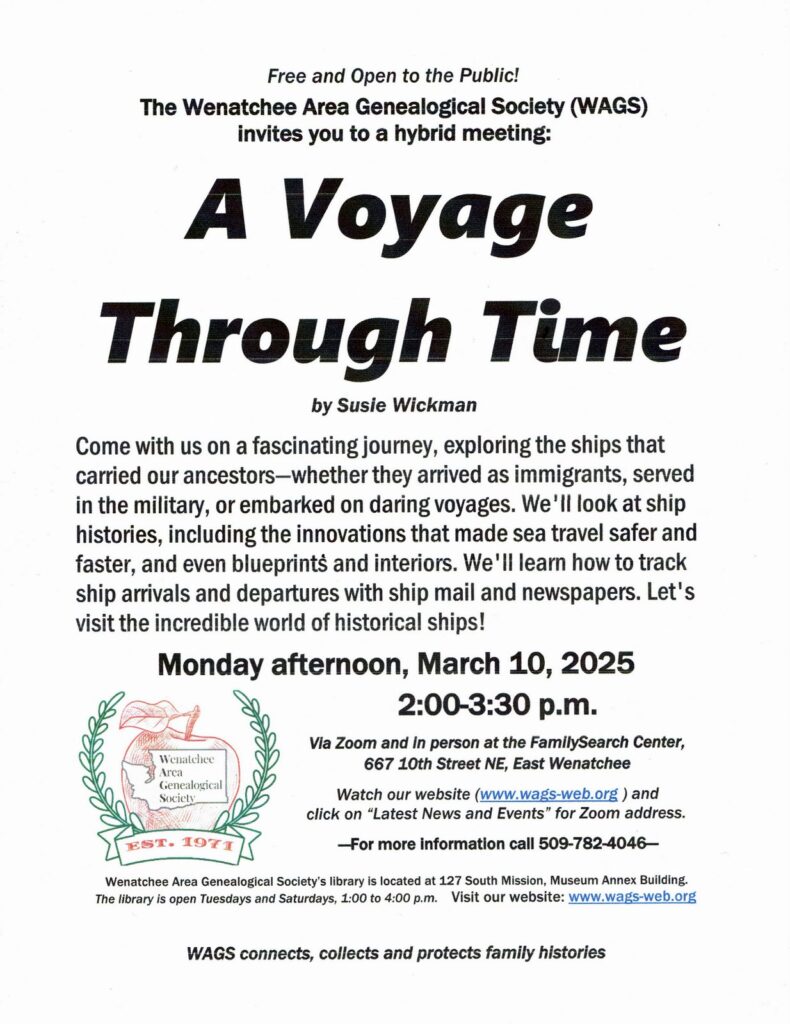
Wenatchee Area Genealogical Society A Voyage Through Time March 2025

Tacoma-Pierce County Genealogical Society Book Club
Saturday, March 15, 2025 starting at 4:00 pm via Zoom
Please join us as we discuss a fictional genealogical book, The Salford Sioux by M.J. Lee. This is the lates book in the Jayne Sinclair series.
More information at:
Amazon: The Salford Sioux
This book may also be available in print from various book stores.
More information at:
Amazon: The Salford Sioux, print and Kindle versions
This book may also be available in print from various book stores.
TPCGS Book Club Zoom Meeting
Every month on the Third Sat beginning at 4:00 PM Pacific Time
Please download and import the following iCalendar (.ics) files to your calendar system.
Monthly: https://us02web.zoom.us/meeting/tZUkfuCqrzgsG9RrrhNAdU65Lz86P0s92mu1/ics?icsToken=98tyKuGppzIjGNWWthiHRpwcHYr4XerzmHZdjfpvjg3tLQFXV1WjGvgaZIIvA4GC
Join Zoom Meeting:
https://us02web.zoom.us/j/81999213610?pwd=Qkk2WFZTZ2Rzdzc1Z0szN1AzdEZCUT09
Meeting ID: 819 9921 3610
Passcode: 479394
One tap mobile:
+12532050468,,81999213610#,,,,*479394# US
+12532158782,,81999213610#,,,,*479394# US (Tacoma)
Dial by your location:
+1 253 205 0468 US
+1 253 215 8782 US (Tacoma)
Meeting ID: 819 9921 3610
Passcode: 479394
Find your local number: https://us02web.zoom.us/u/keibNHDdyf
Tacoma-Pierce County Genealogical Society Writing Family History
Wednesday, March 12, 2025, starting at 7:00 PM via Zoom
The Writing Family History Special Interest Group (WFH-SIG) supports TPCGS members in documenting, writing, and preserving their family histories—formally or informally. Monthly meetings will provide a mix of presentations, writing exercises, and peer reviews to help members make progress in their projects.
Meeting invite with links in file attached below
Date & Time: Every month on the Second Wednesday, starting at 7:00 PM Pacific Time
Please download and import the following iCalendar (.ics) files to your calendar system.
Monthly: https://us06web.zoom.us/meeting/tZMoc-2qqDMjHNXnACfWJ0dop_pMeQXMRoYM/ics?icsToken=98tyKuGvqz8uGNKduR-GRpwEGY-gLOrwplxEgo1lkj7GBRd5Mgf5Jt1SH7dOKPXi
Join Zoom Meeting:
https://us06web.zoom.us/j/87544268961?pwd=oNtdztP51tePuSn3bt45J3wuxnGXzl.1
Meeting ID: 875 4426 8961
Passcode: 328639
One tap mobile:
+12532158782,,87544268961#,,,,*328639# US (Tacoma)
+12532050468,,87544268961#,,,,*328639# US
Dial by your location:
• +1 253 215 8782 US (Tacoma)
• +1 253 205 0468 US
Meeting ID: 875 4426 8961
Passcode: 328639
Find your local number: https://us06web.zoom.us/u/kclCP1SsOV
Tacoma Pierce County Genealogical Society Monthly Educational Meeting
Tuesday, March 11, 2025, starting at 6:00 pm
This month’s presentation will be a video presentation provided by MyHeritage: Researching Family History at Your Library with MyHeritage Library Edition presented by Daniel Horowitz. MyHeritage Library Edition is one of the largest, most internationally diverse genealogy databases of its kind. Containing more than 19.5 billion historical records from all over the world, MyHeritage Library Edition leverages cutting-edge technology to make research fast and easy even across different languages, making it the most convenient genealogy product for libraries and institutions.
Discover the advanced technology behind the scenes and learn how to take full advantage of the search engine’s robust features to explore the lives of your ancestors from your local library or the convenience of your home with your library card. Don’t take our word for it: come to the session and see for yourself!
For this meeting MyHeritage has given a few door prizes that we will give away to in person and online attendees. We ask that online attendees login to the meeting with their first and last name so they can be entered into the random name picker tool.
This meeting will be hybrid and we encourage everyone who can to attend in person at our new meeting location:
University Place Library
3609 Market PL W.
University Place, WA 98466
and via Zoom for those unable to attend in person.
Attend virtually via Zoom:
Tacoma-Pierce County Genealogical Society is inviting you to a scheduled Zoom meeting.
Please download and import the following iCalendar (.ics) files to your calendar system.
Monthly: https://us02web.zoom.us/meeting/tZIqduGpqjgsHtBNs9zc8CGna6R-KHlcz5so/ics?icsToken=98tyKuGuqToiG9CWth2DRpwAB4j4WevwiHZdgrd_sgy8GSMLQST4N7Rwf5lXHNvK
Join Zoom Meeting
https://us02web.zoom.us/j/86718143644?pwd=S0FjYU5acVVKbDEyamdXWWZVekFjdz09
Meeting ID: 867 1814 3644
Passcode: 630507
One tap mobile
+12532050468,,86718143644#,,,,*630507# US
+12532158782,,86718143644#,,,,*630507# US (Tacoma)
Dial by your location
+1 253 205 0468 US
+1 253 215 8782 US (Tacoma)
Meeting ID: 867 1814 3644
Passcode: 630507

Please join us for Tri-City Genealogical Society’s March General meeting at 7 p.m. on Wednesday, March 12. The presentation will be at the Richland FamilySearch Center located at 1314A Goethals Dr. Entrance is down the ramp from the parking lot that is to the north of Dairy Queen. The presentation will also be on Zoom so you can join in from the comfort of your own home. See below for the Zoom link.
RootsTech will be held from March 6 – March 8. There is an option to view many of the presentations online at no cost. To register for the online sessions please visit https://www.familysearch.org/en/rootstech/ . This month’s TCGS General meeting will be held on March 12 and will include a recap of the presentations that members found to be most valuable. Everyone is encouraged to participate.
Thank you to everyone who has already joined TCGS for 2025. For those who would like to join, the online application can be found at https://tricitygenealogicalsociety.org/q/join/join_renew/ and a printable application can be found at https://tricitygenealogicalsociety.org/q/wp-content/uploads/2023TCGSBrochure.pdf .
Join Zoom Meeting
https://us02web.zoom.us/j/83120177764?pwd=TVPbbLW8MvaXgKWQAhJJEXmHbMDMgk.1
Meeting ID: 831 2017 7764
Passcode: 492714
One tap mobile
+12532050468,,83120177764#,,,,*492714# US
+12532158782,,83120177764#,,,,*492714# US (Tacoma)
—
Dial by your location
• +1 253 205 0468 US
• +1 253 215 8782 US (Tacoma)
• +1 346 248 7799 US (Houston)
• +1 669 444 9171 US
• +1 669 900 6833 US (San Jose)
• +1 719 359 4580 US
• +1 312 626 6799 US (Chicago)
• +1 360 209 5623 US
• +1 386 347 5053 US
• +1 507 473 4847 US
• +1 564 217 2000 US
• +1 646 931 3860 US
• +1 689 278 1000 US
• +1 929 205 6099 US (New York)
• +1 301 715 8592 US (Washington DC)
• +1 305 224 1968 US
• +1 309 205 3325 US
Meeting ID: 831 2017 7764
Passcode: 492714
Find your local number: https://us02web.zoom.us/u/kccB5tkj63
—

EWGS member, Karen Lehfeldt, shared a genealogy book with me that she was studying. The title was what I used above and it was by Sally Romano (www.genealogyspace.com). The ideas were so good that I HAD to share them with you in hopes that they will spark you mind to better genealogy researching.
* The FRAMEwork Approach helps identify the key steps on which to focus your research.
* The FW Approach is a guidance process that involves five recurring steps per level.
* F – Focus – identify objective
* R – Records – brain-storm and jot down every to-do idea
* A – Assort – sort and group these ideas into read To-Dos
* M – Maximize – ensure that you’re planning SMART
Goals:
S – Specific Goals – what do I want to achieve?
* E – Execute – activate your plan, regularly tracking your progress.
The final words to the lesson were these: You cannot manage what you don’t measure.

TIP OF THE WEEK –
WATCH OUT FOR INCORRECTLY FILED DOCUMENTS
It is common to see historical documents incorrectly filed. Use logical reasoning when looking through collections, especially if they were filed later. For example, some Civil War Complete Military Service Records from the National Archives have records belonging to two different soldier in the same file — men with the same or similar names mistaken for the same person. Ask yourself a few questions. Are the documents in the file mostly consistent on facts? Are different dates and locations used for where the soldier enlisted? Did he die at multiple places? Do different documents say he was present and absent on the same dates? These may be signs something was incorrectly filed.
This author has even found records for the same solider filed in two different regiments. This was not because the man was actually in two different regiments, but because the regiments’ names were very similar. In this case the solider’s disability discharge papers were incorrectly filed in the wrong regiment with a soldier who had a similar name who served for the entire war. The logic didn’t match up at several points (A man who was discharged because he lost his right arm in 1862, would not have been promoted to sergeant in 1863 ….).
Be sure to gather all names an ancestor’s regiment went by, especially if its name changed during the war. Check similar named regiments for men with the same or similar names if you suspect an error was possible. These concepts apply to other types of collections.
Collecting all facts, understanding the filing system in question, comparing timelines and mapping out locations can help work around filing errors.
Join SGS Today
SGS eNews! comes out the first of every month. contact eNews!
forward this email to a friend
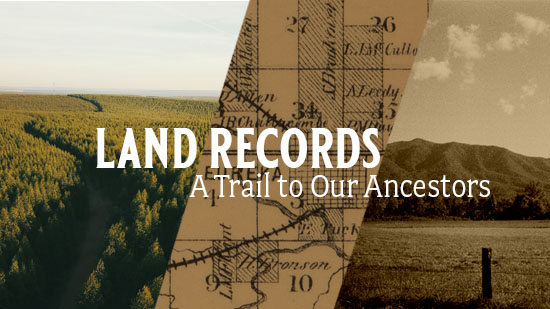
Pedro Henrique Santos and Stone Hood / Unsplash
and Library of Congress
COME FOR THE MEMBERSHIP MEETING,
STAY FOR PRESENTATION ON LAND RECORDS
The March Membership meeting will provide updates on SGS activities and slate of board candidates for upcoming election. The meeting will be followed by a special presentation on land records by Marie Mattson.
Since the RootsTech conference takes place on the day SGS would normally present our Second Saturday presentation we moved that event to Sunday, March 23 — yes, Second Saturday on a Sunday!
The membership meeting begins and 12:30 p.m. with Mattson’s presentation “Land Records: A Trail to Our Ancestors” beginning at 1 p.m. Register once and the Zoom link will get you into both events.
Candidates for the SGS board will be introduced at the membership meeting and the attending members will have the opportunity to propose additional candidates for any position. After that meeting, any new candidates will be vetted to make sure they are eligible to run, after which the slate is final. Ballots will go out at the end of March (via email or postal mail to those with no email address), and voting will run through the end of April.2025 SGS Board Slate of Nominees
President: Kathy Weber
Vice President: Lisa Oberg
Secretary: Leslie Vogel
Treasurer: Betsey Cotter
Education Director: Stephanie O’Connell
Library Director: Kathi M
NEXT MONTH’S SECOND SATURDAY: “Lost + Found Friendship” — Caroline Van Deusen will share how family heirlooms rediscovered in attics, archives, and personal collections helped piece together a fascinating story of a family’s enduring friendship with President Lincoln’s family. Sign up separately for this event held April 12.
NEW GROUPS FOR ANCESTRY USERS AND PUBLISHING KICK OFF THIS MONTH
Ancestry User SIG to meet March 11
Ancestry.com has become one of the largest genealogical websites available today. With vast records collections and extensive tree building tools, there’s much to explore and optimize. To help users get the most out of this resource SGS is launching a new Special Interest Group.
The Ancestry Users SIG is for people who use Ancestry.com (and AncestryDNA) to research their family histories. Members will share research strategies, exchange tips on using Ancestry’s resources effectively, and collaborate to enhance their understanding of Ancestry’s tools, features, and databases.
This group will met monthly on the 2nd Tuesday of the month at 6:30 p.m. For more information or to express interest, email sgsAncestrysig@seagensoc.org.
Publishing SIG kicks off March 13
SGS publishes a journal twice annually. A new SIG is forming to organize the writing and publication of the journal.
The Journal of the Seattle Genealogical Society (formerly the SGS Bulletin), has been published as a benefit for our members by the Seattle Genealogical Society since 1952. Currently issued online twice a year, it includes articles about genealogy research and methodology, family history, acquisition notes for the SGS Library and the Seattle Public Library, and transcriptions of genealogical records from the Seattle area and beyond.
This new Publishing SIG will meet monthly on the 2nd Thursday of the month at 7 p.m.
For more information or to express interest in this SIG, email SGSPubSIG@seagensoc.org.
Image credits: Lashawn Dobbs, Brett Jordan, Anna Keibalo, Daniel Lara, Mihai Lazar, Raymond Petrik, Isaac Quesada, Arno Senoner and Annie Spratt / Unsplash and Gama Films and Library of Congress via Unsplash
LEARN HOW TO ACCESS SGS’S ONLINE RESOURCES
The SGS Library has many resources that can help visitors research their family history. There are so many digital subscription offerings that it can be easy to miss something that could be helpful in your research.
Jill Morelli SGS member and former president Jill Morelli will demo most of the subscription services offered at the SGS library on Saturday, March 15, at 10 a.m. These services include American Ancestors, Find My Past, Historygeo, and Archion. Morelli and other volunteers will be at the library to assist in-person attendees who may want to try out her suggestions on SGS workstations after the presentation.
This event is hybrid. Join Morelli at the library or watch her demonstration via Zoom.
SGS LIBRARY NEWS:
New Books Available About Immigrants in North Dakota
Were any of your immigrant ancestors Scandinavian or Germans from Russia? And did they settle in North Dakota? If so, you may be in luck – SGS recently received a donation of community history books for several North Dakota counties. These books include community descriptions and information on families that lived in
Help Digitize SGS’s Vertical Files
For decades, miscellaneous materials were donated to SGS from its members. These loose papers were grouped according to surname and were filed in file cabinets. We intend to digitize these vertical files and need assistance summarizing the material. If you are interested in assisting with this project, please contact the Library Director at library@seagensoc.org for additional information. The work can be done from home or in the library.
HELP STAFF SGS BOOTH AT IRISH FESTIVAL
SGS is sponsoring a booth at this year’s Irish Festival to be held at the Seattle Center Armory on Saturday and Sunday, March 15–16. There are several time slots available on Sunday. Please contact Jim Ryan at janglinjehu@yahoo.com if you are interested in helping staff our booth.
Signature events of the festival include the lively St. Patrick’s Day Parade, the Mayor’s Proclamation Luncheon at the prestigious Rainier Club, and the Irish Festival at Seattle Center, where families can enjoy live performances, cultural exhibits, and workshops.
The Irish Heritage Club is sponsoring events even before the main weekend. For a full listing of all Irish Week events log on to the Irish Heritage Club website located at www.irishclub.org.
SIG HIGHLIGHTS:
Writer’s Group Seeks New Member
“The Pass It On writer’s group has an opening for a new member. The group is kept small (5 members) and focuses on writing our genealogy history or memoirs for personal and family use. We meet monthly to review 3-5 pages of each member’s writing. We meet on the third Tuesday of each month from 10:00 am – 12:00 noon virtually using Zoom. Our focus is to review each member’s monthly submission for content, continuity, and interest for the intended audience. If you are interested in joining this group, please send us an email (sgspassiton@seagensoc.org) including some information about your writing and what you hope to accomplish by being in a writing group. You will be contacted to see if this group is a good fit.”
New SIGs on Organization and AI Coming Next Month
SGS had been starting up a lot of new Special Interest Groups in the past year. In April two more groups will join the line up:
Artificial Intelligence (AI) for Genealogy will have its first meeting April 3 at 6:30 p.m.
The explosive growth in AI has lead to many applications for it in genealogical research. Do you use AI in your research or want to learn more about how to do so? Email: Education@seagensoc.org (Subject: AI SIG).

Organizing for Genealogy will kick off Monday, April 7 at 7 p.m.
Get out from under that pile of papers and digital files associated with your research. Share information and discuss organization tips, techniques, and habits to enhance your genealogical journey.
Learn about the many SIGs offered by SGS on our webpage. These include the recently added groups focused on Eastern European genealogy and Mexican ancestry, as well as the Pacific Northwest interest group formed last spring.
SGS CALENDAR OF EVENTS
Good Shepherd Center, Suite 302
4649 Sunnyside Ave N
Seattle, WA 98103
206 522-8658
Hours : Tuesday, Wednesday, Thursday, Friday, and Saturday
** 10:00 a.m .- 3:00 p.m. **
Always check the SGS Website Calendar of Events for the meeting links, registration, or for last minute updates or changes to the schedule. Be advised you may need to register in advance to join a meeting.
All times listed are Pacific Time unless otherwise noted
Saturday, March 1, 2025, 10:15 a.m.- 12:15 p.m., FamilySearch SIG, Discover the many ways to use the FamilySearch website in your research. Meeting includes instruction and time for Q&A. Email loudaly@nwlink.com. to get on the email list
Sunday, March 2, 2025, 1:00 pm-3:00 pm, DNA Workshop, with Cary Bright and Craig Gowens. To participate you need to be on the SGS DNA Interest Group email list. Contact Cary Bright at sgsdnasig@seagensoc.org to join.
Monday, March 3, 2025, 10:00 a.m.-11:30 a.m., Brags & Bricks Social Interest Group (Virtual), Join us for an informal social gathering. Share your recent genealogical successes and challenges, or just come to hang out with other genealogists. See SGS Calendar for more information.
Wednesday, March 5, 2025, 6:30 p.m.-7:30 p.m., Pacific Northwest Interest Group (Virtual), Share information and discuss Pacific Northwest genealogical research. Register on the SGS website.
Monday, March 10, 2025, 10:00 a.m.-11:30 a.m., Brags & Bricks Social Interest Group (Virtual), Join us for an informal social gathering. Share your recent genealogical successes and challenges, or just come to hang out with other genealogists. See SGS Calendar for more information.
Monday, March 10, 2025, 1:00 p.m.-3:00 p.m., SGS Board of Directors Meeting (Virtual), All SGS members are welcome to attend. SGS is an all volunteer organization. Please be involved. Members must sign in to website to see Zoom link.
Tuesday, March 11, 2025, 10:00 a.m.-11:00 a.m., Ancestry Users SIG (Virtual), The Ancestry Users Special Interest Group is for people who use Ancestry.com (and AncestryDNA) to research their family histories. Email SGSAncestrySIG@seagensoc.org.
Tuesday, March 11, 2025, 10:00 a.m.-11:00 a.m., Tech Tuesday (Virtual), informal consultation time on DNA, genealogy software, or genealogy-related technical issues. All are welcome. No appointment necessary. Bring us your problem; we’ll try to help.
Wednesday, March 12 2025, 7:00 p.m.-9:00 p.m., MAC Computer SIG, Jointly sponsored by SGS and Fiske. Meetings address topics and resources for Macintosh (Apple) computers and the Reunion genealogy software program. A link to login will be sent to the MAC SIG email list. If you would like to join, send an email to macusersig@seagensoc.org to be added to the email list.
Thursday, March 13 2025, 7:00 p.m.-8:30 p.m., Publishing SIG,
Participate in writing and publishing the SGS Journal twice a year. Email SGSPubSIG@seagensoc.org.
Saturday, March 15, 2025, 10:00 a.m.-noon, Demo of SGS Library Subscriptions (Hybrid: Zoom or at SGS Library), Jill Morelli will demo most of the subscription services offered at the SGS library (e.g., American Ancestors, Find My Past, Historygeo, Archion). She and other volunteers will be at the library to assist in-person attendees who may want to try out her suggestions on SGS workstations after the presentation. Register for Zoom.
Saturday, March 15, 2025, 1:00 p.m.-3:00 p.m, German SIG (Virtual), Share what you know OR get help with problems in your own research. Topic this month: Topic this month: Show & Tell: What is your favorite source for learning more about German genealogy? Register on the SGS website.
Sunday, March 16, 2025, 1:00 pm- 2:30 pm, Virtual Sunday: Something Old, Something New, This month’s topic: “Genetic Genealogy (DNA) for Beginners” presented by Cary Bright. See the SGS website Calendar of Events for further information. Please register in advance.
Monday, March 17, 2025, 10:00 a.m.-11:30 a.m., Brags & Bricks Social Interest Group (Virtual), Join us for an informal social gathering. Share your recent genealogical successes and challenges, or just come to hang out with other genealogists. See SGS Calendar for more information.
Monday, March 17, 2025, 7:00 p.m.-8:30 p.m., Write It Up! SIG (Virtual), Join this group to share and discuss writing projects, resources, and ideas. To join or learn more, contact Sheyna Watkins at sgsWriteItUpSIG@seagensoc.org.
Tuesday, March 18, 2025, 10:00 a.m.-noon, “Pass It On” Writers’ Group, Create your family history and share with others in an effort to improve your writing.
Wednesday, March 19, 2025, 6:00 p.m.-8:30 p.m., SGS Library Evening Hours, SGS library introduces evening hours on a trial basis through April. Use it or Lose it. Every 3rd Wednesday of the month.
Sunday, March 23, 2025, 12:30 p.m.-1:00 p.m., General Membership Meeting, Update on SGS activities and slate of board candidates for upcoming election. The meeting will be followed by the postponed Second Saturday presentation (see entry below). Register here.
Sunday, March 23, 2025, 1:00 p.m.-2:30 p.m., Second Saturday Postponed, “Land Records: A Trail to Our Ancestors” Presented by Marie Mattson. Yes, it’s Sunday, not Saturday. But we were at RootsTech the second Saturday in March, so this is to make it up to you (and to reward you for attending the membership meeting). Register here.
Monday, March 24, 2025, 10:00 a.m.-11:30 a.m., Brags & Bricks Social Interest Group (Virtual), Join us for an informal social gathering. Share your recent genealogical successes and challenges, or just come to hang out with other genealogists. See SGS Calendar for more information.
Tuesday, March 25, 2025, 10:00 a.m.-11:00 a.m., Tech Tuesday (Virtual), informal consultation time on DNA, genealogy software, or genealogy-related technical issues. All are welcome. No appointment necessary. Bring us your problem; we’ll try to help.
Wednesday, March 26, 2025, 7:00 p.m.-8:30 a.m., Mexican SIG (Virtual), Share information and discuss Indigenous North American, Spanish, Cuban, and Hispanic genealogical research. Email Diane Hughes-Hart at SGSMexSIG@seagensoc.org to join.
Saturday, March 29, 2025, 10:00 a.m.-12:30 p.m., DNA SIG, Join our quarterly meetings to discover what’s new in genetic genealogy and learn more about select, in-depth topics. Email SGSDNASIG@seagensoc.org to join.
Monday, April. 31, 2025, 10:00 a.m.-11:30 a.m., Brags & Bricks Social Interest Group (Virtual), Join us for an informal social gathering. Share your recent genealogical successes and challenges, or just come to hang out with other genealogists. See SGS Calendar for more information.
Wednesday, April 2, 2025, 6:30 p.m.-7:30 p.m., Pacific Northwest Interest Group (Virtual), Share information and discuss Pacific Northwest genealogical research. Register on the SGS website.
Monday, March 17, 2025, 7:00 p.m.-8:30 p.m., NEW! Artificial Intelligence (AI) for Genealogy SIG (Virtual), At this first meeting, we will get acquainted, discuss ideas and goals for this new SIG. Topic: “AI and genealogy. What?”, Email SGSAISIG@seagensoc.org.
Saturday, April 5, 2025, 10:15 a.m.- 12:15 p.m., FamilySearch SIG, Discover the many ways to use the FamilySearch website in your research. Meeting includes instruction and time for Q&A. Email SGSFamilySearchSIG@seagensoc.org to join the mailing list.
Sunday, April 6, 2025, 1:00 pm-3:00 pm, DNA Workshop, with Cary Bright and Craig Gowens. To participate you need to be on the SGS DNA Interest Group email list. Contact Cary Bright at sgsdnasig@seagensoc.org to join.
Monday, April. 7, 2025, 7:00 p.m.-8:30 p.m., NEW! Organizing for Genealogy SIG, Share information and discuss organization tips, techniques, and habits to enhance your genealogical journey. Contact Susan McKee at sgsOrganizingsig@seagensoc.org to join.
Tuesday, April 8, 2025, 10:00 a.m.-11:00 a.m., Tech Tuesday (Virtual), informal consultation time on DNA, genealogy software, or genealogy-related technical issues. All are welcome. No appointment necessary. Bring us your problem; we’ll try to help.
** NOTE: There will be no Irish SIG in March — Go to the Irish Festival.
OUR NEIGHBORS AND BEYOND
Registration opens for IGHR 2025 (Virtual)
Saturday, March 1, 2025, 6:00 a.m.
Institute of Genealogy and Historical Research (IGHR) 2025 Virtual Institute classes are scheduled to take place July 27 – August 1, 2025. Get information on courses, instructors, and registration.
Fiske Genealogical Library Classes (Free)
Wednesdays, 10:00 a.m.–11:15 a.m.
March 5 — "A Civil War Ancestor’s Journey through Letters and Research " with Kenneth V. Peterson
March 12 — "Your Ancestor's Occupation: Exploring the 1821 Irish Census" with Steven W. Morrison
For more information and links to the meetings see the Fiske Library website.
RootsTech 2025 (Virtual & in person at Salt Lake City)
Brought to you by FamilySearch
Thursday–Saturday, March 6–8, 2025
Join the world’s largest family discovery event. There are live presentations as well as on-demand video learning available. Learn more on the FamilySearch website.
“AI and Genealogy” (Virtual)
Skagit Valley Genealogical Society
Saturday, March 8, 1:00 p.m.
Join Dave Obee, author, journalist, and genealogist. Dave has written a dozen books and has given more than 700 presentations at genealogy and history conferences. Can’t make it to the Burlington Library, request a zoom link by emailing genealogy0715@gmail.com.
Irish Week 2025
Various locations around Seattle
Saturday-Sunday, March 15-16, 2025
Celebrate Irish Week 2025 with the Irish Heritage Club of Seattle. See the website.
Family Tree Maker SIG
Eastside Genealogical Society
Friday, March 21, 2025, 10:30 p.m.–12:30 p.m.
Join Eastside Genealogical Society and SGS to learn and share tips and tricks for using Family Tree Maker by Software MacKiev. The meetings open about 15 minutes in advance. You can join and/or leave whenever you have to, and you may email your question(s) in advance or bring them up during the meeting.
Join SGS Today
SGS eNews! comes out the first of every month. contact eNews!
forward this email to a friend
WHAT A WONDERFUL FILRE IT WAS – SEATTLE – 1889
Karen I Treiger
HAVING A WONDERFUL FIRE. WISH YOU WERE HERE!
Seattle’s “wonderful fire” arrived on the afternoon of June 6, 1889. It started with an overturned glue pot in the basement of a building on 1st and Madison. It grew to inferno that ripped through Seattle’s business district.

(Photo: Seattle Fire – 1st Ave. 30 min. after it started – UW Special Collections UW2730)
“Within minutes,” Costello writes in his History of Seattle’s First Department Store, Toklas & Singerman, “the flames spread from the carpenter shop to adjoining rooms, then to the entire Denny Block in which the fire originated. Long tongues of flames leaped high into the sky. The air soon darkened with the billowing smoke, through which a former kindly sun now shone red and angry.” (Costello Manuscript)
The flames left nothing behind but a few stray walls and lots of ash. Seattle suffered $15 million in loss ($436 million in today’s dollars). My earliest Seattle ancestor, Paul Singerman’s four story “fire-proof” brick mercantile store on 1st and Columbia, the San Francisco Store, was incinerated down to the last belt buckle. Paul emigrated to the United States from a small town in what is now NE Poland, made his way west to San Francisco and then, in 1874, north to Seattle to try his luck in this pioneer town.

(Photo: Looking West on 1st between Columbia & Cherry. UW Special Collections, UW41285)
“In little more than an hour,” Costello describes, “the entire structure [of the San Francisco Store] and its stocks were a raging inferno, and soon a mass of ruins, flaming and smoking, so completely razed that only a portion of the south walls remained standing” (Costello Manuscript).
When the Fire was finished, writes Murray Morgan in Skid Road, “every wharf, every mill from Union to Jackson Streets, was gone” (Skid Road, 119).
Singerman’s losses, just from the stock inside the San Francisco store amounted to $500,000 ($14.5 million in today’s dollars).

(Photo: Singerman’s Store before Fire. MOHAI, William Newton Photograph Bob. 5.41)
Wonderful? How is this wonderful?
The declaration of having a wonderful fire was not made in 1889, but with years of hindsight in 1967. It was made by Bill Speidel in his funny and informative book, Sons of the Profits. (See Speidel, 238, 240)
I actually understand why the fire was indeed wonderful.
FRESH START
In 1851 a few white Europeans (known as the Denny Party) settled on the shores of Puget Sound and called the place Seattle. Most of the buildings were put up in a hurry and built with lumber produced at Yesler’s Mill, the centerpiece and main employer of the town.
Until Seattle’s Great Fire, C.H. Hanford writes in Seattle and Environs, “Seattle was a shack town. In lieu of pavement the streets having to bear heavy traffic were planked. The Occidental Hotel, a four-story brick building; Frye’s Opera house; the Yesler-Leary three-story building and about a dozen others were the only brick buildings. The burned area was well covered with cheap wooden buildings occupied by hotels, restaurants, saloons, workshops and retail stores. Sawmills and factories and the coal bunkers were located along the waterfront south of where the fire

(Photo: Seattle 1878 – 1st Ave (Pioneer Square). UW Special Collection, UW5894)
With the “shack town” vaporized, the city’s residents could start anew. Six hundred townspeople met the next day, June 7th, and agreed – no more wooden buildings in the downtown corridor. (History of Seattle, 426; Speidel, 241-42).
“Magnificent office and mercantile buildings of brick and stone took the place of low frame structures;” writes Bagley in The History of Seattle, “narrow lanes became broad business thoroughfares and all the unsightly places shone with civic attractiveness.” (History of Seattle, 419)
My great-great-great grandfather, Paul Singerman re-opened his magnificent store exactly one year after the fire, June 6, 1890. Thousands of people flooded the store on opening day to see the beautiful building, the new invention of the elevator, the combination of gas and electric lights and the huge amount of merchandise for sale.

(Photo: Rebuilt Toklas & Singerman Store 1890 – MOHAI, William Newton Photographs)
This fresh start allowed Seattle to build a real city with sturdy buildings, wider, paved streets and some city planning and set the stage for rapid growth. “The population,” writes C.H. Hanford, “according to the census of 1890 was 42,837, which was more than eleven times the number of inhabitants in 1880.” (Seattle and Environs, 219)
Icing on the cake -the Fire killed 1 million rats.
TIMING
Seattle’s Great Fire got a huge amount of press, nationally and internationally, garnering $120,000 ($3.5 million in today’s dollars) in relief from all around the globe (Speidel, 238-39). It was just lucky that there was no other big that week.
Two weeks after Seattle’s Fire, June 22, 1889, Vancouver, Washington had a devastating fire. It received minimal press coverage and aid money did not flow. Seattle’s fire had taken up all the air in the room. Further, on August 4, Spokane had a fire that got out of hand because “the only guy who knew how to run their brand new water system was away on a picnic.” (Speidel, 239). It didn’t receive much press either.
If Seattle’s fire had been five days earlier, on June 1 instead of June 6, there would have been little press coverage. That’s because on May 31, 1889, a dam on the south fork of the Little Conemaugh River failed, causing a flood that killed 2,200 in Johnstown, PA, after (Wikipedia Johnstown Flood; Speidel). That story had the printing presses busy.
“As it was,” Speidel writes, “our [Fire] was just right” (Id.).
SEWAGE
Sewage is not something discussed in middle school’s Washington State History class, but it was a huge problem in early Seattle. Before the Fire, a person “had to climb a ladder to use the plumbing facilities in the heart of Seattle’s main business district.” (Speidel 238). Seattle’s Health Officer, Dr. Edward Loomis, warned the city officials about the sewage problem some six years earlier. The problem, he explained is that in the business district, at the bottom of the steep hills, the “sewers flushed in reverse twice a day when the tide came in.” (Id.)

(Photo: View of Seattle from Beacon Hill 1881 MOHAI, Pic. #1983.10.6089)
So, with the whole city destroyed, it was the perfect opportunity to fix this problem. The solution was to build the city on higher ground. This is why Seattle streets are 10-18 feet higher than they were before the fire. City engineers used a combination of trestles and arches to support the elevated streets. A series of skylights were built into the new streets so that a bit of natural light would seep into the tunnels below.

(Photo: Karen Treiger & Sheldon Goldberg – underground tunnels, 2022)
Seattle’s Great Fire, a centerpiece of Seattle’s history, turned out to be one its greatest blessing. Some eight years after the Fire, Speidel writes, “the sewers were behaving the way any properly raised sewers should behave. Pioneer Square was the hub of electrified transportation from all parts of the city. Streets and sidewalks were immaculate. Window boxes of flowers abounded. Well-dressed men and women strolled about and acknowledged one another with polite nods” (Speidel, 254).
What a wonderful fire.
*****
Karen Treiger is the author of My Soul is Filled with Joy: A Holocaust Story (2018) and author of the upcoming book, Standing on the Crack: The Legacy of Five Jewish Families from Seattle’s Gilded Age.
Her website is: Homepage – Karen Treiger – Author
Her weekly blog about the history of Seattle and stories about her ancestors can be found here: Ancestry, Genealogy, Legacy, History: Stories of Five Jewish Families in Seattle
*****
SOURCES:
Bagley, Clarence B, History of Seattle: From the Earliest Settlement to the Present Time, Volumes I, II & III. Chicago, The S.J. Clarke Publishing Company (1916)
Costello, Gilbert, S., Manuscript History of Seattle’s First Department Store, Embracing San Francisco Store, Toklas & Singerman, MacDougall & Southwick (1924).
Hanford, C. H., Seattle and Environs 1852-1924, Vol. III, Seattle, Pioneer Historical Publishing Co. (1924).
Johnstown Flood, Wikipedia: Johnstown Flood – Wikipedia
Morgan, Murray, Skid Road: An Informal Portrait of Seattle. University of Washington Press – Seattle (1951, newest edition – 2018).
Speidel, William, C., Sons of the Profits or, There’s No Business Like Grow Business! The Seattle Story, 1851-1901, Nettle Creek Publishing Company, Seattle (1967).
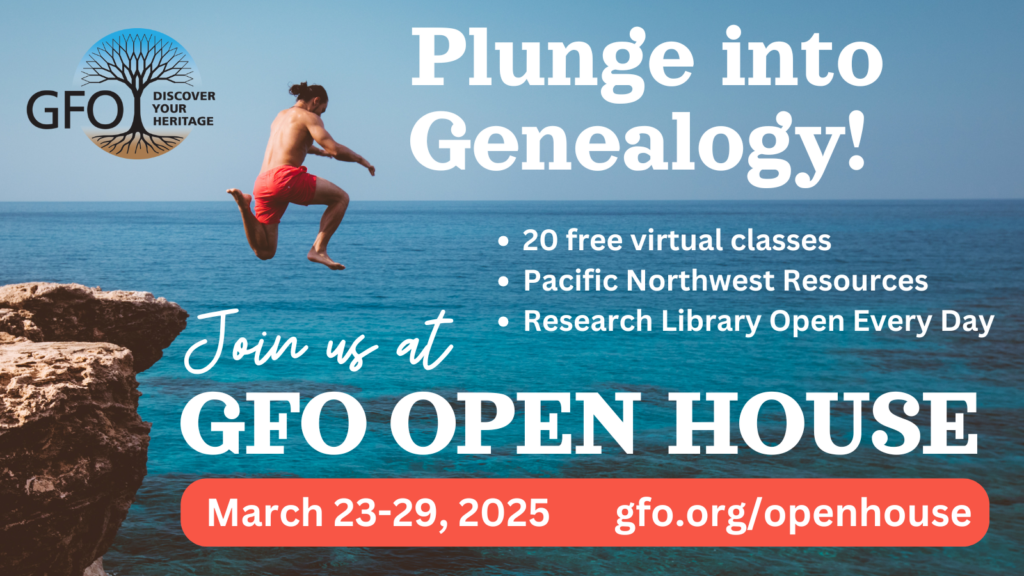
The Genealogical Forum of Oregon is pleased to host our annual Open House this month!
* Join us for 20 free online classes
* The GFO library will be open every day with no day-use fee
* Free beginning research help
This year’s topics include
* Classes on RootsMagic and Family Tree Maker, the leading genealogy software programs
* Jewish genealogy
* Eastern European research
* Virginia roots
* Free online resources hosted on GFO’s website
* Find a Grave
* Finding enslaved ancestors
* Surprising resources for Oregon ancestors
* Writing stories your relatives will read
* Finding the burial ground of the Oregon Hospital for the Insane
Find the entire program and register at https://gfo.org/openhouse
(We still have room for a two evening presentations — contact openhouse@gfo.org)