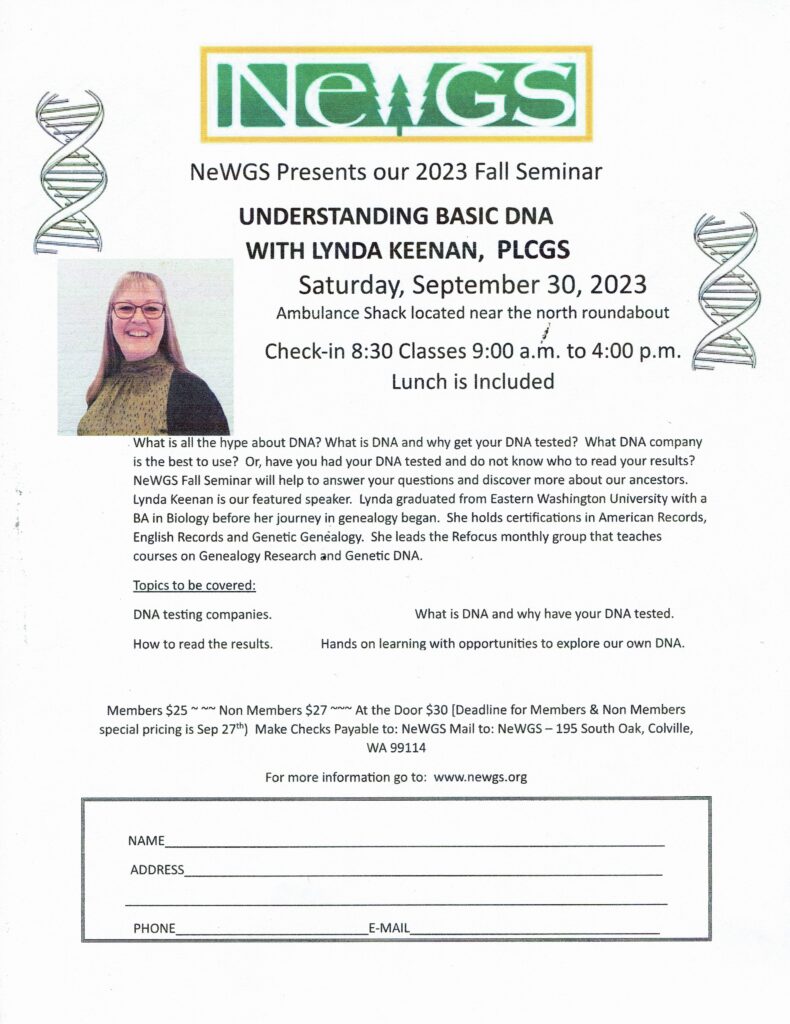
NeWGS 2023 Fall Seminar
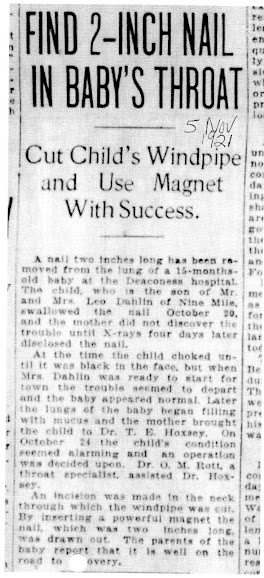
FIND 2-Inch Nail In Baby’s Throat – Spokesman Review, 5 Nov 1921
Cut Child’s Windpipe and Use Magnet With Success
A nail two inches long as been removed from the lung of a 15-month-old baby at the Deaconess hospital. The child, who is the son of Mr. and Mrs. Leo Dahlin of Nine Miles, swallowed the nail October 29th, and the mother did not discover the trouble until X-rays four days later disclosed the nail.
At the time the child choked (sic) until it was black in the face, but when Mrs. Dahlin was ready to start for town the trouble seemed to depart and the baby appeared normal. Later the lungs of the baby began filling with mucus and the mother brought the child to Dr. T.E. Hoxsey. On October 24 the child’s condition seemed alarming and an operation was decided upon. Dr. O.M. Rott, a through specialist, assisted Dr. Hoxsey.
An incision was made in the neck through which the windpipe was cut. But inserting a powerful magnet the nail, which was two inches long, was drawn out. The parents of the baby report that it is well on the road to recovery.
WSGS President Kathleen Sizer is pleased to announce the recipient of the 2023 Outstanding Achievement Award: Karen Mitchell from the Clallam County Genealogical Society. The announcement was made at the WSGS Annual Meeting on 31 Aug 2023.
Created in 2015, the President’s Award for Outstanding Achievement is designed to single out that rare individual, society or organization who has demonstrated exemplary service above and beyond expectations. The award is not given every year as it is based on merit and accomplishments. As you’ll see from reading about Karen’s dedication, she is worthy of this recognition.
A founding member of the Clallam County Genealogical Society (CCGS), Karen has consistently displayed the values of the society through her commitment, determination and leadership.
During her 42-year history with the society, she has succeeded in developing the CCGS Research Center into one of the largest private genealogical libraries on the West Coast. The center is home to over 5,000 cataloged items which can be accessed using LibraryThing. The Research Center is a place to view maps, land plats, photographs, do research and check out materials. Visitors can also view vintage photographs and maps mounted on walls and atlases and periodicals.
Karen was instrumental is obtaining a rare bookcase that now houses books written before 1910 and have never been reprinted. She has created a lending room where members can check out items of interest.
As CCGS’s librarian, Karen was at the forefront of their successful move into a larger facility in 2020. She supervised the packing of over 3,000 items from the previous facility, removal of bookshelves, shipment to the new facility, reinstallation of shelving, books, maps, files, and all the material that make up the expanded library.
Karen has served as president twice and is currently seated on the board of directors as Past President. She obtained certification as a school librarian, worked as a librarian for 30 years, and brought her experience and commitment to record preservation and skill to CCGS.
Karen continues to volunteer at the Research Center along with her husband, Tom. She is often the go-to person on CCGS operating rules and bylaws regarding governance matters.
Because of her lifelong learning (she first worked in a library at age 14), her organizational talents, her patience and persistence have made CCGS’s facility a first-class resource center.
If you want to know more about the qualities needed for this prestigious award, click here. Previous recipients are listed here.
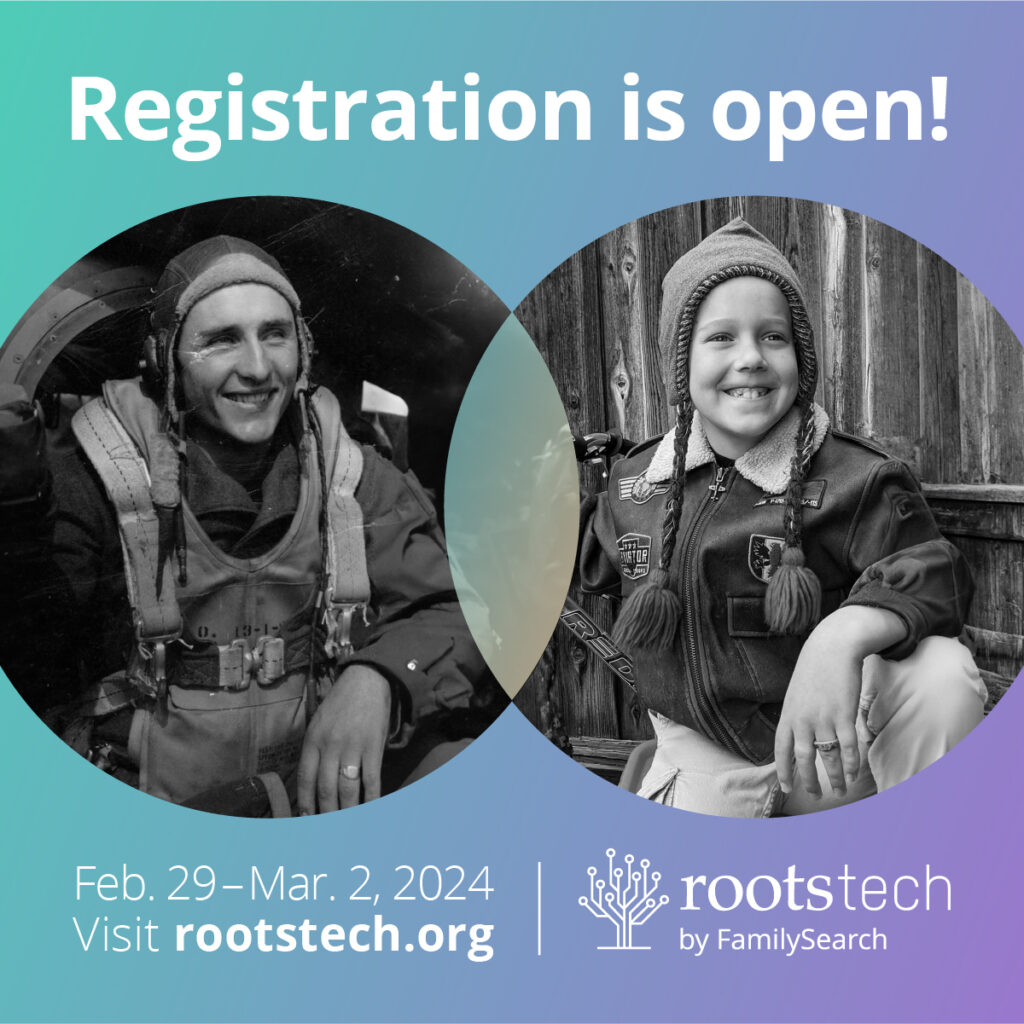
Registration to RootsTech 2024 is open! rootstech.org The major event will be held February 29 – March 2, 2024, both in-person in Salt Lake City, Utah and virtually. The first 1,000 registrants will receive a special limited-edition pin!
RootsTech is the premier event to celebrate your heritage and other meaningful connections through a deeper understanding of family history and genealogy. Discover your story at RootsTech 2024! For more information, visit the Rootstech website.
Who has not seen this fantastic image of the Titanic’s bow as she rests nearly a mile deep in the Atlantic:
Bet you did not know:
********************
August, 2023: Miami, Florida: Archaeologists have found a submerged gravestone in Dry Tortugas National Park near the Florida Keys and they say the discovery could also mean there’s a cemetery and hospital in the area. The site could have been used for quarantined yellow fever patients on a small island that has since eroded into the sea.
*********************
Jeanne Coe, a longtime member of EWGS, does indexing under the SCRIBE project for the Washington State archives. She notes odd and unusual names………. like these:
********************
From Kenneth Roberts’ book, “Trending Into Maine,” published in 1938, I learned that the Salish word for white person was soo-yap-ee, which meant “upside down face.” This happened because most 19th century Euro-American men wore beards.
What would you guess was the longest running newspaper comic strip in the U.S.?? A strip most like your grandparents laughed over?
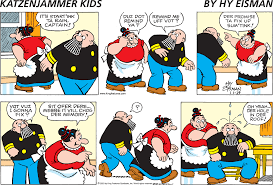
If you guess the Katzenjammer Kids, you win a prize! This strip ran from 1897 t0 2006.
Next in order were…… do you read any of these today? Which ones might you remember your parents, or grandparents, chuckling over? P.S. They’re not all carried in our local newspaper. Makes one wonder how they can still be relevant today…… Prince Valiant?
Since we’re enjoying humor today, here’s a “Chuckleberry” for you (from the Huckleberry Press):
“Okay, so a Texan rancher comes upon a farmer from Maine. The Texan looks at the Mainer and asks, “Say, how much land you think you got here?” The Mainer answers, “Bout 10 acres, I’d say.” The Texan (boasting), “Well, on my lot, it takes me all day to drive completely around my property.” The Mainer (doubtless with a straight face) replies, “Yep, I got one of them trucks too.”

A grave blanket is a handmade or commercially made evergreen arrangement that covers the ground of the grave. They are made of evergreen boughs and can be decorated with ribbons, bows, flowers, pine cones or baby’s breath and are available in a variety of styles and sizes. Grave blankets are most often found in colder, northern regions of the country where traditional flower arrangements would not withstand the cold temperatures or snow. There are many reasons why grave blankets are placed on the graves of loved ones. The symbolic meaning is that the blanket will keep your deceased loved one warm for winter. Another reason is to honor and remember your beloved family member or friend.

** To Forget Is Vain Endeavor. Love’s Remembrance Lasts Forever.

DNA
You’ve seen it in the news…now learn how it’s done!
EWGS FALL SEMINAR
Saturday, October 7
9:00 am to 3:00 pm
Southside Senior & Community Center –
3151 E 27th Ave., Spokane, WA 99223
For more information
and to Register go to our website:
EWGSi.org
Book Sale/Auction
Vendors
Door Prizes Galore
Yummy Lunch
If you need a DNA refresher, these are a few suggested by our speakers.
FamilyHistory “DNA and Genealogy: The Basics”
Amy Johnson Crow “What you NEED to Know About DNA Testing for Genealogy“
CeCe Moore “CeCe Moore Explains How Genetic Genealogy Works”
FamilySearch (Diahan Southard) – Understanding Your DNA Ethnicity Results
Family History Fanatics – DNA Clustering vs Triangulation | What’s the Difference in Genetic Genealogy?
If you are in need of financial assistance to attend this seminar,
please see our website under the “Member’s Only” tab.
The German Interest Group
of The Eastside Genealogical Society (EGS)meeting
When: Friday, October 6, 2023 from 12:30 to 2:30 pm PDT
Zoom Registration required: https://tinyurl.com/39jrfwve
Topic: The ABCs of the Old German Script
Starting from the beginning—the alphabet—dive into how to decipher individual letters of the old German script. Learn how to use that knowledge to decipher key genealogical terms, based on context and expected record content, to start you on your own road to discovering the hidden treasures in your German-language records.
Presenter: Charlotte Noelle Champenois, AG®
Charlotte Noelle Champenois, AG®, originally from Allerød, Denmark, and a long-time resident of Utah, is accredited in Germany Northwest, Denmark, Sweden, and Austria and has a BA in genealogy from Brigham Young University. She is a German Research Specialist at the FamilySearch Library, where she helps guests with research and translation.
More information: Visitors are always welcome. Our website is https://egsgermangroup.wordpress.com/


On September 15, 2023 BIGS Presents
At 10AM, Friday, September 15, 2023,
In-person at the Bainbridge Library, and on Zoom
Mary Kircher Roddy will present:
Bagging a Live One:
Reverse Genealogy in Action.
Mary will show you how to find distant relatives, perhaps ones you never knew existed. You will come away with the skills to target specific people and to find their contact details.
Great for finding missing friends and cousins or for locating family members to fill out your DNA “dance card” or plan a family reunion.
Mary Kircher Roddy, frequently lectures in Washington State as well as at conferences across the US on methodology and records. She is a trustee of the Board for Certification of Genealogists, one of the founders of the Applied Genealogy Institute, and is the co-editor of the National Genealogical Society Quarterly (NGSQ). She also earned a certificate in Genealogy and Family History at the University of Washington. Mary became interested in genealogy in 2000 in anticipation of a sabbatical with her husband and children in Ireland. She was sure she would complete all her Irish genealogy in a year. Two decades later, that genealogy is still a work in progress.
So, please go to our website, bigenealogy.orgto pick up your Zoom link beginning on September 14th, the day before the presentation.
Everyone Welcome! No membership necessary.