
Networking and announcements at 6:30 pm Pacific; program at 7:00 pm
Via Zoom—https://us02web.zoom.us/j/82046663133
Networking and announcements at 6:30 pm Pacific; program at 7:00 pm
Via Zoom—https://us02web.zoom.us/j/82046663133


November to Early December 2025 with South King County Genealogical Society
Be in the know! Receive notices for our virtual meetings, as well as the latest genealogy news and tips, by subscribing (free) to the online group at https://skcgs.groups.io
Skcgs.groups.io is the SKCGS online discussion and collaboration arena where:
PROGRAM UPDATES
NOVEMBER – EARLY DECEMBER 2024 MEETINGS & EVENTS
Saturday 1 November, 10–2am: Family Tree Maker Users Group (Online). Topic: Question & Answer.
Subscribe to our free online group: https://skcgs.groups.io/g/FTMUG
Tuesday 4 November, 6:30pm: SKCGS Board Meeting (Online). All SKCGS Members are invited; write to Board@skcgs.org for the Zoom link.
Friday 7 November, 12:30–2:30pm: German Interest Group (Online, EGS).
Topic: Civil Marriage in Germany in the 19th Century.
Presenter Roland Geiger discusses civil marriages in Germany using examples to illustrate the content of the records and the information that can be gleaned from them. Register: https://gig.eastsidegenealogicalsociety.org/meetings
Monday 10 November,⋅1–2pm: Genetic Genealogy/DNA Interest Group (Online).
Topic: Analyzing Your DNA Matches when the Site Tools Aren’t Helping. Let’s share tactics and ideas.
Subscribe to our free online group: https://skcgs.groups.io/g/Genetic-Genealogy
Wednesday 12 November, 2–3pm: WikiTree User Group (Online).
Topic: How to Add Categories to profiles & Why You Want to. Wikitree Users collaborate to create the best collaborative tree on Earth.
Subscribe to our free online group: https://skcgs.groups.io/g/Wikitree-SIG.
Thursday 13 November,11am–1pm: Genealogy Help with SKCGS at Renton Highlands Library (In-person). No registration required.
Genealogy questions? SKCGS offers one-on-one help with a volunteer: 2801 NE 10th Street, Renton WA
Saturday 15 November,10am: SKCGS Speaker Series (Online). 9:30am– 10am: Social time;sign in early to chat. 10am: Featured speaker presentation: Mags Gaulden presents “WikiTree’s DNA Features, With A Splash of mitoYDNA.org“

Mags co-leads the DNA integrators team at WikiTree, a collaborative global family tree. Working to improve DNA functionality on WikiTree and integrations with outside sites, she has helped to make WikiTree and its DNA features accessible and available to all collaborative genealogists.
As a sought-after international speaker and workshop coordinator, Mags continues to share her expertise on various topics related to genetic genealogy and family history research. Her talks are known for their easy flow of technical terminology and knowledge, combined with a down-home, relaxed, humorous style that connects with audiences.
She is a member of the International Society of Genetic Genealogy, among other organizations. Her passion for family history and her expertise in genetics and genealogy have helped many people uncover their family histories and connect with their roots.
Mags Gaulden is a genetic genealogist based in Ottawa, Ontario, Canada. She has dedicated decades to researching family histories and exploring the role of genetics in genealogy. Born and raised in the United States, Mags developed an early interest in family history and genealogy. She started researching her family tree, which led her to discover the power of genetic testing in genealogy.
Mags is the founder of Grandma’s Genes in Ottawa and mitoYDNA.org, a free and accessible Y and mitochondrial DNA database for the genealogy community. The non-profit organization is a 501(c) 3 based in Maryland.
Monday 17 November, 1–2pm: Tech Users Group (Online).
Topic: How to add & use browser extensions for genealogy.
Subscribe to our free online group: https://skcgs.groups.io/g/TUG
Thursday 20 November, 11am–1pm: Genealogy Help with SKCGS at the Auburn Library (In-person). No registration required.
Genealogy questions? SKCGS offers one-on-one help with a volunteer: 1102 Auburn Way S, Auburn, WA.
Thursday 20 November, 2–4pm. Genealogy Help with SKCGS at the Federal Way Main Library (In-person). No registration required.
Genealogy questions? SKCGS offers one-on-one help with a volunteer: 34200 1st Way S, Federal Way, WA
Monday 24 November, 1–2pm: Genealogy Chat (Online). Meet up and chat about genealogy subjects and topics.
We have no agenda; we just like one another!
Tuesday 2 December, 6:30pm (Online) SKCGS Board Meeting if necessary. All SKCGS Members are invited; write to Board@skcgs.org for the Zoom link.
Friday 5 December, 12:30–2:30: German Interest Group (Online, EGS). Anette Isaacs presents “Frohe Weihnachten: Unwrapping the Charms of German Christmas Traditions.” Discover the rich history and cultural significance of Christmas customs and holiday treats.
Register: https://us02web.zoom.us/meeting/register/DpxnmOaKRpuxVYX0I8UHzw. More at https://gig.eastsidegenealogicalsociety.org/
Saturday 6 December, 10am–noon, Family Tree Maker User Group (Online).
Topic: Question & Answer.
Subscribe to our free online group: https://skcgs.groups.io/g/FTMUG
Monday 8 December, 1–2pm, Genetic Genealogy / DNA Interest Group (Online).
Topic: Ancestry’s Custom Clusters. See
Introducing Custom Clusters: A Smarter Way to Find “Matches That Matter & Struggles with Smithville
Subscribe to our free online group: https://skcgs.groups.io/g/Genetic-Genealogy
Wednesday 10 December,⋅2–3:pm: WikiTree User Group (Online).
Topic: Wikitree Projects, taking Collaboration to the Next Level. https://www.wikitree.com/wiki/Help:Projects.
Wikitree Users collaborate to create the best collaborative tree on Earth.
Subscribe to our free online group: https://skcgs.groups.io/g/Wikitree-SIG
*************
SKCGS Speaker Series: Monthly on the third Saturday, 10am. Featured speakers:
*************
You are receiving this email because you have attended a SKCGS meeting and indicated you would like to receive periodic notice of events. If you would like to be removed from our mailing list, send an email to skcgsfriends+unsubscribe@skcgs.org.
Like – Facebook :: Blog :: Website – SKCGS.org :: Member support – info@skcgs.org
SOUTH KING COUNTY GENEALOGICAL SOCIETY

Tacoma Pierce County Genealogical Society Monthly Educational Meeting
Tuesday, November 11, 2025, starting at 6:00 pm
We will begin with our annual Business meeting to elect Officers for the 2026-2027 term and vote on a motion from the Board regarding a donation to the Veteran Bounty Land Records Capital Campaign led by the National Genealogical Society.
This month’s presentation: After the business meeting is concluded we will have a presentation by Nancy Thaut talking about her trips to the FamilySearch Library in Salt Lake city and how to prepare before your first visit.
This meeting will be hybrid and we encourage everyone who is able to attend in person at our new meeting location:
University Place Library
3609 Market PL W.
University Place, WA 98466
and via Zoom for those unable to attend in person.
Attend virtually via Zoom:
Tacoma-Pierce County Genealogical Society is inviting you to a scheduled Zoom meeting.
Please download and import the following iCalendar (.ics) files to your calendar system.
Monthly: https://us02web.zoom.us/meeting/tZIqduGpqjgsHtBNs9zc8CGna6R-KHlcz5so/ics?icsToken=98tyKuGuqToiG9CWth2DRpwAB4j4WevwiHZdgrd_sgy8GSMLQST4N7Rwf5lXHNvK
Join Zoom Meeting
https://us02web.zoom.us/j/86718143644?pwd=S0FjYU5acVVKbDEyamdXWWZVekFjdz09
Meeting ID: 867 1814 3644
Passcode: 630507
One tap mobile
+12532050468,,86718143644#,,,,*630507# US
+12532158782,,86718143644#,,,,*630507# US (Tacoma)
Dial by your location
+1 253 205 0468 US
+1 253 215 8782 US (Tacoma)
Meeting ID: 867 1814 3644
Passcode: 630507
Find your local number: https://us02web.zoom.us/u/kcFbCNTY39
Tacoma-Pierce County Genealogical Society Writing Family History
Wednesday, November 12, 2025, starting at 7:00 PM via Zoom
The Writing Family History Special Interest Group (WFH-SIG) supports TPCGS members in documenting, writing, and preserving their family histories—formally or informally. Monthly meetings will provide a mix of presentations, writing exercises, and peer reviews to help members make progress in their projects.
Meeting invite with links in file attached below
Date & Time: Every month on the Second Wednesday, starting at 7:00 PM Pacific Time
Please download and import the following iCalendar (.ics) files to your calendar system.
Monthly: https://us06web.zoom.us/meeting/tZMoc-2qqDMjHNXnACfWJ0dop_pMeQXMRoYM/ics?icsToken=98tyKuGvqz8uGNKduR-GRpwEGY-gLOrwplxEgo1lkj7GBRd5Mgf5Jt1SH7dOKPXi
Join Zoom Meeting:
https://us06web.zoom.us/j/87544268961?pwd=oNtdztP51tePuSn3bt45J3wuxnGXzl.1
Meeting ID: 875 4426 8961
Passcode: 328639
One tap mobile:
+12532158782,,87544268961#,,,,*328639# US (Tacoma)
+12532050468,,87544268961#,,,,*328639# US
Dial by your location:
• +1 253 215 8782 US (Tacoma)
• +1 253 205 0468 US
Meeting ID: 875 4426 8961
Passcode: 328639
Find your local number: https://us06web.zoom.us/u/kclCP1SsOV

THOMAS MacENTEE
GENEALOGIST, AUTHOR, BLOGGER
Translating, Transcribing and Summarizing Documents Using AI
Speaker at the Lower Columbia Genealogical Society’s
November 13th Zoom meeting
Virtual meeting doors will open at 6:30 pm
The speaker’s program will begin at 7:00 pm
The public is invited to attend however, non-members will not have access to the handout as per speaker’s request
Please consider joining our society for $20/yr.
For a link to join the meeting or to join the society contact lcgsgen@yahoo.com 24hrs prior to the event

Stillaquamish Valley Genealogical Society
Monthly Business Meeting & Presentation
Creating a Virtual Cemetery
Tuesday, November 11th
1:00 pm
SVGS Library
6111 188 PL NE, Arlington, WA

Our speaker at the library this month will be SVGS society member, Kathie Webber. This event will be in person only. Everyone is welcome to attend this free presentation
Kathie’s topic: Creating A Virtual Cemetery One Kathie’s favorite things about studying her family history has been learning where her ancestors have been buried. Twenty years ago she discovered an online tool called findagrave.com. This website and the accompanying app have enabled her to organize and expand her cemetery research. She will share with everyone the many things she has taken advantage of using Find a Grave, as well as other options that are available.
Bio:
I’ve been doing genealogy for over 40 years. I’ve researched in Washington State, Massachusetts, California, New Brunswick, Nova Scotia, and Ireland. My favorite notable ways to research include visiting cemeteries, family history centers, online research, Facebook groups, and travel.
There will be a short break with refreshments after the presentation followed by our monthly business meeting.
DIG – DNA Special Interest Group
Also join us at the SVGS library on the third Thursday of the month from 1-3pmfor our DNA Special Interest Group (DIG). This group works together to develop a better understanding of DNA techniques and strategies for finding relatives, discuss and review new DNA developments and tools and help members with their research problems.
All DNA skill levels are welcome to attend.
If you have a specific DNA topic you would like to discuss or have any other suggestions for this group, please sen an email info@stillygen.org
Also, if you have not joined us yet and would like to receive emails in the future for the DIG group, please send an email to info@stillygen.org and request to be added to the DIG email list.
New England Interest Group
The SVGS New England Interest Group (includes New York and Pennsylvania) that meets at the SVGS Library on the first Tuesday of the month is now hybrid!
If you have not joined us yet and would like to receive emails in the future for this group or wish to attend via Zoom, please send an email to info@stillygen.org and request to be added to the New England Interest Group email list and receive monthly Zoom invitations.
For more information visit stillygen.org
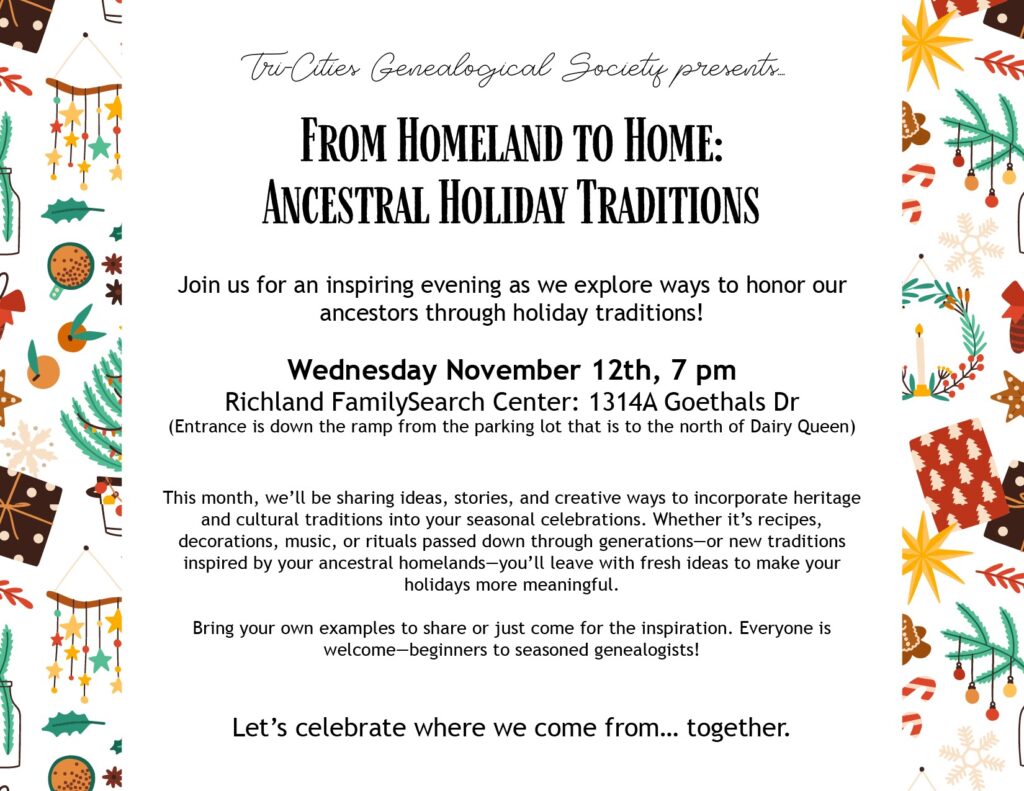
Please join us for Tri-City Genealogical Society’s November General meeting at 7 p.m. on Wednesday, November 12. We will be electing a new board for 2026 and need to have a quorum from the membership. Also, the proposed budget for 2026 will be presented and voted on. After the formalities we will be having an interactive presentation where everyone is encouraged to participate. For people on Zoom the opportunity will be made to share their screen if so desired. See flyer above for details.
Time: Nov 12, 2025 07:00 PM Pacific Time (US and Canada)
Join Zoom Meeting
https://us02web.zoom.us/j/83248129787?pwd=r0AndQAeVkHB2B5oraUOGLO6xazY1V.1
Meeting ID: 832 4812 9787
Passcode: 664352


FamilyTree Magazine is my go-to-tutorial these days for holding-in-my-hands genealogy learning. I like “real” books; I like “real” magazines. If you do too, FT is for you!
For example, in the July-August 2025 issue there were articles on these topics:

As of few weeks ago, when I crafted this post, there were 150,162 articles under this Resource Guide on the FamilySearch.org website. So what is the Wiki anyway?
The Research Wiki is a tree, online genealogical guide that lists websites and resources to help you find your ancestors from countries around the world. The Wiki is a community project where anyone can contribute.
What can you find on the Wiki?
Pro tips for navigating the Wiki:
Recommendations:
The bestest advice I can give you today is to grab a hot or cold drink, set a timer for a full hour, and go explore the FamilySearch Wiki! That’s the “bestest” way to learn how to really utilize this fantastic FREE resource.