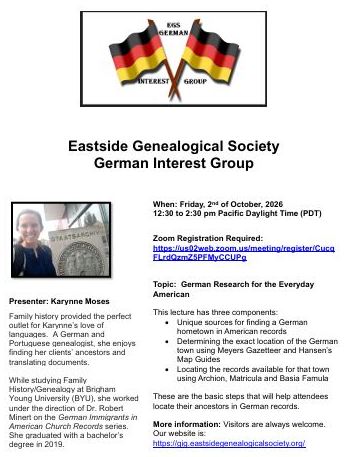
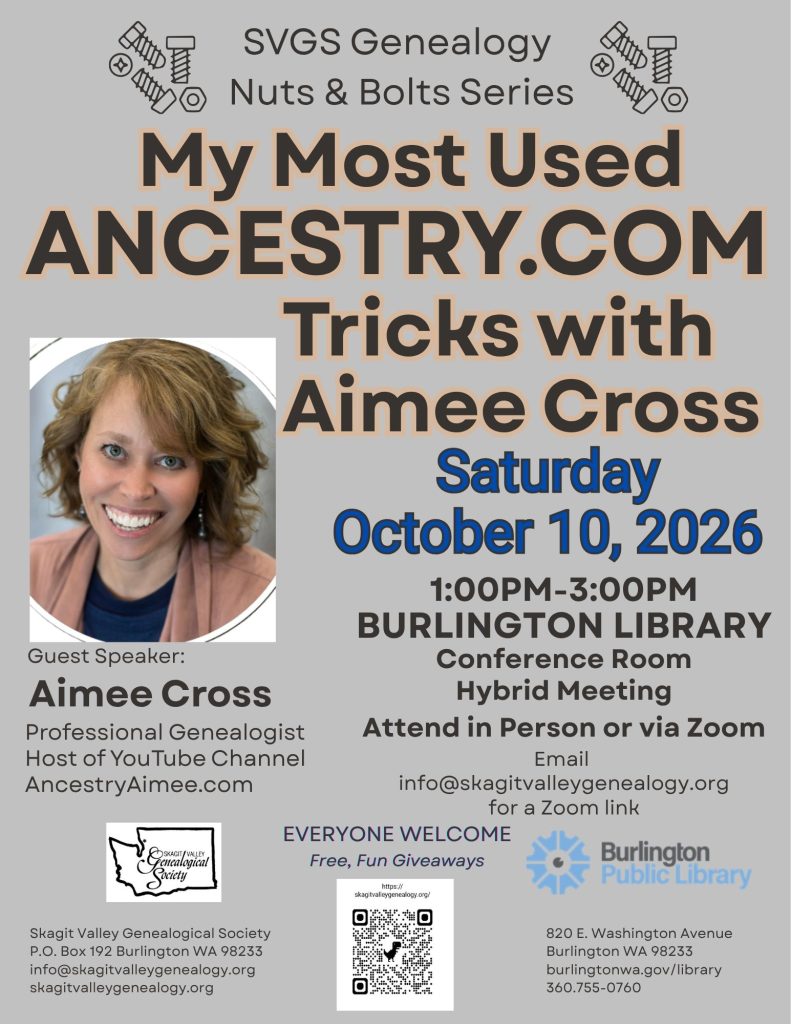
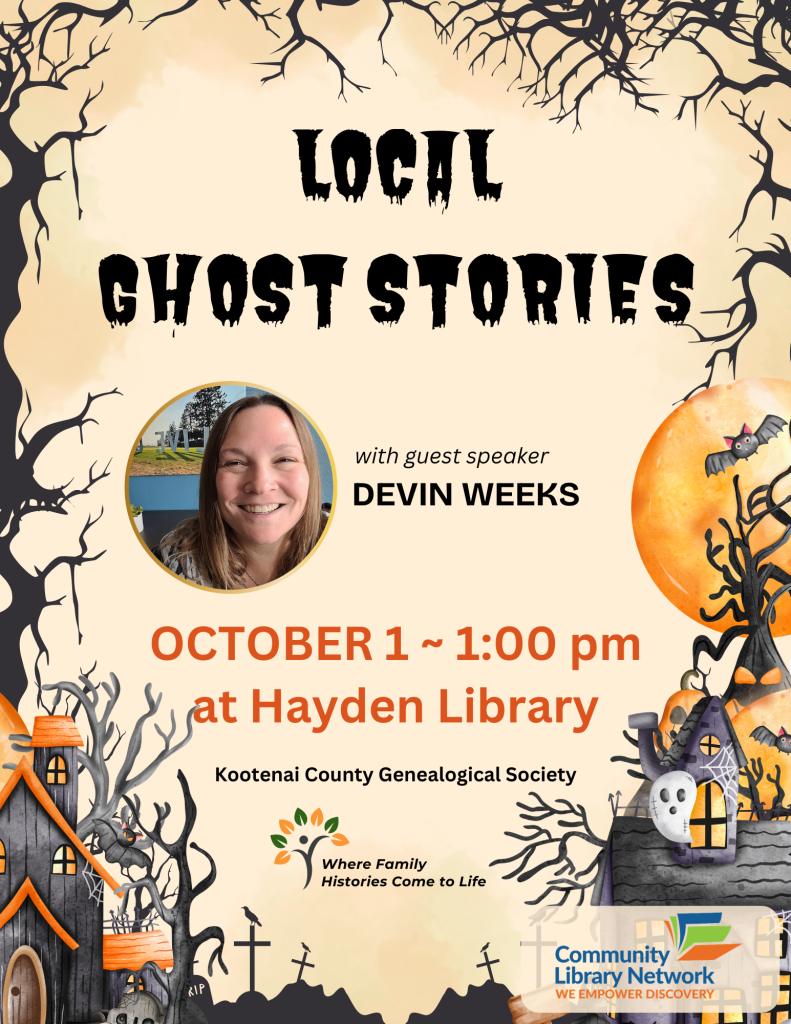
Wenatchee Area Genealogical Society Cousin Baiting


Tacoma Pierce County Genealogical Society Monthly Educational Meeting
Tuesday, May 12, 2026, starting at 6:00 pm
This month Tim Ward will be presenting “You’ve Opened the Boxes, Now What? – How to Preserve and Share your Family History” This presentation covers the steps and tools for digitizing your inherited family history items, storing and sharing your family history items. There is a multipage hand out that goes with the presentation.
This month’s meeting will be Zoom Only until we can find a new physical location to meet in person.
Attend virtually via Zoom:
Tacoma-Pierce County Genealogical Society is inviting you to a scheduled Zoom meeting.
Please download and import the following iCalendar (.ics) files to your calendar system.
Monthly: https://us02web.zoom.us/meeting/tZIqduGpqjgsHtBNs9zc8CGna6R-KHlcz5so/ics?icsToken=98tyKuGuqToiG9CWth2DRpwAB4j4WevwiHZdgrd_sgy8GSMLQST4N7Rwf5lXHNvK
Join Zoom Meeting
https://us02web.zoom.us/j/86718143644?pwd=S0FjYU5acVVKbDEyamdXWWZVekFjdz09
Meeting ID: 867 1814 3644
Passcode: 630507
One tap mobile
+12532050468,,86718143644#,,,,*630507# US
+12532158782,,86718143644#,,,,*630507# US (Tacoma)
Dial by your location
+1 253 205 0468 US
+1 253 215 8782 US (Tacoma)
Meeting ID: 867 1814 3644
Passcode: 630507
Find your local number: https://us02web.zoom.us/u/kcFbCNTY39

Tacoma-Pierce County Genealogical Society Writing Family History
Wednesday, May 13, 2026, starting at 7:00 PM via Zoom
The Writing Family History Special Interest Group (WFH-SIG) supports TPCGS members in documenting, writing, and preserving their family histories—formally or informally. Monthly meetings will provide a mix of presentations, writing exercises, and peer reviews to help members make progress in their projects.
Date & Time: Every month on the Second Wednesday, starting at 7:00 PM Pacific Time
Please download and import the following iCalendar (.ics) files to your calendar system.
Monthly: https://us06web.zoom.us/meeting/tZMoc-2qqDMjHNXnACfWJ0dop_pMeQXMRoYM/ics?icsToken=98tyKuGvqz8uGNKduR-GRpwEGY-gLOrwplxEgo1lkj7GBRd5Mgf5Jt1SH7dOKPXi
Join Zoom Meeting:
https://us06web.zoom.us/j/87544268961?pwd=oNtdztP51tePuSn3bt45J3wuxnGXzl.1
Meeting ID: 875 4426 8961
Passcode: 328639
One tap mobile:
+12532158782,,87544268961#,,,,*328639# US (Tacoma)
+12532050468,,87544268961#,,,,*328639# US
Dial by your location:
• +1 253 215 8782 US (Tacoma)
• +1 253 205 0468 US
Meeting ID: 875 4426 8961
Passcode: 328639
Find your local number: https://us06web.zoom.us/u/kclCP1SsOV

Tacoma-Pierce County Genealogical Society Mystery Book Club
Saturday, May 16, 2026, starting at 3:30 pm via Zoom
Please join us as we discuss a fictional genealogical book, Snoqualmie Bound, the fourth book in the Home to Beulah series, by Claudia Breland.
More information at:
Amazon: Snoqualmie Bound
This book may also be available in print from various book stores or libraries.
Available on Kindle.
TPCGS Book Club Zoom Meeting
Every month on the Third Sat beginning at 3:30 PM Pacific Time
Please download and import the following iCalendar (.ics) files to your calendar system.
Monthly: https://us02web.zoom.us/meeting/tZUkfuCqrzgsG9RrrhNAdU65Lz86P0s92mu1/ics?icsToken=98tyKuGppzIjGNWWthiHRpwcHYr4XerzmHZdjfpvjg3tLQFXV1WjGvgaZIIvA4GC
Join Zoom Meeting:
https://us02web.zoom.us/j/81999213610?pwd=Qkk2WFZTZ2Rzdzc1Z0szN1AzdEZCUT09
Meeting ID: 819 9921 3610
Passcode: 479394
One tap mobile:
+12532050468,,81999213610#,,,,*479394# US
+12532158782,,81999213610#,,,,*479394# US (Tacoma)
Dial by your location:
+1 253 205 0468 US
+1 253 215 8782 US (Tacoma)
Meeting ID: 819 9921 3610
Passcode: 479394
Find your local number: https://us02web.zoom.us/u/keibNHDdyf
Maggie Cogswell
Washington State Archivist

Her topic is
Preserving and Dating Photographs
The speaker at the Lower Columbia Genealogical Society’s May 14th, 2026 zoom meeting will be Maggie Cogswell. Her topic is Preserving and Dating Photographs
Virtual meeting doors will open at 9:30 am
Speaker’s program will begin at 10:00 am
The public is invited to attend.
Please consider joining our society for $20/yr.
For a link to join the meeting or to join the society contact lcgsgen@yahoo.com 24hrs prior to the event

Stillaquamish Valley Genealogical Society
Annual Meeting, Potluck & Silent Auction
Tuesday, May 12th
Potluck starts at Noon
SVGS Library
6111 188 PL NE
Arlington, WA
The Stillaguamish Valley Genealogical Society will hold a Potluck prior to our Annual Meeting (includes Election of Officers), and Silent Auction.
Everyone is welcome!
The money raised from the silent auction will be applied to the operating expenses of our society. We have a lot of great items to bid on! The society does not have the ability to take credit cards so be sure to bring your checkbook.
What to bring for the Potluck? (maybe from an old family recipe)
If possible, we would like you to bring an item based on the following parameters.
If your last name begins with:
A to I Dessert
J to R Salad/Side Dish
S to Z Main Course
Another option that anyone may choose is to bring is an Appetizer or Beverage.
Immediately following the Potluck, at approximately 1PM the SVGS Annual Meeting will begin. Members please stay and vote on the upcoming 2026-2027 budget, the Election of Officers and announcement of winners of the fund-raising Silent Auction.
For more information visit stillygen.org


The Spokesman Review, Wednesday, May 21, 1980
“Once a quiet little agricultural town, Ritzville has been turned overnight into a Sahara of volcanic ash, and the last refuge for thousands of travelers trapped on the roads Sunday when Mount St. Helens violently erupted.
“While the rest of Eastern Washington received only 1/4 of an inch to one inch of ash, Ritzville, sixty miles southwest of Spokane, was buried under 4 to 6 inches of the fine debris. In spots, the ash has drifted as high as two feet. The city is in a state of disaster.”
Lynn Krogh and I had a delightful field trip to Ritzville recently and I took this picture in the railroad museum. This is a scene of downtown Ritzville! I did first think it was snow. Then I read the blurb.
Remembering this day, as many of us do, I learned that the total ash spread over an area of 22,000 square miles with far-away Oklahoma and Minnesota receiving some. Before compaction by rainfall, the total ash deposited was equivalent to a football field piled with ash 150 miles deep.
Ritzville, with 2-4 inches, and Yakima, with 4-6 inches, and little Lind, with 6 inches, were the hardest hit Eastern Washington towns. Ephrata and Othello each received 3 inches. Google states that Spokane received one-half inch but my memory surely remembers more than that.
What are your memories of May 18, 1980? Even if you were not living in Washington then, did the news impact you or your family?

TIP OF THE WEEK – SPRING IS CEMETERY SEASON
Spring is cemetery season for genealogists. Here are the field notes I wish someone had given me when I started.
Bring a kit, but keep it reasonable. You don’t need a backpack full of equipment you won’t use. My kit includes a wide-brim hat, water, sunscreen, and a soft natural-bristle brush. I also carry a spray bottle with distilled water, a rigid notebook, two pens, a small mirror, and a phone with a fully charged battery. I’ve stopped carrying chalk, shaving cream, and flour. Preservation professionals have been clear for over a decade: these substances damage stone.
Document the whole plot, not just the one stone. Family burials cluster. A single ancestor might share a plot with a sibling who died in childhood, a first wife you didn’t know existed, or a cousin whose name appears on no other record. Take a wide photograph of the plot before you zoom in. Note the stones on either side. Note the section and row if the cemetery is mapped.
Read light, not stone. A weathered inscription often reads better at dawn or late afternoon, when the sun strikes the surface at a shallow angle. If you can’t wait for the right time of day, bring a mirror. Stand with your back to the sun, hold the mirror at roughly 45 degrees, and bounce the light across the stone. The shadows in the carved letters will deepen. This costs nothing and harms nothing.
Photograph with care. Shoot straight on, not at an angle. Fill the frame with the stone and not much else. Take one shot for the dates and names, then take a wider shot that shows context, material, and condition. If the inscription is hard to read, take the same photo three times at different exposures. Modern phones do this automatically in HDR mode.
Record as you go. Memory is the least reliable field tool. Before you leave the cemetery, open your notebook. Write the cemetery name, the date of your visit, the weather, and the section if known. Sketch a rough map of where each photographed stone sits. Skip this step, and you’ll return to your desk with thirty-seven images of granite and no idea which one is your great-grandmother.
Respect the living, too. Small rural cemeteries often sit on private land or are maintained by township trustees. Check before you visit. FindAGrave and BillionGraves both list cemetery types and sometimes contact information. A phone call ahead is rarely refused and often rewarded; the person with the key frequently knows more about the cemetery’s history than anything written down.
Upload afterwards. If you photograph a stone that isn’t yet on FindAGrave or BillionGraves, consider adding it. Your picture becomes a permanent record accessible to researchers who may never visit the site. Stones weather. Cemeteries are lost to neglect, development, and flooding. Your image today may be the only image in fifty years.
One last thought. Cemeteries are not laboratories. The people buried there had names and faces and people who loved them. Walk gently. Leave nothing except footprints, and take nothing except photographs and field notes. Join SGS Today
* to renew your membership: log in on the Members Home page
and click the green renew membership button.
DONATE TO SGS
Your donations represent a significant part of the SGS budget. Your continued generosity helps us increase our financial security and expand our services for everyone. We make it easy for you to contribute appreciated stock from your portfolio. We have a brokerage account established and ready to receive your donation from any firm. For details, write treasurer@seagensoc.org. For questions about our needs and our vision, write president@seagensoc.org.

NEW BEGINNING GENEALOGY CLASSES START SOONMorning Classes Begin Wednesday, May 20Evening Classes Begin Thursday, May 21Motivated to learn more about your family’s story? Want to learn how DNA can help? SGS will be offering a new beginning Genealogy class in May. This class fun, online and interactive will give you the tools to succeed in your research. This class includes four weekly sessions online with a fifth, optional session in person at the SGS library. The class covers how to successfully conduct, organize, and record research for your genealogy. How to begin? How to evaluate evidence? What are the best sources? Where are the records–online and off? What can DNA tell us? Start your journey on a foundation of good habits and best practices. Participation will help you develop great genealogy skills. The course finishes with a list of favorite sources for additional learning and an optional meet-up with a personal research session at the SGS library. There are two options for class time, start on May 20 and 21, and both will be taught by Cecellia Rogers: Morning class, Wednesdays 10 a.m. Evening class, Thursdays 7 p.m. Weeks 1 – 4 will meet virtually and consist of lecture, discussion, and workshop for one-and-a-half-hours each session. Week 5 (optional) includes a library tour and one-on-one research assistance. There is a limit of 20 people per class. Class fee $80 (SGS members $60). Learn more. Join the Class!images courtesy of Michael Walk, Mike Tinnion, Johann Siemens, Jennie Razumnaya / Unsplash Second Saturday: May 9, 1:00 p.m.Tame your digital family photographs by adding names, dates, and other information to images to make them searchable. This presentation outlines a simple and effective process – from scanning, tagging, and saving images to organizing and backing up these image files – so you can do it once and do it right.Nancy Loe, a professional genealogist and archivist with decades of experience, helps family historians search smart, find more, and stay organized. As a presenter, she specializes in search strategies, information management, and U.S. and European research and records, speaking at conferences and webinars in the U.S., Canada, and Australia.Sign Up Today!NEXT MONTH: DNA Case Study: Finding a Father. Sign up separately for this event held June 13. Stay after the presentation for the June membership meeting. photo courtesy of laura-fuhrman / Unsplash SGS ELECTIONS: BALLOTS DUE BY MAY 7; RESULTS AT JUNE MEMBERSHIP MEETINGLet your voice be heard! SGS members can find an email dated April 14 which will contain a link to their ballot. Vote for SGS leaders for the coming year! Election results will be shared at the June Membership Meeting.Membership Meeting: June 13, 2:30 p.m.Learn what is happening at SGS. Election results will be shared after the Second Saturday presentation June 13. Sign up for both the Second Saturday presentataion and membership meeting. USE THE STORIED GENEALOGICAL TOOLKITVirtual Sunday, May 17Join SGS as we kick off The Genealogist’s Toolbox, a new Virtual Sunday series where we look at different tools available for genealogy, and discuss how they might fit into our own work. With so many programs available, it can be difficult to know what exists—or which ones might be useful. This series offers an opportunity to become more familiar with available tools together. This session will feature Storied, a platform that combines family history research with tools designed to help bring our ancestors’ stories to life. We will watch a pre-recorded demonstration, followed by time for questions, discussion, and observations. Sign Up!LIBRARY NEWSFamilySearch AccessSome FamilySearch catalog records and details are only available to users when signed-in to their FamilySearch account. This is due to record permissions, licensing agreements, or access restrictions set by the record custodians. These access requirements may change over time as records are updated or new agreements are established. To ensure the highest level of website security and ensure proper access to records, beginning April 30, 2026 FamilySearch users will be required to sign in to their FamilySearch account in order to access the FamilySearch Catalog. Researching at the SGS Library ![]() Above: Bruce and Steve visited the SGS Library Tuesday April 7.Left: Melanie attending a SIG meeting from the SGS Library. She had a chance to implement what she was learning on a second screen. courtesy Jill Morelli SGS VOLUNTEER OF WINTER QUARTER: HELEN SHAWCROFTHelen Shawcroft has been recognized as SGS’s Winter 2026 Volunteer of the Quarter for her valuable contributions as a Library Trustee over the past several years. She shared the following with eNews: Helen Shawcroft My genealogy research journey started when I was a child. My father was into family history in the days before digitization of historical records. Everything came from family documents or a few census records. I was always fascinated by the family tree that he put together with his mother and the family history booklet he was given at a family reunion. He shared his love of family history with his favorite first cousin and I have continued that research with the daughter and granddaughter of that cousin.I didn’t really start my genealogy research in earnest until I went on a business trip to the University of Iowa in my role as a senior executive at the University of Washington Medical Center. My father was born in Iowa and I took a vacation day to visit his hometown and its genealogical society. What a treasure trove I found! After that I was really hooked on genealogical research. I didn’t have much time to work on family history until I retired, although I did manage a trip to Tennessee to start my discovery of my mother’s family history. I didn’t know much detail about my mother’s family other than a few anecdotes (with no names attached) like one of my ancestors was a signer of the California State Constitution, someone fought in the Revolutionary War, some ancestors fought on both sides during the Civil War, my great-great grandfather drove 20,000 head of sheep from Chihuahua, Mexico to California, etc. Since I retired I have visited Poland to see the area where some ancestors lived until the 1850’s. I’ve dragged my husband all over central California to see the places my mother’s ancestors lived starting in the 1840’s, including the foothills of the Sierras that the Mono Tribe calls home and the valley where my ancestors were the first white settlers, as well as records regarding my grandfather’s days as the sheriff of Madera County. And soon we will be going to Scotland to do the same. I’ve even found an ancestor in Tucson, Arizona where he was a businessman, philanthropist and governmental leader. That ancestor is related to my current brick wall. My research in Tucson didn’t provide a lot of information back in time, but I still consider it quite a success since it yielded some maps of where he lived and did business and a photo of my great great great grandmother. While I have found lots of records on line and in the SGS Library and learned much about my ancestors that way, I have found that traveling to the places where my ancestors lived to be far more rewarding. Not only did I find new records from those travels, but I gained a greater understanding of their lives. I hope that SGS engenders in its members and visitors to our great library the same interest I have. There are so many resources there and our members are an even greater resource. I found my time as a Library Trustee to be a way to give back to the wider Puget Sound community. I spent my career in health care, the last 35 years as a hospital administrator at the University of Washington. I always looked at my professional career as a way to help people in my community, however broadly one wanted to define it. In my retirement I knew I couldn’t sit still and knew I needed to give back to my community. The SGS gave me one more way to do that. SGS CALENDAR OF EVENTS Good Shepherd Center, Suite 302 4649 Sunnyside Ave N Seattle, WA 98103 206 522-8658Hours : Tuesday, Wednesday, Thursday, Friday, and Saturday ** 10:00 a.m .- 3:00 p.m. ** Always check the SGS Website Calendar of Events for the meeting links, registration, or for last minute updates or changes to the schedule. Be advised you may need to register in advance to join a meeting. Meeting content is for personal genealogy learning and may not be recorded or transcribed. All times listed are Pacific Time unless otherwise noted Saturday, May 2, 2026, 10:00 a.m.- 12:30 p.m., FamilySearch SIG, Discover the many ways to use the FamilySearch website in your research. Meeting includes instruction and time for Q&A. Email SGSFamilySearchSIG@seagensoc.org to join the mailing list. Sunday, May 3, 2026, 1:00 p.m.-3:00 p.m., DNA Workshop, with Cary Bright and Craig Gowens. To participate you need to be on the SGS DNA Interest Group email list. Contact Cary Bright at sgsdnasig@seagensoc.org to join. Monday, May 4, 2026, 10:00 a.m.-11:30 a.m., Brags & Bricks Social Interest Group (Virtual), Join us for an informal social gathering. Share your recent genealogical successes and challenges, or just come to hang out with other genealogists. See SGS Calendar for more information. Monday, May 4, 2026, 7:00 p.m.-8:30 p.m., Organizing for Genealogy SIG, Share information and discuss organization tips, techniques, and habits to enhance your genealogical journey. Contact Susan McKee at sgsOrganizingsig@seagensoc.org to join. Wednesday, May 6, 2026, 6:30 p.m.-7:30 p.m., Pacific Northwest Interest Group (Virtual), Share information and discuss Pacific Northwest genealogical research. Register on the SGS website. Thursday, May 7, 2026, 6:30 p.m.-8:00 p.m., Artificial Intelligence (AI) for Genealogy SIG (Virtual), explore the intersection of artificial intelligence and genealogical research Email SGSAISIG@seagensoc.org. Saturday, May 9, 2026, 1:00 p.m-2:30 p.m., Second Saturday, “Cataloging Digital Images” Presented by Nancy Loe. Register here. Monday, May 11, 2026, 10:00 a.m.-11:30 a.m., Brags & Bricks Social Interest Group (Virtual), Join us for an informal social gathering. Share your recent genealogical successes and challenges, or just come to hang out with other genealogists. See SGS Calendar for more information. Tuesday, May 12, 2026, 10:00 a.m.-11:00 a.m., Tech Tuesday (Virtual), informal consultation time on DNA, genealogy software, or genealogy-related technical issues. All are welcome. No appointment necessary. Bring us your problem; we’ll try to help. NOTE: Zoom link alternates between 2nd and 4th Tuesday. Tuesday, May 12, 2026, 6:30 p.m.-8:00 p.m., Ancestry Users SIG (Virtual), The Ancestry Users Special Interest Group is for people who use Ancestry.com (and AncestryDNA) to research their family histories. Email SGSAncestrySIG@seagensoc.org. Wednesday, May 13, 2026, 7:00 p.m.-9:00 p.m., MAC Computer SIG, Jointly sponsored by SGS and Fiske. Meetings address topics and resources for Macintosh (Apple) computers and the Reunion genealogy software program. A link to login will be sent to the MAC SIG email list. If you would like to join, send an email to macusersig@seagensoc.org to be added to the email list. Thursday, May 14, 2026, 7:00 p.m.-8:30 p.m., Publishing SIG, Participate in writing and publishing the SGS Journal twice a year. Email SGSPubSIG@seagensoc.org. Friday, May 15, 2026, 10:30 p.m.–12:30 p.m. Family Tree Maker SIG, Join Eastside Genealogical Society and SGS to learn and share tips and tricks for using Family Tree Maker by Software MacKiev. The meetings open about 15 minutes in advance. You can join and/or leave whenever you have to, and you may email your question(s) in advance or bring them up during the meeting. Saturday, May 16 2026, 10:00 a.m.-noon, Irish SIG (Virtual), with Susan McKee. Share information and discuss Irish ancestral research. View SGS calendar for details on joining this group. Saturday, May 16 2026, 1:00 p.m.-3:00 p.m, German SIG (Virtual), topic: Friedrich Eiler, Building an Identity with Scant Clues. Jill Morelli will be telling you a fun story of researching a German rogue. Register on the SGS website. Monday, May 20, 2026, 10:00 a.m.-11:30 a.m., Brags & Bricks Social Interest Group (Virtual), Join us for an informal social gathering. Share your recent genealogical successes and challenges, or just come to hang out with other genealogists. See SGS Calendar for more information. Sunday, May 17, 2026, 1:00 p.m-2:00 p.m., Virtual Sunday, “Genealogist Toolkit: Storied.” Register here. Monday, May 18, 2026, 10:00 a.m.-11:30 a.m., Brags & Bricks Social Interest Group (Virtual), Join us for an informal social gathering. Share your recent genealogical successes and challenges, or just come to hang out with other genealogists. See SGS Calendar for more information. Monday, May 18, 2026, 1:00 p.m.-2:30 p.m., SGS Board of Directors Meeting (in-person at SGS Library this month), All SGS members are welcome to attend. SGS is an all volunteer organization. Please be involved. NOTE: New date and venue this month only! Wednesday, May 20, 2026, 7:00 p.m.-8:30 p.m., Write It Up! SIG (Virtual), Join this group to share and discuss writing projects, resources, and ideas. To join or learn more, contact Sheyna Watkins at sgsWriteItUpSIG@seagensoc.org. Monday, May 25, 2026, 10:00 a.m.-11:30 a.m., Brags & Bricks Social Interest Group (Virtual), Join us for an informal social gathering. Share your recent genealogical successes and challenges, or just come to hang out with other genealogists. See SGS Calendar for more information. Tuesday, May 26, 2026, 10:00 a.m.-11:00 a.m., Tech Tuesday (Virtual), informal consultation time on DNA, genealogy software, or genealogy-related technical issues. All are welcome. No appointment necessary. Bring us your problem; we’ll try to help. NOTE: Zoom link alternates between 2nd and 4th Tuesday. Thursday, May. 28, 2026, 7:00 p.m.-8:30 p.m., Eastern European SIG, Learn about researching family history from the Balkans to the Baltics and in between. For more information email sgseasterneuropesig@seagensoc.org. Monday, June 1, 2026, 10:00 a.m.-11:30 a.m., Brags & Bricks Social Interest Group (Virtual), Join us for an informal social gathering. Share your recent genealogical successes and challenges, or just come to hang out with other genealogists. See SGS Calendar for more information. Monday, June 1, 2026, 7:00 p.m.-8:30 p.m., Organizing for Genealogy SIG, Share information and discuss organization tips, techniques, and habits to enhance your genealogical journey. Contact Susan McKee at sgsOrganizingsig@seagensoc.org to join. Wednesday, June 3, 2026, 6:30 p.m.-7:30 p.m., Pacific Northwest Interest Group (Virtual), Share information and discuss Pacific Northwest genealogical research. Register on the SGS website. Saturday, June 6, 2026, 10:00 a.m.- 12:30 p.m., FamilySearch SIG, Discover the many ways to use the FamilySearch website in your research. Meeting includes instruction and time for Q&A. Email SGSFamilySearchSIG@seagensoc.org to join the mailing list. Saturday, June 7, 2026, 1:00 p.m.-3:00 p.m., DNA Workshop, with Cary Bright and Craig Gowens. To participate you need to be on the SGS DNA Interest Group email list. Contact Cary Bright at sgsdnasig@seagensoc.org to join. NOTE the change of day due to the Easter holiday. Monday, June 8, 2026, 10:00 a.m.-11:30 a.m., Brags & Bricks Social Interest Group (Virtual), Join us for an informal social gathering. Share your recent genealogical successes and challenges, or just come to hang out with other genealogists. See SGS Calendar for more information. Tuesday, June 9, 2026, 10:00 a.m.-11:00 a.m., Tech Tuesday (Virtual), informal consultation time on DNA, genealogy software, or genealogy-related technical issues. All are welcome. No appointment necessary. Bring us your problem; we’ll try to help. NOTE: Zoom link alternates between 2nd and 4th Tuesday. Tuesday, June 9, 2026, 6:30 p.m.-8:00 p.m., Ancestry Users SIG (Virtual), The Ancestry Users Special Interest Group is for people who use Ancestry.com (and AncestryDNA) to research their family histories. Email SGSAncestrySIG@seagensoc.org. Saturday, June 13, 2026, 1:00 p.m-2:30 p.m., Second Saturday, “DNA Case Study: Finding a Father ” Presented by Patricia B. Coleman, Ph.D.. Register here. Saturday, June 13, 2026, 2:30 p.m-3:00 p.m., Membership Meeting, Register here. One registration works for both the Second Saturday presentation and the Membership Meeting. Monday, June 15, 2026, 10:00 a.m.-11:30 a.m., Brags & Bricks Social Interest Group (Virtual), Join us for an informal social gathering. Share your recent genealogical successes and challenges, or just come to hang out with other genealogists. See SGS Calendar for more information. OUR NEIGHBORS AND BEYOND Fiske Genealogical Library Various Wednesdays, 10:00 a.m. (virtual) May 6: Is it True? Using Manuscripts and Family Records for Genealogical Proof Speaker: Steven W. Morrison May 13: Moonshine & Coal Mines: Unraveling Stories & Secrets to Reconstruct a Family through Oral History documents and DNA Speaker: Lisa Vogele May 20: From Territory to State: Records you Might Miss Speaker: Sylvia Doolos May 27: Mapping your Migrating Ancestors Speaker: Tina Beaird For more information and to register. “Reading Bubbe’s Letters Using AI. Unlocking Jewish Historical Documents: AI-Powered Transcription of Yiddish and Beyond” with Edna Kalka Grossman, Hatte Rubenstein Blejer and Jan Gronski Jewish Genealogical Society of Washington State Monday, May 11, 7:00 p.m. (virtual) The speakers showcase the power of AI-driven transcription and translation for handwritten Jewish historical documents, focusing on Yiddish as a primary example. Get more information. “Just Because It Can Be Wrong Doesn’t Mean It Is,” with Paula Williams Eastside Genealogical Society Thursday, May 14, 6:30 p.m. (virtual) Online trees, record hints, DNA predictions, and ethnicity estimates are often shunned, but can still provide valuable clues for our research and lead us to newly available record sets. We’ll discuss ways to evaluate the hints and determine which to use and which to lose! For more information and to register. TIP OF THE WEEK – SPRING IS CEMETERY SEASON By Kate Penney HowardSpring is cemetery season for genealogists. Here are the field notes I wish someone had given me when I started. Bring a kit, but keep it reasonable. You don’t need a backpack full of equipment you won’t use. My kit includes a wide-brim hat, water, sunscreen, and a soft natural-bristle brush. I also carry a spray bottle with distilled water, a rigid notebook, two pens, a small mirror, and a phone with a fully charged battery. I’ve stopped carrying chalk, shaving cream, and flour. Preservation professionals have been clear for over a decade: these substances damage stone. Document the whole plot, not just the one stone. Family burials cluster. A single ancestor might share a plot with a sibling who died in childhood, a first wife you didn’t know existed, or a cousin whose name appears on no other record. Take a wide photograph of the plot before you zoom in. Note the stones on either side. Note the section and row if the cemetery is mapped. Read light, not stone. A weathered inscription often reads better at dawn or late afternoon, when the sun strikes the surface at a shallow angle. If you can’t wait for the right time of day, bring a mirror. Stand with your back to the sun, hold the mirror at roughly 45 degrees, and bounce the light across the stone. The shadows in the carved letters will deepen. This costs nothing and harms nothing. Photograph with care. Shoot straight on, not at an angle. Fill the frame with the stone and not much else. Take one shot for the dates and names, then take a wider shot that shows context, material, and condition. If the inscription is hard to read, take the same photo three times at different exposures. Modern phones do this automatically in HDR mode. Record as you go. Memory is the least reliable field tool. Before you leave the cemetery, open your notebook. Write the cemetery name, the date of your visit, the weather, and the section if known. Sketch a rough map of where each photographed stone sits. Skip this step, and you’ll return to your desk with thirty-seven images of granite and no idea which one is your great-grandmother. Respect the living, too. Small rural cemeteries often sit on private land or are maintained by township trustees. Check before you visit. FindAGrave and BillionGraves both list cemetery types and sometimes contact information. A phone call ahead is rarely refused and often rewarded; the person with the key frequently knows more about the cemetery’s history than anything written down. Upload afterwards. If you photograph a stone that isn’t yet on FindAGrave or BillionGraves, consider adding it. Your picture becomes a permanent record accessible to researchers who may never visit the site. Stones weather. Cemeteries are lost to neglect, development, and flooding. Your image today may be the only image in fifty years. One last thought. Cemeteries are not laboratories. The people buried there had names and faces and people who loved them. Walk gently. Leave nothing except footprints, and take nothing except photographs and field notes. Join SGS Today* to renew your membership: log in on the Members Home page and click the green renew membership button. DONATE TO SGSYour donations represent a significant part of the SGS budget. Your continued generosity helps us increase our financial security and expand our services for everyone. We make it easy for you to contribute appreciated stock from your portfolio. We have a brokerage account established and ready to receive your donation from any firm. For details, write treasurer@seagensoc.org. For questions about our needs and our vision, write president@seagensoc.org. | |
| May 1, 2026 SGS eNews! comes out the first of every month. contact eNews! forward this email to a friend | |