Tacoma-Pierce County Genealogical Society Genealogy Chat Meeting Tuesday, April 15, 2025, starting at 7:00 PM via Zoom
Please join us and let’s chat!
Discussion starter topic Diane B will share with us her experiences attending RootsTech 2025.
This is a monthly opportunity to connect with others and talk about anything and everything genealogical. The value of this meeting increases with the participation of each person that attends and contributes to the conversations. This is your chance to celebrate the breaking down of a brick wall in your research, or ask questions of others that can help you find records or relatives. Everyone, members and guests are welcome and encouraged to attend and participate.
Date & Time: Every month on the Third Tue, from 7:00 PM until 8:30 PM Pacific Time Please download and import the following iCalendar (.ics) files to your calendar system.
One tap mobile: +12532050468,,87839130000#,,,,*836216# US +12532158782,,87839130000#,,,,*836216# US (Tacoma) Dial by your location: +1 253 205 0468 US +1 253 215 8782 US (Tacoma) Meeting ID: 878 3913 0000 Passcode: 836216
Indirectly Evident: Finding William’s Parents When no known records exist to identify the parents of an individual, a researcher may utilize indirect evidence to build a proof argument. This presentation offers a case study into the use of indirect evidence and sibling research to identify the parents of William Graham of Meigs County, Ohio. What can you take away to find your own “William Graham” Debbie Wilson Smyth Debbie has been researching her family since 1993 and holds a Certificate in the Genealogical Research program from Boston University. As owner of the Oak Trails Genealogy Services, LLC, she provides professional genealogical services in research, education, consultation, and speaking. Her research focuses on mid-western and southern states, methodology, lineage society applications, and DNA. Debbie is a member of the Association of Professional Genealogists and the Genealogy Speakers Guild, as well as a number of national, state, and local societies. When: Thursday, April 17, 2025 11:00 AM to 12:00 PM Where: ZOOM Limited in-person (8) Cost: $20 members $25 non-members Sign-up and Payment: ZOOM Go to hqrl.com and click on the HQRL Store (sign in as a member to get the discount) In-Person (8 only) Call HQRL at 253-863-1806 or come into the library located at: 2102 E Main, Ste 105, Puyallup, WA 98372
Bet you would never have guessed that the Union Pacific Railroad operated passenger buses! But they did, through Union Pacific Stages, Interstate Transit Lines and Union Pacific Railroad of Sun Valley.
Union Pacific bus stages ran between town where the railroad did not connect them. Locally, UP started in 1927 to run a bus route between Pendleton and Walla Walla. Soon routes to Salt Lake City and Portland were added and as decades passed, more routes were added. The route to connect rail lines to Sun Valley was completed in 1939.
The UP sold its stages (buses) to Greyhound in 1952.
With Grandma Google’s help (:-)) I located a 21-page article, Buses of the Union Pacific Railroad, published in the Mar-Apr 1991 edition of Utah Rails. This article had a good many black-and-white photos of these old buses.
If you’d like to set aboard one of these buses, visit the Union Pacific Railroad Museum in Omaha, where they boast “150 Years of Rail History.” Here’s the link: UP RR Museum
Did you, or your ancestor, ever ride on a Union Pacific BUS??
Coming up in April from Puget Sound Genealogical Society. We will have the final two classes of Janet’s current series. April 5 will be “What to Do With What We Have” and on April 26, the class will be “Writing Your Research Results”. Both classes will start at 10:30am. Our Program this month will be “Dark as a Dungeon: Researching Mining Records” with Peggy Clemens Lauritzen. This will be on Wed, April 23 at 1pm.
This is The Most Delightful book! Written in 1971 by James W. Phillips, its nearly 180 pages give a bit of history for scores of places in the Evergreen State. For instance:
Cashmere: Originally known as Mission as a result of early Catholic missions established in the area between 1850s and 1870s. Town renamed in 1903 to emulate in name, as well as fertility and valley setting, the beautiful and productive Vale of Kashmir in India.
Hadlock: Originally known as Port Hadlock, the town was named for founder Samuel Hadlock, who built the Washington Mill Co. on Port Townsend Bay in 1870.
Home: In Pierce County; established as a social reform colony in 1896 on Carr Inlet by George H. Allen and named to demonstrate the group’s friendship to all.
Maple Valley: Named Vine Maple Valley by the first settlers in 1879 because of the maple trees growing along that portion of the cedar River, the name was shortened by postal officials in 1888.
Moclips: A Quinault Indian word describing a place where maidens were sent to undergo puberty rites.
Monse: In Okanogan County; original name of Swansea was changed in 1916 to honor Mons, Belgium, where the British fought the first battle of WWI on 23 August 1914.
Jovita: In Pierce County; Townsite developed by the Jovita Land Co. of Seattle.
Joyce: In Clallam County; named in 1913 by its first postmaster J.M. Joyce, who operated a store, a shingle mill and a farm nearby.
Otis Orchards: In Spokane County; originally a railroad flag station called Otis after an early settler; name amended in 1908 with the establishment of a post office to tie into the area’s image as a fruit growing center.
Lots more to come! This book is still available if you want a copy.
Why a monthly Update? To inform our members of upcoming classes, meetings and other activities in your library. If you have any questions or suggestions as to how we can better serve you, please let us know. Sara McGlothlen, Membership Coordinator, membership@hqrl.com
Nourish Our Roots A $10,000 Matching Contribution March 1 through June 1 Our heartfelt thanks to the anonymous donor for the $10,000 matching donation. During this fund-raising event, all donations to Nourish OurRoots will be doubled. We have already received more than $3,000 in donations. Thanks to our early-bird donors who have given us such a good start. We are confident our $20,000 goal will be reached by June 1. What a Deal! New members who donate $100 to the Nourish Our Roots fund will receive a free one-year membership as a thank you gift. This offer is limited to Nourish Our Roots which ends June 1. Be sure and spread the word!
Upcoming April Events April 3 Thursday – 11 am to 12 noonBluegrass Roots – Tracing Your Kentucky Ancestor 1785-1940 Discover record sets and resources for documenting your Kentucky ancestors Presenter: Debra M Dudek Call the library at (253) 863-1806. if you have any questions All our classes can be attended in person or by Zoom. Sign up online or at the library Members $20 and Non-members $25 April 16 Wednesday – 12 noon to 1:00 pmManagement Team Meeting All members are welcome to attend monthly Management Team meetings and quarterly Board of Trustee meetings. April 17 Thursday – 11 am to12 noon Indirectly Evident: Finding William’s Parents A case study to build a proof argument using indirect evidence Presenter: Debbie Wilson SmythCall the library at (253) 863-1806. if you have any questionsAll our classes can be attended in person or by Zoom. Sign up online or at the library Members $20 and Non-members $25 April 22 Tuesday – 1 pm to 3 pm HQRL Board of Trustees Meeting All members are welcome to attend monthly Management Team meetings and quarterly Board of Trustee meetings. April 26 Saturday – 9 am to 2 pm Puyallup Farmers Market Booth Two volunteers are scheduled to manage the library booth and one or two others would be most welcome. Sign up at the library or call 253-863-1806 if you are willing to participate.
Management Team Meeting March 27Price of copies will be reduced from $.50 to $.25. Plans for Autumn Quest 2025 The library continues to operate in the red and Autumn Quest has been a highly successful funding source in the past. We urgently need volunteers for several committees to move this event forward. Also, if you are an organizer and can plan a good party, you would be perfect as Autumn Quest Chairman. Open Management Team positions: Beth Scott has resigned as editor of our newsletter, QuestConnections. Thank you, Beth for your excellent newsletters! However, this adds Newsletter Editor to the unfilled positions on our Management Team. Other open positions are Management Team Secretary, Office Manager, Bookstore Manager, IT Tech, and Books on the Road Coordinator. New in the BookstoreForensic Genealogy Theory & Practice Michael S. Ramage and Catherine B.W. Desmarais $55.00
April Bookstore Specials These three books – 50% offGrass of the Earth: The Story of a Norwegian Immigrant Family in Dakota by Aagot Raaen This is an engaging, richly detailed biography of a family of Norwegian immigrant homesteaders in eastern North Dakota in the late 1800s. Educator and world traveler, Aagot Raaen, wrote this reminiscence late in her life. $20/Now $10 Tracing Your Ancestors: Beginner’s Guide 10 first steps, creating a timeline, census records and how to use them, genealogy software overview, why you should seek vital records, who’s in those family photos, and much more. $9/Now $4.50 Tracing Your Female Ancestors, we’ll show you how!Tips and strategies for tracing your female ancestors. by Gena Philibert-Ortega $9/Now $4.50
Spring has arrived, bringing sunny days, blooming flowers, and a fresh sense of energy. As the season renews everything around us, we’d love for you to bring that same spirit to our organization by volunteering. Take a look at our list of opportunities here and discover how you can make a meaningful impact—your time and support truly make a difference!
Today is the final day to submit nominations for the President and Treasurer positions. Officers are elected for two-year terms beginning June 1, 2025. We’re pleased to have a candidate for Treasurer, but we’re still looking for someone to step up as President. You can find more details about the positions and how to apply on our website at https://www.skcgs.org.
Be in the know! Receive notices for our virtual meetings, as well as the latest genealogy news and tips, by subscribing (free) to the online group at https://skcgs.groups.io
Skcgs.groups.io is the SKCGS online platform for discussion and information sharing:
we communicate and exchange ideas
other than your email, you are not required to provide personal information
you can unsubscribe at any time
PROGRAM UPDATES
All meetings are online except the in-person Research Group and Genealogy Help at KCLS Auburn, Federal Way, and Renton Highland library branches
Live transcription (captioning) is available during our Zoom meetings by request
Online meeting participants need to register for SKCGS Zoom meetings. Upon registration, Zoom will send a confirmation email with instructions on joining the meeting.
APRIL – EARLY MAY 2025 MEETINGS & EVENTS All meetings are Pacific Time (PT) zone Register at https://www.skcgs.org for all meetings unless stated otherwise Tuesday, April 2, 2025 Nominations Close for SKCGS Officer Positions: President and Treasurer See the SKCGS website for more information. Friday, April 4, 2025 ⋅ 12:30pm PT EGS German Interest Group (online) Topic: “What’s in a Name? Deciphering German Given Names and Nicknames” by presenter Gail Blankenau Genealogists often focus on surnames, but what happens when multiple ancestor candidates share the same name? German given names can be tricky—many individuals had multiple names but were known by a “Rufname” (call name). Don’t let name confusion derail your research—discover strategies you need to ensure you’re barking up the right tree. For meeting registration, visit https://egsgermangroup.wordpress.com/
Saturday, April 5, 2025, 10:00am – 12:00pm PT Family Tree Maker Users Group (online) Question & Answer. Each month, we will learn about using the features of FTM. Subscribe to the free SKCGS FTM email list for announcements and discussion: https://skcgs.groups.io/g/FTMUG
Thursday, April 10, 2025 ⋅ 11:00am – 1:00pm PT Genealogy Help with SKCGS at Renton Highlands Library (in-person) Genealogy questions? SKCGS offers one-on-one help with a volunteer 2801 NE 10th Street Renton WA 98056 Registration not required. In-person event.
Monday, April 14, 2025 ⋅ 1:00pm – 3:00pm PT Genetic Genealogy/DNA Interest Group (online) Topic: Using Mitochondrial DNA To Answer Your Research Question
Subscribe to the free SKCGS Genetic-Genealogy email list for announcements and discussion: https://skcgs.groups.io/g/Genetic-Genealogy Thursday, April 17, 2025 ⋅ 11:00am – 1:00pm PT Genealogy Help with SKCGS at the Auburn Library (in-person) Genealogy questions? SKCGS offers one-on-one help with a volunteer 1102 Auburn Way S Auburn, WA 98002 Registration not required. In-person event.
Thursday, April 17, 2025 ⋅ 2:00pm – 4:00pm PT Genealogy Help with SKCGS at the Federal Way Library (in-person) Genealogy questions? SKCGS offers one-on-one help with a volunteer 34200 1st Way S Federal Way, WA 98003 Registration not required. In-person event.
Friday, April 18, 2025, 1:00pm – 3:00pm PT Research Workshop (in-person) For SKCGS members Kent FamilySearch Center 12817 SE 256th St., Kent, WA Seating is limited RSVP REQUIRED to Winona at w.laird@skcgs.org
Saturday, April 19, 2025, 9:30am PT social time; 10am – 11:30am PT program SKCGS Speaker Series (online) “FamilySearch 2025: New Tools, New Discoveries” by Debbie Gurtler, AG
Join us as we explore the latest tools and innovations at FamilySearch in 2025. These tools and new features are designed to enhance your family history research and help you to discover, gather, and connect with your family in new and exciting ways.
Debbie Gurtler graduated with honors from Brigham Young University with a bachelor’s degree in Family History. She has made research trips to Spain, Portugal, Virginia, and North Carolina. She is employed by FamilySearch as the Assistant Director of the FamilySearch Library in Salt Lake City. Fluent in Spanish, she can also read genealogical documents in Portuguese, Italian, and French. Debbie holds five AG® credentials. They are for the United States Mid-South region, Spain, Mexico, Chile, and Portugal. The program will be recorded for playback by SKCGS Members. Guests welcome!
Monday, April 21, 2025 ⋅ 1:00pm – 3:00pm PT Tech User Group (online) Topic: Using All the New Tools for FAN Club Research. Ancestry, FamilySearch, MyHeritage, and others Subscribe to the free SKCGS Technical User Group email list for announcements and discussion: https://skcgs.groups.io/g/TUG
Monday, April 28, 2025 ⋅ 1:00pm – 3:00pm PT Genealogy Chat (online) Meet up and chat about genealogy subjects and topics. We have no agenda; we just like one another! Subscribe to the free SKCGS email list for announcements and discussion: https://skcgs.groups.io/g/Society
Friday, May 2, 2025 ⋅ 12:30pm PT EGS German Interest Group (online) Topic: “Tools for Reading German Handwriting” by Dana Palmer, CG, CGL For meeting registration, visit https://egsgermangroup.wordpress.com/ Saturday, May 3, 2025, 10:00am – 12:00pm PT Family Tree Maker Users Group (online) Question & Answer. Each month, we will learn about using the features of FTM. Subscribe to the free SKCGS FTM email list for announcements and discussion: https://skcgs.groups.io/g/FTMUG
——————
MEMBERSHIP: We welcome guests to our meetings and special interest groups, which are free. Naturally we hope that visitors will want to become members. Support like yours helps us to educate and engage with our community to foster interest in family and local history. You can find more information about membership at our website at https://www.skcgs.org/support-skcgs/membership.
You are receiving this email because you have attended a SKCGS meeting and indicated you would like to receive periodic notice of events. If you would like to be removed from our list and stop receiving emails from us, send an email to skcgsfriends+unsubscribe@skcgs.org.
Since 2003, the Washington State Genealogical Society has recognized over 600 outstanding volunteers and teams, nominated by their local society or genealogical organization for their service and dedication. These volunteers are the backbone of their local society, giving their time and expertise, to the organization and the field of genealogy. In the coming months, you will be introduced to each of the 2024 award recipients and learn why they received they received a WSGS Outstanding Volunteer and Team Award.
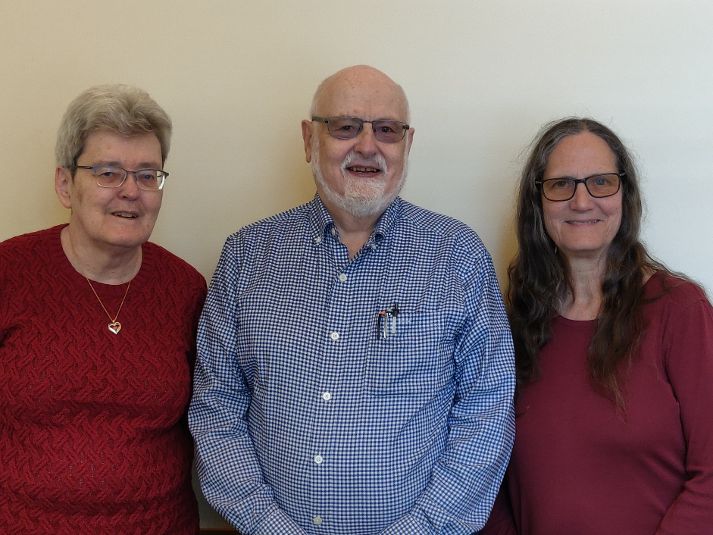
Today we’re introducing the EGS’s Help Desk Team who was selected by the Eastside Genealogical Society as their recipient of a WSGS Outstanding Team Award. The team is composed of Helen Carlson, Robert Barnes and Jane Wickert.
Bob Barnes, Jane Wickert, and Helen Carlson have contributed their knowledge, time, and energies to keep this important service operating through uncharted waters. Helen handles Scandinavian, Upper Mid-West and Eastern Washington. Jane is very good at Virginia, Kentucky, Pennsylvania, and Ohio resources. Bob contributes additional experience in Illinois, Iowa, Missouri, Kansas, Hawaii and Washington. Together they support each other on challenging family quests that the public brings in. Because of their persistence, the Help Desk thrives today.
For more information on the WSGS Outstanding Volunteer Award program, visit the Recognition page of the WSGS website or contact Info@wasgs.org. Please type “Volunteer Award” in the subject line.
Whatcom Genealogical Society meets the 2nd Monday of each month at 2 P.M.,
except December, January, July, and August at the Pioneer Pavilion, 2007 Cherry St., Ferndale,
WA – Doors open at 1:30 P.M.
There is plenty of free parking and no stairs to navigate.
No experience in genealogy is necessary to join us.
WGS General Meeting, April 14, 2025
“Reaping a Harvest with Land Records” with Larry W. Thomas
Larry is a retired US Army Captain with 23 years in the field of Aviation, Transportation
& Logistics, he has a bachelor’s degree in “Aviation Management Information Systems” from Southern Polytechnic State University while working for the US Army Reserves as a Program Manager earning his certification as a Project Management Professional from the Project Management Institute in 2013. Larry began his Genealogy Research over 30 years ago with his own Thomas Family, Georgia residents since the 1750’s. Then, adding the rest his and his late wife’s families before the beginning to research for clients in 2008, operating www.AtlantaGenealogy.com.
A graduate of ProGen 38, Larry has assisted the TV show “Finding Your Roots.” He is a member of numerous genealogical and historical societies, serves on the Board of the Georgia Genealogical Society, is the current president of Genealogical Speakers Guild, and is past president of the Cobb County Genealogy Society. He is becoming a popular genealogy presenter, bringing some fun to learning how to research.
You are free to copy articles to any non-commercial web site or message board or printed publication you wish. Don’t bother to ask permission, just do it.


 Debbie Wilson Smyth