TIP OF THE WEEK – FREEBIES
Both American Ancestors and Ancestry have free access promotions this
month. If you hurry, you can get in on the last few days.
Between Tuesday, November 12 and Tuesday, November 19, 2019, anyone
can access the many research databases of American Ancestors by
registering as a FREE Guest Member. That link is AmericanAncestors.org/Free-Billion
AmericanAncestors.org
contains some of the most important online databases for researching
American ancestry, with more than 1.4 billion names in records covering
18 countries.
For Veterans Day, Ancestry.Com is offering free access to their military records collection covering all 50 states and nearly 400 years of American history, from the Colonial era to Vietnam—and beyond. Search for free now through November 17
HELP SGS WHILE YOU SHOP
Black
Friday and Cyber Monday, kicking off the holiday shopping season, are
just around the corner. Think about helping SGS while you do your online
shopping by using AmazonSmile with Seattle Genealogical Society
selected as your charity of choice.
AmazonSmile is a website operated by Amazon with the same products, prices, and shopping features as Amazon.com. The difference is that when you shop on AmazonSmile, the AmazonSmile Foundation will donate 0.5% of the purchase price of eligible products to the charitable organization you choose.
SAVE THE DATE
Spring 2020 SGS Seminar with Fritz Juengling, Fairview Christian School, 844 NE 78th St, Seattle, WA Saturday, May 16, 2020 Mr Juengling is the German, Dutch and Scandinavian Research Specialist at the Family History Library in Salt Lake City. Fritz’ self-description says, “I read old documents in German, Dutch, French, Latin, Danish, Swedish and Norwegian, help people with their genealogical research, teach classes, publish articles, and lecture at conferences.” SGS is happy to have Fritz as the presenter for our spring seminar. Save the date. SGS CALENDAR OF EVENTS Unless otherwise indicated all programs will be at the SGS Library, 6200 Sand Point Way NE, Seattle. Check the SGS Web Site for additions, changes, and corrections. Programs may be canceled or postponed because of inclement weather. The Library will be closed from November 24, 2019 through December 2, 2019, for the Thanksgiving Holiday. NOVEMBER Saturday, November 16, 10:15 am – 12:15 pm, Irish Interest Group, with Jean Roth Saturday, November 16, 1:00 pm – 3:00 pm, German Interest Group, with Jean Roth
Saturday, November 16, 1:00 pm – 3:00 pm, Digging Deeper: Comparing Genealogical Software, presenters will compare Legacy, Family Tree Maker, and RootsMagic. Come see which one is right for you.
Tuesday, November 19, 11:00 am – 1:00 pm, Family History Writers’ Group, contact Gail Stevens for more info at stevens_gail@hotmail.com DECEMBER
Saturday, December 7, 10:15 am – 12:15 pm, Family Tree for Family Search Interest Group, with leader Lou Daly. Saturday, December 14, 1:00 pm – 4:00 pm, Second Saturday – Holiday Potluck – watch for details
Come hear our speaker, Lori Washburn, this Saturday, Nov. 16 from 2 – 3 p.m. as she presents GFO’s November GenTalk, Scanning and Archiving Your Family Photos and Documents. Whether
you want to scan just a few photos, have inherited a box of photos, or
plan on visiting a relative who might have photos, this class is for
you. We will briefly discuss scanners and then learn how to scan and
archive those precious photos and documents, as well as how to file the
scans. We will also touch on the basics of touching up your scans. Join us at the GFO. GenTalks are free and open to the public.
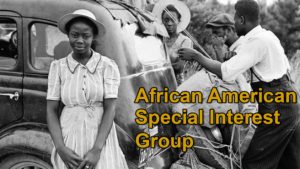
Join
the African American Interest Group as they host a special webinar on
Saturday, November 16, from 12:00 to 2:00 at the GFO. Dr. Charles Foy,
Associate Professor of Early American and Atlantic History, Emeritus, at
Eastern Illinois University and a scholar of 18th-century Black
maritime culture will present “Black Hands, White Profits: The Critical Role Black Mariners Played in 18th-century America.”
During
the 18th century, when North America lacked a network of highways, the
country’s economy was maritime-centered. In his talk, Dr. Foy, will
detail how Southern planters, Northern merchants, ship captains, and
government officials relied upon Black maritime labor for profits and to
develop the new American economy. He will also provide an overview of
how this drive by whites for profits offered enslaved Blacks
opportunities for freedom and economic independence. Dr.
Foy is the creator of the Black Mariner Database, a data set of more
than 30,000 18th-century Black Atlantic mariners and maritime fugitives.
He is completing a book manuscript, Liberty’s Labyrinth: Freedom in the 18th-Century Black Atlantic, that details the nature of freedom in the 18th century through an analysis of the lives of black mariners. All GFO Interest Group meetings are free and open to the public.
For GFO, GivingTuesday isn’t about fundraising. It’s
about banding together for a volunteer blitz to accomplish one large
task. What if all GFO’s members came together on just one day to give
back by lending their time and talent?
Please save the date: December 3rd and come to the GFO all or part of the day to help. GFO will provide pastries, fruit, and coffee in the morning, pizza and pop in the afternoon. You provide the people power. Please help.
GFO Gift Memberships
Give the meaningful gift of family history this holiday season with a gift membership to the GFO. It’s so easy. Just download and complete the form and send it with a check to Membership at the GFO. You’ll receive a holiday card (in an envelope) you can use to announce the gift. All memberships will begin January 1, 2020. Orders
received by December 10 will be mailed out on or before December 15.
Orders received after December 10 may not be fulfilled in time for
Christmas gift giving.
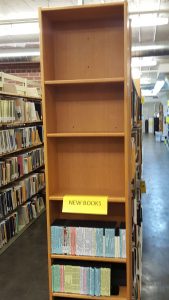
News from the Library: No new books?
Q: Why is the new book shelf empty? Isn’t the GFO getting any new books? A:
Actually, we have a number of new books that have been donated, and
some that we’ve purchased. But, for now, the library team is working to
get ready for GivingTuesday–and that means getting the books that are
already in the collection on the shelves where they can be inventoried
on December 3. Watch for more new books the second week of December.
This is the last weekend to take advantage of the Portland Center Stage offer to friends of GFO for a currently running play that happens to revolve around genealogy! Redwood
is billed as “a beautiful, humor-filled excavation of our shared
history. When Steve Durbin sets out to chart his Black family’s ancestry
online, his revelations unwittingly throw his entire family into
turmoil.” You can read Amy Wang’s review of the play in The Oregonian, here.
Redwood runs from now through November 17 at Portland Center Stage at the Armory. PCS has a deal for Friends of the GFO: Now through November 17: Use promo code “COMMUNITY*” for $10 off tickets. Get tickets here.
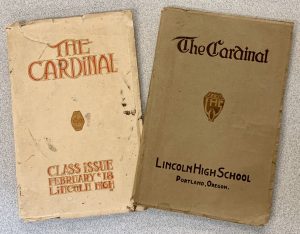
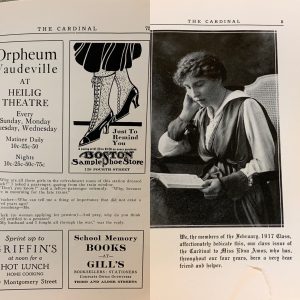
This week’s surplus books take us on a little local time travel. We have two spare copies of Portland’s Lincoln High School yearbook, The Cardinal, from 1917 and 1918. You’ll love the photos of the students, the advertisements for local businesses, and the articles from a bygone era.
These small paperbound volumes have seen better days, but they still hold together. Pick up at GFO Price: $15 for the set of two. Ship to You Price: $20 for the set of two. If you’re interested in buying these please contact booksales@gfo.org.
Survey Results: Personal Family Tree Software Usage
We
received 68 responses to last week’s query about what software E-News
readers use for their own family tree. We’re curious what you like best
and what could be better about the software you use. One person has used (COSMI) Perfect Family Tree for over 10 years and described it as cheap, functional, but can’t print in color. Two over-10-year users of Ancestral Quest report it is easy to use but could be better handling photos in the notes.
One person reports using Brother’s Keeper for between 5 and 10 years—but doesn’t have time to use it much and finds it confusing. Family Tree Maker
has the most reported users (32). Two people using it for less than a
year, 5 people for 1-5 years, 8 people for 5-10 years, and 17 over
10-year users. The most repeated feature they liked was the ability to
sync with Ancestry. Also mentioned were ease of use and the report
functions. We heard from 7 Legacy Family Tree
users—two users for 1-5 years, 4 for 5-10 years, and 1 for more than 10
years. Users like the reports and the citation template, and while
there were some ideas, there was no consensus on things that could be
improved. One user of MacFamily Tree (10+ years) who likes the ease of use and support. Three Master Genealogist users (10+ years) who wish the program was still supported.
PAF (Personal Ancestral File) – 3 users for 10+ years who like the ease of use but wish the program was still updated and supported. Six Reunion
users (1 less than a year; 2 for 5-10 years, 3 for 10+ years) the
comments in favor were varied, and the only request for improvement was
the ability to sync with Ancestry. RootsMagic
had twelve users respond. Seven have used it for 1-5 years, two 5-10,
and one didn’t say. Users like the ability to sync with Ancestry is just
one of many favored features. Several noted that source citation
templates could be improved. To see all the responses click here.
New Survey: Are you attending GivingTuesday?
We hope you are planning to join us on December 3 for our GivingTuesday volunteer blitz. We need you! A large turnout will make this event a success. Please take our survey to let us know if you’re coming.
Saturday, November 16th Genealogy Problem Solvers 9:30 – 11:30 a.m. If you are part of a big family tree, there is a good chance that you have some famous relatives. When doing family history research, we all get excited when we discover that a relative or ancestor is someone famous. This month’s challenge is to determine how our GFO member is related to Claire Lee Chennault, the U.S. major general who commanded the U.S. Army Air Forces in China during WWII. For more information contact Katie Daly at GPS@gfo.org. African American Group 12:00 – 2:00 p.m. Our speaker will be Dr. Charles Foy joining us remotely from the UK via Webinar. His talk will be Black Hands, White Profits: The Critical Role Black Mariners Played in 18th-century America and will detail how Southern planters, Northern merchants, ship captains, and government officials relied upon black maritime labor for profits and to develop the new American economy. He will also provide an overview of how this drive by whites for profits offered enslaved blacks opportunities for freedom and economic independence. For more information, see the feature article above or contact Janice Sellers african_american@gfo.org. GenTalk: Scanning and Archiving Your Family Photos and Documents 2:00 – 3:00 p.m. Presented by Lori Washburn Whether you want to scan just a few photos, have inherited a box of photos, or plan on visiting a relative who might have photos, this class is for you. We will briefly discuss scanners and then learn how to scan and archive those precious photos and documents, as well as how to file the scans. We will also touch on the basics of touching up your scans. GenTalks are free and open to the public. Sunday, November 17th Library Work Party 9:00 a.m. – Noon There’s another work party at the GFO library today for those of you who can come. There’s lots to do and we’d love to have your help. Doors open at 9 and work usually wraps up around noon. Some people come for just an hour or so; others work the full time. You are welcome to do either. Any time you can share is valuable. Hope to see you there. Family Tree Maker User’s Group 1:00 – 3:00 p.m. Join other users who want to work through the 2017 Companion Guide to Family TreeMaker. Bring your laptop with 2017 version of FTM installed – build 1-480 of FTM installed. Come 30 minutes earlier if you’ve never been or have skipped sessions. You might need an update of the “fake” practice tree we are using. For questions or info, contact Joyce Grant-Worley at FTM@gfo.org French Canada Group 3:30 – 5:00 p.m. Share stories of our history. Come and join this group to learn more about French Canadian ancestry and Acadia. The group leader is Bob LaMarche. FrCan@gfo.org Wednesday, November 20th Learn & Chat 10:00 a.m. – 12:00 p.m. In the next several sessions, we will be looking at the three aspects of the Genealogy Proof Standard as set forth by the Board for Certification of Genealogists in the BCG Genealogical Standards Manual. The goal is to learn together to integrate these standards and methods into our daily routines, to become better genealogists, maximize our efficiency, reach more accurate solutions, and breakdown more brick walls. Join us to talk about your genealogy, support others, and hopefully learn something new. Facilitated by Sandy Alto and Jeanne Quan. Questions? learnandchat@gfo.org DNA Q&A: The Basics 1:00 – 3:00 p.m. This meeting is for those who are just beginning to use DNA testing for genealogy. Each class begins with a presentation of general information about DNA testing. General questions regarding DNA testing are welcome at the end of each planned discussion. Lisa McCullough leads this group. Questions? dna_qa@gfo.org GFO Library Open Late to 8:00 p.m.
We want to share with you a presentation given by one of our Whitman County Genealogical Society members, Joye Dillman.
Joye Dillman of Pullman will give a historical presentation on toys and games enjoyed by children before computer games and the internet at 6:30 PM, Wed., Nov. 20, at the Troy Historical Society. Joye’s presentation is titled “For the Fun of it: American Childhood Toys and Games.” She is a museum correspondent docent with the National Society Daughters of the American Revolution, and a retired professor of human development at WSU. Attendees are welcome to bring their antique toys to add to the displays at the event. The society is located at 421 S. Main St., Troy, Idaho.
One of the more interesting part of posting all these articles on the blog is checking to see which blog posts are read by the most people. Google Analytics keeps track of which blog posts are read the most, which have the highest bounce rate (people that only read one article), and duration of time on the article. They recently added a switch to turn off listings from known search bots which really are not blog readers.
The majority of our readers are from the United States, but we get readers from many countries, today ten countries are listed from Brazil to Slovakia. I am always amazed we get very few from Canada even though we are very close to British Columbia.
To break down where the readers are, Google Analytics also lists the city of the reader, and for the past year or so that city is Chicago. In case you did not know they collect information on conferences, seminars and even monthly genealogical programs and post them on a list of genealogical happenings for the whole country and that is done in Chicago. Number 2 on that list is always Seattle, I guess since they are the largest city in Washington. Past Seattle is a bunch of other cities that change places almost daily, but usually the next two are Spokane and Wenatchee. In this weeks top 25 is Brookline, San Francisco, Des Moines Iowa, San Antonio, Ashburn and New York. There was also two readers from Busan in Korea.
We have as of today 875 subscribers to this blog, and I guess it is one of the largest of any of the blogs from the Easy Net sites that many genealogical societies subscribe to. Only about half of those subscribed read the blog weekly. So how do others find the blog? Google is the most used method. All blogs are easily found by Google and all the other search engines. So what article was most searched by Google this last month? It was an article on the University of Washington genealogy Class that was posted in 2015: http://wp.wasgs.org/2015/06/04/university-of-washington-genealogy-class/
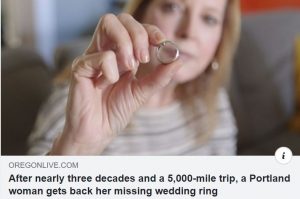
GFO volunteer Nanci Remington played a key role in helping Samantha Swindler and Tom Hallman Jr. of The Oregonian/OregonLive find the owners of a wedding ring lost almost three decades ago.
Watch the video and read the full, heart-warming story here.
Share Your Knowledge at the GFO 2020 Open House
Have
you learned some nifty genealogy research tricks? Discovered some
records that often go overlooked? Become a mini-expert in a particular
location? We’d love to have you participate. The GFO Open House will run March 13-22 next spring, and we’re looking for speakers! If
you’ve given a presentation elsewhere or have given it at the GFO
before, we’d be happy to feature it again. Or, bring in something new. Our
Open House aims for beginners. It’s our annual drive to bring in new
members. What better way to begin than to show them what a friendly
community we are? Sharing is part of our key mission. Can you help us? Please contact Vice President Marti Dell at vicepresident@gfo.org.
Did you know the GFO has 5,000 family histories from around the U.S? And more than 1,000 surname vertical files? Most
of them are not listed in the Library of Congress. Our collection is
unique, and likely not available in any other library in the Pacific
Northwest.
Family histories at the GFO are shelved alphabetically by the surname of the main family in each volume.
The
surname of the family usually appears in the title, but many more
collateral names may hide inside those books waiting to be discovered.
When these books are recataloged, the new records will reveal many of
these surnames as well. So, for now, don’t just search our library catalog for your ancestors’ names. Also look for the names of their friends and neighbors.
Saturday, Nov. 16 from 2 – 3 p.m. Presenter: Lori Washburn Whether
you want to scan just a few photos, have inherited a box of photos, or
plan on visiting a relative who might have photos, this class is for
you. We will briefly discuss scanners and then learn how to scan and
archive those precious photos and documents, as well as how to file the
scans. We will also touch on the basics of touching up your scans. Free for everyone at the GFO library.
What if all GFO’s members came together on just one day to give? For GFO, GivingTuesday isn’t about fundraising. It’s about banding together for a volunteer blitz to accomplish one large task.
Please save the date: December 3rd and come to the GFO all or part of the day to help. GFO will provide pastries, fruit, and coffee in the morning, pizza and pop in the afternoon. You provide the people power. Please help.
We are delighted that Portland Center Stage is offering friends of GFO a special offer for a currently running play that happens to revolve around genealogy! Redwood
is billed as “a beautiful, humor-filled excavation of our shared
history. When Steve Durbin sets out to chart his Black family’s ancestry
online, his revelations unwittingly throw his entire family into
turmoil.”
Redwood runs from now through November 17 at Portland Center Stage at the Armory. PCS has a deal for Friends of the GFO: Now through November 17: Use promo code “COMMUNITY*” for $10 off tickets. Get tickets here.
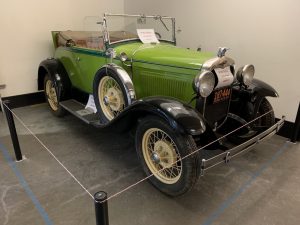
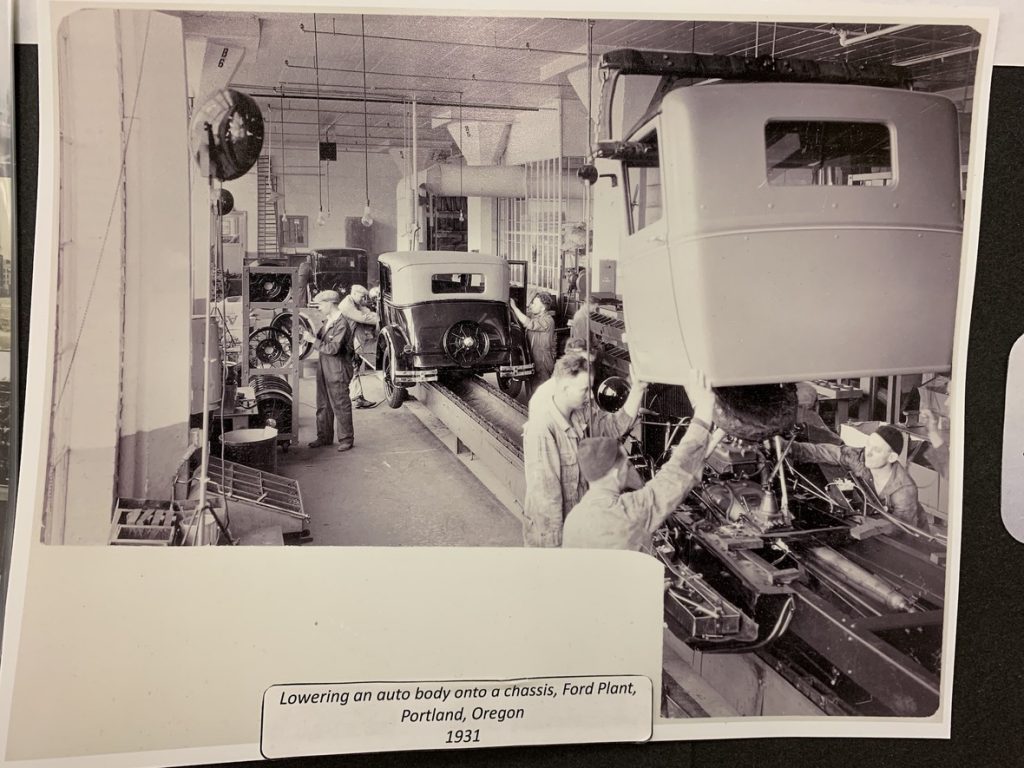
Ford in the Ford Building
Check out the new addition to our building, one floor above the GFO! It’s very fitting for the Ford Building since cars like these were assembled right here, early in the 20th century. Walk down the hall past the elevator to see for yourself. (That doesn’t look like an original paint job though!)
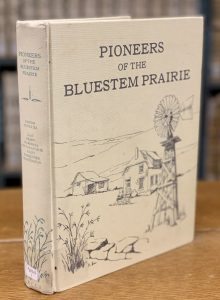
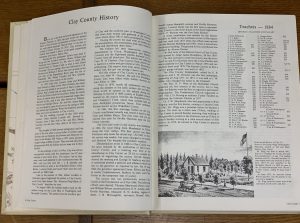
Do you have ancestors from the Flint Hills of Kansas? This book may be just what you’re looking for. Pioneers of the Bluestem Prairie
includes histories and family biographies for Clay, Geary, Marshall,
Pottawatomie, Riley, Waubaunsee, and Washington Counties, as well has
history for Riley County Schools, and maps for Kansas Trails and the
Manhattan area. This 608-page hardcover book is in excellent condition. The only marks are library stamps and labels.
Pick up at GFO Price: $40Ship to You Price: $46 If you are interested in buying this book, contact booksales@gfo.org. Do not simply come to the library to get it.
Survey Results: Halloween Stories
About 83% of you report having spent Halloween with your parents and 38% with grandparents. Just over 50% report spending it with their children; however, 58% report spending it with grandchildren. No
one reported spending the holiday with either great-grandchildren or
great-grandparents—but we did get a few interesting stories.
▪ I
was at home, sick with the chicken pox. This was back in the day when
parents thought it advisable to expose their own kids to sick kids when
measles, mumps, and chicken pox was in the neighborhood. Two of my
friends came by to share their haul with me. I don’t recall whether
either of them got the pox after visiting but getting some of those
treats sure made me feel better. ▪ A
couple of years ago, I took two of my grandsons trick or treating. They
filled up their bags and we went back for more. They ended up with a
huge pile of candy on the dining room table, from which their mother let
them keep a few. They put most of the candy on the porch (for teenagers
to take) and in the morning (better than the tooth fairy) they had new
boxes of Legos! ▪ A
friend’s family reunion is always a camping trip the weekend closest to
Halloween. They set up a haunted forest for the kids and adults to
enjoy as well as trick or treating at each RV. I want them to adopt me!
New Survey: Family Tree Software One of the special interest group leaders wants to know what software the E-News readers use for their own family tree. We’re curious what you like best and what could be better. Please tell us by taking the survey now.
This week at GFO … Saturday, November 9th Great Lakes Interest Group 9:30 – 11:30 a.m. We welcome guest speaker Kathryn Stock to discuss the Fenian Raids in the late 1860s in which the Fenian Brotherhood carried out a series of attacks on British army forts in the U.S. and Canada as a way to pressure the UK to withdraw from Ireland. This promises to be an especially interesting topic as it tends to be a lesser-known part of the region’s history. As always, our group’s meetings are free and open to the public. For more information contact Lynn Rossing at GreatLakes@gfo.org Writers’ Forum 1:00 – 3:00 p.m. This is a peer group of genealogists, who meet to learn about writing and to share our writing with each other. Everyone is welcome, whether you have participated before or not. We are currently working with Bruce Tarshis’s “How to Be Your Own Best Editor,” chapter 15. If you are new to the group, just show up and we’ll get you started! Peggy Baldwin facilitates this group and can be reached at writers@gfo.org Sunday, November 10th Library Work Party 9:00 a.m. – Noon There’s another work party at the GFO library today for those of you who can come. There’s lots to do and we’d love to have your help. Doors open at 9 and work usually wraps up around noon. Some people come for just an hour or so; others work the full time. You are welcome to do either. Any time you can share is valuable. Hope to see you there. Tuesday, November 12th Board Meeting 6:10 – 8:10 p.m. Everyone is welcome. Wednesday, November 13th PMUG College 6:00 – 8:00 p.m. Description pending GFO Library Open Late to 8:00 p.m.
TPCGS will hold our monthly meeting this coming Tuesday, November 12th, at Bates Community College, South Campus.
6:00 pm Member Networking and Sharing 6:30 – 8:30 pm Business Meeting and Program
PROGRAM: Finding Your Ancestors in Fraternal Records.
SPEAKER: Steve Dunkelberger
Hope to see everyone there!
TPCGS
monthly meetings are held September through June from 6 pm to 9 pm,
usually at Bates Technical College, South Campus, Building E, 2201 South
78th St, Tacoma.
Guests are always welcome, so bring a friend! For more information check our website at www.tpcgs.org.
Whatcom Genealogical Society will meet Monday, November 11 at 2 pm
at the Bellingham Elks Lodge, 710 Samish Way, downstairs. The speaker
will be Lori Lee Sauber, Professional Genealogist. She will present
“Even Our Plain Quaker Ancestors Lived Colorful Lives — How to Write
Interesting Family Histories”. Visitors welcome! Contact:
360-733-8300.
TIP OF THE WEEK – ARE YOUR “SAVED” RECORDS “SAFE”?
Most people who keep their family tree on Ancestry regularly attach
records/images to an individual in their tree using the ‘Save to a
person in my tree’ function, thinking they have really saved the record
to their tree, and it will be there forever and ever. Fun and easy?
True. Forever and ever? Not true. What has really happened was a link
was created from their tree to that record/image in a database. So once
they stop subscribing to Ancestry, they will still have access to their
family tree kept there, but they will no longer be able to view any
record/image attachments “saved” from a paid database — which most are.
The bottom line, if these records/images are important to you, by all
means, “Save to someone in my tree” as you have been doing, but also use
the “Save to my computer” function. Name the record/image file you
saved something meaningful, so it can easily be identified later, and
keep it organized in a folder on your computer. A good practice might be
to create a folder on your computer for each of your family surnames.
You are free to copy articles to any non-commercial web site or message board or printed publication you wish. Don’t bother to ask permission, just do it.