Coronavirus Impacts: Open House, Seminar, SIGS, GenTalk
The
Genealogical Forum of Oregon is actively monitoring communications from
local, state and federal authorities about the ongoing coronavirus
pandemic. Today, Oregon Governor Kate Brown instructed all groups
in the state to cancel events hosting 10 people or more in high risk
populations. Older adults are considered high risk. A large percentage
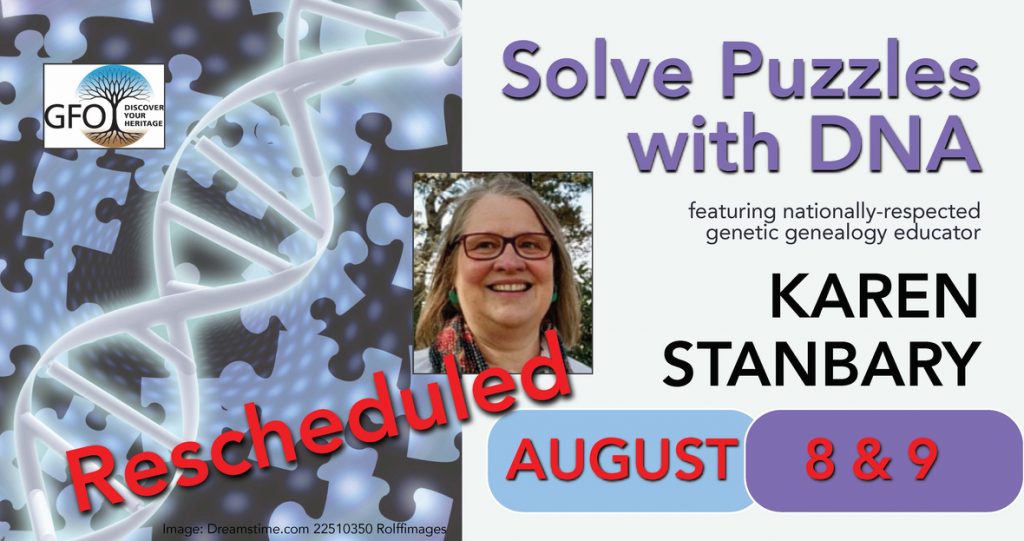
of our members and SIG participants are older. Therefore, we have taken these actions: Canceled Special Interest Group meetings. Canceled GenTalk about PERSI on March 21. Rescheduled the Open House to Sept. 25-Oct. 4. Rescheduled the DNA Seminar with Karen Stanbary to August 8-9. Those
who have registered for the seminar remain registered for the future
dates. All registered attendees will receive a direct email about
refunds if they need them.
Courtesy Tri-Met The library typically attracts a minimal number of people and we believe it can remain open for the time being. At
the GFO library, we are using disinfecting wipes on keyboards, mice,
desktops, chair backs, and door handles multiple times a day. You can help keep us all healthy too. The Centers for Disease Control has some basic, effective prevention steps: ▪ If you or anyone in your household has a cough or feels sick, stay home. ▪ Cough or sneeze into your elbow, not your hand. ▪ If
you do cough or sneeze into a tissue, wash your hands immediately for
60 seconds or use alcohol-based hand sanitizer. Please observe the steps
in the following videos, released by the WHO, that provide instructions
on how to properly wash your hands and disinfect your hands with sanitizer. It’s
easy to forget to cough into your elbow, but it’s really important not
to cover your mouth with your hand (and then touch surfaces others will
touch), or worse, to cough out into the air. Experts say washing hands really does prevent epidemics. Let’s work together to keep all of us healthy.
Membership Meeting Will Happen March 21 in Much Smaller Form
Our bylaws require an annual Membership Meeting in March to finalize the ballot for the election of the Board. Given the circumstances, we are not asking you to attend. We
are arranging just enough people to come as the bylaws require a
nomination for Director at Large be made from the floor. This is the
meeting at which the ballot for the upcoming Board election is
finalized. We have a willing candidate for each of the three positions
open this year: President, Secretary, and Director at Large.
Hall of Fame Nominations Sought
It’s time for GFO Hall of Fame Nominations! Any GFO member may nominate another member by April 1. Nominees
must have a well-documented history of service, leadership, and
accomplishment in more than one facet of the GFO, over a long period of
time. Please include: ▪ Name, list of services, activities, positions, and accomplishments; ▪ A narrative describing the nature of their work in terms of its importance to the success of the GFO; ▪ A short biography. Please send to secretary@gfo.org by April 1. The
board will decide if any merit selection. Winners are awarded in June
and receive a free Life Membership and their name on our Hall of Fame
plaque.
Have a Fun Genealogy Story? Share it with our Insider
We’re looking for stories for the May 2020 Insider issue at this time, and we need your help. What
we’re looking for: genealogy and history- centric articles, tips,
resources, ideas, serendipity stories, techniques, events, etc. Please email insider@gfo.org by April 4th to get your news and items of interest into May’s issue. Again, submissions are due by April 4th, please.
News from the Library
New Digital Content ▪ Berks of Old ▪ Craig Links ▪ Edgar Newsletter ▪ Francisco Researcher [Francisco surname and variations] ▪ San Luis Obispo County Genealogical Society, Inc. [bulletin].New Books ▪ The Blows of yesteryear: an American saga ▪ Genealogies of Hadley families: embracing the early settlers of the towns of Hatfield, South Hadley, Amherst and Granby ▪ Painter families ▪ The Descendants of Peter and Margaret Rankin: from Kilsyth, Scotland ▪ Stratton notes ▪ Monumental inscriptions of the parish church of St. Mary, Oakley: (Part only) ▪ Who was Ann Gregg ▪ Colonial tavern keepers of Maryland and Delaware, 1634-1776 ▪ Chesapeake
and Ohio Canal: a guide to Chesapeake and Ohio Canal National
Historical Park, Maryland, District of Columbia, and West Virginia ▪ The Civil War in Fairfax County: civilians and soldiers ▪ Communities of kinship: antebellum families and the settlement of the cotton frontier ▪ A guide to researching land in Oklahoma at the Oklahoma Historical Society. ▪ Genealogical research guide to Reno County, Kansas ▪ Hughes County history ▪ Ghost towns and historical haunts in Arizona: Stories and photos ▪ Baker County [Oregon] links to the past ▪ Camp Polk Cemetery, 1880-1999 ▪ Monmouth, Oregon: the saga of a small American town ▪ Collected memories: Umatilla Tales from the past: pioneer stories of the lower Willamette Valley
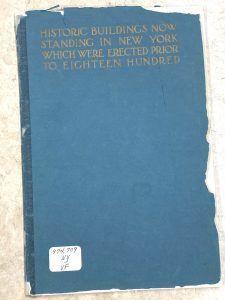
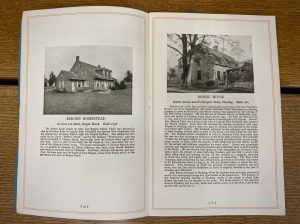
This week’s surplus book has a truly self-explanatory title: Historic Buildings Now Standing In New York Which Were Erected Prior To Eighteen Hundred. However, the “now” in that title is a bit dated, because this book was printed in 1914. This
is a fun piece of pictorial New York history with photos on almost
every page, accompanied by descriptions of the truly old buildings of
New York.
It’s
a thin volume, 45 pages, and its cover is a bit tattered, its spine
taped to keep it intact. Pages inside are crisp and as vibrant as when
they were printed. This booklet contains library marks and a label. Price for pickup at the GFO: $18 Price to ship to you: $24 If you’re interested, please contact booksales@gfo.org.
Survey Results:
Last
week, we provided a list of research locations and asked what
percentage of respondents had been there. Respondents were allowed to
select more than one answer, and the percentages have been rounded. 75% Family History Library (Salt Lake City, Utah) 61% National Archives (Washington, DC) 32% NEHGS Library and Archives (Boston, MA) 32% National Archives (other locations) 25% DAR National Library 21% Allen County Public Library (Ft. Wayne, Indiana) 11% Mid-Continent Public Library (Independence, Missouri) Many
of the respondents wanted to go to the places in the survey again. But
here are the places mentioned that were not listed above: ▪ Musselman Library in Gettysburg College, Gettysburg, Pennsylvania ▪ National Records of Scotland to research my Scottish connections ▪ New York State Archives ▪ Fayetteville Arkansas Archives and the Fayetteville Library ▪ The Newberry Library was a good one. ▪ Richmond Virginia it was a treasure trove of Virginia history. They have a fantastic archive. ▪ I’ve also visited the Oregon State Archives and the Minnesota Historical Society Library ▪ Indian
and Colonial Research Center, Connecticut. A hidden gem with an amazing
resources for a researcher with extensive CT and RI ties as well as
Indian ancestors. ▪ University of Washington Libraries. ▪ Anything in England, now that I know where we came from. ▪ Tennessee State Archives ▪ I want to go to New England, so pretty much any library or archive there. ▪ The Fiske Library in Seattle because it is relatively nearby and I have never been there.
New Survey: Newspapers
Newspapers can be a great resource. This week, we’re asking if they’ve helped you solve any genealogical puzzles.
Sunday, March 15th Library Work Party – 9:00 a.m. – 12:00 p.m. We’ll be working to digitize more periodicals while we have fun chatting about genealogy. We will make sure everyone sits three feet apart, in accordance with state recommendations. French Canada Group CANCELED Per Governor’s Instruction. The group leader is Bob LaMarche. FrCan@gfo.org Wednesday, March 18th DNA Q&A – CANCELED Per Governor’s Instruction Leader: Lisa McCullough dna_qa@gfo.org GFO Library Open Late to 8:00 p.m.
I have been trying to keep up with all the Corona Virus Cancellations here, but this blog is really not a great place to post them, because the majority of people get the once a week digest, and so I have also been posting all the cancellations I have gotten on the Washington State Genealogical Society FaceBook page as soon as I get the notice, so check there for the most up to date list of cancellations.
The EWGS Seminar scheduled for April 4th has been postponed till May 2nd. If you have already paid and can not make the May date you can get a refund, or the money carries over for the May Seminar. Saturday, May 2 Enhancing Your Genealogy Repertoire (Seminar) 9:30 pm to 3:30 pm Prince of Peace Lutheran – 8441 N Indian Trail Rd. Spokane, WA 99208
#1 Researching Is Child’s Play with Barbara Brazington
#2 Census with Lynda Keenan
#3 Ancestry DNA and Thru-Lines with Janice Moerschel
#4 DNA Painter with Lynda Keenan
Handouts will be on the Home page of the website for attendees to print their own. LUNCH: Taco Bar catered by Becky’s Catering COST: $25.00 (includes lunch) for members
$30.00 (includes lunch) for non-members
$30.00 at the door (lunch not guaranteed)
Doors open at 9:00 am Payment methods will be listed on the website soon!
As you know Seattle is the country’s epicenter of the Covid-19 virus
outbreak. All experts urge those who are vulnerable due to older age or
with compromised immune systems to stay at home. While not all of our
SGS friends fall into these categories, many do.
Yesterday, at our monthly Board meeting, which was held virtually, we
decided to close the physical facility at 6200 Sand Point and to cancel
all meetings and gatherings of our members held there until 30 March
2020. The facility is not being closed due to any known contamination,
but rather as a pro-active move to avoid possible person-to-person
transmission of the virus. The Board will meet on 23 March to reassess
the situation and we will let you know when this policy changes.
Our ability to help with your family history has not stopped, however!
Here are a few things we will be doing in the next few weeks of this
shutdown to reach out to you and help with your genealogy:
The
eNews! will be issued more frequently in order to keep you apprised of
the situation; inform you of new online resources; and outline upcoming
online opportunities. Thanks to Deb Klein, our editor!
We
are postponing all meetings and volunteer events held at the Society at
least until 30 March.This includes all Special Interest Groups (SIGS),
SGS Writer’s Group, our Second Saturday (and quarterly meeting) session,
the Centennial Planning Kick-off meeting and any volunteer work at the
desk or for the Library. The events will be rescheduled.
We
are NOT cancelling SGS sponsored events which are held at off site
locations, e.g. “Digging Deeper: Researching Women’s History” (UW) by
LIsa Oberg. This event and its potential closure will be decided by the
institutions or individuals who run them. If it is held, it is your
decision whether you attend or not.
At
the Board meeting today, the Board approved the slate of officers and
authorized SGS to inform the members of the slate via eNews! on
15 March. We have several openings still unfilled; if you know of
someone who might be good to fill the position, please let us know. We
will contact that person and see if they are willing to serve before
placing them on the ballot. The ballot will go to the members
electronically on 31 March. Note: There will also be a couple of by-law
issues that we ask for your consideration. These were missed last year.
Don’t
forget that we have two Facebook pages “Seattle Genealogical Society
and Library” and “Seattle Genealogical Society Networking.” The former
is generally for announcements and the latter is for asking your
research questions. If you get stuck with your research you can also
always request help through the FB page or by submitting a research
request through the website.
SGS
will ramp up its online offerings during this period that our physical
facility is closed. Watch your eNews! for the link to join the
presentations by Heidi Mair and me.
We
will soon be announcing 2 new online courses–“Genealogy Basics &
Beyond,” and “DNA by the Numbers.”. Stay tuned for registration
information.
The
online offerings will use Zoom as the meeting platform, the same as we
use for our Board meetings. Zoom is very easy to use…click on the link
provided for the class or the meeting, click positively through the
question and you’re in!
We certainly hope
that you are safe and well. Our thanks go out to the scientists at the
UW, Fred Hutch, the CDC and other institutions who are working overtime
to tame this beast. In the meantime—have you washed your hands
recently?
Thanks so much for your support of SGS.
Jill Morelli, CG
Seattle Genealogical Society, President
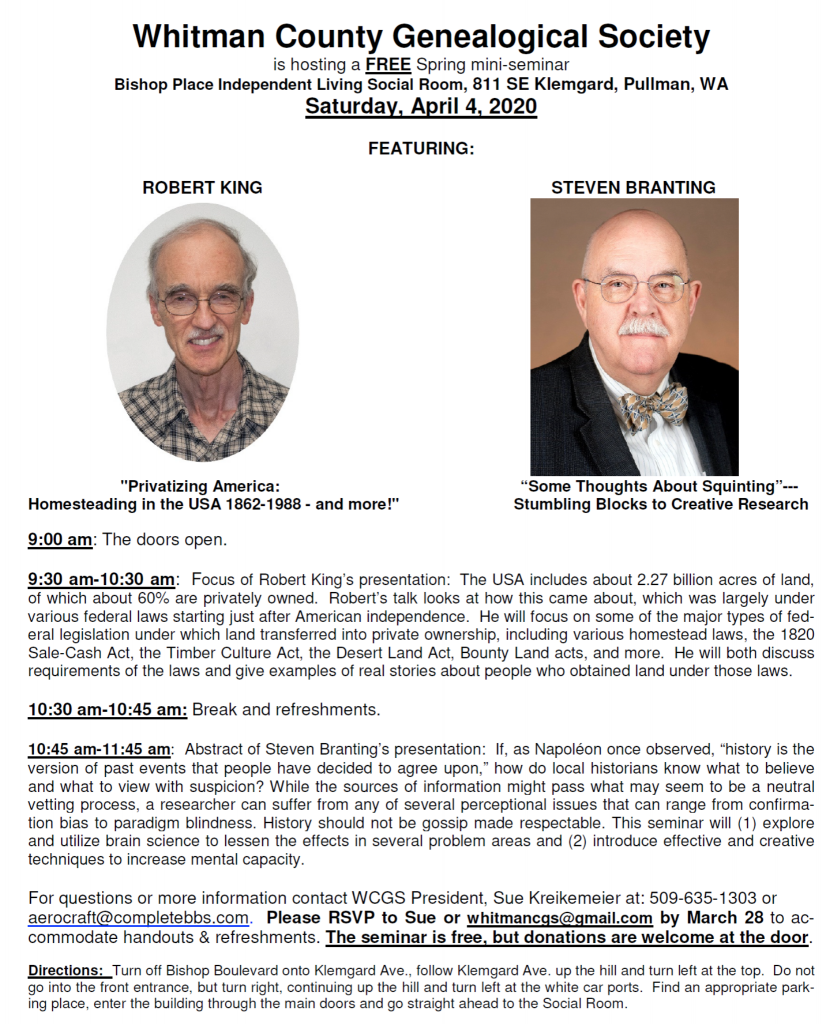
Based on all the current information, the WCGS board decided it is best to postpone our April 4 seminar. We have been in touch with both speakers about a date in the future that would work for both of them and have settled on Sat., Aug. 29 in the morning, using the same format as previously published. We have also contacted Bishop Place and put it on their calendar so the venue will be the same as previously published. It’s not too early to mark your calendar for this informative and, what we think, is an exceptional mini-seminar with very well-known and much in demand speakers. We thank both Bob and Steve for their flexibility in working with us to re-schedule their presentations at a later date. Monica Peters, WCGS Corresponding Secretary
For questions or more information contact WCGS President, Sue Kreikemeier at: 509-635-1303 or aerocraft@completebbs.com. Please RSVP to Sue or whitmancgs@gmail.com by March 28 to accommodate handouts & refreshments. The seminar is free, but donations are welcome at the door.
Directions: Turn off Bishop Boulevard onto Klemgard
Ave., follow Klemgard Ave. up the hill and turn left at the top. Do
not go into the front entrance, but turn right, continuing up the hill
and turn left at the white car ports. Find an appropriate parking
place, enter the building through the main doors and go straight ahead
to the Social Room.
BIOGRAPHIES
OF SPRING SEMINAR SPEAKERS
Robert
King’s biography includes the following:
Robert
E. King grew up in Pullman where he graduated from WSU with degrees
in Anthropology and History. He completed his Ph.D. at the
Univ. of Pennsylvania in Anthropology (specialty: Ethnohistory &
Archaeology) and since 1981 has worked for the Bureau of Land
Management in Alaska. He has been the BLM’s State Archaeologist
in Alaska for over 33 years, with his work taking him to much of the
state. He has a strong interest in federal land laws including
homesteading, and has spoken and written on this subject for several
years. Currently, he writes a guest monthly column on the
history of homesteading for the Homestead National Monument of
America’s electronic newsletter. Locally, he is best known in
Whitman County as a frequent contributor to the “Bunchgrass
Historian,” having authored over 30 articles in the past nearly
25 years on a variety of topics. He is also an avid genealogist
and has co-written several books on various families, with some of
his relatives settling in Whitman County in the 1870s. He
maintains homes in both Anchorage and Pullman.
Steven
Branting’s biography includes the following:
Since
2000, many of this country’s leading history, geography and
preservation organizations — including the American Association for
State and Local History, The History Channel and the Society for
American Archaeology — have honored Steven Branting for the depth,
scope and variety of his research and field work.
In
2009,
he
was nominated for the American Historical Association’s prestigious
William and Edwyna Gilbert Award, which recognizes outstanding
contributions to the teaching of history through the publication of
journal articles. Branting has written eight (8) books on the history
of Lewiston. Branting’s articles have appeared in, among others,
the Western
Historical Quarterly,
TheHistory
Teacher,
Idaho
Magazine, Nostalgia
and Idaho
Yesterdays.
The
Idaho State Historical Society conferred upon him the 2011 Esto
Perpetua Award,
its highest honor, citing his leadership in “some of the most
significant preservation and interpretation projects undertaken in
Idaho.” Governor C. L. “Butch” Otter awarded him that year’s
Outstanding Cultural Tourism Award for showcasing Idaho’s heritage.
In
2013, the National Society Daughters of the American Revolution
awarded Branting its coveted Historical Preservation Medal. In 2015,
Lewis-Clark State College selected him for the Marion Shinn Lifetime
Achievement Award, and in 2016 he was awarded the President’s
Medallion for his efforts to safeguard the heritage that the college
and community have shared since the 1890s.
During
2018, the Lewiston
Tribune
published 104 of his columns highlighting events and people who
featured greatly in the history of Lewis-Clark State College, which
was celebrating its 125h anniversary and for whom Branting holds the
office of “Institutional Historian,” the first since Henry
Leonidas Talkington in the 1940s.
Branting’s eighth
Lewiston book — The
Words That Were Our Names
— was released in October 2019.
SGS Members and Friends of SGS;
This
is to inform you that some genealogy events scheduled for March are
being canceled due to health concerns raised by the presence of the
Corona virus locally.
Here is a list of cancellations reported to SGS as of today:
JGSWS
has canceled their event originally scheduled for Monday, March 9, at
the LDS Stake Center in Bellevue. It was Ron Arons, and his topic,
“Sex, Lies, and Genealogical Tape” and it will be rescheduled for
another time.
SGS
event Using KC3I with Reiley Kidd and Jess Ramey, originally scheduled
for Wednesday, March 11 at 10:15 am at the SGS Library is canceled. It
will be rescheduled for another time.
MAC Computer Users Group Meeting originally scheduled for Wednesday evening, March 11, at the Fiske Library has been canceled.
Watch our Facebook page for any further updates or cancellations
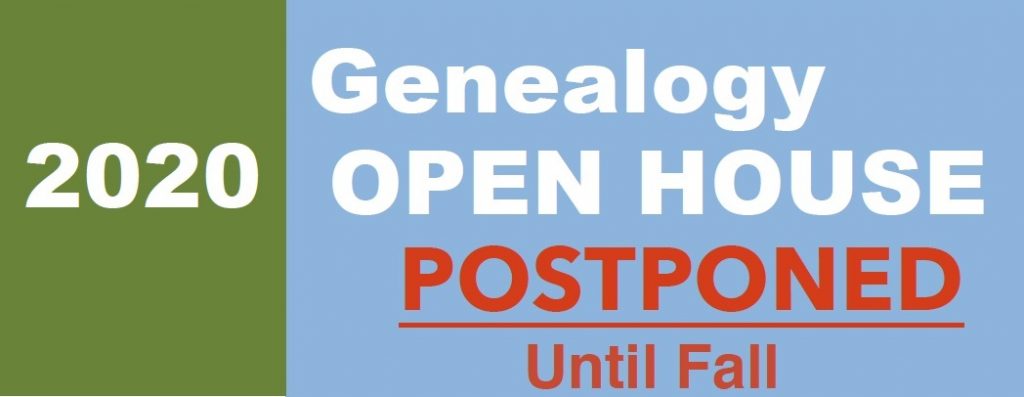
GFO Postpones Open House Due to Coronavirus Concern
After
weeks of telling you how excited we were about our upcoming Open House,
we have now made the difficult decision to postpone it until this fall. The
COVID-19 outbreak caused by the coronavirus in the Portland area has
many people worried about gathering for public events. We share that
concern. It does not make sense to host an event that people may be afraid to attend. We will let you know when we have new dates set.
Coronavirus Prevention In Full Swing at GFO
Courtesy TriMet We
also want you to know we are taking the advice of medical experts. Our
volunteers are wiping down surfaces that people touch with disinfecting
wipes multiple times a day. This includes computer keyboards, mice,
printers, and door handles. Hand sanitizer bottles now sit in several locations throughout the library. We ask you to do your part too. Doctors advise: ▪ If you or anyone in your household**** has flu-like or respiratory symptoms (fever, coughing, or shortness of breath) please stay home. ▪ If
you cough or sneeze in the library, please do so into your elbow, not
into your hand. If you have tissue in your hand and cough into it,
please immediately wash. ▪ Avoid touching your eyes, nose or mouth. Since
the library typically attracts small numbers, members have felt
comfortable coming in. We are following the advice of health authorities
in order to continue offering our services. Special Interest Groups may decide to postpone meetings. Please check the GFO Calendar before you come in for any SIG gathering.
We had a hunch that DNA would be a popular topic for our Spring Seminar, and we were right. The
Sunday half-day seminar is full! If enough of you join the wait list,
we may be able to find another venue. Sign the wait list right away so
we can gauge the interest. (Click the Register button below, then scroll
down to add yourself to the Wait List.) Saturday’s full-day seminar still has seats in our ample auditorium at SEI. We hope you will join us for our 2020 Spring Seminar, Nationally-known genetic genealogy author and educator Karen Stanbary, CG®, MA, LCSW brings her “Solve Puzzles with DNA,” lectures to Portland on April 4 & 5.
The Saturday, April 4 classes, will be held from 10:00 a.m. to 4:30 p.m.at Portland’s Center for Self Enhancement (SEI). Classes include: * Tips to Manage Conversations about Unexpected DNA Results: * The DNA You Need – Elements of Creating a Testing Plan: Who to Test and Why * Avoiding Common Mistakes When Working with atDNA: * Spit and You Shall Find! Autosomal DNA Identifies a Charming Scoundrel The
Sunday half-day classes on April 5 will be held at the GFO from 9:30
a.m. – Noon. Karen will focus on two complex case studies. Download the Seminar Flyer for more details.
This is a great opportunity to learn more about solving those genealogy puzzles with the use of DNA.
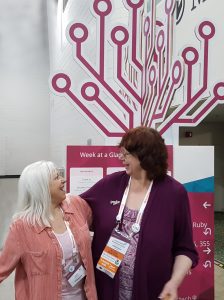
Surprise! App Reveals GFO Leaders are Fifth Cousins
Loretta Welsh and Laurel Smith, both GFO board members, discovered at Roots Tech they are fifth cousins. Chalk this up to the wonders of modern technology. GFO Library Chair Laurel Smith attended the giant RootsTech conference last week and agreed to allow the FamilySearch app Relatives Around Me to access her online tree to see if she had any shared matches who were also attending the conference. 10,000 people were there in Salt Lake City using the app. Relatives Around Me said Laurel was linked to more than 4,000 of them. When
it revealed her very closest match among those, Laurel was dumbfounded.
The app pointed her to Loretta Welsh, who has worked with Laurel at the
GFO since 2011! Both serve on the GFO Board of Directors. Now after 9 years of knowing each other, they also know they are fifth cousins. Time to cue up the It’s a Small World music!
Volunteer Opportunities – Research Assistants and Receptionists
One
of the most impressive things we do is keep a library open seven days a
week without a single paid employee. It’s a real tribute to all our
volunteers who care so much. We
need a bit more help keeping the library staffed, especially during the
upcoming Open House when expect more visitors than usual. No prior experience is needed; we will train you on the job. If you can help for half a day, once or twice a month, please contact Alice Duff, our Volunteer Coordinator at volunteer@gfo.org.
Volunteer Opportunities – Digitizing Periodicals
I’m asking for your help in digitizing GFO’s periodicals collection. There are several steps to the process (preparation, scanning, PDF processing), and one of them is probably right up your alley. Monday and Tuesday, March 9 and 10, I will be providing training for anyone who’d like to know more. Sessions are scheduled from 10:00 – 11:30 a.m. and 1:00 – 2:30 p.m. Once you know the process, you could continue helping on your schedule, anytime the library is open. Please
join the GFO library team in preserving content, making records more
accessible, and clearing space on our packed library shelves. Laurel Smith
Tip: Check Out Mountain West Digital Library
Here’s
a collection that those researching in western states should know
about. Mountain West Digital Library is a portal that links you to
digital collections in Utah, Nevada, Idaho, Montana, Hawaii, and other
parts of the U.S. West. “Other parts” includes Oregon. Here’s a sampling of the Oregon content: A selection of historical maps from the Oregon Highway Department An enormous collection of yearbooks from Oregon State University Numerous photograph collections at the University of Oregon, including: * Angelus Studio photographs, 1880s-1940s * C. L. Andrews photographs, 1880s-1948 * Charles W. Furlong (1874-1967) photographs, 1895-1965 * Lee D. Drake (1882-1957) photographs, ca. 1910-1957 * Frazier Augustus Boutelle photographs, c. 1865-1900 University
of Oregon has collections from the African Studies Program, the Center
for Asian Pacific Studies, and the Latino Roots Program as well as
personal papers, family papers, and manuscript collections.
News from the Library
New BooksA Fragile Freedom: African American Women and Emancipation in the Antebellum CityA Troublesome Commerce: The Transformation of the Interstate Slave TradeAbuse and mMurder on the Frontier: The Trials and Travels of Rebecca Hawkins, 1800-1860East Hampton: A History and GuideFreedom at Risk: The Kidnapping of Free Blacks in America, 1780-1865Front Line of Freedom: African Americans and the Forging of the Underground Railroad in the Ohio ValleyHirelings: African American workers and free labor in early MarylandIndex to West Virginia estates before 1866Speculators and Slaves: Masters, Traders, and Slaves in the Old SouthThe Bayfront Book: Coastal HistoriesThe King’s Best Highway: The Story of the Post Road from Boston to New York, the Forgotten Road That Made AmericaThe Lost: A Search for Six of Six MillionThe New England Merchants in the Seventeenth CenturyThe Price of Freedom: Slavery and Manumission in Baltimore and Early National MarylandThe Puritan Family: Religion & Domestic Relations in Seventeenth-Century New EnglandThe Ragged Road to Abolition: Slavery and Freedom in New Jersey, 1775-1865Travels in the American ColoniesWar On All Fronts: Oregonians Remember the Second World WarWayward Puritans: a Study in the Sociology of Deviance
Genealogists
know that location matters. But county lines have changed a lot. We
need to know where our ancestors were living and what that area was
called back then. This is an incredibly handy guide to solve those mysteries. Map Guide to the U.S. Federal Censuses 1790-1920 includes maps for all 50 states, displaying old county borders and names
and the newer ones that replaced them. Flip to the state you’re curious about and you’ll find your county markings instantly. William Thorndale and William Dollarhide published this 420 page book in 1987. Our copy is in mint condition.
Online copies of this book sell for $30 in fair condition. Ours is pristine. Pick up at the GFO price: $20 Ship to you price: $30 If you’d like this handy reference guide, contact booksales@gfo.org.
Survey Results:
Last
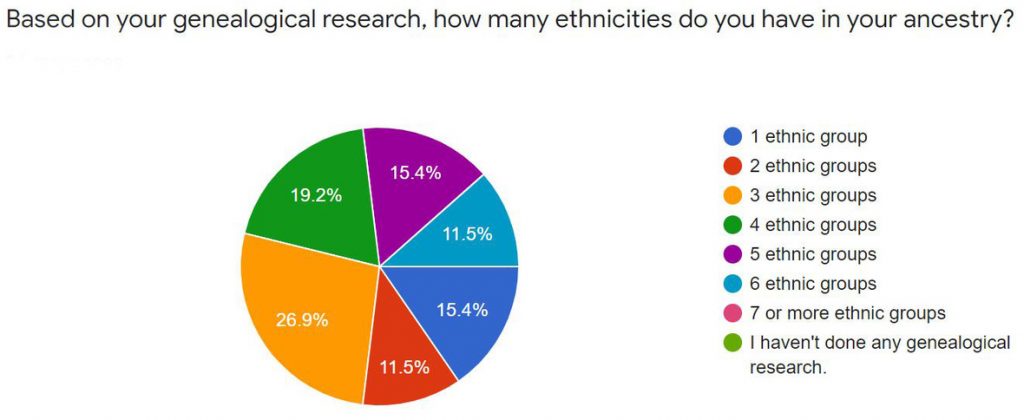
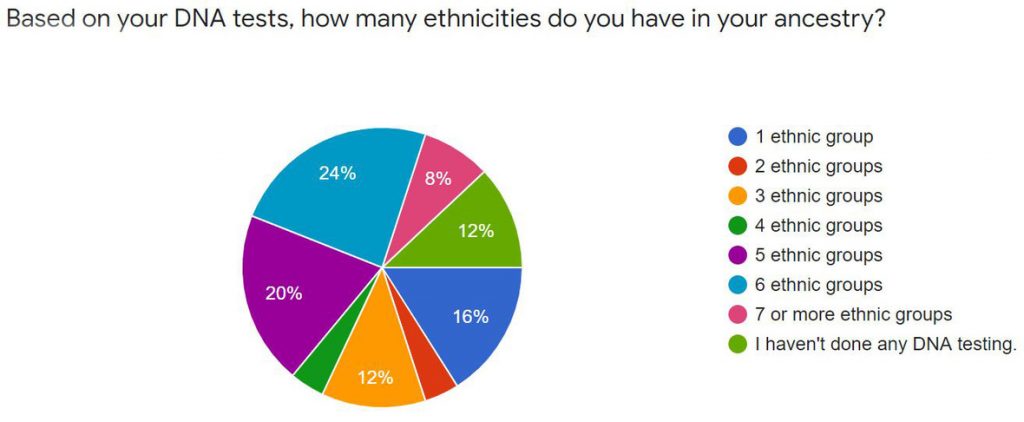
week, we asked about how many different regions of the world
respondents have been told that they are from. The answer varied
significantly from question to question:
Additionally,
we would like to apologize for using the term “ethnicity” rather than
speaking of regions of the world. Ancestry.com also uses “ethnicity” for
its test results, while 23andMe uses “origins” and FamilyTreeDNA uses
“ancestry composition.” One respondent was kind enough to point out the
inaccuracy of “ethnicity” in their response; here is that response, in
addition to some others we received: ▪ The
word Ethnicity is a social construct and not a scientific one. Too many
people mistake the DNA percentages as ethnicity when they are really
admixture, bio-geographical or regional comparisons. The public needs to
be educated on using the correct terms. I feel it is GFO’s
responsibility to do so along with it’s members. After all, what makes
one Irish or Swedish…is it because family lived there for 100 or more
years? How can you call a person who has half their family white and
half black …or even a drop of African heritage…as African American?
We need more sensitivity and just state that they have ancestors from
various REGIONS of the world. I know two people who are from England and
look VERY English, but the Y-chromosome is African. He has no features
similar to Africans, so he is considered white. Please do not use the
term ethnicity; it’s better to even say cultural groups for your survey.
Thank you. ▪ The stories were confirmed by the genealogy research and both were confirmed by the DNA testing. ▪ My
ethnicity is Western European: German, French and Scots-English. DNA
tests corroborated genealogy research and family stories. ▪ The
“ethnicities” in the DNA tests are the most useless part (even if they
are what helps sell them), so I don’t count them as anything other than
white noise or cocktail party conversation. ▪ DNA
can bring some real ethnic surprises. A very small amount of Black
showed up in my sisters, second cousins and myself. Also a bit of Jewish
and Native American where it comes from is a bit of a mystery. Our
mother’s family was from Virginia and had been slave owners. The Jewish
possibly came from dad’s Eastern European folks on his mother’s side is
my guess. Sis and I are having a good laugh over it because mom was very
adamant there was no Indian in her family and that grandpa was “black
Irish” he had a dark complexion with black hair. Also how dare anyone
think there was any thing but English and Irish in her back ground? We
think it’s a real hoot for that reason. So much for family stories. ▪ Discovering
the different ethnicities based on DNA has taken my research in a
different direction–which has led to some successful discoveries. ▪ Fascinating
to see that my ethnicity is more diverse than I’ve found or been told.
But then, I don’t have all my ancestors for the last 200 years
discovered yet! Do you? Onward …
New Survey: Must-visit Destinations
Which major libraries and archives for genealogy have you visited? And which one is on your list to visit next?
Saturday, March 7th Virginia Interest Group 10:00 a.m. – 12:00 p.m. June Ralston Anderson will join us to discuss finding Scottish ancestors and will focus on beginning research in the US with online resources such as source finding aids, repositories, and libraries. Some examples of what you may find will be shown. There will be information about why the history of the pertinent times is very important. The talk will include some key historical events centered around those leading to both emigration and immigration; the push, pull events of geographers. For those with very early immigrants, some helpful websites and sources will be shared as will some of June’s favorite resource books. If you would like more information about this group or have questions, please contact Judi Scott and Carol Surrency at virginia@gfo.org and see our blog at Virginia Roots and Vines. German Interest Group 1:00 – 3:00 p.m. Our aim is to be a source of information and inspiration for anyone with German speaking ancestors as we focus on a variety of topics related to Germanic history and migration. We also will provide time for members to share their research journeys and connect with others who may be researching the same region or time period. For questions and information, contact german@gfo.org. Sunday, March 8th Library Work Party 9:00 a.m. – noon There’s another work party at the GFO library today for those of you who can come. There’s lots to do and we’d love to have your help. Doors open at 9 and work usually wraps up around noon. Some people come for just an hour or so; others work the full time. You are welcome to do either. Any time you can share is valuable. Hope to see you there. Monday & Tuesday, March 9th & 10th Digitizing GFO’s Periodicals Training Please see the times and description above. Wednesday, March 11th Work Party – Digitizing Periodicals 11:00 a.m. – 5:30 p.m. Come and help us preserve the periodicals! We’ll be working to prepare periodicals for scanning and doing some scanning too! Some people come for just an hour or so; others work the full time. You are welcome to do either. Any time you can share is valuable. Hope to see you there. Portland Mac Users Group College 6:00 – 7:55 p.m. Topic: Get creative with Apple’s free apps: Pages, Numbers & Keynote To register: Call 503-228-1779; Email: college@pmug.org. Bring your Mac/iPad to participate with instruction. If you would like additional info for attending this class, please email us GFO Library Open Late to 8:00 p.m.
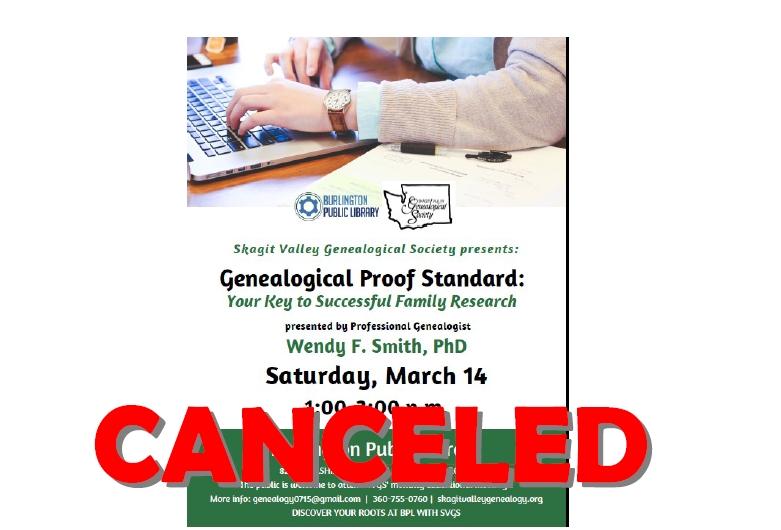
Our upcoming free genealogical event that had been set for Monday evening, March 9, 2020, in Factoria/Bellevue, has been canceled due to the concerns raised by the Corona virus locally.
In concert with best practices, we realized we should err on the side of caution and health of all our members and attendees.
Our speaker, Ron Arons, and his topic, “Sex, Lies, and Genealogical Tape” will be rescheduled to another date.
You are free to copy articles to any non-commercial web site or message board or printed publication you wish. Don’t bother to ask permission, just do it.