America at 250 Joseph Walling/Wallen

AMERICA 250 REVOLUTIONARY WAR ANCESTER JOSEPH WALLING/WALLEN

By Kathleen Weddle Sizer

Joseph Wallen, 5th great-grandfather served in the Revolutionary War in the militia of Montgomery County under Captain Harmon Cox 1777.  Montgomery County men took Oaths of Allegiance to the Commonwealth of Virginia in 1777-1779 and Joseph, John and Thomas Wallen signed the Oath in the company of Captain John Cox. The Oaths are found in the Montgomery County courthouse in Entry Book A page 104 and 106 of Fincastle and Montgomery Counties, Virginia

Wallen’s Ridge in Southwest Virginia and Wallins Creek and town of Wallins in Harlan County, Kentucky are named for the Walling brothers.  From Tennessee Cousins by W. S. Ray, page 163 “… The Indian Traders and what was called the ‘long hunters’, of course had been through the country before the Indians had consented…  Men like Daniel Boone, the Wallens … had seen the country …”

General Lord Cornwallis’ Army marched northward through the Carolinas and Colonel Patrick Ferguson, …  sent a threat to the “Over Mountain Men” if they did not cross the mountains and take the oath of allegiance to King George William Frederick III, that he would cross over “hang their leaders and lay their country to waste” and destroy “wityh fire and sword”.  Ferguson and Cornwallis underestimated these men.  Cornwallis sent Ferguson on ahead to cover his left flank while dealing in another area of battle and Ferguson set up camp on a rocky hilltop called King’s Mountain in Western South Carolina.

The militia was called into actions; 910 men answered the call as Patriots but were two days’ travel away.  Ferguson delayed moving east giving the militia time to arrive.  They left October 6, 1780 that night, marching all night and into the next morning October 7 through rain with 15 miles to go to arrive at King’s Mountain in early afternoon.  Around 3:00 o’clock the commanders of the militia immediately launched the offensive, breaking the men into units of 200 to attack from all sides, being below the ridge where Ferguson was, a difficult task.  Commanders told the men “Don’t wait for the word of commence.  Let each one of you be your own officer and do the very best you can.”  “Shout like Hell and fight like devils.”  They were described as “a race of hardy men who were familiar with the use of the horses, rifle and stout, active, patient under privation and brave”.  The battle was described later as the largest “all American Fight”; the Loyalist militia and Patriot militia being almost all Americans.

Ferguson didn’t realize that these men had endured hardship, discomfort, hard work, Indian incursions and even their woman were strong surviving in the back county for 30 years.  Many men were also Scots, Irish and German and had endured decades of persecution at the hands of English and Germanic nobility

Ferguson was killed; most of his men surrendered from a force of 1,125 to the Patriots with a force of 910 men.  Of Loyalist 668 were taken prisoner, 163 wounded and 244-290 killed; the Patriots suffered 28 killed and 58-60 wounded.  Three to survive were grandpa Joseph Walling, brother Elisha and Daniel Boone’s father John.  The battle lasted 65 minutes.  President Thomas Jefferson said “The turn of the tide of success” was the battle of King’s Mountain.”  Joseph returned to backwoods life, killed by Indians in 1792 in Kentucky.  Because of his early death, he did not receive a pension and his wife Millicent died in 1800.

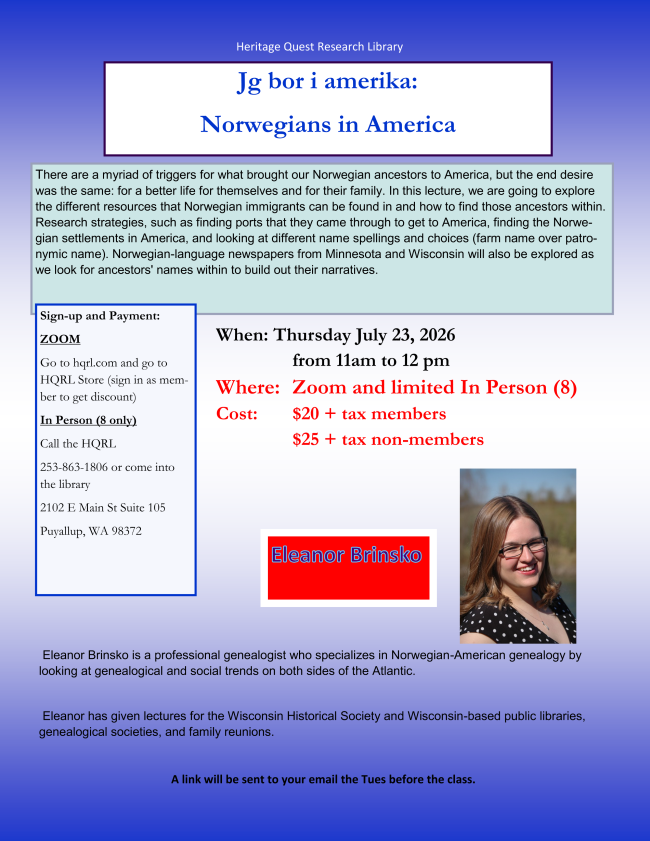
Tacoma Pierce County Genealogical Society Chat


Tacoma-Pierce County Genealogical Society Genealogy Chat
Tuesday, June 16, 2026, starting at 7:00 PM via Zoom

Please join us and let’s chat!

Discussion starter topic – open.

This is a monthly opportunity to connect with others and talk about anything and everything about genealogy.
The value of this meeting increases with the participation of each person that attends and contributes to the conversations. This is your chance to celebrate the breaking down of a brick wall in your research or ask questions of others that can help you find records or relatives. Everyone, members, and guests are welcome and encouraged to attend and participate.

Date & Time: Every month on the Third Tue, from 7:00 PM until 8:30 PM Pacific Time

Please download and import the following iCalendar (.ics) files to your calendar system.

Monthly: https://us02web.zoom.us/meeting/tZMldOCprTsqGtSoVglOBTElUaBRgTq5IEgI/ics?icsToken=98tyKuGvpjgjG9eVsBmHRpwEGojCXevztmJfjbdukyniDw9xVib6A-NgALVLAY35

Join Zoom Meeting:
https://us02web.zoom.us/j/87839130000?pwd=dGdHY2wrZ0d1bDNRTEQ4Uk15OVk0Zz09
Meeting ID: 878 3913 0000
Passcode: 836216

One tap mobile:
+12532050468,,87839130000#,,,,*836216# US
+12532158782,,87839130000#,,,,*836216# US (Tacoma)

Dial by your location:
        +1 253 205 0468 US
        +1 253 215 8782 US (Tacoma)
Meeting ID: 878 3913 0000
Passcode: 836216

ind your local number: https://us02web.zoom.us/u/kdesX0el3t

America at 250 John Morton Signer of the Declaration of Independence

John Morton, Signer of the Declaration of Independence

By Margie Wilson, descendant

Skagit Valley Genealogical Society member

A common misconception that many people have is that all of the colonists were of British descent. But, in the Delaware/Pennsylvania area in the mid-1600s there was a small colony formed called “New Sweden.” These colonists were of Finnish descent but ruled by Sweden at the time, so considered “Swedish.”

Thus, in 1654, my Finnish immigrant ancestor, Mӧrten Mӧrtensen, from Rautalampi, Finland, arrived on the shores of Delaware as part of Sweden’s interests in founding a colony in the New World.

Mӧrten Mӧrtensen’s (many spelling variations of his first and last named recorded) original log cabin still stands today, protected by the National Park Service, located just south of the Philadelphia airport. In fact, it was the Finns who brought the log cabin architecture to America.

Mӧrten Mӧrtensen’s great-grandson, John Morton, was a surveyor, farmer, self-taught lawyer, and well respected in the community of Ridley Park, Pennsylvania. John Morton’s political career spanned being elected county sheriff, a justice of the Supreme Court of Pennsylvania, and elected to the 1st Continental Congress.

John Morton was opposed to war with Britain. Instead, he tried to convince King George III that the many grievances the American colonists had against the British governing of the colonies, could perhaps be listened to and reconciled by some alterative to all out war between the colonies and Great Britain. To John’s disappointment, King George III never responded to any of his many letters of appeal to avoid a military conflict.

On that fateful day, July 2, 1776, at the meeting of the Continental Congress in Philadelphia, the delegates gathered to vote, for or against, breaking away from British rule. The history of that decision reflects the immense pressure that must have been felt by the delegates assembled. Their vote would declare war with the greatest military power in existence at that time.

When it was Continental Congress delegate, John Morton’s time to vote, he could no longer hope for reconciliation between the colonists and the king. All the colonies had voted. The vote was tied yes for independence, or no, to continue under the abuses of King George III. Since delegate Morton had been so intend on avoiding war, when it was now his turn to vote, his fellow delegates were uncertain as to how he will vote.

My ancestor, John Morton of Pennsylvania, cast the deciding vote for independence from British rule. He was the 17th signer of the Declaration of Independence as a delegate for Pennsylvania, along with James Wilson and Benjamin Franklin, also from Pennsylvania.

Sadly, not much is told about John Morton and his courageous decision for independence. John Morton’s distinction became that “he was the first signer to die.” John died in April 1777. In biographies of that time, he is said to have died of “brain fever.” But many believe it was the intense stress and the fallout from his July 2nd, 1776 decision that led to his early death at age 53. Respected by his community for his integrity and years of service as a lawyer and justice of the Supreme Court. After John Morton’s July 2nd, 1776 vote, that swung the decision to split from British rule, his neighbors and even friends turned against him. This reversal of support and affection from his neighbors deeply concerned him. Remember that most of his neighbors were Finnish descendants but also Quakers, who held pacifism as their beliefs. So, a declaration of war with Britain, their former homeland turned them away from their friendship with John Morton.

Because John Morton died in 1777 his signature does not appear on the United States Constitution, like so many of his fellow signers of the Declaration of Independence lived to sign.

My direct ancestral connection to John Morton is through his eldest daughter Mary Morton. Mary married yet another Finnish immigrant family named Justus. (Mary Morton married Charles Justus, later spelled Justis (no “c”). The generations of Justis family descendants stayed mainly in the eastern Pennsylvania region, focused in Philadelphia as well as Lancaster County.

From the Philadelphia Daily News (Philadelphia, Pennsylvania) Saturday July 5, 1969 page 5

The American Miracle Special Film Celebrating America’s 250th Anniversary

I apologize for the short notice on this movie event.  The attached flier is pretty self-explanatory however I’ll include a few comments.  The movie “The American Miracle” will be presented on June 14, 2026 by:

Sponsors:

The Seattle Chapter of the Sons of the American Revolutions, and

The Rainier Chapter of the Daughters of the American Revolution

Along with the movie, author and nationally syndicated commentator Michael Medved with the movie’s executive producer Ralf Augstroze will introduce the movie and provide perspective on its meaning and the making of the movie.

Before and after the movie guest will be able to tour the Rainier Chapter House, a replica of George Washington’s beloved Mount Vernon home, that was built in 1925 by the Daughters of the American Revolution.  Historical artifacts and an extensive flag exhibit will be on display along with a number of displays by the SAR, DAR, CAR, and Girl Scout. 

Location:

DAR Rainier Chapter House

800 E Roy Street, Seattle, Washington

Time:

The Rainier House will open at 1:00, movie introduction at 2:15, and movie at 3:00.  

Tickets:

Admission is free but please sign in for the event at Eventbrite by clicking here or use the QR code shown at the attached flier.

Concessions will be available for sale.

Let’s Talk About: WikiTree & Geni

I heard a respected genealogy expert (Arlene Eakle) once say that you could and should check 50 sources to fully document any one family group. Bet we’ve not been doing that, right?

Two places we might look are places were family trees are posted and genealogists collaborate. WikiTree has been around since 2009, currently (as of March 2026) has 1,326,162 community members with 44,622,928 ancestors on trees. Geni offers 208,319,099 profiles connected in its trees. 

Both websites are free so why not check them out?

Wikitree Strong Points: strong focus on accuracy and sourcing; collaborative environment, free access and helpful community.  Potential Weaknesses:  relies on user input; potential for inaccuracies and unsourced claims, not a record repository and can be clunky and unintuitive.

Geni Strong Points:  collaborative world family tree; curator program, DNA features, GEDCOM support. Limitations: reliance on user-generated content; lack of internal record database and does offer subscription for premium features.

Recommendations: always verify information; focus on well-sourced profiles, consult original sources whenever possible, don’t rely on any one tree for all your information; use these collaborative websites as starting points not definitive sources; always cite your sources. 

Michele Norton Mattoon Named One of WSGS’s Outstanding Volunteers in 2025

Since 2003, the Washington State Genealogical Society has recognized over 600 outstanding volunteers and teams, nominated by their local society or genealogical organization for their service and dedication. These volunteers are the backbone of their local society, giving their time and expertise, to the organization and the field of genealogy. In the coming months, you will be introduced to each of the 2025 award recipients and learn why they received they received a WSGS Outstanding Volunteer and Team Award.

Today we’re introducing Michele Norton Mattoon of Seattle, Washington who was selected by the South King County Genealogical Society as its recipient of a WSGS Outstanding Volunteer Award.

Michele has been treasurer of SKCGS for several years, performing all the duties of the office very efficiently.  In addition, she has taken on side projects of sorting and cataloging newspaper obituary clippings and digitizing miscellaneous society records. These are projects she has quietly completed for the posterity of the society.

Michele’s dedication behind the scenes is greatly appreciated by the society.

For more information on the WSGS Outstanding Volunteer Award program, visit the Recognition page of the WSGS website or contact Info@wasgs.org. Please type “Volunteer Award” in the subject line.

Let’s Talk About: Money Laundering

No, not the illegal process of making large amounts of money generated by criminal activity. I’m talking about with-soap-and-water WASHING money. No, not in a wringer washing machine.

Spotting this tidbit in the March 19, 1910 issue of the Colville Examiner, I just had to share it with you:  “Representative Wiley of New Jersey has a bill before Congress providing that all paper money which reaches the treasury be burned and new clean currency furnished in lieu of it. In support of this measure he had a current $1 bill microscopically examined and the report on its condition laid before the house committee on banking and currency. The bill in question had on it 92,000 germs of different diseases and paper money generally has been found to carry germs of smallpox, scarlet fever, typhoid, tuberculosis and diphtheria. Desiring to aid in this crusade against diseased paper money, the Examiner hereby announces that anyone having dirty paper money in their possession may bring it to this office and receive in exchange a clean paper every week in the year. An editor takes so many chances in this world that a few million germs more will not make any great difference. It’s the absence of these money germs that makes trouble for us.”

This is a hoot!  I think the newspaper is saying “Baloney!” to the idea of “dirty money” and just telling folks to come in and subscribe to the paper……… bring your money to this office and exchange it for a clean paper every week????  Too funny. 

What is really too funny is that Spokane’s historic Davenport Hotel, during this same time period, offered the service to its guests of washing their coins and pressing their currency as part of a high-end service idea. Supposedly this added to the prestige of the hotel. 

Stillaquamish Valley Genealogical Society Navigating the Seven C’s of Genealogy

Stillaquamish Valley Genealogical Society

Monthly Business Meeting & Presentation

Navigating the Seven C’s of Genealogy

Tuesday, June 9th

1:00 pm

SVGS Library

6111 188 PL NE, Arlington, WA

This month we will be watching another great pre-recorded webinar at the SVGS Library presented by Thomas MacEntee.

Thomas’s topic: Navigating the Seven C’s of Genealogy

Do genealogy “resolutions” really work? How about setting genealogy “goals” or “themes” instead? Thomas has developed list of seven “themes” to guide you this year and hopefully you can institute these as general “rules to do genealogy by” over the next few years. The themes cover most areas of concern for every family historian, whether you’ve been at this for some time or you are just getting started. Participants will learn how to focus on seven key areas of genealogy research: Clean, Collect, Curate, Create, Connect, Conserve and Continue.

Bio: 

Thomas MacEntee is a Baby Boomer guy with a love of punk rock music but also art history who somehow “fell” into the technology industry almost 40 years ago and then left a lucrative IT career to pursue his love of family history and genealogy. Technology and historical research are opposites, but “tech people” like Thomas are needed to guide today’s genealogists through the maze of options so they can deploy the best apps and devices to break down research brick walls. Thomas MacEntee: author, educator, advocate, entrepreneur, and that “genealogy guy” who helps you accomplish your family history goals.

There will be a short break with refreshments after the presentation followed by our monthly business meeting.

Seattle Genealogical Society Tip of the Week Finding Women in Your Family Tree

TIP OF THE WEEK — FIND THE WOMEN IN YOUR FAMILY TREE

Find the names of female ancestors in the ledger in their local general store. Purchases by the family are listed by household account numbers in a day book which often mentions the various family members. There is usually a corresponding account book with additional information.