Seattle Genealogical Society Tip of the Week

TIP OF THE WEEK – WORLDCAT

Suppose you just learned about a book on a subject or a family that you were researching, a book that you had not heard of before?  Wouldn’t it be great if there was a quick & easy way to find the library closest to you that had that book?!

Well, there is.  It’s called WorldCat and it’s the world’s largest library catalog, literally a global catalog of library collections.

On this website, https://www.worldcat.org/, you can enter the title or the author of the book to find a list of libraries that hold that book.  By entering your zip code, you can quickly determine whether a nearby library has that book.  Seattle Public Library, the King County Library System, the University of Washington libraries and the Fiske Genealogical Library are all participants in WorldCat.  (The SGS Library is not at this time because the costs have been deemed too great.)

If no nearby library has the book, you can still obtain information from a library that does have it, via interlibrary loan, or by requesting photocopies of relevant pages. WorldCat can also be used to search for all books on a given topic or subject, thereby discovering books that you didn’t know about before
Seattle Genealogical Society Tip of the Week

TIP OF THE WEEK – Puget Sound Genealogical Society’s Obituary Records Project

Check out Puget Sound Genealogical Society’s Obituary Collection Index file on-line.  PSGS entered into a partnership with the Kitsap Regional Library and has indexed over 40,000 obituaries dated from 1891 through August 31, 2012.

You can request a search and mailing of obituaries that they may have on file. Response is fast.  It’s free; however, they are always happy to receive a donation for this valuable service.

You can access their Obituary Index File & the Obituary Research Request Form at : http://www.pusogensoc.org/obituaryprojectcommittee.html

Seattle Genealogical Society Tip of the Week

TIP OF THE WEEK  –  Bring Back the Interactive Map
Have you ever used the Newberry Library website “Atlas of Historical County Boundaries” page?

Renowned as the easiest, most complete site to track county boundaries, it has maps, text and tools to view historical county configurations against the modern county network.

The Legal Genealogist, Judy Russell, has an informative article about this interactive map at :
http://www.legalgenealogist.com/blog/2015/07/21/dear-newberry/?utm_source=feedburner&utm_medium=email&utm_campaign=Feed%3A+T

Unfortunately at this moment, as you read, the interactive map portion of this site is “temporarily unavailable”. Please take the time to add your email address to the list of those that need to be notified “when this functionality has been restored”.  Let the Newberry Library folks know this interactive map is useful and important to you.

TIP OF THE WEEK  –  Update

Remember “U.S., Index to Alien Case Files, 1940-2003” from last issue’s “Tip of the Week”?  It is not only available at Ancestry.com as reported, but it is also available via FamilySearch.org.  Check out:  https://familysearch.org/search/collection/2540918

Seattle Genealogical Society Tip of the Week

TIP OF THE WEEK – INDEX TO U.S. ALIEN CASE FILES, 1944-2003

Are you researching an ancestor who immigrated to the U.S. prior to World War II, was alive during the war, but was not a naturalized citizen before the start of the war? Such individuals were required to register as an alien so seek out their “Alien File” aka “A-File”.  It will contain valuable genealogical information, including birthplace and birth date, maybe even a physical description and fingerprints.

Obtaining these documents can be a bit tedious.  They are held by the National Archives and there is no on-line ordering system.  You will have to write, call or fax in order to get the documents.  However, if you have an Ancestry.com account, you can search the database “U.S., Index to Alien Case Files at the National Archives at Kansas City, 1944-2003” to determine if an Alien File exists for the ancestor you are researching.

If you don’t have an Ancestry.com subscription, stop by the SGS Library and use Ancestry at the library.

Do You Have An Emergency Preparedness Plan?

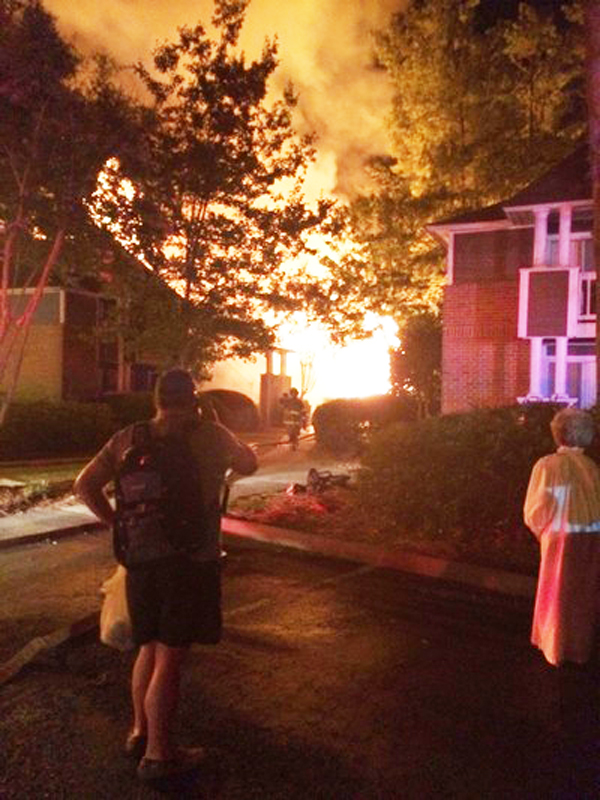
My husband works in Aiken, South Carolina and has maintained a temporary office and apartment there for three years. Recently the apartment building he was staying in was completely destroyed by fire. He had no idea that when he crossed the threshold at midnight he would be the last person to ever pass through that door. Since he was sleeping at the time the fire broke out he was very lucky to escape with the shirt on his back, his smartphone, and his laptop.

DaveFireAikenStandard


Continue reading

Washington Remembers World War II Special Exhibit

Join us for an exhibit opening!

August 20, 2015 | Office of the Secretary of State | Olympia 3-5pm

The Secretary of State cordially invites you to the opening of Washington Remembers World War II—a special exhibit marking the 70th anniversary of the conflict’s end.

At an event honoring survivors  of the war, hear from one of the first black Marines since the Revolution who served his country in a prejudiced America. Meet a Holocaust survivor from Poland who hid in a barn loft to escape the death camps, and  a veteran of the Battle of the Bulge whose letters home detailed the grueling day-to-day life of a soldier.

Join Secretary of State Kim Wyman on August 20 at the Capitol Building on the 2nd floor in the Secretary of State’s Office.  The program starts at 3pm. Reception to follow. To RSVP or for more information: info@sos.wa.gov or (360) 902-4171.

Physical Address:
416 Sid Snyder Avenue SW, Room 250
Olympia, WA 98501

For parking information please see the Capitol Campus parking map.

Check out our Faces of Heroes. | Read the stories of our veterans. | Support Legacy Washington.

Seattle Genealogical Society Tip of the Week

Seattle

 TIP OF THE WEEK – NEW SOCIAL SECURITY INDEX ON ANCESTRY.COM

People just starting their genealogy research, and who know little about their parents or grandparents, are told that if their ancestor was alive after the Social Security system was established in 1935, they should get that person’s Social Security application.  The application should list the person’s parents’ names as well as the person’s place of birth. Since this application was completed by the individual, it should be more accurate than other sources. But ordering these applications can be expensive and time consuming.

Ancestry now has a new database called “U.S., Social Security Applications and Claims Index, 1936-2007”.  The difference between this database and the old Social Security Death Index is that the new database reports the individual’s place of birth and both parents’ names, which is what one wants from the SSN application in the first place.

Of course keep in mind, you won’t find your ancestor in this index if they died before the Social Security Act of 1935 or if they never applied for Social Security.

If you don’t have a subscription to Ancestry, visit the SGS library and use our computers, or try your local community library.

Dwight Radford & All Things Irish Research

I have been privileged to have known and to have worked with Dwight Radford for about 20 years. I know him to be a thoroughly competent professional researcher in all areas of Irish research. He recently put up his website… if you have Irish research needs, you could do no better than to contact Dwight.      Donna

Dwight Radford is a full time professional genealogist residing in the Salt Lake City area. His interests lie in Ireland and Ireland immigration research problems. He has a blog site and a facebook page: www.thejourneyhomegenealogy. Another interest of his is researching the intermixing of the Irish immigrants with the local populations of all races where ever they settled.

Dwight is the co-author of A Genealogist’s Guide to Discovering Your Irish Ancestors (Betterway Books: Cincinnati, Ohio, 2001, 2012) and was co-editor of the journal The Irish at Home and Abroad (1993-1999).  He has published many Irish-related articles in North American genealogical journals.

He will be speaking on “Researching Your Irish Ancestors” on August 11th at the Ohio History Connection in Columbus:
www.ohiohistory.org/learn/archives-library/archiveslibrary-services/genealogy-workshops

Dwight recently completed a video, on his website, describing Irish research and its quirks. This was accomplished with the help of participants of the Salt Lake Christmas Tour and participants of the Kelowna &  District Genealogy Society in British Columbia.

Dwight has been to Ireland and Northern Ireland many times to work in the archives and to document the ancestral home sites for clients.

He can be reached at dwightradford@msn.com

Tip of the Week

At the recent WSGS conference David Rencher said that Family Search was adding about a million new names, and I can not remember if that was a day or a week, but still it is a lot of new names to research, and to come back often to see if the name you are researching is there now. He also said he gets reports telling him what new data is being added, but how does the average genealogist find out what is being added? The answer is blogs! I know several of the blogs I read using Feedly list the updated list almost weekly. I will just list three here, the first one is a Washington resident Leland Meitzler in his GenaelogyBlog . The second is Randy Seaver with his GeneaMusings Blog. Randy also lists the new or updated lists on Ancestry. The last one is Renee Zamora, and she lists a lot of happenings at Family Search, like the call for 100,000 volunteers to index records  or to beta test the new Family Search Home Page