David Smith Goes to War
Larry Turner
David Smith was said to have been born in Ireland in 1740. He came to America at some time and appeared in Farmington, Hartford county, Connecticut where he married Lydia Orvis Hawley, a young widow of Benjamin Hawley, in January, 1775.1, 2
Two years later, shortly after his first son, Chauncey was born, David enlisted in the Continental army on March 1, 1777.3 At that time there was a significant effort to recruit new volunteers for the army; a number of others were recruited from Farmington around the same time. It appears as if he entered as a corporal, which would not be too surprising for an older volunteer when a new company is being established. He was recruited into Col. Samuel Wyllys’ 3rd Connecticut Regiment in Capt. William Judd’s Company. The third regiment was organized between January and April, 1777 and was composed of 8 companies from Windham and Hartford Counties.
The 3rd regiment was initially assigned on April 3 to the 1st Connecticut Brigade, an element of the Highlands Department.4
The Brigade had two primary tasks: to protect the Hudson Highlands, and to deter British troops occupying New York City from joining up with other British forces, specifically British General Burgoyne’s army which had just captured the supposedly impregnable Fort Ticonderoga and was headed south towards Albany. The Brigade was reassigned to the main army for a few weeks in mid-summer, 1777, when British General Howe and General Washington were maneuvering for position in northern New Jersey, and Washington was concerned about defending Philadelphia.5 Then the Connecticut Brigade was returned to the Highlands Department until July 1778. Most of David’s time in the war was spent in the Highlands (see map), an area where the Appalachian Mountains cross the Hudson River. Because the military records do not indicate David’s whereabouts from in March, 1777 until summer 1778, the only way to determine where he is, is to track his regiment under General Putnam.
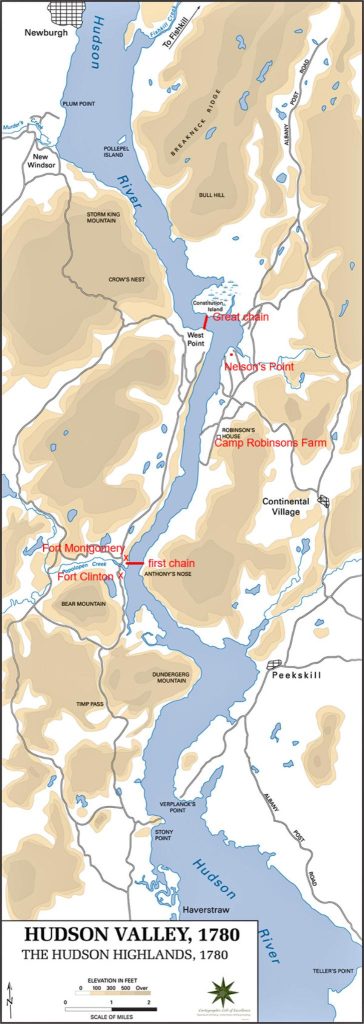
The aptly named Highlands Department’s role was primarily to protect the New York Highlands, especially the Hudson River. If the British could penetrate up the River and connect with Fort Ticonderoga which General Burgoyne had just captured, Lake Champlain and Canada , they could split the colonies in two, separating New England from the other colonies. Barely a month after the war started at Lexington and Concord on May 25, 1775, the Continental Congress authorized the placement of chains across the Hudson River to deter British ships and protect the Highlands.
During 1776 and 1777 several chains and wooden spike blockages were placed upstream from Peekskill. To protect the chains, the Continental Congress also authorized the construction of Fort Montgomery, which was built by the Army in 1776. Another fort, Fort Clinton, was built nearby on higher ground.
David’s regiment was part of General Israel Putnam’s command and was stationed nearby at Peekskill. British General Sir Henry Clinton, who commanded the occupation troops in New York City, moved a contingent of them in the direction of Saratoga where General Burgoyne was having difficulties. Clinton made a feint that completely fooled Gen. Putnam, who went back into the Highlands where he thought the British were. Then on October 6, 1777, Sir Henry moved in, captured the two forts, and dismantled the chain.6 David almost certainly was in the fooled force and apparently avoided any battle at this time. The British were able to keep the river open and raided as far upstream as Kingston, NY, a distance of about 50 miles north from the lost forts.
In spring, 1778, the very heavy “Great Chain” was stretched across the Hudson at West Point, being supported by huge, floating logs. Each link was 2 feet long and weighed 114 lb. The chain could be adjusted for tides and currents by means of ropes, pulleys, and other devices. It was removed in winter and reinstalled each spring, remaining in place until 1783. The British never tried to “run” the Great Chain.
In June, 1778, General Clinton, now in charge of all British Forces,7 withdrew from Philadelphia, fearing a blockade by French Ships. Because the French officially entered the fray in March8, and because Britain had to divert resources, Clinton could accomplish essentially nothing in the north. He needed his major forces in the mid-Atlantic and South. So the Highlands troops faced no major difficulties. British raiders attacked with some frequency along the coast and inland New England, but these were relatively small events handled usually by militia and local troops rather than bringing in the Continental Army.
In the summer of 1778, David’s unit spent most of its time in the White Plains area, although he had a 15 day furlough in August. By early December, his brigade was at Camp Redding, near Danbury, CT, where it could not only spend the winter, but also could guard a major supply depot at Danbury. Although David missed the opportunity to be at Valley Forge in the very difficult winter of 1777-78, the winter of 1778-79 at Camp Redding, CT was said to be more severe than Valley Forge, although on a smaller scale.9
David arrived at Camp Redding in mid-November. In December, he was reported as sick since Nov 22, 1778. In January, he was reported “Lame at Hartford Hosp since Dec 10, 1778″, but he was back with his company in February, 1779. While he was apparently gone, there was an uprising by the soldiers regarding the lack of adequate food and clothing, along with pay in low value continental dollars. When a group of soldiers started off to Hartford “to air their complaints”, they were intercepted by Maj. Gen. Putnam, who with a stirring speech persuaded the men to return. One unrepentant ringleader was jailed, and then shot dead when he tried to escape. The site was known as “Connecticut’s Valley Forge”.
In May, David’s unit moved to Camp Highlands of New York, then to Camp Nelson’s Point across the river from West Point in June. He spent July, August and September at Camp Robinson’s Farm, a little further downstream near Garrison, NY.10 As typical, the unit largely powered down for the winter. David’s location is unspecified but he is on the rolls until January 22, 1780 when he is discharged by paying Benjamin Perry to replace him.11 He received $32.60 from the paymaster for back pay and for returned clothing.
Fighting in the north was nearly done for the war. David’s captain, William Judd, spent from January 1780 until at least June “on command at home”, or “at Hartford”. In August, he was across the Hudson from White Plains at Orangetown, NY, but then was furloughed from October through the end of the year. Clearly, David would not have faced much fighting if he had stayed in. So, why did he pay someone to cut short fairly easy duty; after all, he was a corporal and would not have the worst of military chores like a private. Maybe it was something at home. That will warrant further investigation.
From January 1780 until April 1782, David was a civilian and presumably in Farmington. In May 1782, he joined the army again for a period of 3 years. A little perspective is necessary here. The “turning point of the war”, in retrospect a few months later, was considered to be the defeat of General Burgoyne and capture of his army at Saratoga in October, 1777.12 Also important to the Highlands, that defeat severely diminished pressure from the north, which combined with limits on British resources resulted in little activity north of New York city, other than British raiding. After a few battles in the mid-Atlantic area in 1779, the British focused on the “Southern Campaign”, while still maintaining control of New York City. Then the surrender of Cornwallis at Yorktown occurred in October, 1781, effectively ending the war. The British House of Commons voted to end the war in April, 1782, and a preliminary peace agreement was reached in November, 1982.
So, rejoining the army in May of 1782 did not seem very risky for David, but we do not know why he did it. He entered as a private in the 5th Continental Regiment of foot commanded by Lt. Col. Sherman in the 3rd company captained by Nehemiah Rice. In November 1782, he transferred into the 2nd Connecticut Regiment commanded by Col. Heman Swift, serving in Capt Elijah Chapman’s “Light Infantry Company”. His previous unit, the 5th Connecticut was disbanded at the end of the year.
It doesn’t look like David, or anyone else, was seeing any action, but he stayed in nearly to the end. He was on furlough in December 1782 and January 1783.13 In March he was transferred into Capt. Thaddeus Weed’s company. He was present on muster rolls until it was reported that he deserted July 20, 1783; but he “joined from desertion” before Aug 13. This is the last muster card I could find for him. The use of the term desertion seems strange; perhaps it is more like what is currently called AWOL, absent without official leave. Perhaps he had something to do in Farmington. But it also seems strange because the army is disbanding at this time; five regiments were collapsed into three, then one regiment The Connecticut Line was completely disbanded on November 15, 1783. David was already home.
Larry Turner, Feb 21,2021, file Genealogy\Smith\David et al\David Smith War Narrative
1 Descendants of David Smith by Eben C. Farley, Los Gatos, CA 1902 (from DAR Library, printed brochure; no publication information; used to support DAR membership).
2 This narrative includes very little beyond David’s military service. There is much else that will be the subject of a future narrative.
3 All military information comes from muster cards and similar military records obtained from Fold3. There were no muster cards or other Fold3 records for David from his enlistment in March, 1777 until June, 1778. There are also no records for his captain, William Judd or his sergeant, Asa Chapman during that same period; however, there are cards for Captain Judd in 1776, suggesting that the company records for the 1777-early 78 period were lost.
4 A “Department” is composed of 2 or more Brigades, each of which have 3 or more Regiments. A Regiment at full strength will have 8-10 companies each having up to 90 men.
5 Information on the army composition, movement, and battles was derived from a variety of on-line sources. These recommended websites and Wikipedia are considered generally reliable, but they were not always in complete agreement, mostly about details not relevant to David’s service. I have included some of my own thoughts also. While the surrounding history may have some embellishments, all individual information is based factually as determined from the military records.
6 Both forts were destroyed; the modest number of American defenders took significant casualties. General Washington had a new fort built to the north at West Point; the fort that Benedict Arnold tried to give to the British in September, 1780. Sir Henry, having provided General Burgoyne the diversion he thought Burgoyne wanted (actually, Burgoyne wanted the troops to come fight with him), returned his troops to New York City. As a side note, Forts Clinton and Montgomery were defended by brother generals George and James Clinton, after one of whom the fort was named; George also had just been appointed governor of New York. With Gen. Henry Clinton (no known relationship) leading the British, the event was often called the “Battle of the Clintons”.
7 His predecessor, British General Howe had resigned and returned to Britain.
8 The French had long helped the American cause in many ways. But when the French provoked Britain into declaring War against France, it was on a worldwide basis. Britain then had to contend and defend well beyond the 13 colonies. Men and resources in America became a serious difficulty for the British.
9 Private Yankee Doodle; A Narrative of Some of the Adventure, Dangers and Sufferings of a Revolutionary Soldier – Joseph Plumb Martin, edited by George F. Scheer; The New York Times & Arno Press, 1962
00 Camp Robinson’s Farm was one of the largest camps of the Revolution with troops mostly from CT and MA. Benedict Arnold was headquartered at the Robinson House prior to his committing treason.
11 Private Perry began his duty by going on leave for two weeks in February, and then deserted April 1. Not a good bargain for the army. (Perry previously served a six month enlistment from August, 1779 until January 15, 1780, 7 days before David’s discharge.)
22 France officially entered the war in March, 1788, when they provoked Britain into declaring war by recognizing the United States. The decision for France to recognize the United States was greatly influenced by the American victory at Saratoga; thus the “turning point”.
33 Location was not noted on any of his muster cards, nor those of his captains, for his entire second enlistment. We also do not know where he enlisted or where he was discharged.