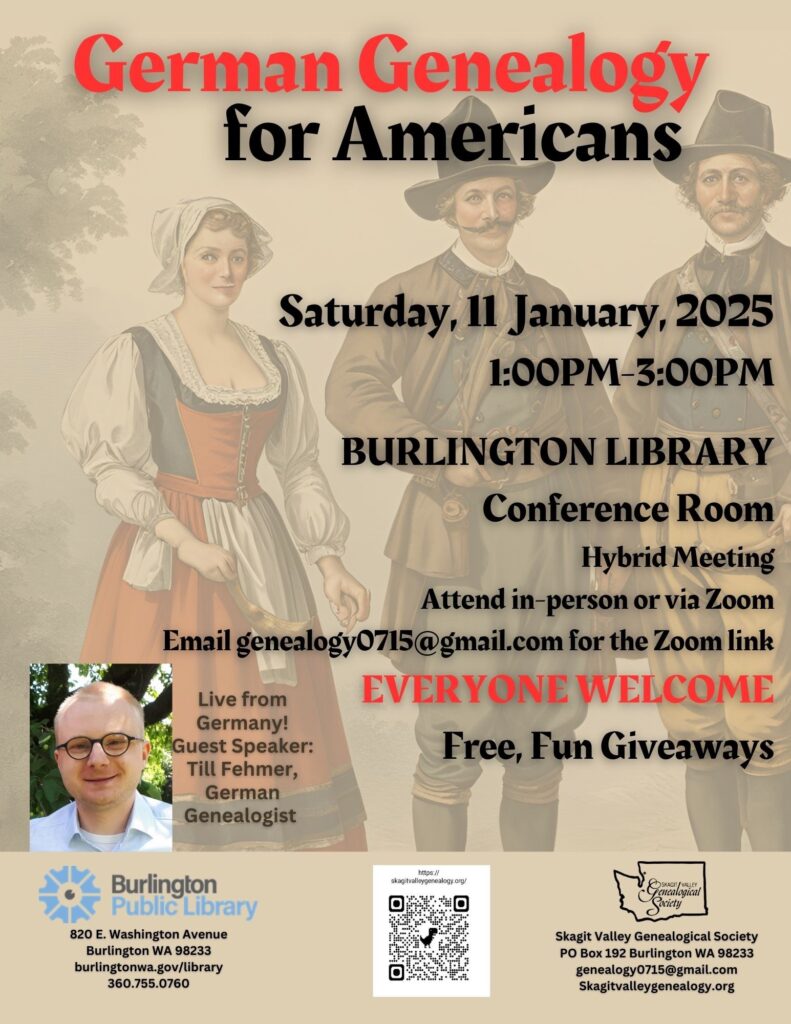
Skagit Valley Genealogical Society German Genealogy for Americans

Likely when you think of “Spokane River bridges” your mind jumps to the iconic Monroe Street Bridge, first built in 1911.
But would you have guessed there are nearly 40 bridges spanning a river only 111 miles long? Originating in Lake Coeur d’Alene, the river meanders through the Spokane Valley to empty into the Columbia River. Those are current bridges and don’t count the many that were built and then washed away.
It had been long realized and known that a bridge was needed to cross the Spokane River in the downtown area. Between 1890 and 1896 several bridges were constructed but all fell prey to The River. Finally in 1902, realizing that timber for such a bridge would not do, the bridge pretty much as we see it today was completed and dedicated on 21 Nov 1911 at a cost of $477,682.67. (SUCH precise accounting!)
The biggest problem facing construction of the Monroe Street Bridge was the south side where after the great fire of 1889 tons of the ash and debris were pushed over and deposited there…. making for a very unstable bridge footing. The ash and debris was dumped atop a small stream which continued to flow and be a continual problem.
On May 4, 1892, Miss Mary Winitch gained fame by becoming the first pedestrian of record to cross the bridge. (I did several minutes of research on Miss Mary but found nothing.)
QUESTION: How many times would you guess you have walked over….. or driven over….. the Monroe Street Bridge?
SOURCE: The Pacific Northwesterner, Vol. 28k Winter 1984, article by Byron Barber.
WSGS members are encouraged to cast their ballot for Vice President and Treasurer by 11:59 p.m., 15 Dec 2024. An email with a Google Forms link was sent on 08 Dec. to your email of record. If you did not receive the email, please email Info@wasgs.org.
Even though LeAnne Koliha and Frank McLean are running unopposed (Vice President and Treasurer respectively), we view your vote as a vote of support for WSGS. There is also an opportunity in the ballot to make suggestions or ideas to support the society. We are reading every comment.
If you want to know more about LeAnne or Frank, read this blog post.
Thank You for your support and looking forward to a great New Year in ancestor hunting!
Please refer to our blog page for program schedules and latest society news.
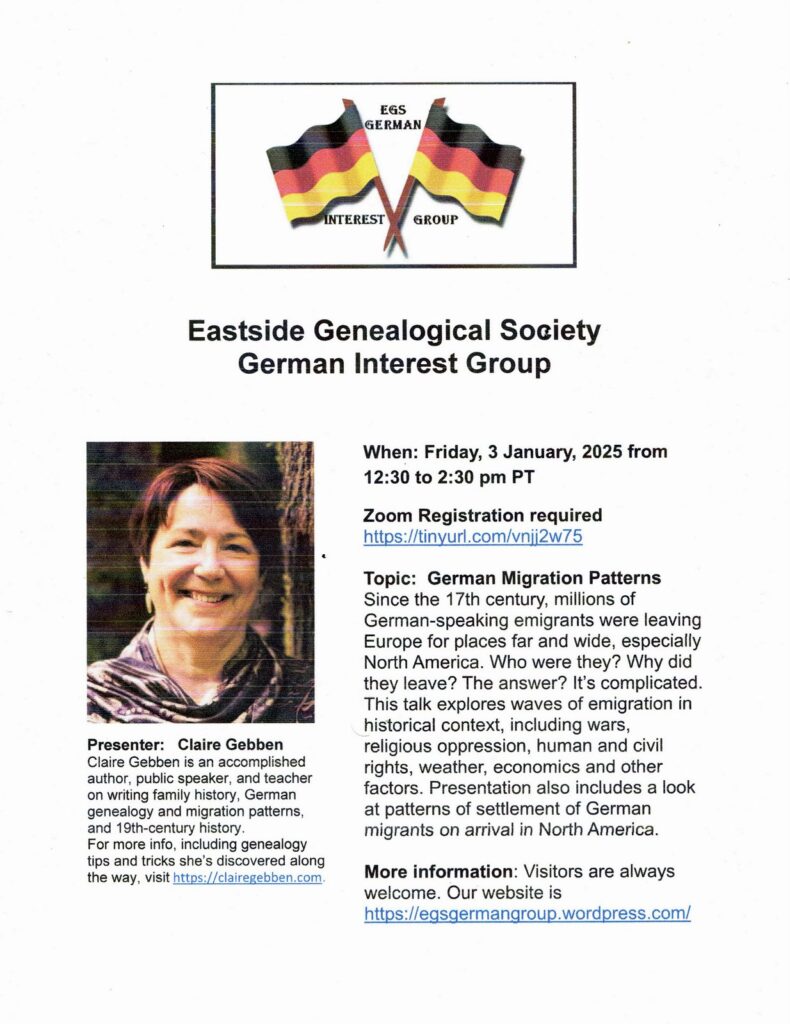
Zoom Registration required: https://tinyurl.com/vnjj2w75
More information: Visitors are always welcome. Our website is https://egsgermangroup.wordpress.com/

Tacoma-Pierce County Genealogical Society Genealogy Chat
Tuesday, December 17, 2024, starting at 7:00 PM via Zoom
Please join us and let’s chat!
This is a monthly opportunity to connect with others and talk about anything and everything genealogical. The value of this meeting increases with the participation of each person that attends and contributes to the conversations. This is your chance to celebrate the breaking down of a brick wall in your research or ask questions of others that can help you find records or relatives. Everyone, members, and guests are welcome and encouraged to attend and participate.
Date & Time: Every month on the Third Tue, from 7:00 PM until 8:30 PM Pacific Time
Please download and import the following iCalendar (.ics) files to your calendar system.
Monthly: https://us02web.zoom.us/meeting/tZMldOCprTsqGtSoVglOBTElUaBRgTq5IEgI/ics?icsToken=98tyKuGvpjgjG9eVsBmHRpwEGojCXevztmJfjbdukyniDw9xVib6A-NgALVLAY35
Join Zoom Meeting:
https://us02web.zoom.us/j/87839130000?pwd=dGdHY2wrZ0d1bDNRTEQ4Uk15OVk0Zz09
Meeting ID: 878 3913 0000
Passcode: 836216
One tap mobile:
+12532050468,,87839130000#,,,,*836216# US
+12532158782,,87839130000#,,,,*836216# US (Tacoma)
Dial by your location:
+1 253 205 0468 US
+1 253 215 8782 US (Tacoma)
Meeting ID: 878 3913 0000
Passcode: 836216
Find your local number: https://us02web.zoom.us/u/kdesX0el3t
Tacoma-Pierce County Genealogical Society Mystery Book Club
Saturday, December 21, starting at 4:00 pm via Zoom
Please join us as we discuss a fictional genealogical book, The Hollywood Strangler by Nathan Dylan Goodwin.
More information at:
Amazon: The Hollywood Strangler
This book may also available in print from libraries or other book stores.
TPCGS Book Club Zoom Meeting
Every month on the Third Sat beginning at 4:00 PM Pacific Time
Please download and import the following iCalendar (.ics) files to your calendar system.
Monthly: https://us02web.zoom.us/meeting/tZUkfuCqrzgsG9RrrhNAdU65Lz86P0s92mu1/ics?icsToken=98tyKuGppzIjGNWWthiHRpwcHYr4XerzmHZdjfpvjg3tLQFXV1WjGvgaZIIvA4GC
Join Zoom Meeting:
https://us02web.zoom.us/j/81999213610?pwd=Qkk2WFZTZ2Rzdzc1Z0szN1AzdEZCUT09
Meeting ID: 819 9921 3610
Passcode: 479394
One tap mobile:
+12532050468,,81999213610#,,,,*479394# US
+12532158782,,81999213610#,,,,*479394# US (Tacoma)
Dial by your location:
+1 253 205 0468 US
+1 253 215 8782 US (Tacoma)
Meeting ID: 819 9921 3610
Passcode: 479394
Find your local number: https://us02web.zoom.us/u/keibNHDdyf
Hello IGGP friends and followers,
Join the International German Genealogy Partnership (IGGP) for our premier German genealogy conference to be held on Friday, June 13, Saturday June, 14, and Sunday, June 15, 2025 — with pre-conference events on Thursday, June 12 — at the Nationwide Hotel and Conference Center in suburban Columbus (100 Green Meadows Drive South, Lewis Center, Ohio).
The in-person only conference is being hosted by the Palatines to America German Genealogy Society (PalAm), an IGGP partner headquartered in Columbus celebrating its 50th anniversary in 2025.
The conference theme is Celebrate Your German-Speaking Ancestors and will feature presentations from experts from the U.S., Germany, Austria, Belgium, and Israel. A rich array of programming will allow participants to hone their skills along four tracks:
Resources in the U.S.

Researching Basic German records

General research in German-Speaking Lands

Refining Research Skills
For more information about the conference, and to register, please visit the conference homepage.
What to Expect
25 of the top voices and experts in the field of German genealogy, including Timo Kracke, Michael Lacopo, James Beidler and Katherine Schober, will lead sessions and answer your questions.

In addition to 40 presentations, subject-specific "Connection sessions" will give attendees an opportunity to participate in group discussions devoted to research resources in specific geographic regions related to their own research.

Optional activity: A bus tour Thursday, June 12 of historic German Village, including a German buffet lunch and an opportunity to visit the Palatines to America collection at the Columbus Metropolitan Library.

Special celebration events recognizing PalAm's 50th anniversary and IGGP's 10th anniversary.

A sponsor and exhibitor hall featuring top genealogical companies and products will be available during conference.
Pricing
Early Bird Session Pass (by Feb. 28, 2025): $299

Session Pass (after Feb. 28, 2025): $349
Are meals included at the conference?
Lunch on Friday and Saturday is included as part of conference registration. All hotel guests will receive the complimentary breakfast. Non-conference registered guests may purchase one or both buffet lunches on Friday and Saturday. Separate fees apply for the German Village tour, Friday evening PalAm anniversary German dinner,and Saturday evening IGGP celebration.
Where should I stay?
A block of rooms has been reserved at the Nationwide Hotel and Conference Center at a discounted rate. Reservations in that block are available now. The conference group rate is $145/night (plus taxes). If rooms are not available, the conference center will make a reservation for you at an area hotel. You may, of course, choose to book a reservation at a hotel of your choice. Booking your room.
What is the accessibility like at the Nationwide Hotel and Conference Center?
Nationwide Hotel and Conference Center complies with the Americans with Disabilities Act (ADA). Details available when you read the hotel reservation instructions.
Questions or comments may be sent to info@iggp.org.
 Copyright © 2024 International German Genealogy Partnership, All rights reserved. Copyright © 2024 International German Genealogy Partnership, All rights reserved.You subscribed to receive news about IGGP and its activities. Use the links below to change your subscription preferences or unsubscribe. Our mailing address is: International German Genealogy Partnership 1385 Mendota Heights Road, Suite 100 c/o Minnesota Genealogy Center Mendota Heights, MN55120-1367Add us to your address book |

“Legend has it that coffee was discovered in Ethiopia by a goat herder in the 11th century. He noticed that his goats became energetic and unable to sleep after eating the berries from a certain bush. News of the “magical” plant soon spread and it wasn’t long before Arab traders were bringing the plants hoe and cultivating them, boiling the beans and drinking the resulting liquid. By the mid-15th century, the Ottoman Turks had brought coffee to Constantinople and before long, Italian traders had introduced it to the West. The first European coffee houses appeared around 1650.”
So I read in the Viking river cruises cookbook in spring of 2024.
The article in that big, heavy cookbook which I did not carry home, ran to three pages. Some twenty countries’ coffee culture were stated:
Italians usually drink their coffee standing up. In Portugal, there is a coffee shop on every corner. In Sweden the word coffee is both an adjective and a noun…. it’s a coffee break where you sit down with friends. Coffee is the essentially national drink in Norway. Germany is known for its kaffee und kuchen, or coffee and cake.
Did you know that Starbucks was founded in Seattle…… at the Pike Place Market? How many of us today can say they’ve never had a Starbucks (coffee, tea, chocolate)????

What was the colonial schoolroom like? Google gives this answer: “Colonial schoolrooms were single-room buildings where all students were taught together. These sparse rooms utilized shared resources and focused largely on reading, writing and arithmetic, often through religious texts. Most teachers were men and members of the local church.”
For children living in the 13 colonies, the availability of schools varied greatly by region and race. Most schools of the day catered to children of European settlers who could afford to contribute a fee to educate their children. Massachusetts towns had “publik” schools in the sense that anyone who could afford the modest fee could attend. Massachusetts passed a law in 1642 that required all children to be educated (either in school or at home). This education included reading, religion and the law.
For the Puritans, reading was a religious duty. They believed that the faithful could commune directly with God by reading the Bible. Hence, the building of schools outpaced all other types of buildings.
Reading, writing and basic arithmetic teachings were infused with a healthy dose of religious and moral instruction. The textbook of the day was The New England Primer, a pocket-sized volume with drawings and a rhyming alphabet of Puritan couplets: “In Adam’s fall, we sinned all.” “Heaven to find the Bible to mind.”
QUESTION: How many ways were colonial schools like today’s schools and how vastly do they differ???
(Source: www.history.com, “What School Was Like in the 13 Colonies,” by Dave Roos, 3 September 2024)