Friday Serendipity

This is Part 3 about Mason City, built to house the workers on Grand Coulee Dam, and their local company-published newspaper.

Interesting quotes:

“Up to 1928, a million dollars has been expended in various surveys to where the dam should be built.” (Folks, that is $13,955,606.94 in 2017 dollars!! Nearly fourteen BILLION…just to find the best/correct site.)

“Air is a major item used in the construction of Grand Coulee. Nearly 3,000,000 cubic feet of air is being used daily to run the jackhammers, bit sharpeners, forges, and numerous other devices.”

Tools don’t cause accidents; it’s the men who use them.”

The Mason City theater in August 1935 was showing the film, Call of the Wild, with Clark Gable and Loretta Young.

Produce ads in 1935 in Mason City grocery stores:

  • Thompson Seedless Grapes – #3 for 10 cents
  • Tomatoes – 2 for 5 cents
  • Watermelon – 1 cent per pound
  • Hamburger – 12 cents per pound
  • Weiners – 15 cents per pound
  • Eggs – 21 cents per dozen
  • Brown Sugar – #1 package for 5 cents
  • Peanut Butter – #1 glass jar for 17 cents
  • Lettuce – 2 heads for 7 cents

(Let us do remember that the average weekly wage for a worker in 1935 was $12.00. Likely the Grand Coulee Dam workers got a bit more.)

May 13, 1936:  “The payroll this week: 347,624 checks issued for over $6,000,000.” (I divided that out; it comes to $17.26.)

And there was this cute joke:  “Without doubt woman is the eternal question. It may also be added that man is eternally finding the wrong answer.” 

Did one of your ancestors work on the building of Grand Coulee Dam???


THE GENEALOGICAL FORUM’s Wednesday Evening E-News


THE GENEALOGICAL FORUM’s
Wednesday Evening
E-News
26 July 2017

For more information visit www.gfo.org, contact us at info@gfo.org, or call our library at 503-963-1932. We love hearing from you!


Also, if you missed your free copy of our monthly Insider for July 2017, you’re in luck because we saved you a copy HERE. NOTE: The Insider issues are now located under the “Learn” > “Our Publications” menu at our new website (still gfo.org).
Curious about the status of your GFO Membership?? We’d love to have you as a GFO Member!
***
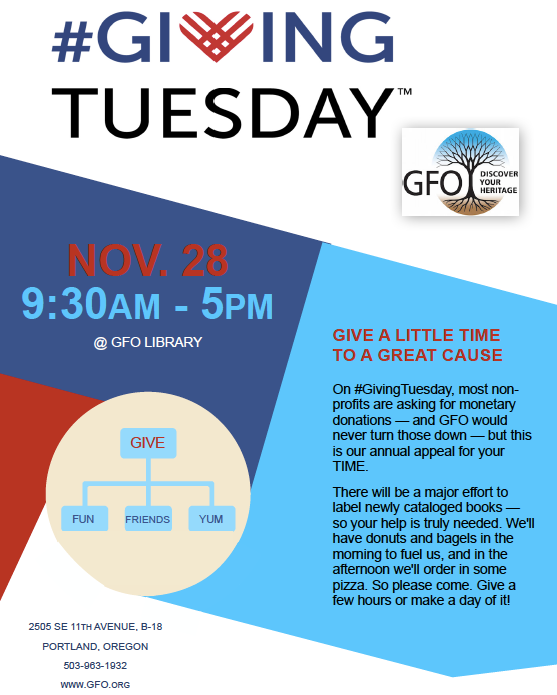
GFO’s Book Sales Team Dilemma

We need your help!!

Continue reading

Wednesday Nostalgia

Thinking about odd things, I wonder which is really better? To save Great-Grandmother’s brooch in its velvet box where few of her descendants will see it, wear it, or know of its history or to just let it go with her stuff to the Thrift Shoppe when she passes and the family cleans out her house??

I really thought about this idea as I enjoyed the site of so many old brooches and pins offered for sale at a recent Vintage Faire. Many of these pieces of adornment was some woman’s treasured item, don’t you suppose?

Far, far, FAR better would be to ensure that all Great-Grandmother’s descendants know about that brooch of hers. Bet you’d agree to that.

(Note the prices and note the fence/gate that this display was mounted upon. )

Meet the Board: Frank McLean

Do you know who’s running the show at the Washington State Genealogical Society? Did you know we have an Executive Committee, six standing committee chairs and three appointed non-elected officers? Who are all these people? In the coming months, we’ll introduce them to you, so you can say “hi” the next time you see them.

Frank McLean

In today’s “Meet the Board” series, we’re introducing you to Frank McLean. Frank lives in Yakima and is WSGS’s chair of the Pioneer and First Citizen Program and the Conference Liaison. He has been a member of the WSGS since 1986, previously serving as President and Vice President. He was named as a WSGS Outstanding Volunteer in 2003, 2005 and 2006. He’s been a proud member (and past President) of the Yakima Valley Genealogical Society since 1986.

Frank’s high school picture

Frank Leroy McLean was born in Chewelah (Stevens County), Washington in 1937 to Jonathan Cornelius and Margaret Ella (Starz) McLean, the third of six children. After high school, Frank served proudly in the Army for 20-plus years, then worked for 19 years at the U.S. Department of Defense, with a short break in between working in Spokane. In 1958, Frank married Delma Dee Roloff. They have three surviving children and seven grandchildren.

Frank has a special interest and knack in technology and computers. In fact, he maintains a database for the American Historical Society of Germans from Russia Society that holds about 560,000 names. He also manages the WSGS Pioneer and First Citizen certificate database — almost 30,000 strong. For an index of the names, click here.

Frank, Delma and their children

John Robertson McLean (1847 – 1919)

Speaking of Germans from Russia…that’s how Frank got his interest in genealogy. No, he doesn’t have German ancestors from Russia, but Delma does. She joined the Central Washington chapter of the American Historical Society of Germans from Russia Society in 1985 and Frank tagged along as “driver, cemetery walker and microfilm cranker.” From there, his interest grew. His ancestors hail from Germany, Nova Scotia,  Maine and Minnesota. Frank’s grandfather, John Robertson McLean (pictured at left) was born in Nova Scotia, but moved to St. James, Minnesota in 1870. While there, he started a church in a boxcar on a siding. Frank and his family attended the 125th anniversary of the church, where they were given a copy of the picture that hangs in the church. There is also a miniature replica of the boxcar on the lawn in front of the church.

Frank likes the research part of the genealogical search, but he’s not as thrilled with the documentation part. He also prefers his hard-copy paper charts and lists over paperless research.

A few more interesting tidbits about Frank:
• Favorite genealogy website: Family Search
• Favorite color: Blue
• Favorite dessert: Lemon Cream Pie

Now you know a little more about another of the WSGS Board members. The next time you see Frank, say hello and thank him for his service to WSGS.

Tuesday Trivia

According to a reminder bit in my local newspaper, it was 100 years ago about now that the first World War I draft registration numbers were called. Most of us know about, and have happily used, the World War I Draft Registration records but have we thought further to WHY those little cards were created and HOW the men were called up? Check it out….. most interesting reading.

The World War One Draft – Reporting of the First Draft Lottery – 1917

The Secretary of War, Mr. Baker draws the first number in the World War 1 Draft and Announces ” 2 5 8″ Photograph Copyright 1917 by Committee on Public Information.

Draft lottery selects 1,374,000 men for examination to provide 687,000 of first increment troops others of 10,000,000 are definitely listed for future service; Baker draws the first number.
​ ​

Gen. Crowder, Gen. Bliss, Senator Chamberlain and Representatives Dent and Kahn also select capsules from the 10,500 in the great glass bowl in senate office building room where drawing continues until morning

​. ​

Newspapermen present drafted—society women in night throngs—scenes and incidents that thrill.

Read more: World War One Draft – Reporting of the First Draft Lottery | GGArchives http://www.gjenvick.com/Military/WorldWarOne/TheDraft/SelectiveServiceSystem/1917-07-20-Draft

​ ​

DrawingTheFirstNumber.html#ixzz4nljqpuav

Monday’s Mystery

Today’s mystery is a photo-mystery. What is this (obviously a hill!) and where is it and why is it important to Washington history?

With last week’s mystery, I was musing about how a little wooden image of an ancient Hindu elephant god came to be floating along the western-end-edge of Long Lake where I found it among the driftwood. Two possible solutions were offered….love ’em!

Sonji Ruttan:  A group of Hindus were holding a seance on a luxury houseboat on Long Lake and offered this to the river god.

 Bettye Hull: There was a very old Hindu man traveling by wagon train in the 1880s through these parts. The wagon train was raided by Indians and many things were stolen. Obviously, this fell out of the bag of “loot”, or was discarded by the Indians because they had no idea what it represented.

Friday Serendipity

Con su permisio (with your permission), I’d like to continue with snips from the M.W.A.K. Columbian, the newsletter of the Mason Walsh Atkinson Kier Company, builders of Grand Coulee Dam, for their employees housed in the company town of Mason City.

One issue featured a list of Ways To Keep From Growing Old: 

(Remember, this is advice for the workers on the dam.)

  1. Don’t wear your safety belt.
  2. Do walk under overhead swinging loads.
  3. Do put your hand on a roller under the conveyor belt.
  4. Do talk back to one of our local minions of the law.
  5. Do step in from of a “cat.”
  6. Do handle electrical fixtures with wet hands.
  7. Do ignore the blasting signal whistles.
  8. Do eat with your knife.
  9. Do neglect to get prompt first aid when you’ve had an accident.
  10. Do not pay close attention to what you are going and what is going on around you.

This bit of sage advice was followed by  jokes:  Teacher: “Spell straight.” Johnny:  “S-T-R-A-I-G-H-T.”  Teacher: “Good! Now what does it mean?” Johnny, “Without Ginger Ale!”

Little Mary comes home from Sunday School and was asked by her mother what she had learned. Mary replied, “Oh, we learned all about King Solomon and his cucumber vines.”