SPEAK OUT NOW TO PRESERVE PUBLIC ACCESS TO GENEALOGY RECORDS – HELP!
Dear SGS members and supporters,
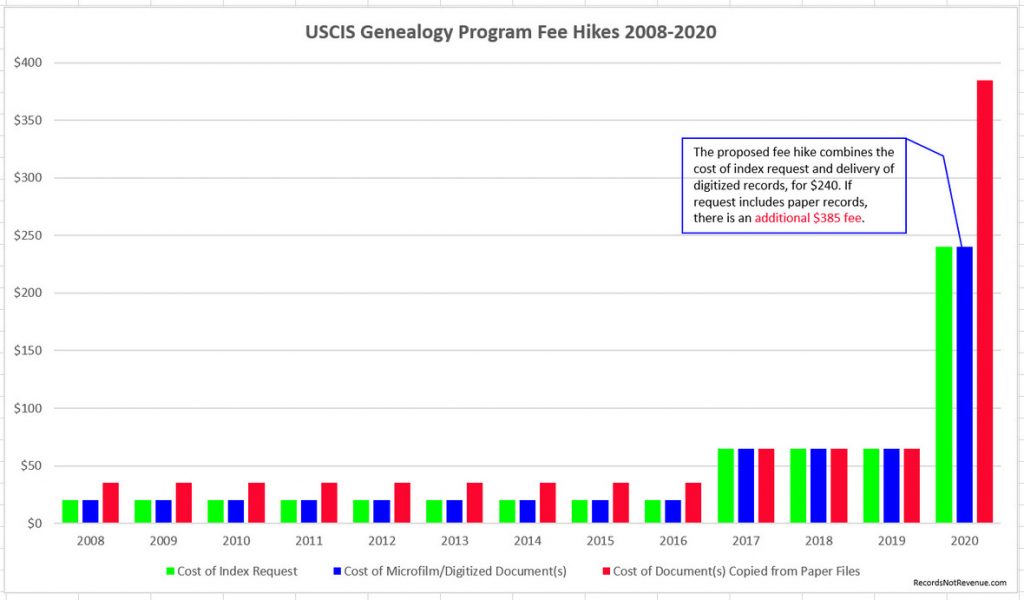
You have all probably seen some mention of a significant proposed fee increase by the United States Citizenship and Immigration Service (USCIS). Essentially what they are proposing for fees are: raising the search fee 269% from $65 to $240 and the cost of the actual file 481% from $65 to $385.
For those not familiar with the types of records genealogists want from USCIS, here is a sample: Naturalization Certificate Files (C-Files), September 27, 1906 to March 31, 1956 Alien Registration Forms (Form AR-2), August 1940 to March 1944 Visa Files, July 1, 1924 to March 31, 1944 Registry Files, March 1929 to March 31, 1944 A-Files, April 1, 1944 to May 1, 1951 If you had relatives who immigrated to the United States in the 20th century, USCIS is the place to order the above records.
USCIS has provided an opportunity for the genealogical community to comment on this proposed Rule that dramatically impacts the USCIS Genealogy Records Program. We want to encourage our members to make their voices heard and express your concern with this outrageous proposal.
The Records Preservation and Access Committee (RPAC) is sending in a letter outlining some of our objections. Your help is needed! Please write to the NCIS responding to their request for comment. The deadline is 30 December. You can find a link to sign up and more information at “Records, Not Revenue” at: https://www.recordsnotrevenue.com
Be sure to contact your Congress people as well!
If you would like to read the proposed rule, see:
https://www.govinfo.gov/content/pkg/FR-2019-11-14/pdf/2019-24366.pdf
The Genealogy section is Section N which starts on page 62315-62316.
See Section 103.40 for Genealogical Research Requests on page 62359.
The Washington Post had an article on the proposed fee increases last Thursday which may be read at:
https://www.washingtonpost.com/history/2019/12/05/genealogy-boom-has-hit-roadblock-trump-administration-plans-huge-fee-hikes-immigration-records/
The link to send a comment is at https://www.recordsnotrevenue.com/
We encourage the individual members of our society to get behind this process and let USCIS and your local representatives know that you object to this unsupportable, exorbitant charge for access to value genealogical documentation.
Thank you for your consideration. If you have any questions, you may feel free to contact me.
Sincerely,
Jill Morelli
President, Seattle Genealogical Society
IT’S THE GIVING SEASON! Please consider making a tax-deductible contribution to support the Seattle Genealogical Society and Library during our Annual Appeal this December. SGS 2019 Annual Appeal Donate Now Online If you have a Paypal account, you may donate to SGS via the Paypal Giving Fund. The transaction fee will be waived and your gift will be matched with an additional 1% by the fund. Go to: Paypal Giving Fund – SGS THANK YOU!
2020 CENSUS JOB OPPORTUNITIES Want a temporary job? If you are an experienced genealogist, you may be interested in and well qualified for positions supporting the 2020 U.S. Census. The Census Bureau is looking to fill literally thousands of positions – enumerators, clerks, supervisors. SGS member, Ellen Stewart, wants to help out with the 2020 Census so she’s very excited about her new position and encourages other SGS members to check out the opportunities. She suggests you visit the official site, set up an account, and complete the application online. The application includes an assessment to help match your skills to the available job opportunities.
Here’s the link for the official website: 2020census.gov/jobs SAVE THE DATE
Spring 2020 SGS Seminar
with Fritz Juengling,
Fairview Christian School,
844 NE 78th St,
Seattle, WA
Saturday, May 16, 2020 Mr Juengling is the German, Dutch and Scandinavian Research Specialist at the Family History Library in Salt Lake City. SGS is happy to have Fritz as the presenter for our spring seminar. SGS CALENDAR OF EVENTS
Unless otherwise indicated all programs will be at the SGS Library, 6200 Sand Point Way NE, Seattle. Check the SGS Web Site for additions, changes, and corrections. Programs may be canceled or postponed because of inclement weather. The Library will be closed Dec 21, 2019 – Jan 1, 2020 for the Winter Holiday.
JANUARY Saturday, January 4, 10:15 am-12:15 pm, FamilySearch SIG, with leader Lou Daly, discover the many ways to use Family Tree & FamilySearch.org. Each meeting will feature an aspect of the FamilySearch website. There will be time for Q&A.
Sunday, January 5, 1:00 pm-3:00 pm, DNA Workshop SIG with leader Cary Bright
Wednesday, January 8, 7:00 pm-9:00 pm, MAC Computer SIG, co-chairs Lisa Marker & Diane Hettrick. Meets every other month at the Fiske Genealogical Library in Madison Park, 1644 43rd Ave E, Seattle, WA. Jointly sponsored by SGS & Fiske. Open to the public. Focuses on resources for users of Macintosh/Apple computers & the Reunion Program.
Saturday, January 11, 1:00 pm-3:00 pm, Second Saturday Series: “Fraktur und Fremdworter: Hacks for Reading Foreign Books & Newspapers” – presenter will be Mary Kircher Roddy.
Sunday, January 12, 1:00 pm-3:00 pm, Scandinavian SIG, lead by Karen Knudson, this group will be reviewing new searches from Arkivdigital (Swedish Research) and Digitalarkivet (Norwegian Research). Everyone is welcome to come and share their research.
Saturday, January 18, 10:15 am – 12:15 pm, Irish SIG, with Jean Roth
Saturday, January 18, 1:00 pm – 3:00 pm, German SIG, with Jean Roth
Saturday, January 25, 10:00am-12:30pm, DNA SIG, Meets quarterly in the fellowship hall of Wedgwood Presbyterian Church, 8008 35th Ave NE, Seattle. Come early for the Beginner Session 9:30-10:00am. Co-chairs Cary Bright & Herb McDaniel. An annual $5 contribution is collected at the door to fund rental of the space. |