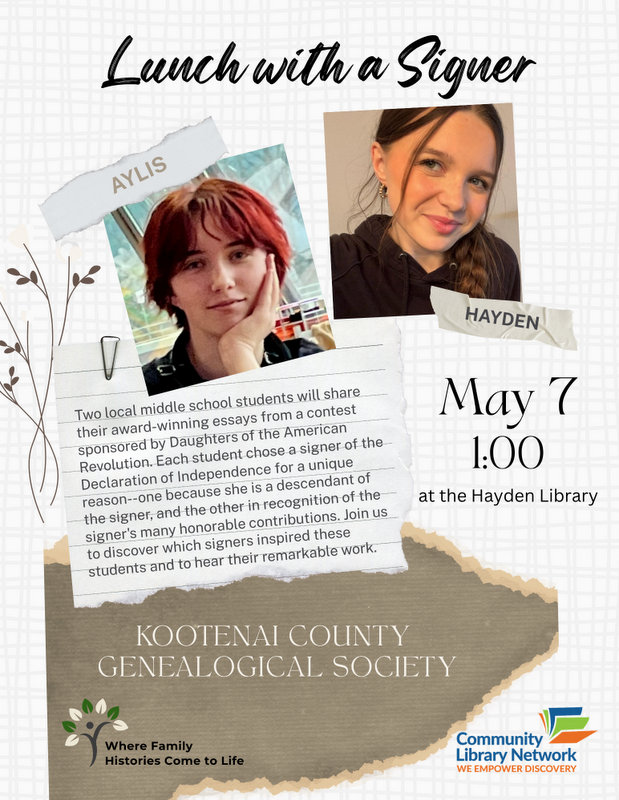
Revolutionary War soldier, Private Thomas Gould Alvord Jr., served New York in the war. He enlisted at age 16 as a gunner in the 2nd artillery regiment under Capt. Joseph Thomas and Col. John Lamb. He served with his father. He was at Cornwallis’ surrender. He drew lot No. 56 for 600 acres of land in Homer, NY. But he was told by some land sharks that the land was poor and covered with water for most of the year. He parted with the land for a few dollars, a horse and saddle. He settled with his brothers, Charles and Ebenezer, upon Lot No 13 which his father had received for service in the war.
He was born on March 23, 1763, in Farmington, Hartford co., CT to Thomas Gould Alvord Sr. and Keziah Orvis. He married Nancy Scoughton in CT. on June 17, 1783. He was an innkeeper for an inn established in 1808. Their children were James Wadsworth, Elias, Jacob Byington, Luman, Nancy (Atwater), Eliphalet, Keziah Orvis (Babcock), Elizabeth, Edward, and Phebe Ann (Williams). He died on June 22, 1835, in Homer, NY and was buried in Alwater Cemetery in Homer. His widow collected a pension of $100 annually.
Submitted for Martha McNeill, a member of the Mason County G.S. Thomas has a DAR I.D. No. A002140. He has three female descendants with DAR member numbers.
AMERICA 250 REVOLUTIONARY WAR ANCESTER JOSEPH WALLING/WALLEN
By Kathleen Weddle Sizer
Joseph Wallen, 5th great-grandfather served in the Revolutionary War in the militia of Montgomery County under Captain Harmon Cox 1777. Montgomery County men took Oaths of Allegiance to the Commonwealth of Virginia in 1777-1779 and Joseph, John and Thomas Wallen signed the Oath in the company of Captain John Cox. The Oaths are found in the Montgomery County courthouse in Entry Book A page 104 and 106 of Fincastle and Montgomery Counties, Virginia
Wallen’s Ridge in Southwest Virginia and Wallins Creek and town of Wallins in Harlan County, Kentucky are named for the Walling brothers. From Tennessee Cousins by W. S. Ray, page 163 “… The Indian Traders and what was called the ‘long hunters’, of course had been through the country before the Indians had consented… Men like Daniel Boone, the Wallens … had seen the country …”
General Lord Cornwallis’ Army marched northward through the Carolinas and Colonel Patrick Ferguson, … sent a threat to the “Over Mountain Men” if they did not cross the mountains and take the oath of allegiance to King George William Frederick III, that he would cross over “hang their leaders and lay their country to waste” and destroy “wityh fire and sword”. Ferguson and Cornwallis underestimated these men. Cornwallis sent Ferguson on ahead to cover his left flank while dealing in another area of battle and Ferguson set up camp on a rocky hilltop called King’s Mountain in Western South Carolina.
The militia was called into actions; 910 men answered the call as Patriots but were two days’ travel away. Ferguson delayed moving east giving the militia time to arrive. They left October 6, 1780 that night, marching all night and into the next morning October 7 through rain with 15 miles to go to arrive at King’s Mountain in early afternoon. Around 3:00 o’clock the commanders of the militia immediately launched the offensive, breaking the men into units of 200 to attack from all sides, being below the ridge where Ferguson was, a difficult task. Commanders told the men “Don’t wait for the word of commence. Let each one of you be your own officer and do the very best you can.” “Shout like Hell and fight like devils.” They were described as “a race of hardy men who were familiar with the use of the horses, rifle and stout, active, patient under privation and brave”. The battle was described later as the largest “all American Fight”; the Loyalist militia and Patriot militia being almost all Americans.
Ferguson didn’t realize that these men had endured hardship, discomfort, hard work, Indian incursions and even their woman were strong surviving in the back county for 30 years. Many men were also Scots, Irish and German and had endured decades of persecution at the hands of English and Germanic nobility
Ferguson was killed; most of his men surrendered from a force of 1,125 to the Patriots with a force of 910 men. Of Loyalist 668 were taken prisoner, 163 wounded and 244-290 killed; the Patriots suffered 28 killed and 58-60 wounded. Three to survive were grandpa Joseph Walling, brother Elisha and Daniel Boone’s father John. The battle lasted 65 minutes. President Thomas Jefferson said “The turn of the tide of success” was the battle of King’s Mountain.” Joseph returned to backwoods life, killed by Indians in 1792 in Kentucky. Because of his early death, he did not receive a pension and his wife Millicent died in 1800.
John Morton, Signer of the Declaration of Independence
By Margie Wilson, descendant
Skagit Valley Genealogical Society member
A common misconception that many people have is that all of the colonists were of British descent. But, in the Delaware/Pennsylvania area in the mid-1600s there was a small colony formed called “New Sweden.” These colonists were of Finnish descent but ruled by Sweden at the time, so considered “Swedish.”
Thus, in 1654, my Finnish immigrant ancestor, Mӧrten Mӧrtensen, from Rautalampi, Finland, arrived on the shores of Delaware as part of Sweden’s interests in founding a colony in the New World.
Mӧrten Mӧrtensen’s (many spelling variations of his first and last named recorded) original log cabin still stands today, protected by the National Park Service, located just south of the Philadelphia airport. In fact, it was the Finns who brought the log cabin architecture to America.
Mӧrten Mӧrtensen’s great-grandson, John Morton, was a surveyor, farmer, self-taught lawyer, and well respected in the community of Ridley Park, Pennsylvania. John Morton’s political career spanned being elected county sheriff, a justice of the Supreme Court of Pennsylvania, and elected to the 1st Continental Congress.
John Morton was opposed to war with Britain. Instead, he tried to convince King George III that the many grievances the American colonists had against the British governing of the colonies, could perhaps be listened to and reconciled by some alterative to all out war between the colonies and Great Britain. To John’s disappointment, King George III never responded to any of his many letters of appeal to avoid a military conflict.
On that fateful day, July 2, 1776, at the meeting of the Continental Congress in Philadelphia, the delegates gathered to vote, for or against, breaking away from British rule. The history of that decision reflects the immense pressure that must have been felt by the delegates assembled. Their vote would declare war with the greatest military power in existence at that time.
When it was Continental Congress delegate, John Morton’s time to vote, he could no longer hope for reconciliation between the colonists and the king. All the colonies had voted. The vote was tied yes for independence, or no, to continue under the abuses of King George III. Since delegate Morton had been so intend on avoiding war, when it was now his turn to vote, his fellow delegates were uncertain as to how he will vote.
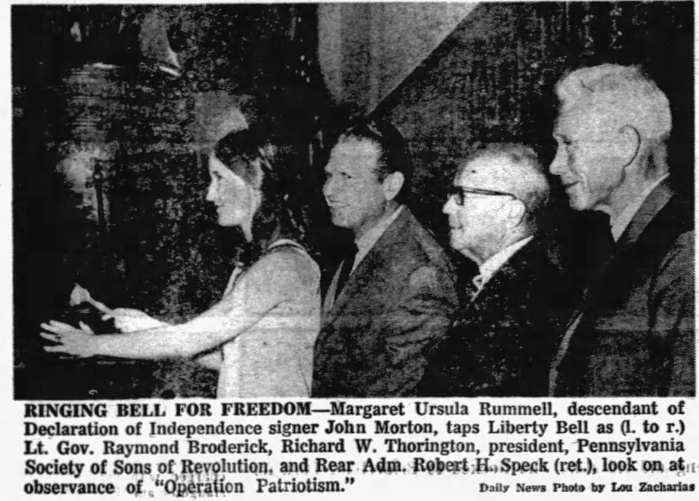
My ancestor, John Morton of Pennsylvania, cast the deciding vote for independence from British rule. He was the 17th signer of the Declaration of Independence as a delegate for Pennsylvania, along with James Wilson and Benjamin Franklin, also from Pennsylvania.
Sadly, not much is told about John Morton and his courageous decision for independence. John Morton’s distinction became that “he was the first signer to die.” John died in April 1777. In biographies of that time, he is said to have died of “brain fever.” But many believe it was the intense stress and the fallout from his July 2nd, 1776 decision that led to his early death at age 53. Respected by his community for his integrity and years of service as a lawyer and justice of the Supreme Court. After John Morton’s July 2nd, 1776 vote, that swung the decision to split from British rule, his neighbors and even friends turned against him. This reversal of support and affection from his neighbors deeply concerned him. Remember that most of his neighbors were Finnish descendants but also Quakers, who held pacifism as their beliefs. So, a declaration of war with Britain, their former homeland turned them away from their friendship with John Morton.
Because John Morton died in 1777 his signature does not appear on the United States Constitution, like so many of his fellow signers of the Declaration of Independence lived to sign.
My direct ancestral connection to John Morton is through his eldest daughter Mary Morton. Mary married yet another Finnish immigrant family named Justus. (Mary Morton married Charles Justus, later spelled Justis (no “c”). The generations of Justis family descendants stayed mainly in the eastern Pennsylvania region, focused in Philadelphia as well as Lancaster County.
From the Philadelphia Daily News (Philadelphia, Pennsylvania) Saturday July 5, 1969 page 5
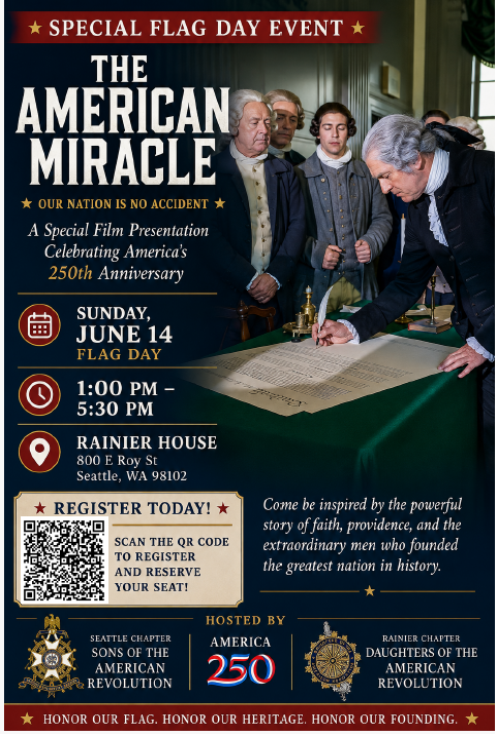
I apologize for the short notice on this movie event. The attached flier is pretty self-explanatory however I’ll include a few comments. The movie “The American Miracle” will be presented on June 14, 2026 by:
Sponsors:
The Seattle Chapter of the Sons of the American Revolutions, and
The Rainier Chapter of the Daughters of the American Revolution
Along with the movie, author and nationally syndicated commentator Michael Medved with the movie’s executive producer Ralf Augstroze will introduce the movie and provide perspective on its meaning and the making of the movie.
Before and after the movie guest will be able to tour the Rainier Chapter House, a replica of George Washington’s beloved Mount Vernon home, that was built in 1925 by the Daughters of the American Revolution. Historical artifacts and an extensive flag exhibit will be on display along with a number of displays by the SAR, DAR, CAR, and Girl Scout.
Location:
DAR Rainier Chapter House
800 E Roy Street, Seattle, Washington
Time:
The Rainier House will open at 1:00, movie introduction at 2:15, and movie at 3:00.
Tickets:
Admission is free but please sign in for the event at Eventbrite by clicking here or use the QR code shown at the attached flier.
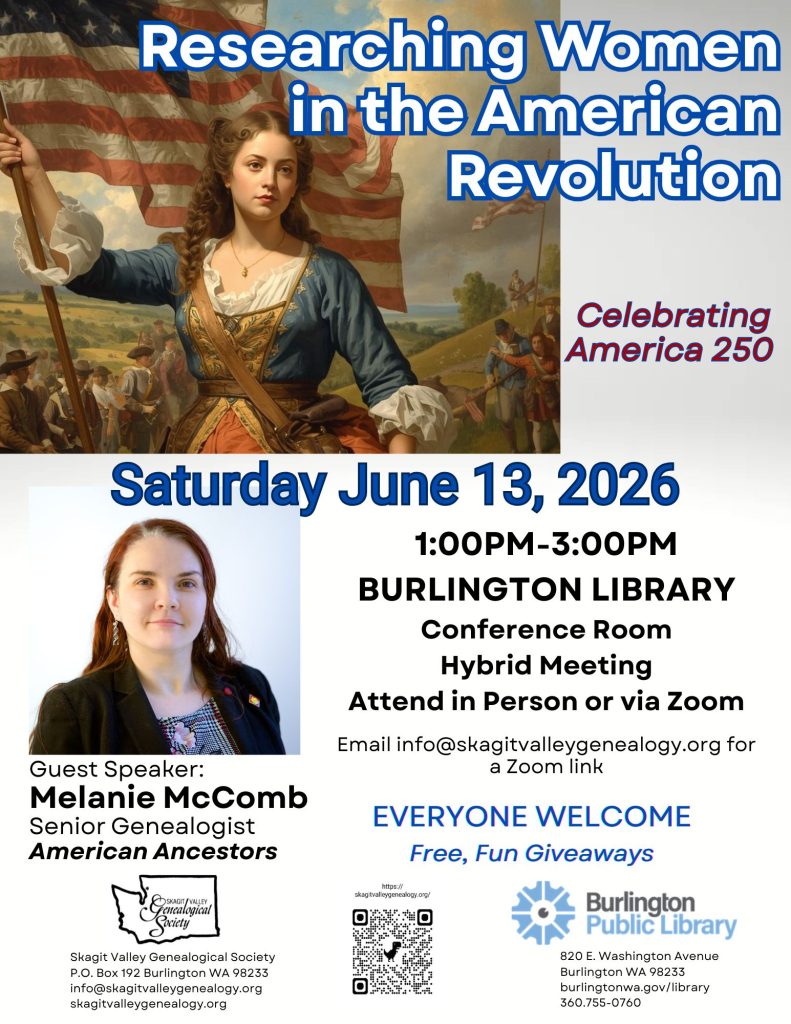
Join SVGS as we celebrate America 250 on Saturday June 13, 2026, at 1pm at the Burlington Public Library with “Researching Women in the American Revolution” with Melanie McComb. Melanie is a Senior Genealogist with American Ancestors (originally known as the New England Historic Genealogical Society). Come learn how women contributed to the American Revolution from boycotts to the battlefield, and how you can discover your female ancestors from this period. Can’t make it to the Burlington Library, request a zoom link by emailing info@skagitvalleygenealogy.org.
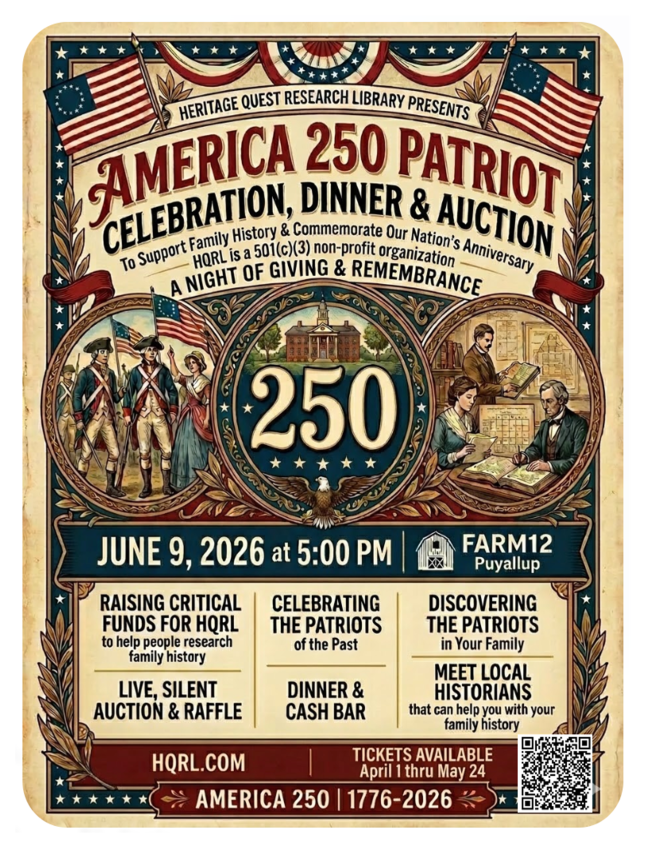
Only 6 more days to buy your tickets!PURCHASE YOUR TICKETS through May 24th! SCAN THE QR CODE orCLICK HERE to PURCHASE TICKET If you need help purchasing a ticket or have questions, please call the library at 253-863-1806, Mon-Sat 10am to 4pm As we celebrate the history of our great country and help raise critical funds for the library, come meet Vern Frykholm portraying George Washington who served as the Commander-in-Chief of the Continental Army during the American Revolutionary War (1775–1783), leading the colonies to independence from Great Britain. You don’t want to miss it! We look forward to seeing you there!
Heritage Quest Research Library | 2102 East Main Ave Suite 105 | Puyallup, WA 98372 US
Joseph Guess was born about 1762 in Fairfax, County in the Colony of Virginia. His family moved to Orange County, in the Province of North Carolina when he was young and he was drafted in the local militia when he was of “age”, usually 16. He served as a private for 9 months in the New Levies (emergency conscripted soldiers in 1778 and 1779 authorized by the North Carolina General Assembly) under Capt. William Jamieson and Lt. Col. Archibald Lytle. They marched to Charlotte, then on to South Carolina; Charleston, Purrysburg, Two Sisters and Turkey Hill on the Savannah River. He was discharged at a place called Stono, according to his pension information.
A short time after his discharge, he was again drafted as a private and served for 3 months under Capt. Davis Gresham, Lt. Col. Thomas Taylor and Col. Francois DeMalmedy in the North Carolina Light Dragoons. The Dragoons were trained to fight on both horseback and foot, playing a crucial role in the American Revolution. They went against the Tories on the Pee Dee River and had many skirmishes with them. The prisoners they took were sent to Gen. Henry William Harrington, who was in the field not far from them.
Joseph Guess was my 5th great grandfather. He applied for a Revolutionary War pension and was placed on the pension roll on 14 March 1833. He died on 13 Jan 1835 in Caldwell, Kentucky. There is no marriage record and in order to continue to receive his pension, his widow Constance (Taylor), appeared in the Princeton, Kentucky courthouse on 17 May 1841 and testified under oath that she and Joseph were married on 11 Jan 1785 in North Carolina.
Angela Michener, Yakima Valley Genealogical Society
Jan Wells Minzel’s DAR Revolutionary War Soldier ancestor is Ichabod Brown from Rhode Island, my 4th Great Grandfather. He was commissioned by Gov. Greene of Rhode Island in 1779. He was appointed ensign in 1779 of the 1st Cumberland company 2nd regiment, of the Rhode Island militia. He served as a Sargent for Rhode Island under Capt. Weatherhead and Col. John Mathewson.
He was born on April 1745 in Smithfield, Rhode Island and died on September 16, 1828, in Farmington, New York. He married Hannah Ballou on November 9, 1777, in Cumberland, Mass. Their daughter, Rhoby Brown, married my 3rd great grandfather, Joseph L. Wells, on October 27, 1803, in Manchester, New York.
By Jan Wells Minzel, a member of the Mason County and Olympia Genealogical Societies.
TICKETS STILL AVAILABLE!Come celebrate a very special night with us and help support our incredible genealogy library, a 501(c)(3) nonprofit. Come hear about finding the patriots in your family, enjoy a great dinner and fun auction! PURCHASE YOUR TICKETS BY SCANNING THE QR CODE or CLICK THE LINK BELOW! CLICK HERE to PURCHASE TICKET If you need help purchasing a ticket or have questions, please call the library at 253-863-1806, Mon-Sat 10am to 4pm We look forward to seeing you there!
Heritage Quest Research Library | 2102 East Main Ave Suite 105 | Puyallup, WA 98372 US
You are free to copy articles to any non-commercial web site or message board or printed publication you wish. Don’t bother to ask permission, just do it.
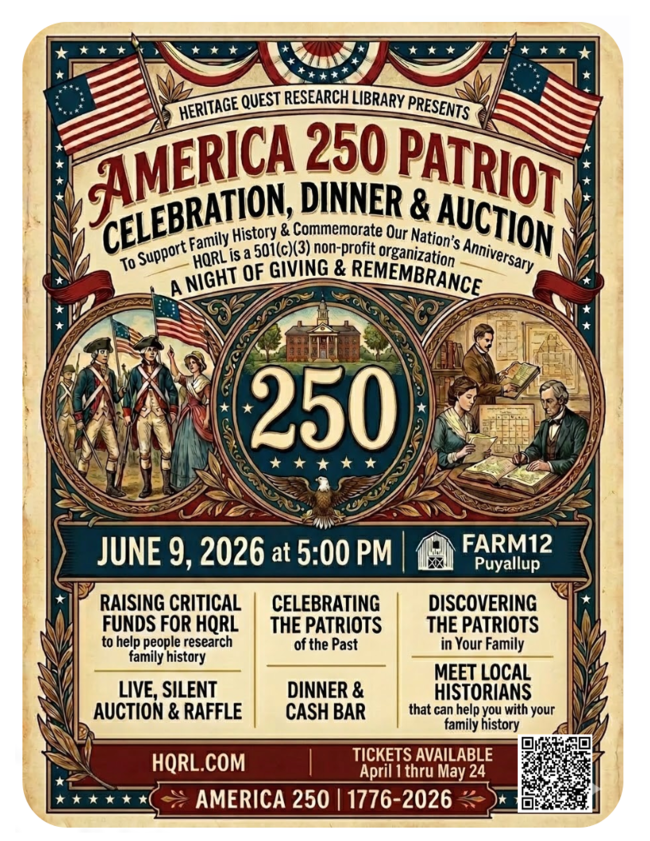
 PURCHASE YOUR TICKETS through May 24th! SCAN THE QR CODE or
 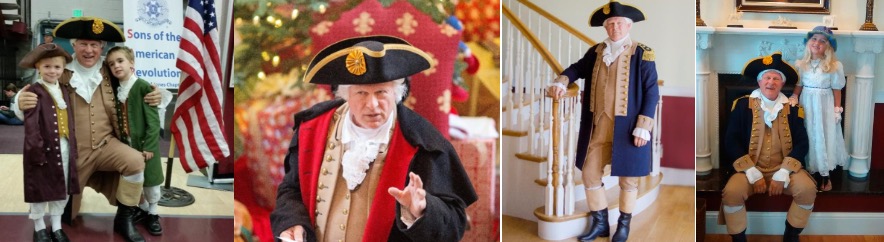 As we celebrate the history of our great country and help raise critical funds for the library, come meet Vern Frykholm portraying George Washington who served as the Commander-in-Chief of the Continental Army during the American Revolutionary War (1775–1783), leading the colonies to independence from Great Britain. You don’t want to miss it! We look forward to seeing you there!