John Morton, Signer of the Declaration of Independence
By Margie Wilson, descendant
Skagit Valley Genealogical Society member
A common misconception that many people have is that all of the colonists were of British descent. But, in the Delaware/Pennsylvania area in the mid-1600s there was a small colony formed called “New Sweden.” These colonists were of Finnish descent but ruled by Sweden at the time, so considered “Swedish.”
Thus, in 1654, my Finnish immigrant ancestor, Mӧrten Mӧrtensen, from Rautalampi, Finland, arrived on the shores of Delaware as part of Sweden’s interests in founding a colony in the New World.
Mӧrten Mӧrtensen’s (many spelling variations of his first and last named recorded) original log cabin still stands today, protected by the National Park Service, located just south of the Philadelphia airport. In fact, it was the Finns who brought the log cabin architecture to America.
Mӧrten Mӧrtensen’s great-grandson, John Morton, was a surveyor, farmer, self-taught lawyer, and well respected in the community of Ridley Park, Pennsylvania. John Morton’s political career spanned being elected county sheriff, a justice of the Supreme Court of Pennsylvania, and elected to the 1st Continental Congress.
John Morton was opposed to war with Britain. Instead, he tried to convince King George III that the many grievances the American colonists had against the British governing of the colonies, could perhaps be listened to and reconciled by some alterative to all out war between the colonies and Great Britain. To John’s disappointment, King George III never responded to any of his many letters of appeal to avoid a military conflict.
On that fateful day, July 2, 1776, at the meeting of the Continental Congress in Philadelphia, the delegates gathered to vote, for or against, breaking away from British rule. The history of that decision reflects the immense pressure that must have been felt by the delegates assembled. Their vote would declare war with the greatest military power in existence at that time.
When it was Continental Congress delegate, John Morton’s time to vote, he could no longer hope for reconciliation between the colonists and the king. All the colonies had voted. The vote was tied yes for independence, or no, to continue under the abuses of King George III. Since delegate Morton had been so intend on avoiding war, when it was now his turn to vote, his fellow delegates were uncertain as to how he will vote.
My ancestor, John Morton of Pennsylvania, cast the deciding vote for independence from British rule. He was the 17th signer of the Declaration of Independence as a delegate for Pennsylvania, along with James Wilson and Benjamin Franklin, also from Pennsylvania.
Sadly, not much is told about John Morton and his courageous decision for independence. John Morton’s distinction became that “he was the first signer to die.” John died in April 1777. In biographies of that time, he is said to have died of “brain fever.” But many believe it was the intense stress and the fallout from his July 2nd, 1776 decision that led to his early death at age 53. Respected by his community for his integrity and years of service as a lawyer and justice of the Supreme Court. After John Morton’s July 2nd, 1776 vote, that swung the decision to split from British rule, his neighbors and even friends turned against him. This reversal of support and affection from his neighbors deeply concerned him. Remember that most of his neighbors were Finnish descendants but also Quakers, who held pacifism as their beliefs. So, a declaration of war with Britain, their former homeland turned them away from their friendship with John Morton.
Because John Morton died in 1777 his signature does not appear on the United States Constitution, like so many of his fellow signers of the Declaration of Independence lived to sign.
My direct ancestral connection to John Morton is through his eldest daughter Mary Morton. Mary married yet another Finnish immigrant family named Justus. (Mary Morton married Charles Justus, later spelled Justis (no “c”). The generations of Justis family descendants stayed mainly in the eastern Pennsylvania region, focused in Philadelphia as well as Lancaster County.
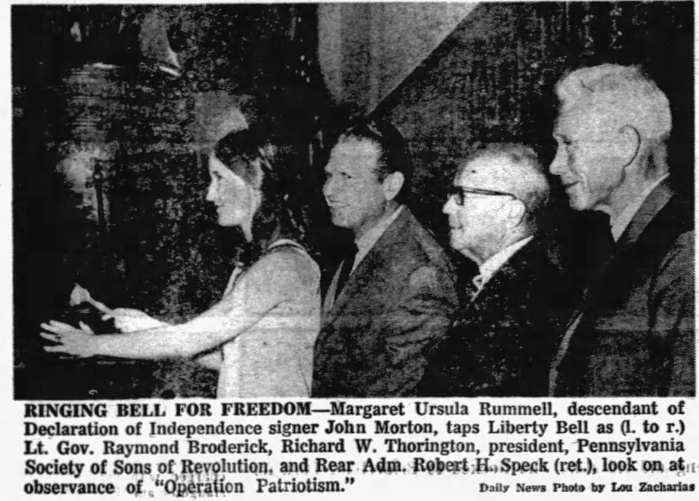
From the Philadelphia Daily News (Philadelphia, Pennsylvania) Saturday July 5, 1969 page 5
Margie, such an interesting history you have. Having Quaker ancestors myself and understanding the doctrine, it would have been hard for him to make that decision. He probably would have been asked by the church to seek forgiveness or been asked to leave the congregation of Friends. Thank you for sharing your ancestor John Morton’s story with us.