|
|
|
|

Yes, last week’s mystery photo was the backwash from a ferry….. Pat Manning was first to post the correct answer. We be Washingtonians!
Question: Are there now, or have there ever been, any Homes for Aged Women in Washington???
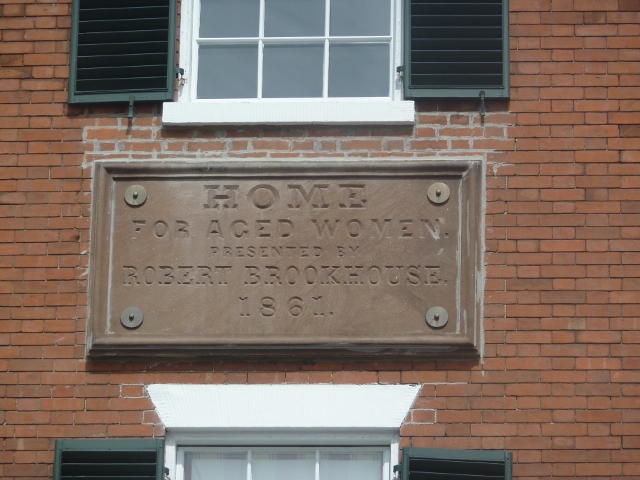
Well there was in Boston, Massachusetts, in 1861. I think today they’re called Long-Term Care Facilities, or some such. Interesting idea, I thought. And especially for this place to be established right before the Civil War.
Wonder what’s listed on the 1870 census for this place???
DIGITAL ARCHIVES PASSES 200 MILLION RECORDS MARK

Graphic of file cabinets feeding information to a matrix-like binary screen
The Washington State Archives’ Digital Archives reached a milestone achievement last month when it entered its 200 millionth record into the state database. In the months leading up to the milestone, the Washington State Archives ran a public contest to see who could guess the exact date on which Digital Archives reached the record. The winner, who guessed December 5 and was closest to the actual date of November 30, got to take home an Ancestry DNA kit.
The Washington State Archives’ Digital Archives was the nation’s first archives dedicated specifically to the preservation of electronic records from both state and local agencies that have permanent legal, fiscal or historical value. The facility, which opened in 2004, includes a research room, computer research stations, a high-tech presentation classroom, and a world-class data center. Digital Archives delivers broad public access to both digitized and “born digital” records of state and local government, provides government accountability and – in the case of digitized documents – helps preserve the originals.
Great job to our dedicated Archives and IT staff that make this possible!
Sign up for Scribe an join the super scribe’s

The German Interest Group of The Eastside Genealogical Society (EGS) will meet on Friday, January 5, 2018, from 1 to 3 pm in the Relief Society Room of the LDS Church at 10675 NE 20thSt, Bellevue, WA 98004 with doors opening at 12:45 pm for networking. Visitors are always welcome at our meetings.
Topic: Using US Records to Search for an Immigrant Ancestor’s Village – Locating an immigrant ancestor’s village can be challenging. Not all records are online or have the information being sought. Three speakers will share their experiences using US records to find an ancestor’s Old World village. They’ll discuss what they did, where they went and what they found. Strategies and tips offered here can be modified to apply to any immigrant ancestor.
Speaker: Janet O’Conor Camarata, a member of Eastside Genealogical Society and South King County Genealogical Society, has over 25 years of experience in genealogy. She is an instructor in genealogy at Pierce College, a seminar presenter and trainer in genealogy societies across Washington, who takes advantage of the latest technology and staying mobile with the latest computing tools.
Speaker: Dorothy Pretare started collecting family history in 1995 and is active in 2 local genealogical societies, leader of the EGS German Interest Group and a member of 2 societies in Minnesota. In 2008, she visited her ancestral villages in old East Germany and present day Poland.
Speaker: Melanie Matway was fortunate to have learned her immigrant ancestors’ villages first-hand with one exception. The quest for a great-grandmother’s village of origin has taken her to Ohio and Pennsylvania and has been a learning experience utilizing a variety of records and non-familial sources of information.
For more information, kindly visit our website at https://egsgermangroup.wordpress.com/ .
The Chinese Exclusion Act files.
The files are located on the National Archives at Seattle. They covered the Chinese who came into the ports of Seattle, Port Townsend, Sumas, WA; and Portland, OR. The act was in effect from 1882 to 1943 and there are over 50,000 files at the Seattle branch of the National Archives.
The files contain a variety of genealogical information on the subject of the file and their family, documents and most include photos. Sometimes there are affidavits by Caucasians in the files.
I highlight a different file every week. The final destination of the Chinese coming into the PNW ports may have been anywhere in the U.S. but most of the files on the blog are for people who lived in Washington or the PNW.
The blog is located at www.ChineseExclusionFiles.com.
Trish Hackett Nicola
www.ChineseExclusionFiles.com
THE GENEALOGICAL FORUM’sWednesday EveningE-News, Early Edition6 December 2017 |
|
For more information visit www.gfo.org, contact us at info@gfo.org, or call our library at 503-963-1932. We love hearing from you! For a complete GFO CALENDAR click here. Also, if you missed your free copy of our monthly Insider for November 2017, you’re in luck because we saved you a copy HERE. NOTE: The Insider issues are now located under the “Learn” > “Our Publications” menu at www.gfo.org. |
Curious about the status of your GFO Membership?? We’d love to have you as a GFO Member! |
 |
We wanted to say thank you again for helping us get ALL CAUGHT UP on our labeling project this last week. This project’s success couldn’t have come at a better time, with the holidays around the corner! We’re happy to announce we have reached our labeling goals for this year.Now it’s time to go out and play and rest with all our friends and family. We hope you all have a very very merry holiday season!! Many hands have sure made the recataloging and relabeling much much lighter! Thank you again everyone! |
|
|


ABOUT OUR PROGRAM: Tired of being told by state and local archives and government agencies that your family’s genealogical records are “unavailable” to the public or only available if you visit them onsite? We were too, so we figured out what to do about it. We’re Reclaim The Records, a new activist group that filed a first-of-its-kind Freedom of Information Law (FOIL) legal petition in the Supreme Court of New York against the NYC Municipal Archives in order to access to twentieth century genealogical records…and won! We also secured the first-ever public release of the indices to hundreds of thousands of vital records from the New Jersey State Archives. And we’re filing many more requests against city and state agencies, large and small. This presentation will tell the story behind these cases, walk through the legal basics of FOIL, and teach genealogists how to file their own FOIL requests for their own records.
ABOUT OUR SPEAKER: Brooke Schreier Ganz is the founder of Reclaim The Records, a not-for-profit activist group that uses state Freedom of Information requests to return genealogical records to the public. As the former Vice President of Gesher Galicia, she designed and built their website, including its innovative “All Galicia Database”. The underlying search engine codebase, named “LeafSeek,” was released by Brooke as a free open source project, for which she won second place in the 2012 RootsTech Developer Challenge. She further refined it to build the bilingual “All Israel Database” for the Israel Genealogical Research Association (IGRA). She lives in California
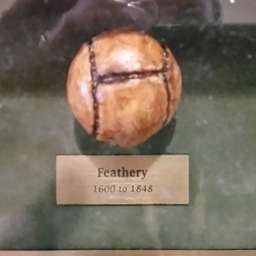
What do you know about golf balls? Would you have guessed that for hundreds of years prior to 1850, golf balls were made of a leather circle stuffed with feathers? In the 1840s, various experiments were performed to make a golf ball from a certain kind of tree gum which had immediate appeal. Next came the rubber-core ball in 1898….. and the simple round golf ball has become more and more sophisticated. Next time you play a round of golf, take a moment to think what’s inside that white round ball. (I took these photos in the Arlington Country Club, near where the Stillaguamish Valley Gen Society held their conference last August.) 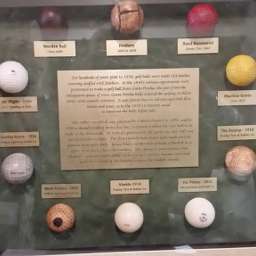
What do you know about Washington’s oldest apple tree? Here is my photo of the tree in early spring but the tree still produces apples!
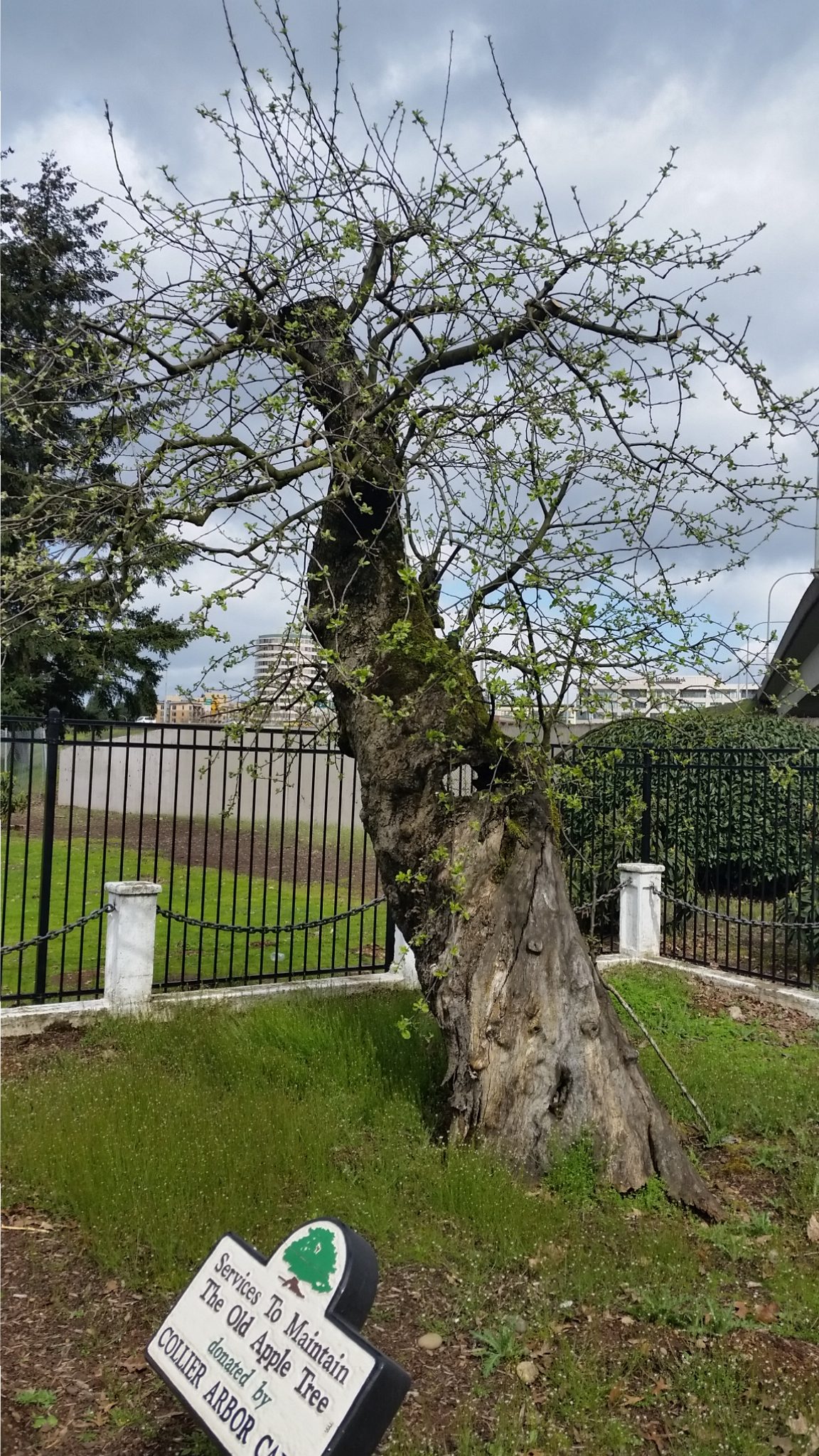
Vancouver, Washington’s “Old Apple Tree” (“Mallus spp.”) was one of five seeds planted in late 1826 and then eventually placed outside of the gates of the first Fort Vancouver. The seeds for the tree were brought over from England by Emilius Simpson. The “Columbian.com” website, covering local history of Vancouver, tells the story:
|