Hopefully we’re into the hottest days of summer, so tiz a good time for some genealogy and history trivia!
“In the 1800s the method of making one plank (long board cut from a log) was that a pit was dug. The tree was placed over the pit. Two men would go into the pit, and two men would be on top of the log and together they would handsaw each plank. The men down in the pit would get sawdust in their eyes and that was how the expression “it’s the pits!” originated.” (Church of Our Lord tour guide, Victoria, BC)
In November, 1217, the 10-year-old King Henry III signed a charter giving England’s common people some legal rights for the first time. One big provision is that the concept of “royal forests,” where common folks could not hunt and poaching was a death sentence. This new rule reduced the size of these off-limits forests and restored ancient hunting rights. (History Magazine, from England, 2024)
Ever heard of Frozen Charlotte Dolls? Frozen Charlotte dolls are small, solid, porcelain or bisque dolls that were popular in the mid-1800s to early 1900s, particularly in Europe and the United States. They are named after a popular poem and song about a young woman named Charlotte who froze to death while refusing to bundle up for a winter carriage ride. The dolls were mass-produced in Germany and became a common bath toy and a relatively inexpensive children’s toy.
Tacoma-Pierce County Genealogical Society Mystery Book Club Saturday, August 16, starting at 4:00 pm via Zoom
Please join us as we discuss a fictional genealogical book, The Diamond Eaters by M.K. Jones.
More information at: Amazon: The Diamond Eaters Free loan on Kindle Unlimited
This book may also be available in print from various book stores.
TPCGS Book Club Zoom Meeting Every month on the Third Sat beginning at 4:00 PM Pacific Time Please download and import the following iCalendar (.ics) files to your calendar system.
TIP OF THE WEEK – THIS AUGUST IS THE 80TH ANNIVERSARY OF THE END OF WWII: RESEARCH YOUR PACIFIC THEATER ANCESTORSBy Kate Penney Howard
World War II ended on August 15, 1945. We now call this day “Victory over Japan Day.” This day began the journey of millions of servicemen and servicewomen home to start the families many of us descend from.
Unlike the European Theater, where forces generally worked in divisions within one branch, in the Pacific Theater, military branches began working together. The Army and Navy (and their Air Forces) and the Marines and Coast Guard all played crucial roles, creating diverse record types scattered across different repositories.
We should also remember that hundreds of thousands of American and Canadian troops were positioned for “Operation Downfall” — the planned invasion of Japan. These preparations created extensive records, even though the invasion never occurred.
Key Record Types for Pacific Theater Research: Unit histories and war diaries Medical records from Pacific hospitals Prisoner of war documentation Occupation duty records (1945-1952) Transport ship passenger lists The Pacific Theater’s geography created unique documentation. Island-hopping campaigns meant servicemen often served in multiple locations, each generating separate records. Military postal service records can help track movements between islands.
The Pacific Theater affected the Home Front too. West Coast defense installations, aircraft manufacturing, and shipbuilding created a need for workers. People from all over the country relocated to work in defense plants, particularly in California, Washington, and British Columbia.
Some servicemen married overseas, creating international family connections. Others spent extended periods in military hospitals, creating detailed medical records that might mention family health history.
Research Strategy: Identify your ancestor’s specific unit and theater movements Research ship manifests for Pacific crossings Check veteran administration records for post-war benefits Look for local newspaper coverage of homecomings Consider interviewing surviving family members about stories August 1945 also began the massive demobilization effort. Discharge papers, final pay records, and veteran benefit applications provide detailed personal information often missing from wartime records.
Special Considerations:
Did you know that in 2022, Reclaim the Records won their FOIA lawsuit against the VA? This means that, even if your ancestor’s original personnel file was burned during the 1973 NARA fire, the VA may have records for you. These could include birth, marriage, and death records, medical and pension documents, employment details, home purchase information, education transcripts, and military details. The GI Bill enabled college education and home ownership, generating educational and property records. Many veterans used VA benefits, creating extensive medical documentation. Join SGS Today * to renew your membership: log in on the Members Home page and click the green renew membership button.
August 1, 2025
SGS eNews! comes out the first of every month. contact eNews!
Monthly Meeting & Presentation – Sons of the American Revolution and Revolutionary Era Genealogy
Tuesday, August 12th
1:00 pm
SVGS Library
6111 188 PL NE, Arlington, WA
You are invited to this free presentation at the SVGS library. Everyone is welcome!
Jason Rice, a SVGS member, will be giving an inpersononly presentation at our library. Our business meeting will follow the presentation.
Jason’s Presentation: Sons of the American Revolution and Revolutionary Era Genealogy
Founded in 1889, the Sons of the American Revolution (SAR) stands as a prominent non-profit, non-political organization deeply committed to the core tenets of volunteerism, a comprehensive understanding of American History, and fervent Patriotism. Since its inception, the SAR has cultivated an extensive international network, currently encompassing over 550 chapters strategically located throughout North America and Europe. The SAR boasts a substantial membership exceeding 35,000 individuals, each of whom has meticulously documented their lineage, demonstrating a direct ancestral connection to the Patriots who played pivotal roles in the American Revolutionary War. These esteemed ancestors encompass a wide spectrum of individuals who either rendered military service in the Continental Army or Navy, or who actively contributed to the cause of American independence through various forms of support, including political activism, financial contributions, and the provision of essential resources. The SAR serves as a vital link to the nation’s foundational history, fostering a profound appreciation for the sacrifices and ideals of the Revolutionary War era among its members and the broader public. Through its diverse programs and initiatives, the organization actively promotes historical education, civic engagement, and a deep-seated sense of national pride.
Bio:
Jason attended Southern Illinois University and the University of Illinois – Springfield, studying Political Science, Philosophy, and Public Administration. He began genealogical research in 2013. He is a member of the Southern Illinois Genealogical society, Pope County, Illinois Historical Society, Jackson County (Illinois) Historical Society, SVGS, and currently the Chapter Genealogist of Supplemental Applications for the Ranger Chapter, Sons of the American Revolution.
There will be a short break with refreshments. The monthly meeting will follow at 2pm.
New England Interest Group – 1st Tuesday of the Month
The SVGS New England Interest Group (includes New York and Pennsylvania) meets at the SVGS Library on the first Tuesday of the month at 10am. This is a hybrid group. You may attend in person at our library or join via Zoom.
If you have not joined us yet and would like to receive emails in the future for this group or wish to attend via Zoom, please send an email to info@stillygen.org and request to be added to the New England Interest Group email list and receive monthly
Zoom invitations.
DIG – DNA Special Interest Group – 3rd Thursday of the Month
Also join us at the SVGS library from 1-3pm on the 3rd Thursday of the month for the DNA Special Interest Group (DIG). This group works together to develop a better understanding of DNA techniques and strategies for finding relatives, discuss and review new DNA developments and tools and help members with their research problems.
All DNA skill levels are welcome to attend.
If you have a specific DNA topic you would like to discuss or have any other suggestions for this group, please send an email info@stillygen.org
Also, if you have not joined us yet and would like to receive emails in the future for the DIG group, please send an email to info@stillygen.org and request to be added to the DIG email list.
Can you lend a hand to help get the word out about our events? If you find this monthly schedule helpful, we’d love for you to contribute by volunteering to help create it. Contact publicity@skcgs.org for more info.
Stay connected! Get updates on our virtual and in-person events, plus the latest genealogy news and tips, by subscribing (free) to the online group at https://skcgs.groups.io
Skcgs.groups.io is the SKCGS online platform for discussion and information sharing:
we communicate and share information with each other
other than your email, you are not required to provide personal information
you can unsubscribe or change your email format at any time
PROGRAM UPDATES
All meetings are online except Genealogy Help at KCLS Auburn, Federal Way, and Renton Highland library branches.
The monthly online SKCGS Genealogy Chat is on hiatus until September.
Live transcription (captioning) is available during our Zoom meetings by request
Online meeting participants need to register for SKCGS Zoom meetings. Upon registration, Zoom will send a confirmation email with instructions on joining the meeting.
Members, the passcode for the recording of this month’s speaker presentation is at the bottom of this email
Note: Special meeting of the SKCGS Family Tree Maker Users Group in September with Mark Olsen as a speaker. Topic: the 2024 upgrade of FTM. We all have the new 2024 version and have lots of questions. September 11, 2025 at 5:00pm PDT, for 1 and half hours. Register in advance:
After registering, you will receive a confirmation email containing information about joining the meeting.
Monday, August 11, 2025, 1 – 3pm
Genetic Genealogy/DNA Interest Group (Online)
Topic: AncestryDNA® ThruLines®
This group is for genealogists who use DNA data as part of their research. Join the free email group for meeting notices and discussion: https://skcgs.groups.io/g/Genetic-Genealogy
The Tech Users Group is for sharing knowledge and learning about technology tools, media, apps and websites. Please join our free email group for meeting information and discussion: https://skcgs.groups.io/g/TUG.
Thursday, August 21, 2025, 11am – 1pm
Genealogy Help with SKCGS at the Auburn Library (In-person)
Genealogy questions? SKCGS offers one-on-one help with a volunteer
1102 Auburn Way S
Auburn, WA 98002
Registration not required. In-person event. Safety guidelines and current protocols followed. More information at King County Library, email kcls-auburn@kcls.org
Thursday, August 21, 2025, 2 – 4pm
Genealogy Help with SKCGS at the Federal Way Main Library (In-person)
Genealogy questions? SKCGS offers one-on-one help with a volunteer
34200 1st Way S, Federal Way, WA 98003
Registration not required. In-person event. Safety guidelines and current protocols followed. More information at King County Library: https://kcls.org/locations/federal-way, or phone: (253) 838-3668
Monday September 1 is Labor Day. No SKCGS events, and KCLS Libraries are closed for the holiday.
You are receiving this email because you have attended a SKCGS meeting and indicated you would like to receive periodic notice of events. If you would like to be removed from our mailing list, send an email to skcgfriends+unsubscribe@skcgs.org.
Focus of Presentation to be German ImmigrantsWe are excited to welcome back Kimball Carter, CG®, for the opening session of our fall Second Saturday speaker series. Kimball will guide attendees in discovering the places of origin of their German immigrant ancestors. Using U.S. and German records, Kimball will demonstrate practical strategies with case studies that will help advance your research.
Members Can Access Past Presentations on the SGS Website Although our popular Second Saturdays and Virtual Sundays have been on summer hiatus, many past presenations are available on the SGS website members pages.Kimball Carter, CG® has more than 45 years of family history research experience. A retired graphic artist and creative director, he now volunteers at the FamilySearch Library in Salt Lake City, helping patrons with German ancestry, identifying immigrant hometowns, and Colonial American research.
Come Early for the Membership Meeting There will be a membership meeting just before the Second Saturday presentation on Sept. 13 from 12:30 p.m. to 1:00 p.m. The tentative agenda will include information regarding the America 250 writing contest and updates on our new website.
photos courtesy Roman Kraft / Unsplash, Library of Congress, David Rumsey Map Collection, David Rumsey Map Center, Stanford Libraries and location icon created by kmg design / Flaticon
CYBELE O’BRIEN NAMED 2025 SGS VOLUNTEER FOR SPRING QUARTER
Cybele O’Brien Cybele O’Brien has been nominated as our Spring Quarter Volunteer for 2025. This award considers volunteer activities performed during the months of April, May, and June, but O’Brien has been supporting our Society throughout this past year. When she began her role of Secretary in February 2024, she had little guidance as to the scope of the job. She quickly learned how to document the business of the board with her accurate and comprehensive minutes. This requires preparation as well as finalization of the document each month.
O’Brien also assisted the Director of Technology in moving documents onto a new shared drive and improving the organization of its files. She has maintained the digital Bi-laws and Policy Manuals which have replaced binders kept in the library. O’Brien has been timely in her role of managing societal communications including writing numerous thank-you letters and distributing daily Society emails. The Board is grateful for all her work this past year and unanimously nominated her for this recognition.
This award recognizes the time O’Brien spent in Zoom and in-person sessions training the incoming secretary. She shared her knowledge as well as numerous tips learned through experience. Her updated job description has served as a road map during this transition.
O’Brien joined the Society in the 2020-2021 membership year. She is an avid family historian and enjoys traveling. We hope that she finds some time this summer to make new genealogical discoveries.
NEW CLASS TO HELP YOU WRITE AS YOU RESEARCH Got a brick wall? Join past SGS president Jill Morelli and she beta tests a new workshop: Write As You Research. This class will provide a methodology for identifying possible solutions to brick walls. Writing genealogical problems accumulates all known information in one place, aids identifying gaps and overlaps, and provides a written report for future readers. Get started writing more! This workshop provides a format for genealogical reports.
Save the date: August 20, 6 p.m. to 8 p.m. Registration fee: TBD (discount for SGS Members) Registration opening SOON!
STATE LIBRARY CLOSURE: NOW WHAT?The Washington State Library in Tumwater closed to the public on July 1 due to a lack of state funding. This means there is limited access to the library’s genealogical material for researchers.Leslie Vogel of SGS’s Pacific Northwest SIG shared these tips for researchers at the July meeting and agreed to share them with eNews.
How to Access WSL RecordsContact the Library: Patrons can still email askalibrarian@sos.wa.gov (which probably will not be a genealogist) or leave a voicemail at 360-704-5221 and within one week they will answer your questions.
Interlibrary Loan: Some items can be accessed via interlibrary loan to local libraries. Access information through their online catalog to determine if the item is available.
Books: Many of the books in the rare and special collections, territorial materials, northwest collection, genealogical collection and reference materials can not be accessed through inter-library loan.
Newspapers on Microfilm may be borrowed but only a few local libraries have a microfilm reader available to view them. The only library in the Seattle Public Library with a microfilm reader is the downtown central library!!!
Newspapers via InterLibrary Loan: The Washington State Library serves as the depository “for newspapers published in the state of Washington thus providing a central location for a valuable historical record.” [RCW 27.04.045] The WSL has 6,500 newspaper titles on 50,000 reels of microfilm from 1850s to present. They had four microfilm readers onsite.
Northwest Digital Heritage Site (WA and OR): This site supports libraries museums and communities with their digital collections. They are a partner of WSL, Oregon Heritage Commission, State Library of Oregon
Michelle Chiachiere SGS member Michelle Chiachiere was recently informed by the Board for Certification of Genealogists that her portfolio was to the standards required for receipt of the credential Certified Genealogist. This rigorous credentialing process requires the submission of multiple examples of her work and is peer-reviewed by at least three judges. As well as being a member of SGS, Chiachiere is also a member of the Puget Sound chapter of the Association of Professional Genealogists, and graduate of SGS’s Certification Discussion Group. Chiachiere takes clients and can be found at her website.
THE SEMIQUINCENTENNIAL IS COMING! THE SEMIQUINCENTENNIAL IS COMING!
Next year, 2026, marks the 250th anniversary of the founding of the United States of America! State and national planning is already underway. Seattle Genealogical Society will be sponsoring a writing contest, My American Story, and more details about that will be shared in the coming months. But, that’s just one way we want to celebrate this milestone. If you are interested in volunteering to be a judge for the writing contest, assist with brainstorming or planning events, or have programing ideas please contact Lisa Oberg, SGS Vice President at vicepresident@seagensoc.org.
SGS CALENDAR OF EVENTSGood Shepherd Center, Suite 302 4649 Sunnyside Ave N Seattle, WA 98103 206 522-8658
Always check the SGS Website Calendar of Events for the meeting links, registration, or for last minute updates or changes to the schedule. Be advised you may need to register in advance to join a meeting.
All times listed are Pacific Time unless otherwise noted
Monday, Aug. 4, 2025, 10:00 a.m.-11:30 a.m., Brags & Bricks Social Interest Group (Virtual), Join us for an informal social gathering. Share your recent genealogical successes and challenges, or just come to hang out with other genealogists. See SGS Calendar for more information.
Monday, Aug. 4, 2025, 7:00 p.m.-8:30 p.m., NEW-ish! Organizing for Genealogy SIG, Share information and discuss organization tips, techniques, and habits to enhance your genealogical journey. Contact Susan McKee at sgsOrganizingsig@seagensoc.org to join.
Wednesday, Aug. 6, 2025, 6:30 p.m.-7:30 p.m., Pacific Northwest Interest Group (Virtual), Share information and discuss Pacific Northwest genealogical research. Register on the SGS website
Monday, Aug. 11, 2025, 10:00 a.m.-11:30 a.m., Brags & Bricks Social Interest Group (Virtual), Join us for an informal social gathering. Share your recent genealogical successes and challenges, or just come to hang out with other genealogists. See SGS Calendar for more information.
Tuesday, Aug. 12, 2025, 10:00 a.m.-11:00 a.m., Tech Tuesday (Virtual), informal consultation time on DNA, genealogy software, or genealogy-related technical issues. All are welcome. No appointment necessary. Bring us your problem; we’ll try to help.
Tuesday, Aug. 12, 2025, 6:30 p.m.-8:00 p.m., NEW! Ancestry Users SIG (Virtual), The Ancestry Users Special Interest Group is for people who use Ancestry.com (and AncestryDNA) to research their family histories. Email SGSAncestrySIG@seagensoc.org.
Thursday, Aug. 14, 2025, 7:00 p.m.-8:30 p.m., Publishing SIG, Participate in writing and publishing the SGS Journal twice a year. Email SGSPubSIG@seagensoc.org.
Monday, Aug. 18, 2025, 10:00 a.m.-11:30 a.m., Brags & Bricks Social Interest Group (Virtual), Join us for an informal social gathering. Share your recent genealogical successes and challenges, or just come to hang out with other genealogists. See SGS Calendar for more information.
Tuesday, Aug. 19, 2025, 10:00 a.m.-noon, “Pass It On” Writers’ Group, Create your family history and share with others in an effort to improve your writing. This group is currently accepting new members. Send queries to SGSPassItOn@seagensoc.org.
Wednesday, Aug. 20, 2025, 6:00 p.m.-8:30 p.m., SGS Library Evening Hours, Come by and join host, Lisa Oberg, for a quiet, comfortable place to work on your genealogy research. Every 3rd Wednesday of the month.
Wednesday, Aug. 20, 2025, 6:00 p.m.-8:00 p.m., Write As You Research! (Beta Offering), Join Jill Morelli as she provides a methodology for outlining problems and identifying a solutions. This workshop provides a format for all of your genealogical reports. Cost: TBD, registration opening soon
Wednesday, Aug. 20, 2025, 7:00 p.m.-8:30 p.m., Write It Up! SIG (Virtual), Join this group to share and discuss writing projects, resources, and ideas. To join or learn more, contact Sheyna Watkins at sgsWriteItUpSIG@seagensoc.org.
Thursday, Aug. 21, 2025, 6:00 p.m.-8:30 p.m., SGS Quarterly Program Planning (Virtual), be a part of SGS’s strategic planning effort, collaborate with the leaders of our education programs (e.g., SIGs, field trips, classes, seminars, discussion groups). Register here.
Monday, Aug. 25, 2025, 10:00 a.m.-11:30 a.m., Brags & Bricks Social Interest Group (Virtual), Join us for an informal social gathering. Share your recent genealogical successes and challenges, or just come to hang out with other genealogists. See SGS Calendar for more information.
Tuesday, Aug. 26, 2025, 10:00 a.m.-11:00 a.m., Tech Tuesday (Virtual), informal consultation time on DNA, genealogy software, or genealogy-related technical issues. All are welcome. No appointment necessary. Bring us your problem; we’ll try to help.
Wednesday, Aug. 27, 2025, 7:00 p.m.-8:30 p.m., Mexican SIG (Virtual), Share information and discuss Indigenous North American, Spanish, Cuban, and Hispanic genealogical research. Email Diane Hughes-Hart at SGSMexSIG@seagensoc.org to join.
Thursday, Aug.28 2025, 7:00 p.m.-8:30 p.m., Eastern European SIG, Learn about researching family history from the Balkans to the Baltics and in between. For more information email sgseasterneuropesig@seagensoc.org.
Monday, Sept. 1, 2025, 10:00 a.m.-11:30 a.m., Brags & Bricks Social Interest Group (Virtual), Join us for an informal social gathering. Share your recent genealogical successes and challenges, or just come to hang out with other genealogists. See SGS Calendar for more information.
Monday, Sept. 1, 2025, 7:00 p.m.-8:30 p.m., NEW-ish! Organizing for Genealogy SIG, Share information and discuss organization tips, techniques, and habits to enhance your genealogical journey. Contact Susan McKee at sgsOrganizingsig@seagensoc.org to join.
Wednesday, Sept. 3, 2025, 6:30 p.m.-7:30 p.m., Pacific Northwest Interest Group (Virtual), Share information and discuss Pacific Northwest genealogical research. Register on the SGS website
Thursday, Sept. 4, 2025, 6:30 p.m.-8:00 p.m., Artificial Intelligence (AI) for Genealogy SIG (Virtual), explore the intersection of artificial intelligence and genealogical research Email SGSAISIG@seagensoc.org.
Saturday, Sept 6, 2025, 10:00 a.m.- 12:15 p.m., FamilySearch SIG, Discover the many ways to use the FamilySearch website in your research. Meeting includes instruction and time for Q&A. Email SGSFamilySearchSIG@seagensoc.org to join the mailing list. NOTE: New starting time!
Sunday, Sept. 7, 2025, 1:00 p.m.-3:00 p.m., DNA Workshop, with Cary Bright and Craig Gowens. To participate you need to be on the SGS DNA Interest Group email list. Contact Cary Bright at sgsdnasig@seagensoc.org to join.
Monday, Sept. 8, 2025, 10:00 a.m.-11:30 a.m., Brags & Bricks Social Interest Group (Virtual), Join us for an informal social gathering. Share your recent genealogical successes and challenges, or just come to hang out with other genealogists. See SGS Calendar for more information.
Monday, Sept. 8, 2025, 1:00 p.m.-2:30 p.m., SGS Board of Directors Meeting (Virtual), All SGS members are welcome to attend. SGS is an all volunteer organization. Please be involved. Members must sign in to website to see Zoom link.
Tuesday, Sept. 9, 2025, 10:00 a.m.-11:00 a.m., Tech Tuesday (Virtual), informal consultation time on DNA, genealogy software, or genealogy-related technical issues. All are welcome. No appointment necessary. Bring us your problem; we’ll try to help.
Tuesday, Sept. 9, 2025, 6:30 p.m.-8:00 p.m., NEW! Ancestry Users SIG (Virtual), The Ancestry Users Special Interest Group is for people who use Ancestry.com (and AncestryDNA) to research their family histories. Email SGSAncestrySIG@seagensoc.org.
Wednesday, Sept. 10, 2025, 7:00 p.m.-9:00 p.m., MAC Computer SIG, Jointly sponsored by SGS and Fiske. Meetings address topics and resources for Macintosh (Apple) computers and the Reunion genealogy software program. A link to login will be sent to the MAC SIG email list. If you would like to join, send an email to macusersig@seagensoc.org to be added to the email list.
Thursday, Sept 11, 2025, 7:00 p.m.-8:30 p.m., Publishing SIG, Participate in writing and publishing the SGS Journal twice a year. Email SGSPubSIG@seagensoc.org.NO AUGUST MEETINGS FOR …
The following groups/meetings will not be held in August. • Artificial Intelligence (AI) for Genealogy SIG • SGS Board of Directors Meeting • Irish SIGOUR NEIGHBORS AND BEYONDEast European Family History Conference Foundation for East European Family History Studies Wednesday, Aug. 6, 2025, 7:30 a.m.
More than 60 sessions will be presented in 8 tracks: Polish, Russian, Germans from Eastern Europe, German, Austro-Hungarian, Jewish, DNA and General Eastern European. Early-bird rates available until July 7. Get more informataion and register.
Family Tree Maker SIG Eastside Genealogical Society Friday, Aug 15, 2025, 10:30 p.m.–12:30 p.m.
Join Eastside Genealogical Society and SGS to learn and share tips and tricks for using Family Tree Maker by Software MacKiev. The meetings open about 15 minutes in advance. You can join and/or leave whenever you have to, and you may email your question(s) in advance or bring them up during the meeting.
“Summer Seminar 2025: Researching Your German Roots” The Genealogical Forum of Oregon and the German American Society of Portland Saturday, Aug. 16, 2025, 10:30 a.m. At the German American Society of Portland, 5626 NE Alameda St., Portland, Oregon
Join us for a full-day seminar on researching German records with Katherine Schober, founder of Germanology Unlocked. This in-person seminar is oriented to researchers at the beginner and intermediate level of experience with German records. Get more information and register (early bird pricing ends today).
The dates have been set for this year’s “largest folk festival in the Northwest.”A full schedule along with a listing of the venues, food & drink, activities, as well as ticket information can now be found online.“Genealogy Week” The Rogue Valley Genealogical Society Monday, Sept. 22 – Saturday, Sept. 27, 2025
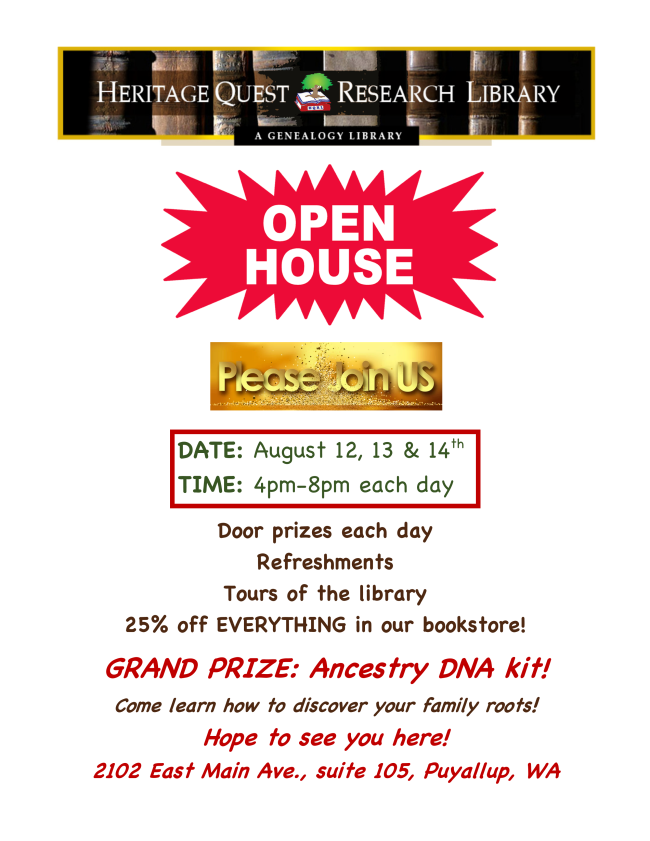
What’s your family’s story?We can help you explore your family heritage! HQRL.com
Heritage Quest Research Library | 2102 East Main Ave Suite 105 | Puyallup, WA 98372 US
You are free to copy articles to any non-commercial web site or message board or printed publication you wish. Don’t bother to ask permission, just do it.




 What’s your family’s story? We can help you explore your family heritage!