America at 250 John McGee & Robert McGee

Among the Revolutionary War patriots in her family is Lee Ann Mauk’s 5th great-grandfather, John McGee (1761–1844), and her 6th great-grandfather, Robert McGee (1730–ante 1793), both Scotch-Irish patriots from New Jersey who contributed to the American cause during one of the most difficult periods of the Revolution.

The Scotch-Irish formed a large part of General George Washington’s Continental Army and played a critical role during the harsh winter of 1777–1778 and the Forage Wars in New Jersey. These engagements involved securing food, hay, and supplies for the army while preventing the British from obtaining them.

Robert McGee served as a Forage Master in 1778, helping procure and transport essential supplies that sustained Washington’s army. His work was vital to the survival and effectiveness of the Continental forces.

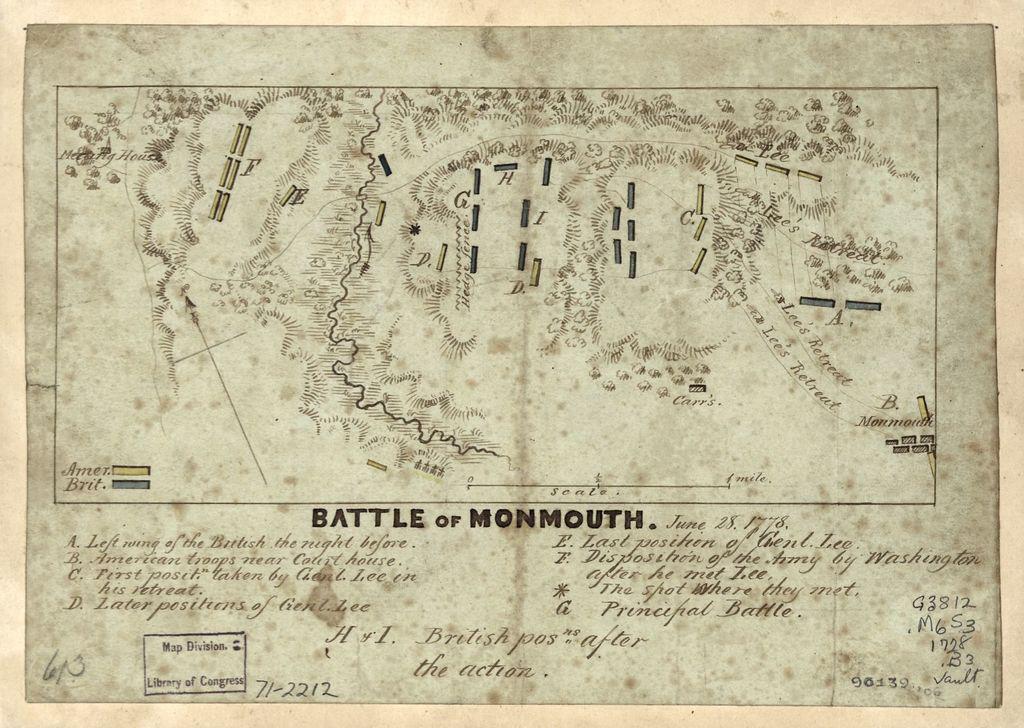
His son, John McGee, served several tours of duty as a private in the New Jersey militia. He served as a wagoner, transporting military hospitals and public stores from Princeton, New Jersey, across the Delaware River to Bethlehem, Pennsylvania. As a member of Captain David Chambers’ Company, he marched to the field at Monmouth, New Jersey, on June 28, 1778. He assisted in guiding General Charles Scott’s troops into action during the battle. After the battle, John guarded the New Jersey shores against British incursions.

The Battle of Monmouth was one of the largest battles of the Revolutionary War and demonstrated the growing discipline on the open field of battle of the Continental Army after the winter encampment at Valley Forge. Washington directed American forces against the British led by General Sir Henry Clinton and Lieutenant General Charles Cornwallis.

America at 250 JOSIAH HOARD BRANDON

JOSIAH HOARD BRANDON

Reverend Brandon was born in Burke County, North Carolina in 1761. Josiah, between fifteen and sixteen years old enlisted under Captain Samuel Davidson to fight the Cherokee Indians. He participated in the building of “Old Fort” and in 1779 joined in pursuit of Captain Cunningham serving in Captain Boykin’s Company of Light Horse Cavalry as a Private and Light Horseman. He served some three years total.

He enlisted again in 1780 to fight the Cherokees who had butchered the John Davidson family, close neighbor of the Brandon’s. During the battle at King’s Mountain Josiah’s father was killed and Josiah was captured, though released shortly afterwards by Major McDowell. Shortly after, he re-enlisted under Captain Boykin to march against Captain Cunningham who was marauding the settled areas of South Carolina near Ninety-Six.

Shortly after King’s Mountain Josiah married Rachel Brown, a childhood friend and neighbor and daughter of Thomas Brown, a noted Quaker in western North Carolina. She was fifteen when they married and lived to eighty years of age after giving birth to some fifteen children. Rachael died in 1847 in Lincoln County, Tennessee. They were married 8 March 1781 in Burke County, North Carolina.

Josiah became a Methodist minister and about 1805 moved to Lincoln County, Tennessee where he lived until his death in 1842. He and his wife are buried opposite his church, Brandon Chapel, near Lynchburg, Tennessee.

Josiah is my GGG Grandfather on my Father’s side. My Grandfather William Riddle married Cora Brandon in 1900 in Tennessee.

Submitted by: Frances L. Riddle Baker-Spuler

Italian Interest Group of the Eastside Genealogical Society No July & August Meetings

Italian Interest Group (IIG) NO JULY & AUGUST MEETINGS
Trascorri un’estate speciale con i tuoi cari in Italia.
Spend a special summer with your loved ones in Italy.
Save the Date
DATE:
TIME:
September 19, 2026
1:30 PM (PT)

COUNTDOWN TO THE MEETING:
Days Hours Minutes Seconds
Italian Interest Group (IIG) of theEastside Genealogical Society P.O. Box 374
Bellevue, WA 98009-0374

Cecellia Rogers Named One of WSGS’s Outstanding Volunteers in 2025

Since 2003, the Washington State Genealogical Society has recognized over 600 outstanding volunteers and teams, nominated by their local society or genealogical organization for their service and dedication. These volunteers are the backbone of their local society, giving their time and expertise, to the organization and the field of genealogy. In the coming months, you will be introduced to each of the 2025 award recipients and learn why they received they received a WSGS Outstanding Volunteer and Team Award.

Today we’re introducing Cecelia Rogers of Seattle, Washington who was selected by the Seattle Genealogical Society as its recipients of a WSGS Outstanding Volunteer Award.

Cecellia has served SGS as our Director of Education since June 2021. She was effective in growing our online educational offerings, including seminars, monthly education programs, and special interest groups (SIGs). She increased the number of SIG offerings, adding the Pacific Northwest, Eastern European, Mexican, Publishing, Artificial Intelligence, Ancestry and Organizational SIGs. To encourage program collaboration between SIG leaders, Ceil initiated a quarterly Educational Program Consortium.

Ceil has also overseen the initiation of several four-week courses for Beginning Genealogy, DNA for Beginners and Organizing for Genealogy. Her participant tracking system has allowed the society to evaluate its offerings. As she exits her role as director of education, Ceil will continue to support our society as Zoom administrator.

For more information on the WSGS Outstanding Volunteer Award program, visit the Recognition page of the WSGS website or contact Info@wasgs.org. Please type “Volunteer Award” in the subject line

Let’s Talk About: Future Proofing Your Genealogy

Thomas MacEntee is a wonderful genealogy resource and has been for several years now. On his website, genealogybargains.com he offers many of his resources for free.

For instance, here’s the link to the above 26-page book:  https://genealogybargains.com/wp-content/uploads/2020/04/EBOOK-After-Youre-Gone.pdf

I urge you to download this resource and read it and heed it! To help ensure you do (smile), I’ll only list the highlights of the book:

* Know the perils of inaction: lost genealogy. I could chill your bones with stories of things I’ve seen of boxes of family heirlooms tossed into the weeds by the side of the road (YES!) and in thrift stores:

* Create an inventory of your research so you know what you have that merits saving.

* Create a list of websites where you posted your tree, or anything about your family, online.

* Realize that you cannot plan just to leave your stuff to your kids, your local genealogy society or library (even the FamilySearch Library in Salt Lake City). They do not want your unorganized boxes of stuff and will not accept such. 

Thomas also includes in his book a list of “Best Practices for Genealogy Future Proofing.” 

I might add my two cents worth to this: I’ve long preached the importance of “Leaving A Legacy & Not A Mess.” YOU gathered all the stuff; it’s totally up to YOU to leave it in an organized, worthwhile fashion. (I took this picture when out walking one day.)

Rosemarie Robins Named One of WSGS’s Outstanding Volunteers in 2025

Since 2003, the Washington State Genealogical Society has recognized over 600 outstanding volunteers and teams, nominated by their local society or genealogical organization for their service and dedication. These volunteers are the backbone of their local society, giving their time and expertise, to the organization and the field of genealogy. In the coming months, you will be introduced to each of the 2025 award recipients and learn why they received they received a WSGS Outstanding Volunteer and Team Award.

Today we’re introducing Rosemarie Boat Robins of Yakima, Washington who was selected by the Yakima Valley Genealogical Society as its recipients of a WSGS Outstanding Volunteer Award.

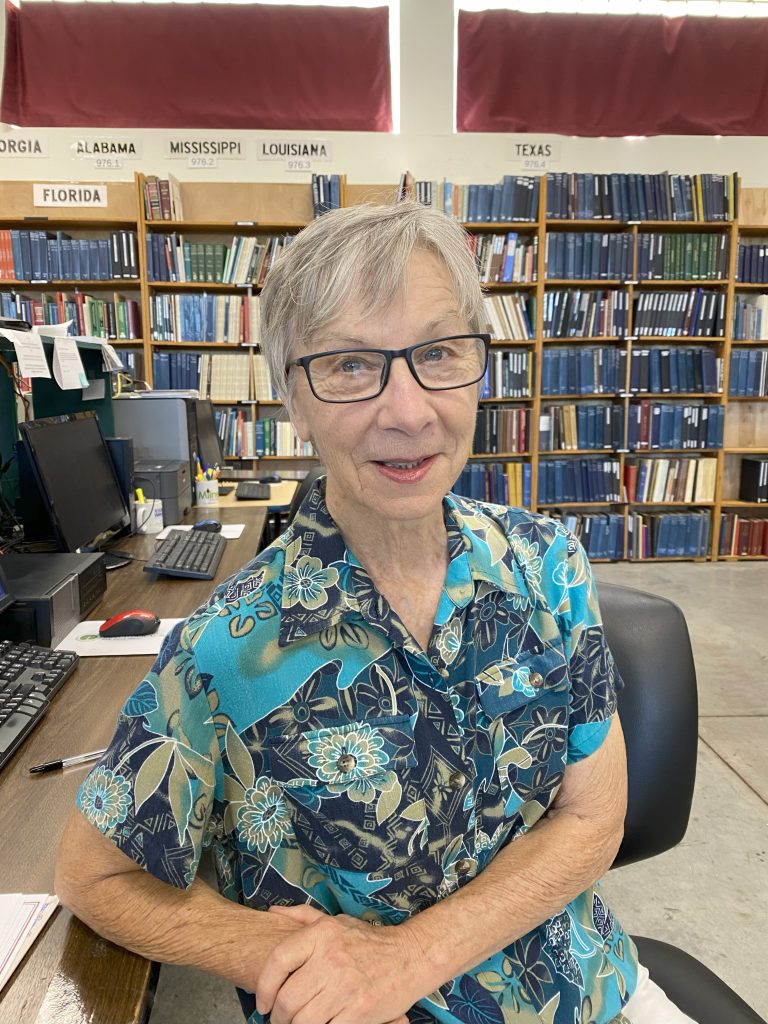
In 2018, Rose became a member of YVGS, and wears many hats in our society, including working as a full-time librarian every Tuesday and is always willing to be a substitute if someone is gone.

With a few other members, she is re-indexing our book collection with better descriptions for locating books for our new card catalog project. Twice a year she is at our yard sale, setting up and taking down tables, folding clothes, selling items and helping customers.  She helps clean up after our monthly meetings and is one of our best workers at our annual library and grounds cleanup day in the fall.

For more information on the WSGS Outstanding Volunteer Award program, visit the Recognition page of the WSGS website or contact Info@wasgs.org. Please type “Volunteer Award” in the subject line

America at 250 Anastasium Staats Sager

Revolutionary War Soldier ancestor, Anastasium Staats Sager, served for New York and had the rank of Lieutenant. He was private in Van Schaick’s battalion in NY in 1776, and a corporal by October 1777. He served in militia companies of Clock and Adam Vrooman. He served in the French and Indian Wars. His sons, Gerritt, Peter, Frederick, Johannes and Adam fought for the British Butlers Rangers and fought against the rebels. They went to Canada. Peter returned to the States and finding his property not confiscated, he remained in the US.

He was born on August 11, 1715, in Highland or Hoogerland, Albany County, NY to Gerrit Segers and Anna Maritje Weigand or DeGroot. He used his middle name as his first name many times. He married Susanna Bradt in December 1740 in Albany. Their children were Garret, Peter Staats, Frederick, Johannes Garret, Adam, Maria, and Adriaan. He died in 1809 in Richmond, Lennox and Addington, Ontario, Canada.

Submitted for Martha McNeill, a member of the Mason County G.S.

America at 250 Joseph Primmer

Cindy Lundberg, May 21,2026

Joseph Primmer my Revolutionary War Patriot DAR Ancestry Number A093232

He was born In Birmingham, Warwickshire, England about 1738. His parents were Charles Primer and Anne Jackson. Charles was a button maker in Birmingham, Warwickshire, England.

Joseph Primmer was playing as a young lad, upon the coast of his native land, where he was shanghaied and pressed into service on a British War vessel. After he finally reached our shores, the next twenty years he was engaged in shipping services on the Hudson River, making his headquarters at Schodack Landing.

Joseph married Maria Shufeldt in 1760 She was from Prussia. Joseph and Maria had five children. William Primmer, (the eldest son, is my line. He was born in 1767 and died 25 of March in 1865 at the age of ninety-eight.) Rachel Earing, Alchey, Peter Primmer, and Deborah Frost.

In 1760 Joseph Primmer and Hugh Wilson moved with their families to the locality formally known as Hoag’s pond and on the Schodack side of the line (Nassau, Rensselaer, Co.) Indians had their wigwams in the neighborhood, which was known as ON-TI-KE-KO-MUCK. The chief was KA-SHE-KE-KO-LUCK. From these Indians Primmer made his purchase of land. The deed which Joseph Primmer received showed the date of May 16,1760. This deed signed by the chief using his mark, Hugh Wilson and John Fitzgerald witnessed the signing. This land was at the head of Hoag’s pond. Primmer’s diet consisted of Hasty Pudding, boiled corn, bread baked in ashes and fried Indian meal cakes.

Hoag’s pond became Nassau Lake after the “Beaver Dam” was in place. Primmer’s property extended westward from the Valatie Kill between the north end of the “Beaver Dam” (now Nassau Lake) and present Central Nassau Road. He built a house and the site of his house was visible as late as 1896. Primmer’s first house may have been on the North side of present Nassau Lake, in Morey Park just west of the Valatie Kill. Primmer was living there as early as 1780’s. It is possible the damming of Hoag’s Pond caused him to relocate to this other location. Primmer cut a direct road from his settlement to Schodack Landing. Traveling over this road he brought back vital supplies including apple seeds which he planted for years. This road was known as the Schodack Landing Road.

DAR records for Joseph Primmer show his service during America Revolutionary War as being a private with the Albany County Militia, 4th Regiment, and Land Bounty Rights. The 4th New York Regiment was one of four established by the New York Provencial Congress at the direction of the Continental Congress for the defense of the King’s Bridge where Manhattan Island joins the mainland, and the Hudson River. This regiment would see action in the invasion of Canada, New York Campaign, the battle of Saratoga, Battle of Monmouth, and the Sullivan Expedition. The 4th Regiment was active May 25th, 1775, to January 1, 1781. They were an Infantry type of Regiment with 720 men. The 4th Regiments merged into the 2nd Regiment of New York on January 1, 1781. A second service Joesph Primmer performed was issuing Land Bounty Rights. Land bounty rights refer to government grants of public land to individuals who served the U.S. military, primarily to encourage enlistment and reward veterans. The rights were active from the Revolutionary War through the 1850’s.

He died sometime between April 9, 1803, and August 10, 1803 (date will probated). His burial place is unknown; he may be buried on his farm at the north end of Nassau Lake in Rensselaer County, New York.
America at 250 Pieter Seger

Revolutionary War Soldier ancestor, Pieter Seger, served for New York. He served for the 3rd regiment under Quackenbos, land bounty rights, for Albany County Militia. He served under Philip Schuyler’s regiment NY Militia.

He was born on December 6, 1742, in Albany, NY to Anastasius Staats Seger and Susanna Bradt. He married Hannah Houck (Annatje Huyck) in 1770. Their children were Susanna, John, Lewis Lodowick, Magdalena, Mary, Staats Peter, Adam, Catherine Jane Glick, Frederick, and Conrad. He died in February 1826, at age 86 in Bethlehem, NY and was buried in the Jerusalem Cemetery in Feura Bush, NY.

Submitted for Martha McNeill, a member of the Mason County G.S.

America at 250 Frederich Titius/Decius

My Patriot Ancestor

Frederich Titius/Decius

b. 1762 Ashersleben, Saxony Anhalt, Hanover, Germany d. Sept. 1826 Shenandoah Co. VA

Frederich Decius is my is my 4x Gt. Grandfather on my fathers side.

Born in Hanover Germany, Frederich Tisius/Decius at age 14 was conscripted by Col. Albrecht von Schneiter for King George of England to be sent to America to fight against the Americans. He is registered in the British Army records as enlisted 25 Aug 1776 in the 4th Regiment of the Company of Capt. John Webster arriving in New York City 30 Dec 1776.

He deserted the British Army on 18 June 1778 after the Battle of Brandywine along with 2 other young men, Effinger & Fauchs(Fox). .

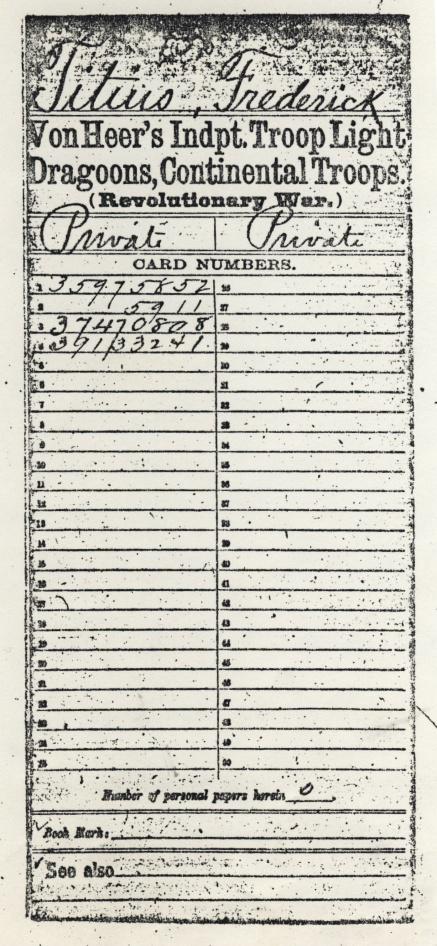
He was hidden by German families in eastern PA until he joined Col Bartholomew von Heers Unit 986  Marechaussee Corps on the 15th of March 1780 and served as a private in this unit until it was disbanded 4 November 1783 . This unit of the American Army served as George Washingtons Provost Troop of Light Dragoons or mounted military police. The men of this early MP organization, participated in combat, fighting with General Nathaniel Greene’s army in the Battle of Springfield, New Jersey, June 1780. The next year, the Corps protected General Washington and his headquarters during the siege of Yorktown, the last major battle of the American Revolution. Frederich received bounty land in Shanandoah Co., VA and raised his family there but never requested a pension. .

FYI- The spelling of Titius was legally changed to Decius in 1818 by the Gov. of VA as there was so much confusion on the spelling and pronunciation . The T is pronounced like the English D and in Frederich’s land and court records we find 11 spellings of the name up until the change. Frederick signed his deeds etc in English but wife Magdalena kinda of used a combination of English/Gothic.