Jewish Genealogical Society Upcoming Meetings

From Matches in a List to Family: Case Studies in DNA” “by Mary Kathryn Kozy, Genealogical Lecturer

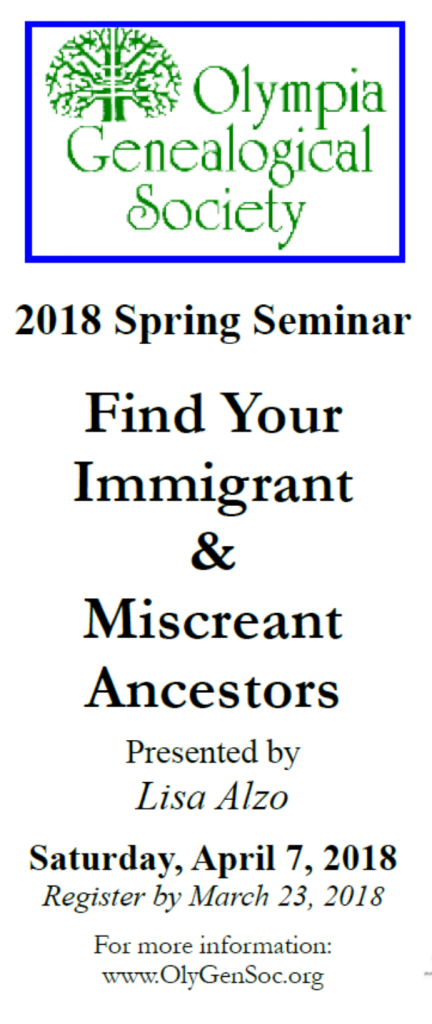
DATE:  Monday, December 11, 2017

LDS Factoria Building
4200 124th Ave SE
Bellevue, WA  98006

   Doors open at 6:30 p.m., for all to enjoy the extensive JGSWS Library’s genealogical resources!

   Free Wi-Fi available

  Presentation starts promptly at 7:15 p.m.

  Free admission and refreshments

ABOUT OUR PROGRAM:  As more and more people decide to DNA test, the bigger our match lists become! With somewhere close to eight million people in the test pool amongst the four major companies, we have many more matches to deal with. What does one DO with them all? How can we organize them? What are the best practices for sorting them out, especially when dealing with endogamous populations? This lecture will focus somewhat on the use of various tools at the DNA testing companies, but will also deal with several case studies in actually finding the relationships between various unknown individuals. What if the DNA match has no tree? Is it hopeless? Absolutely not! Come learn some tips and techniques for taking those matches and turning them into family.
ABOUT OUR SPEAKER:   Mary Kathryn Kozy has been working on her own family history for over 35 years. She has researched families from the Midwest to the Deep South and from both Western and Eastern Europe. She has served in multiple positions in several local societies and on the state level. She currently serves on the board of the JGSWS, serves as a part-time LDS Family History missionary, and speaks to many groups in the area. Mary is married, the mother of three wonderful children and two grandchildren. She holds bachelor’s degrees in both Zoology and Information Technology & Systems and has completed three certificate programs with the National Institute for Genealogical Studies. She has also completed the ProGen program with an eye toward certification as a professional genealogist.

“Reclaim The Records: Genealogy Fought the Law and Won” (How to Use State Freedom of Information Laws for Genealogy) , presented by Brooke Schreier Ganz

DATE:  Monday, January 8, 2018

LDS Factoria Building
4200 124th Ave SE
Bellevue, WA  98006

    Doors open at 6:30 p.m., for all to enjoy the extensive JGSWS Library’s genealogical resources!

    Free Wi-Fi available

   Presentation starts promptly at 7:15 p.m.

   Free admission and refreshments

ABOUT OUR PROGRAM:  Tired of being told by state and local archives and government agencies that your family’s genealogical records are “unavailable” to the public or only available if you visit them onsite? We were too, so we figured out what to do about it. We’re Reclaim The Records, a new activist group that filed a first-of-its-kind Freedom of Information Law (FOIL) legal petition in the Supreme Court of New York against the NYC Municipal Archives in order to access to twentieth century genealogical records…and won! We also secured the first-ever public release of the indices to hundreds of thousands of vital records from the New Jersey State Archives. And we’re filing many more requests against city and state agencies, large and small. This presentation will tell the story behind these cases, walk through the legal basics of FOIL, and teach genealogists how to file their own FOIL requests for their own records.

ABOUT OUR SPEAKER:  Brooke Schreier Ganz is the founder of Reclaim The Records, a not-for-profit activist group that uses state Freedom of Information requests to return genealogical records to the public. As the former Vice President of Gesher Galicia, she designed and built their website, including its innovative “All Galicia Database”. The underlying search engine codebase, named “LeafSeek,” was released by Brooke as a free open source project, for which she won second place in the 2012 RootsTech Developer Challenge. She further refined it to build the bilingual “All Israel Database” for the Israel Genealogical Research Association (IGRA). She lives in California

Nostalgia Wednesday

What do you know about golf balls? Would you have guessed that for hundreds of years prior to 1850, golf balls were made of a leather circle stuffed with feathers? In the 1840s, various experiments were performed to make a golf ball from a certain kind of tree gum which had immediate appeal. Next came the rubber-core ball in 1898….. and the simple round golf ball has become more and more sophisticated. Next time you play a round of golf, take a moment to think what’s inside that white round ball.  (I took these photos in the Arlington Country Club, near where the Stillaguamish Valley Gen Society held their conference last August.) 


Wednesday Nostalgia

What do you know about Washington’s oldest apple tree? Here is my photo of the tree in early spring but the tree still produces apples!


Vancouver, Washington’s “Old Apple Tree” (“Mallus spp.”) was one of five seeds planted in late 1826 and then eventually placed outside of the gates of the first Fort Vancouver. The seeds for the tree were brought over from England by Emilius Simpson. The “Columbian.com” website, covering local history of Vancouver, tells the story:

“… It all started at a party in London … A lady at a farewell dinner party for Lieut. Emilius Simpson, the cousin of Hudson’s Bay governor Sir George Simpson, playfully put the seeds of her desert apple into his waistcoat pocket. She asked him to plant them when he arrived at his destination on the other side of the world. Emilius Simpson arrived in Vancouver in November of 1826 and was soon invited to dine with Dr. McLoughlin in the stockade on the present Deaf School site. During the evening he absentmindedly stuck a finger into his waistcoat and discovered the seeds. Dr. McLoughlin, Simpson and Pierre C. Pambrun planted the apple seeds in small boxes which were put under glass. Dr. McLoughlin kept the boxes in the store where they could not be touched. The apple tree was planted outside the fort when he felt it could survive. Around 1830, Washington’s first apple harvest occurred. It was here in Vancouver, and produced one apple. …” [“Columbian.com” website, 2007, “Local History, Old Apple Tree”]


Tuesday Trivia

We all know that “the Pilgrim Fathers or Planters” were those who arrived in what-would-become American shores in 1620 aboard the ship Mayflower, right?  Wrong.

“We may define, roughly, the “Pilgrim” Planters as those who came to New Plymouth in the Mayflower in 1620, and in the Fortune in 1621, and  in the Anne and Little James in 1623, and the Mayflower (again) in 1629. There were a few, closely related to this group, who came over in the Handmaid, and other ships, in 1630 or soon thereafter.

So how would you define the difference between a Pilgrim and a Planter?

(History and Genealogy of the Mayflower Planters, by Leon Clark Hills, 1936, published in the Cape Cod series, Vol. 1 and 2.)

Genealogical Forum of Oregon Upcoming Events

Thank you so much for sharing GFO’s events with your patrons!

Below are links to flyers for our upcoming events at GFO.

If your organization has events or news items you’d like GFO to share, please email news@gfo.org.

Saturday, Dec 16th, 2 – 3pm, at GFO’s Library

December GenTalk – Personal Archiving

Presenter: LauraDenise White, GFO’s Resident Archivist

Personal Archiving – Flyer

Wednesday, Jan 31st, 9:30am – 6pm, at GFO’s Library

Winter Workshop – Beginner’s Boot Camp

Presenter: Laurel Smith, GFO’s President

Beginner’s Boot Camp – Flyer

Continue reading

Tri-City Genealogical Society December Meeting


Our December 13th meeting will be at the Benton County PUD Auditorium in Kennewick on the corner of Hwy #395 and 10th Street.
Beginning Genealogy Class: Genealogy Education – 6:15 p.m. to 6:45 p.m.
Program: 7:00 p.m.
Show Off Your Heritage
 
Members and guests are asked to bring items about your family heritage/history as well as what you interests you have.
1. Photographs
2. Documents
3. Family heirlooms, antiques
4. Hobbies, collections or recreation interests
Your legacy will one day be handed down to your children/grandchildren/great-grandchildren and they will want to know what hobbies and collections you had as a child/teenager or as an adult. So, bring whatever you use to collect or still collect or photographs or a sample of what you use to collect as a kid/young adult.
You can display your family photographs and documents on a poster or a tri-fold or on the table.
This will be a fun event for everyone to have a glimpse of your family history as well as the antiques/heirlooms, hobbies and collections that you either inherited or have or previously engaged in.
Heather Murphy will bring her “ShotBox” to demonstrate as well as for anyone to use, so please bring your own cell phone or a smart phone which may be even better. Please bring your own photos/small items to be photographed. For more information/description of the ShotBox, please see their website:
Sandra Floberg will bring her “Flip-Pal” to demonstrate which is another “must see” tool. You can visit the website which is:
Refreshments:
Please bring homemade or store bought cookies, candies, fudge, muffins, quick breads (banana, zucchini, apple, pumpkin), cake, etc.  Beverages of water and/or 7-up/Sherbet will be provided.
If you have any questions, please do not hesitate to contact me.
Thank you for your continued interest in TCGS.
Art Kelly

Tri-City Genealogical Society Tip of the Week

Timelines: How to Get More Out of What You Know

Whenever you start researching an individual or family one of the most helpful things to do is make a timeline, or chronology, for them. By creating an outline of what you know you can gain ideas of where to search for the additional information you need and identify conflicts with the information you already have.  Timelines are especially useful with families that have not lived in the same place…

Heather Murphy

TCGS Social Media Manager

Seattle Genealogical Society Tip of the Week

TIP OF THE WEEK –
NATIONAL ARCHIVES SEARCH IMPROVEMENT

If you haven’t tried a surname search in the National Archives Catalog in awhile, Claire Kluskens, Archivist with the National Archives, urges you to try again as there are so many newly indexed databases.

A search for the surname “Bode” provides good examples of what’s been added thus far. On the first page, there are references to persons named Bode in:

  • Labor Camps Bibliography

  • Military Service Records

  • Records of Lawrence Walsh, related to Iran/Contrai

  • Military fatal casualties of Vietnam

  • Presidential Appointments by Harry Truman (Post Masters were presidential appointees)

  • Records of the US Naval Academy

  • Records of the US Fish & Wildlife Service

  • Naturalization Index

  • Prologue article on Chinese Exclusion Act files

  • OSS Art Looting investigation

And, that’s only the first page!!

Just put your surname of interest in the search box at the top right of the home page:
http://archives.gov

Give it a try. What might you find?

This tip was modified from “The Twelve Key”, informational blog about U.S. archival records, by Claire Kluskens, archivist of the National Archives in Washington, DC., 4 November 2017.

If you would like to follow  “THE TWELVE KEY” , go to:
https://twelvekey.com/

Enter your email address to receive notifications of new posts by email. Remember you can unsubscribe at any time.