Yakima Valley Genealogical Society Spotlighting the Book

Yakima Valley Genealogical Society spotlighting the book:

The Refugees of 1776 from Long Island to Connecticut by Frederic Gregory Mather, published in 1913, is held in our library at Yakima Valley Genealogical Society.

This 1,204 page book deals with the refugees from Long Island, New York during the American Revolution and the movement of the families as the British invaded Long Island, New York.

Mr. Mather did much research in documents to compile this wonderful book. His book starts out with a history of the Revolutionary War and how it affected Long Island, New York. He discusses the early peopling of Long Island, their environment, their economics, their religion and their stance as the war began. This book covers over 1,316 or more individuals who fled from the British. There are 638 pages of families that he researched who sheltered in Connecticut or were involved in Long Island in some way. Mr. Mather also has a chapter on refugees who fled from New York City to Connecticut in 51 pages. The general index of names in this book is around 22,428 names. There is a census taken in 1776 and he focuses on the refugees in this census. He delves into records of reimbursements to the families who had to supply the American troops, reimbursements for lost property the British stole during the war and for reimbursements of supplies delivered by ship owners and also military men who asked for reimbursement. He has a chapter on captains and masters of ships. There are appendixes on men that served in the military associated with Long Island. Mr. Mather has many charts, statistics, over 63 photos of homes, and also maps.

If you have family in Long Island and do not have access to this book, come spend a day in Yakima at our library to research the book alone!

Let’s Talk About: Wind Power, Yesterday & Today

Being an unashamed history buff, I nearly teared up when I came upon the picture on the left. How vitally important the old windmills were to our ancestors! Now likely only a few isolated farms rely on windmills. Our electricity comes with a button. 🙂 


If you take the back road from Ellensburg down to Vantage, you will come to the Wild Horse Wind and Solar Facility and Renewable Energy Center. This is a fascinating place and you’ll come away with a greater understanding and appreciation of the benefits to us from these ginormous wind turbines dotting our state. 


For instance: did you know that each single blade averages 200 feet long and requires a L-0-N-G trailer for transport? Most towers have elevators for maintenance to the top and each tower costs about $1,000,000 (so I was told). The “box” at the top may look small but it’s the size of a school bus! Towers are 221 feet high and weigh 104 tons. 


This facility has 149 turbines spanning across 10,000 acres. The facility can generate up to 273 megawatts of electricity, enough to serve an average of 60,000 homes annually. 


Wild Horse benefits the surrounding community by creating jobs and providing leasing income for landowners. The facility also produces significant local tax revenue.


The Visitors’ Center provides visitors with an up-close look at turbines as well as 360o views of Mount Rainier, Mount Adams, Mount Hood and the Columbia River Basin. Tours are offered and their educational displays are super.


NOTE: Do check before you go. As I was researching for this post, the facility was temporarily closed. 

Let’s Talk About: Rollling Palouse Hills

“Our wonderful Palouse region is the most serene and pastoral of the seven wonders of Washington State. It is a region in southeastern Washington characterized by gentle rolling hills covered with wheat fields. The hills were formed over tens of thousands of years from wind blown dust and silt, called loess (and pronouned luss) from dry regions to the southwest. Seen from the summit of 3612-foot high Steptoe Butte they look like giant sand dunes because they were formed in much the same way. The Palouse hills are not only a landscape unique in the world but they are beautiful to behold and worthy to be on the list of Seven Wonders of Washington State.”

This was an excerpt from Howard Fisk’s book, The Seven Wonders of Washington State: Your guide to exploring the natural wonders of the Evergreen State, published in 2015 and available via Amazon. 

Green in the spring, golden brown at harvest time and snowy white in winter…. Washington’s Palouse is a beautiful and very unique region.

Heritage Quest Research Library Researching in German Church Records

Explore the Exceptional Genealogy Classes at HQRL! Join us online via Zoom or in person at HQRL and connect with fellow genealogy enthusiasts who share your curiosity and drive—together, we can explore the fascinating world of family history! JOIN US for our next class on August 6, 2026! Don’t miss out, sign up today! CLICK HERE to register for this class! Visit our blog for great tips & hints exploring your family story! Click Here to See All of Our 2026 Classes! HQRL.com / Classes & Events / Contact
Heritage Quest Research Library | 2102 East Main Ave Suite 105 | Puyallup, WA 98372 US

South King County Genealogical Society August 2026

Happy Summer! ☀️🌺

All SKCGS Members and their loved ones are invited to join us in our potluck social! Local Members, search your email for Signup Genius for more details. Please respond with what you plan to bring to the lunch social as soon as possible.

Help Wanted

Your Education team is planning the 2026-27 Speaker Series. We would like to hear recommendations of speakers and programs you have found engaging, useful and that you think your fellow SKCGS members would enjoy. Please write to Education@skcgs.org and share your thoughts, or become part of the team! Most of our small meetings continue through the summer; our Speaker Series and the Research Workshop will resume in September. 

Stay connected! Get updates on our virtual and in-person events, plus the latest genealogy news and tips, by subscribing (free) to the online group at https://skcgs.groups.io

Skcgs.groups.io is the SKCGS online platform for discussion and information sharing:

  • we communicate and share information with each other
  • other than your email, you are not required to provide personal information
  • you can unsubscribe or change your email format at any time

PROGRAM UPDATES

All meetings are online except the in-person Research Group and Genealogy Help at KCLS Auburn, Federal Way, and Renton Main library branches. 

Live transcription (captioning) is available during our Zoom meetings by request.

Online meeting participants need to register for SKCGS Zoom meetings. Upon registration, Zoom will send a confirmation email with instructions on joining the meeting. https://www.skcgs.org

*Local Members: We are looking forward to seeing you soon at the potluck social in early August. Please carpool if possible because parking is limited.

AUGUST TO EARLY SEPTEMBER  2026 MEETINGS & EVENTS

All meetings are Pacific Time (PT) zone

Register at https://www.skcgs.org for all meetings unless otherwise stated.

Saturday, August 1, 10–11am PT: Family Tree Maker User Group (Online). Topic: General Q&A for the Family Tree Maker Program. Subscribe to the free SKCGS FTM email list for meeting reminders and discussion: https://skcgs.groups.io/g/FTMUG.

****

Monday, August 3, 11:30am-3:30 pm PT: SKCGS Members  Potluck and Social. Members’ loved ones are welcome. If you don’t see a link to sign up to bring food, your membership has expired. Renew or sign up as a new Member, and you are invited!

****

Monday, August 10, 1–2pm PT: Genetic Genealogy/DNA Interest Group (Online). Topic: Research  at Family Tree DNA if You Did Not Test There.

1. Test someone else! or upload for someone else with permission

2. Upload your autosomal raw data from another testing company

3. Get permission from a family member to see their kit results

4. Upload to Gedmatch and/or MitoYdna.org to compare results with FTDNA testers

5. Connect your DNA tests to your Wikitree profile for hints to matches; Geni profiles can also link to FTDNA.

6. Use public Y DNA Project data at FTDNA and/or Wikitree

7 Check mail lists at Groups.io, GoogleGroups, & Substack

We are genealogists who use DNA data as part of their research. Join the free email group for meeting notices and discussion: https://skcgs.groups.io/g/Genetic-Genealogy

Wednesday, August 12, 2–3 pm PT: WikiTree Users(Online): Topic: Wikitree Goals through 2026. How can we help one another make our part of Wikitree the best? Let’s share profiles and learn together. Wikitree Users collaborate to create the best collaborative tree on Earth. Join our free online group: https://skcgs.groups.io/g/Wikitree-SIG.

Thursday, August 13, 11am–1:pm:Genealogy Help with SKCGS at Renton Main Library (In-person). Genealogy questions? SKCGS offers one-on-one help with a volunteer. 100 Mill Avenue S, Renton

Monday, August 17, 1–2 pm PT: Tech Users Group (Online). Topic: Putting it All Together: Practical Research Routines. What are the tools, nuts & bolts we can share with one another–using online sites, platforms, and software that not just move the research forward, but also build confidence in what we think we know. See: Genealogical Research Process Simplified:  https://youtu.be/G0poOZn6rfw?si=cz3XNXddACtStmEn (20 mins).Tech User Group shares knowledge and learns about technology tools, media, apps and websites. Join our free email group for meeting information and discussion: https://skcgs.groups.io/g/TUG.

Thursday, August 20: Genealogy Help with SKCGS (in-person). Genealogy questions? SKCGS offers one-on-one help with a volunteer

  • 11am-1pm: Auburn Library: 1102 Auburn Way S, Auburn
  • 2-4pm:  Federal Way Main Library: 34200 1st Way S, Federal Way

Monday, August 24, 1–2pm PT: Genealogy Chat (Online). Meet up and chat about genealogy subjects and topics. We have no agenda; we just like one another! Join our free online group for Chat reminders and genealogy discussion: https://skcgs.groups.io.

Saturday, September 5, 10–11 am PT: Family Tree Maker User Group (Online). Topic: General Q&A for the Family Tree Maker Program. Subscribe to the free SKCGS FTM email list for meeting reminders and discussion: https://skcgs.groups.io/g/FTMUG

Tuesday, September 8, 1–2pm PT: SKCGS Board Meeting (Online). Write to Board@skcgs.org for the Zoom link. 

Wednesday, September 9, 2–3pm PT: WikiTree Users (Online). Topic: Space Pages? Creating & Using this flexible tool. Bring your questions and examples. Wikitree Users collaborate to create the best collaborative tree on Earth. Join our free online group: https://skcgs.groups.io/g/Wikitree-SIG

Thursday, September 10,11–1pm PT: Genealogy Help with SKCGS at Renton Main Library. Genealogy questions? SKCGS offers one-on-one help with a volunteer. 100 Mill Avenue S, Renton.  

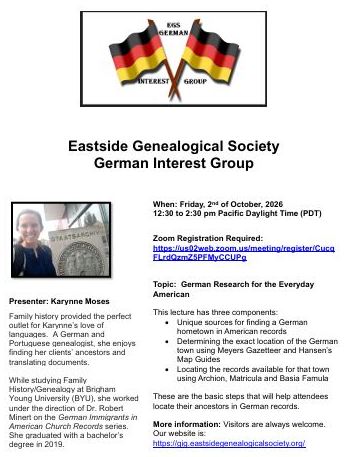
Friday, September 11, 12:30–2:30 pm PDT: EGS German Interest Group: 1816: The Year Without a Summer & Its Impact on German Migrationby  Carolyn Schott, CG® 

Visitors welcome: https://gig.eastsidegenealogicalsociety.org/

Registration is required:   https://tinyurl.com/2s4z4c8z  

The eruption of Mt. Tambora in Indonesia unleashed a volcanic winter that reverberated around the globe, earning the year 1816 the name “The Year Without a Summer.” Immense quantities of volcanic ash drastically altered weather patterns and created unseasonably cold temperatures that caused crop failures and food shortages. This crisis prompted many Germans to seek new opportunities abroad, both in the U.S. and in the Russian Empire, which offered both land and religious freedom.

 This presentation discusses the intertwined environmental, economic, and social ramifications of the Year Without a Summer, highlighting its pivotal role in the history of German emigration.

Presenter Carolyn Schott, CG® has researched her German ancestors for 30 years, following their wanderings through Eastern Europe before arriving in the U.S. She is a founder of the Black Sea German Research Community (www.blackseagr.org), a former board member of the Germans from Russia Heritage Society (GRHS), and author of the book, “Visiting Your Ancestral Town.”

Schott’s research has required her to research records in the U.S., Germany, Ukraine, Moldova, Hungary, and Poland. The Black Sea German Research Community, which she helped found, is a website dedicated to helping people with hard-to-find information on their ethnic German ancestors who lived in areas bordering the Black Sea. She has been speaking on genealogy-related topics since 2007 and has been a regular speaker at the International German Genealogy conventions, the Foundation for East European Family History Studies, the American Historical Society of Germans from Russia, and other genealogy societies. This presentation will not be recorded.

Monday, September 14, 1–2pm PT: Genetic Genealogy/DNA Interest Group (Online). Topic: Using DNA Matches as Clues to Build Your Tree. See Dare to Grab the Gold Ring: https://skcgs.blogspot.com/2024/04/dna-dare-to-grab-gold-ring.html,  How to Use DNA Relatives Clustering at 23andMe: https://customercare.23andme.com/hc/en-us/articles/38509301730839-How-to-Use-DNA-Relatives-Clustering-at-23andMe & Building Family Trees with DNA Evidence: Beginner’s Guide: https://www.gedmatch.com/blog/building-family-trees-with-dna-evidence-beginners-guide/

We are genealogists who use DNA data as part of their research. Join the free email group for meeting notices and discussion: https://skcgs.groups.io/g/Genetic-Genealogy

Thursday, September 17: Genealogy Help with SKCGS (in-person). Genealogy questions? SKCGS offers one-on-one help with a volunteer

  • 11am-1pm: Auburn Library: 1102 Auburn Way S, Auburn
  • 2-4pm:  Federal Way Main Library: 34200 1st Way S, Federal Way

————————–

MEMBERSHIP:  We welcome guests to our meetings and special interest groups, which are free. Naturally we hope that visitors will want to become members. Support like yours helps us to educate and engage with our community to foster interest in family and local history. You can find more information about membership at our website at https://www.skcgs.org/support-skcgs/membership.

You are receiving this email because you have attended a SKCGS meeting and indicated you would like to receive periodic notice of events. If you would like to be removed from our list and stop receiving emails from us, send an email to skcgsfriends+unsubscribe@skcgs.org.

Like – Facebook :: Blog :: Website – SKCGS.org :: Member support – info@skcgs.org

SOUTH KING COUNTY GENEALOGICAL SOCIETY

Tacoma Pierce County Genealogical Society Legacy Family Tree SIG

Tacoma-Pierce County Genealogical Society Legacy Family Tree SIG Meeting

Tuesday, August 4, 2026, from 7:00 pm to 8:30 pm virtual via Zoom

This month using notes provided by Siri Nelson 2022-09, Making a gedcom for DNA tree uploading, Tagging/Hashtags and things that might be useful to hashtag.

This is our monthly meeting to share tips & tricks, problems & solutions. Sometimes we will watch videos or share our screens to aid in learning more about using Legacy Family Tree software. 

Everyone is welcome to attend and participate in the learning. If you are just thinking about trying Legacy for the first time, you’ve been using it for a year or two or you are an old pro with many years of experience using Legacy this is the group for you.

We look forward to meeting with you, every month on the First Tuesday at 7:00 PM Pacific Time

Please download and import the following iCalendar (.ics) files to your calendar system.

Monthly Calendar Reminder: https://us02web.zoom.us/meeting/tZYpfuyuqDovHNwtBgxtQjWKOjDQ8k5Q9bPD/ics?icsToken=98tyKuGqqjIvHNKUtR-PRpwQBor4Z-7wpn5Ygo1KiD3iGzRiaDTdGehmA-p0RemJ

Join Zoom Meeting:

https://us02web.zoom.us/j/82495661568?pwd=dy85YmluVzF5aEU4SzFTcTUrVDlTUT09

Meeting ID: 824 9566 1568

Passcode: 715731

One tap mobile:

+12532050468,,82495661568#,,,,*715731# US

+12532158782,,82495661568#,,,,*715731# US (Tacoma)

Dial by your location:

+1 253 205 0468 US

+1 253 215 8782 US (Tacoma)

Meeting ID: 824 9566 1568

Passcode: 715731

Find your local number:

https://us02web.zoom.us/u/kcphK19I1E

Let’s Talk About: Oregon Grape…Jelly?

 But it is NOT a grape and its origin is NOT Oregon. So how come???

Also known as Holly-Leaved Barberry and Mahonia, this plant has been used by Indigenous peoples of North America for centuries as a food source and a medicine. Lewis and Clark collected specimens of this plant on the expedition of 1804-1806. 

Since these berries are ubiquitous to our area, here’s the recipe for “Mahonia Berry Jam: a stunning wild preserve made from the tart, vibrant berries of the Mahonia shrub, also known as Oregon Grape. Those these berries are mouth-puckeringly sharp when raw, they transform beautifully into a glossy, jewel-toned jelly with a tangy zing. “

To make 4 small jars of Mahonia Berry Jelly:  Gather about 3 1/2 pounds of ripe Mahonia berries, stalks removed and rinsed. Put in large pot with 2 1/2 cups water and bring to a boil, simmer for 20-25 minutes, mashing berries with a spoon or potato masher to release the juices. Pour the mixture through a jelly bag or muslin-lined sieve into a clean bowl. Let it drip overnight. For the clearest jelly, avoid pressing the pulp.

For every 2 1/2 cups of juice, use one pound of sugar (less to taste). For a firmer set, you can add a teaspoon of pectin if Mahonia’s natural pectin content isn’t enough. Add the lemon juice. 

Still continually over low heat until sugar has fully dissolved, then bring the mixture to a rapid boil. Boil until the jelly reaches setting point (104oC or 220oF). Pour into warm, sterilized jars and seal. 

TIP: Pick RIPE berries only; under ripe berries are overly bitter. 

If anybody makes this jelly, I’d surely like to know how it was. 🙂 

Certification Discussion Group Classes

Are you considering certification through the Board for Certification of Genealogists, or would you simply like to understand the certification process more fully? The Certification Discussion Group offers an opportunity to learn about the requirements, standards, and portfolio elements involved in becoming a certified genealogist.

The next series begins on 2 November 2026 and includes seven virtual sessions, meeting on Mondays and Thursdays. Participants will explore the certification process in a supportive  setting and gain a clearer understanding of what is expected in a successful portfolio.

All classes are held online, making the program accessible from anywhere.

Go to the website for more information and to sign up for our registration email  (coming in September)  https://theCDGseries.wordpress.com.

Let’s Talk About: Cranberry Glass

Do you recall your mother or grandmother having any cranberry glass? This very special type of glass became famous in the Victorian Era in Britain and came with the English immigrants to America. Cranberry glass creations were most popular as a table display, often holding candy or flowers. 

If you happen to have one of your grandmother’s cranberry glass pieces, please know that it is highly collectible but its value varies wildly from $10 to thousands of dollars! The value of the piece is determined by the amount of gold used to make the rich color.

Antique cranberry glass is occasionally found in old outhouse pits (privies). Before city trash pickup, people threw broken household trash—including expensive glassware—into outhouse holes. 

I became intrigued when viewing a YouTube video where a fellow found cranberry glass in an old privy pit! (No comments on my eclectic viewing habits, please. 🙂 Videos

Cranberry Glass and a Small Figure – Bottle Dump FindsYouTube · Mudlarking with SteveDec 15, 2025YouTube · Mudlarking with Steve

Italian Interest Group Update on FamilySearch and Italian Records

Italian Interest Group (IIG) SEPTEMBER 2026 MEETING
Click to Request the Zoom meeting invitation
DATE:September 19, 2026
TIME:1:30 PM (PT)
TOPIC:Update on FamilySearch and Italian Records
PRESENTER:
Joel Cole
Description:   In this presentation “Update on FamilySearch and Italian Records,” the following topics will be discussed: An overview of the principal repositories of Italian genealogical and historical records throughout Italy.The latest updates and developments on the FamilySearch website.Recent developments in FamilySearch’s collaboration with the Direzione Generale Archivi (DGA) and other Italian institutions.Future expectations regarding Italian records, including upcoming acquisition initiatives and the availability of new indexes and searchable collections.
Presenter: Joel Cole was born and raised in Padova, Italy. He has been involved with Italian Family History for over 30 years. He accompanied his father Trafford for his first genealogical research in Maniago, Italy, when he was 15 and since then he has been fascinated by family history. He has worked as a researcher for over 25 years, visiting almost every State Archive in Italy and almost 1,000 parish archives. He is familiar with paleography having taken several classes in Italy, and with Latin documents, having studied it for over 10 years. Joel has presented in many international genealogical conferences about Italian Family History and has worked for years for private companies performing research in all of Italy, consulting Civil records, Parish and Diocesan Catholic records, Notary records and many more sources. In 2015 he moved to Utah covering several roles for FamilySearch. He is currently the content strategist for Southern Europe, including Italy. Joel’s research specialties are: Italy, Southern Switzerland and Istria-Croatia. Expert at deciphering ancient Italian and Latin documents.
COUNTDOWN TO THE MEETING:
Days Hours Minutes Seconds
Italian Interest Group (IIG) of theEastside Genealogical Society P.O. Box 374
Bellevue, WA 98009-0374