 Explore the Exceptional Genealogy Classes at HQRL! Join us online via Zoom or in person at HQRL and connect with fellow genealogy enthusiasts who share your curiosity and drive—together, we can explore the fascinating world of family history! Just a reminder of upcoming class March 5, 2026! Don’t miss out, sign up today! Explore the Exceptional Genealogy Classes at HQRL! Join us online via Zoom or in person at HQRL and connect with fellow genealogy enthusiasts who share your curiosity and drive—together, we can explore the fascinating world of family history! Just a reminder of upcoming class March 5, 2026! Don’t miss out, sign up today!  What is Your Name? Thursday, March 5, 2026 Virgina Majewski Join Virgina Majewski to learn about naming patterns. She will explain the use of four research concepts to improve your success when researching surnames and given names. (“Ginny” is a fourth generation Washingtonian and descendant of a WA Pioneer family.) Virginia has been involved in genealogy for the past 30 years. It all started with a couple of boxes of “junk” from her grandparent’s estate. She was bitten by the genealogy bug and it became one of her life’s passions. Virginia holds a Certificate in Advanced Genealogical Studies in both American Records and Methodology, from the National Institute of Genealogical Studies, Toronto, Canada. Her specialty is Mennonite Research. Currently, she is President of the Clallam Co. Gen. Society. Virginia is Past President of the WA State Gen. Soc., as well as a member of numerous other genealogical societies. She initiated the Pioneer Pursuit program with WA State. Click Here to Sign-up Click Here to See All of Our 2026 Classes! BONUS RESEARCH HOURS!!! Research Sunday March 8, 2026 10am-4pm Heritage Quest Research Library will be open on Sunday, March 8th, from 10am-4pm allowing you to come in and work on your family genealogy. As always, our very skilled Librarians will be available to assist you, so don’t miss out on these special hours! Visit our blog for great tips & hints exploring your family story! HQRL.com / Classes & Events / Contact |
| Heritage Quest Research Library | 2102 East Main Ave Suite 105 | Puyallup, WA 98372 US |
Let’s Talk About: Dead Fred, A Delightful Website


What can you do here? “Trace your roots for free with our searchable dtabase containing thousands of identified and mystery photos for genealogy enthusiasts looking for long-lost family.” Wowsers, indeed!
Did you catch the word “free?” And could you read the fine print under the photo? 23,659 surnames, 163,161 records.
At this really fun website (and it’s FREE to use, remember) you can search photos and post photos. I searched for the surname “Gurney,” and there was one entry, for baby Forrest Gurney. I don’t know where he fits into my tree, but I’ll be looking.
Do check out www.DeadFred.com. You’ll be glad you did.
Let’s Talk About: Baby Names…Opinion, Please?

One of my favorite things to do is, when I spot a nametag showing a most unusual name, I’ll ask that person, “How did your mother come up with such an unusual name?” And most usually they know! And are happy to share their story.
Besides the baby girl names listed above, Google helped me find rare baby girl names: Perach, Phannie, Salomi, Megara, Caliste, Lune, Zixuan and Darana. (Yes, these were really-used names.)
Baby boy names weren’t much better: “Nicodemo, Cathan, Finian, Prentice, Lazare, Sophus, Thorley and Negasi.
Google also found the best exotic baby boy names: Amari, Daxton, Kairo, Ryker, Zephyr, Bodhi, Jaxon and Koa.
Overall, would you choose one of these baby names: Akira, Averill, Sky, Cayson, Petronilla, Osbert, Vidura, Finrod, Ares, Jovan, Nyx or Caiman.
Personally, I’m watching out for names from Star Trek or Deep Space Nine: Odo, Kira, Nerys, Quark, Ezri, Nog, Dax, Dukat or Sisko.
So far my great-grandchildren have pretty standard names. What about YOUR grandchildren? And do you know the reason your mother chose YOUR name?
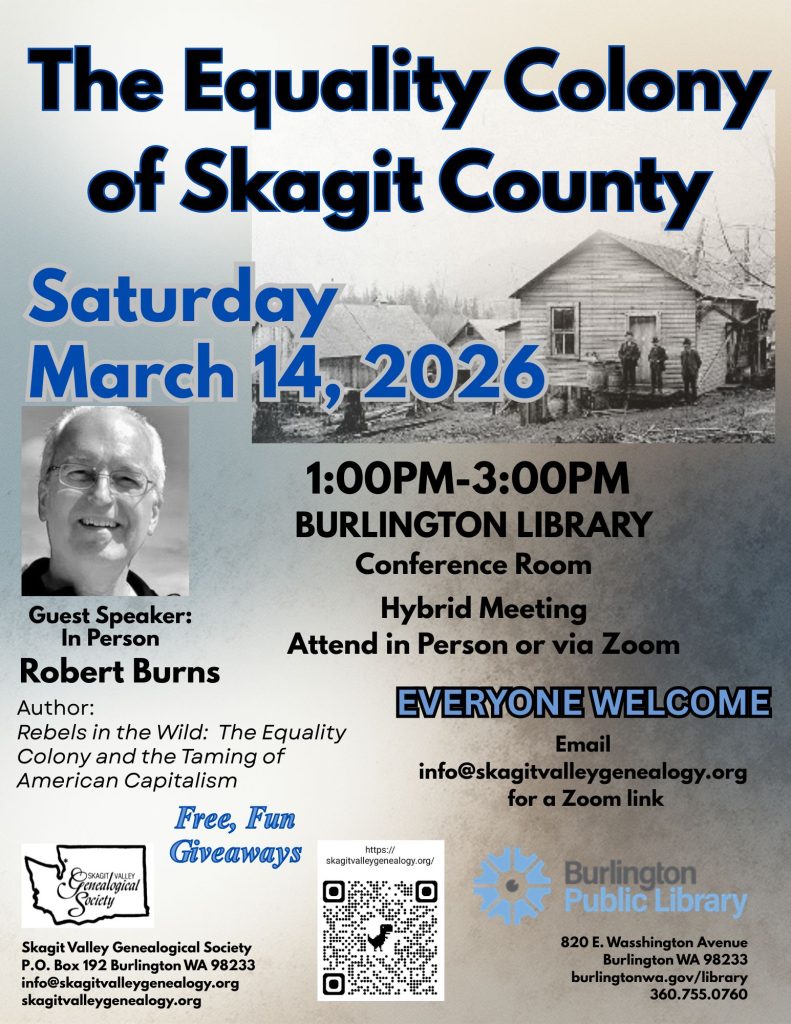
Skagit Valley Genealogical Society The Equality Colony of Skagit County
Did your ancestors mysteriously appear in Skagit County in the 1900 Census? Maybe they were in the Equality Colony. Join SVGS on Saturday March 14, 2026, at 1pm at the Burlington Public Library for “The Equality Colony of Skagit County” with Robert Burns, author of “Rebels in the Wild: The Equality Colony and the Taming of American Capitalism”. In the late 1890s a group of like-minded individuals came from around the country to establish a socialist colony in Skagit County. Find out who they were, what motivated them, why they chose Skagit County, and why the colony collapsed. Can’t make it to the Burlington Library, request a zoom link by emailing info@skagitvalleygenealogy.org.
Eastern Washington Genealogical Society Finding Irish Origins
Please Join Us for
Using U.S. Records to Find Irish Immigrant Origins
A presentation by Pamela Holland

Pam will help us with
• Discovering an Irish ancestor’s place of origin in Ireland is a much sought-after goal.
• Successful research in Irish records first starts with thorough research in US records.
• Learn what sources to examine, identify overlooked records,
and explore strategies to locate that elusive Irish location for your ancestor.
Date: Saturday March 07, 2026
Time: 01:00 PM to 03:00 PM
Location: The Hive 2904 E Sprague, Spokane, WA 99202
Door Code: 985426#
Handouts and Zoom Link will be on the website the day prior to this event. EWGSi.org
DOORS OPEN AT 12:30 P.M.
Come Join Friends old and new.
Coffee Cookies Raffles $50/50$ Free Table
Please bring your book donations for the April Seminar Book Sale!
Tacoma Pierce County Genealogical Society DNA SIG Meeting February 2026

Tacoma-Pierce County Genealogical Society DNA Special Interest Group Meeting
Tuesday, February 24, 2026, Starting at 7:00 pm via Zoom
We will discuss our latest discoveries using DNA and how to make the most of the various tools available.
Calendar reminder: TPCGS DNA Special Interest Group Meeting
Every month on the Fourth Tuesday beginning at 7:00 PM Pacific Time
Please download and import the following iCalendar (.ics) files to your calendar system.
Monthly: https://us02web.zoom.us/meeting/tZYqdeyrrz0iEtx-c_J3gNfcI8mebT1zajLo/ics?icsToken=98tyKuGqqTkvGdWTuBGPRpwQB4joZ-nzmCFHj7dF0RzaKXNUTAX1H7pPN7BLQcLR
Join Zoom Meeting:
https://us02web.zoom.us/j/82725316888?pwd=MDc3UEZrUVJNbmxmK2ZORmw5YzdDdz09
Meeting ID: 827 2531 6888
Passcode: 811780
One tap mobile:
+12532050468,,82725316888#,,,,*811780# US
+12532158782,,82725316888#,,,,*811780# US (Tacoma)
Dial by your location:
+1 253 205 0468 US
+1 253 215 8782 US (Tacoma)
Meeting ID: 827 2531 6888
Passcode: 811780
Find your local number: https://us02web.zoom.us/u/kIKCyZLQy
Heritage Quest Research Library Midwest Genealogical Center
Explore the Exceptional Genealogy Classes at HQRL! Join us online via Zoom or in person at HQRL and connect with fellow genealogy enthusiasts who share your curiosity and drive—together, we can explore the fascinating world of family history! Just a reminder of upcoming class February 19, 2026! Don’t miss out, sign up today! 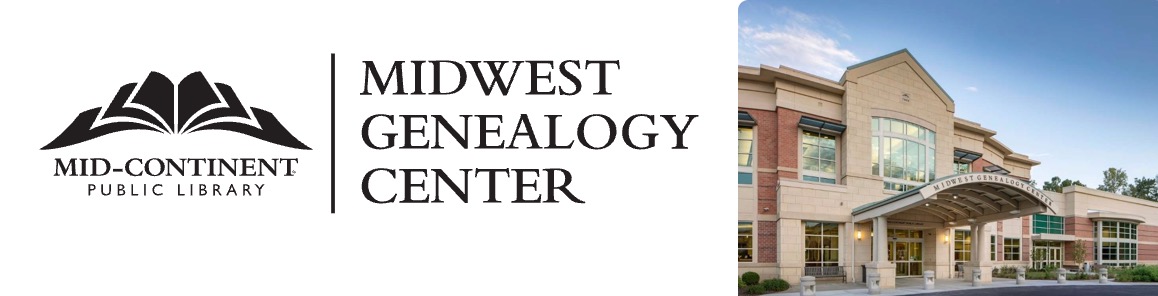 Midwest Genealogy Center Thursday, February 19, 2026 The Midwest Genealogy Center is one of the United States’ preeminent resources for family history, providing access to almost three-quarters of a million on-site materials. They have access to databases, scanning and digitization stations, oral history recording kits, microfilm reader scanners, and more. MGC features 52,000 square feet of space that houses all of the free resources needed to research your family history. Learn more about how to access and utilize their incredible resources. Click Here to Sign-up Click Here to See All of Our 2026 Classes! Visit our blog for great tips & hints exploring your family story! HQRL.com / Classes & Events / Contact |
| Heritage Quest Research Library | 2102 East Main Ave Suite 105 | Puyallup, WA 98372 US |
German Interest Group of the Eastside Genealogical Society Using Genealogy.net/Compgen.de

Zoom Registration required: https://tinyurl.com/mry7k3kn
More information: Visitors are always welcome. Our website is
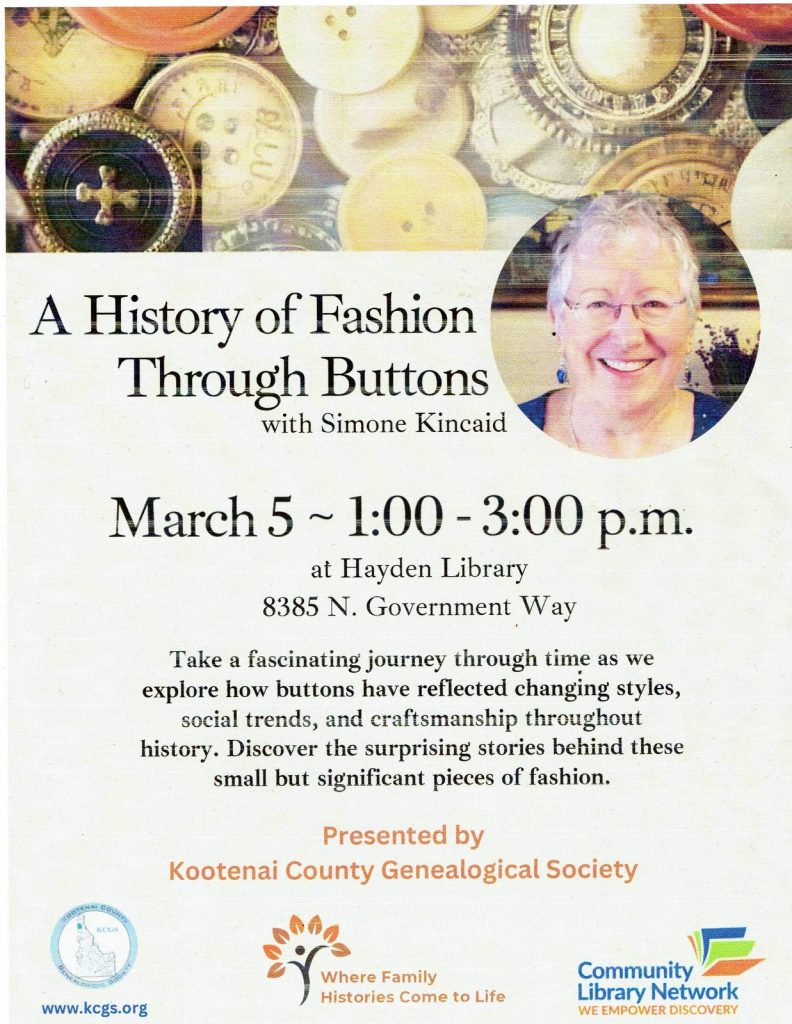
Kootenai County Genealogical Society History of Fashion Through Buttons
Puget Sound Welsh Association Welsh Roots?
To Washington State Genealogical Society:
Curious about your Welsh roots? Celebrate St. David’s Day in Seattle
with music, stories, tea, and a fun limerick contest.
Saturday, February 28, 2026 | 2:30–4:30 PM (doors open at 2:00 PM)
Ballard First Lutheran Church, Seattle, WA
2006 NW 65th St, Seattle, WA 98117
The celebration features vocalist Paul Kawabori, a Washington native,
accompanied by local pianist Steven Luksan—both performers with Seattle
Opera and the North American Welsh Choir—along with community
participation in the Welsh tradition of a noson lawen: an informal,
joyful sharing of music, song, poetry, stories, humor, and a bit of
friendly fun, including a lighthearted Welsh-themed limerick contest.
In Welsh culture, gatherings like this are about welcome, not
performance. You’re free to sing along, listen quietly, laugh, or simply
enjoy the afternoon—however you choose to be present is enough.
A te bach (little tea) will be served, featuring light refreshments and
a sampling of Welsh fare, with time to mingle and relax before the noson
lawen begins.
This celebration is hosted by the Puget Sound Welsh Association
(www.PugetSoundWelsh.org), a nonprofit organization dedicated to sharing
Welsh culture and traditions in the Pacific Northwest.
Suggested donation: $10 per adult. Every contribution is appreciated and
helps PSWA continue celebrating Welsh culture with events like this.
https://www.eventbrite.com/e/discover-wales-music-stories-tradition-st-davids-day-celebration-tickets-1980679100508?aff=oddtdtcreator
We hope to see you there!
Karyn Davies
PSWA Board