Tacoma-Pierce County Genealogical Society Writing Family History Wednesday, April 8, 2026, starting at 7:00 PM via Zoom
The Writing Family History Special Interest Group (WFH-SIG) supports TPCGS members in documenting, writing, and preserving their family histories—formally or informally. Monthly meetings will provide a mix of presentations, writing exercises, and peer reviews to help members make progress in their projects.
Date & Time: Every month on the Second Wednesday, starting at 7:00 PM Pacific Time
Please download and import the following iCalendar (.ics) files to your calendar system.
The Diamond Point Quarantine Station across Discovery Bay from Port Townsend. was a 156-acre federal facility opened in 1893 to control infectious diseases on ships entering Puget Sound. The station featured barracks, labs, staff housing and disinfection services for vessels wishing to enter Puget Sound and an isolation hospital for passengers or crew members found to be suffering from or suspected of carrying infectious disease. The site grew from three to 27 buildings over the course of its 43 operational years. Moved eventually nearer Port Townsend, it is now the site of Miller Peninsula State Park.
If you’d care to learn more about this episode in Washington history, click to www.historylink.org (a free website) and look for the article by Paula Becker, posted in 2007 on this subject.
All vessels arriving from foreign ports were required to pass through quarantine. When deemed necessary, vessel were fumigated with burning pots of sulphur in order to kill fleas, rats, live and other vermin. Passengers or crew members were inspected for any symptom of infectious diseases such an influenza, cholera malaria, smallpox, yellow fever, diphtheria and leprosy. This place was not a happy place. Quoting from a 1937 book: “Port Townsend’s pest-house was situated in the dense woods about two miles west of town. Here the unfortunate patients was kept under the care of a volunteer nurse, usually an old sailor, and a doctor visited the sufferer when he could spare the time.”
In 1878, Congress had passed the National Quarantine Act which prevented vessels from carrying infectious diseases into any U.S. port. In 1888, the Diamond Point station was authorized and a total of $55,000 allocated for the construction.
There is much more to learn about this episode, event and place in Washington history. Ask Google to help you find more information.
The SVGS New England Interest Group (includes New York and Pennsylvania) that meets at the SVGS Library on the first Tuesday of the month is now hybrid!
If you have not joined us yet and would like to receive emails in the future for this group or wish to attend via Zoom, please send an email to info@stillygen.org and request to be added to the New England Interest Group email list and receive monthly Zoom invitations.
DNA Special Interest Group
Also join us at the SVGS library on the third Thursday of the month from 1-3pmfor our DNA Special Interest Group (DIG). This group works together to develop a better understanding of DNA techniques and strategies for finding relatives. We will discuss and review new DNA developments and tools and help members with their research problems.
All DNA skill levels are welcome to attend.
If you have a specific DNA topic you would like to discuss or have any other suggestions for this group, please send an email info@stillygen.org
Also, if you have not joined us yet and would like to receive emails in the future for the DIG group, please send an email to info@stillygen.org and request to be added to the DIG email list.
NEW – Using AI to Write Your Family History
Starting Thursday, March 26th
This group will meet the on the 4th Thursday of every month at 1 pm at the SVGS Library to discuss and assist in writing your family history using AI resources. Various AI platforms, tools and new developments using AI will be introduced.
Bring your questions, laptop and narratives for help or feedback.
NEW – American Ancestors Webinar Day
Starting Saturday, March 28th
Join us on the last Saturday of the month at the SVGS library at 11am to watch an American Ancestors webinar.
This month:
A Perfect Frenzy: A Royal Governor, His Black Allies, and the Crisis That Spurred the American Revolution” with Andrew Lawler
As the American Revolution broke out in New England in the spring of 1775, dramatic events unfolded in Virginia that proved every bit as decisive as the battles of Lexington and Concord and Bunker Hill in uniting the colonies against Britain. A Perfect Frenzy chronicles these stunning and widely overlooked events for the first time.
Many communities across the United States boast a rich Dutch heritage, owing their founding and regional culture to the influence of Dutch immigration. This presentation will explore resources and techniques to trace your Dutch ancestors in the United States and back into the Netherlands, with additional emphasis on cultural and historical context that surrounded the lives of your Dutch ancestors. Join Alexander Tolksdorf to explore resources and techniques to trace your Dutch ancestors in the United States and back into the Netherlands, with additional emphasis on cultural and historical context that surrounded the lives of your Dutch ancestors. Click Here to Sign-up Click Here to See All of Our 2026 Classes!Visit our blog for great tips & hints exploring your family story!HQRL.com /Classes & Events / Contact
Heritage Quest Research Library | 2102 East Main Ave Suite 105 | Puyallup, WA 98372 US
(more information about scholarships will be sent to you shortly)
Date: April 04, 2026
Time: 09:00 AM to 03:00 PM
Location: South Side Senior and Community Center
3151 E 27th Ave Spokane
DOORS OPEN AT 8:30 A.M.
David Allen Lambert- Friend or Foe?
• Nearly 250 years ago, America declared its independence from the British Empire, changing the course of history. While many took up the cause and supported revolution, others remained loyal to the British government—turning friends into foes and pitting neighbor against neighbor. • In this lecture, Chief Genealogist David Allen Lambert will discuss how to research your colonial ancestors and determine if—and how—they may have served the cause of the American Revolution.
Stan Wills- Flags, Uniforms & Weapons: The Making of a Revolution
This is a presentation you don’t want to miss! Stan will have actual-in-person items to see and touch.
Dolly Webb- The Rest of the Story: An Exploration of the Loyalist Perspective
A challenge to the traditional ‘traitor’ narrative by examining how Loyalists—driven by a sophisticated ideology of constitutional restraint and fear of mob rule—sought to preserve the benefits of the British Empire while navigating the chaos of a civil war. We will explore the diverse makeup of the Loyalist population, ranging from enslaved individuals seeking freedom to Native Americans protecting land claims, to demonstrate that loyalty to the Crown was often a choice for survival . Then there were the Quakers and “fence sitters” caught in the middle of a revolution not of their choosing.
Registration is required
Please register on the EWGSi.org website
$40 (lunch included) for EWGS members
$50 (lunch included) for non-members
$20 for zoomers
Deadline to register is March 31st
. NO REFUNDS AFTER MARCH 31st
. IF you pay by check: Please include your email address so we can contact you and provide any handouts for this event.
Deadline if you pay by check is March 27th
. EWGS yearly Book Sale
Door Prizes
Quilt Raffle: Quilt created by EWGS members especially for America 250
The phrase “mad as a hatter” referred to the 19th century hat-makers were were poisoned by the mercury they used to treat the felt.
Christmas was not declared a national holiday until 1890.
The phrase “second string,” which today means replacement or backup, originated in the Middle Ages, when an archer carried a second string in case the one on his bow broke.
During the peak of the western cattle drives, as many as one in four cowboys was African-American.
After she was crowned, the first act of Britain’s Queen Victoria was to move her bed out of her mother’s bedroom and into a room of her own.
The first bomb dropped by the Allies on the city of Berlin during WWII claimed an unusual casualty…the only elephant in the Berlin zoo.
During his invasion of England in 1014, King Olaf’s fleet of Viking ships managed to pull down London’s wooden Thames River bridge. Hence the children’s song about London Bridge falling down.
The last soldier of WWII, Japan’s Lt. Hiroo Onoda, didn’t surrender until 1974. He refused to be “fooled” by allied stories about the war ending in 1945 and only gave up the fight after his old unit commander was flown to the Philippines and ordered him to lay down his arms.
And where did these wonderful bits come from? The Armchair Reader: Amazing Book of History, published in 2008, and found in a thrift store. Are they true?
Years ago my father gave a paper bag on which was written many names and dates of ancestors. At the very top of the bag was written “6/5/05 [her birthday – 6/5/1805] Matilda Atwater – father was aid to Geo Washington.” My search began!
Research revealed that there were many Stephen Atwaters. The Atwater family was prominent in colonial Connecticut. After much research, I discovered the following, copied from his pension application 14 Nov 1832:
“Stephen Atwater, Conn, S12014. I was born in Cheshire, Connecticut, New Haven colony, on 13 May 1758. I presume the records of my birth is in Wallingford Connecticut (for Wallingford & Cheshire were then one town) but I have no record of it anywhere – I was 74 years old on the 13 May last [1832].”
Stephen was the last of 7 children born to Stephen Atwater (1720-1806) and Hannah Hotchkiss (1722-1779). There were probably 2 sisters left at home when he enlisted.
Stephen Atwater’s pension application continues:
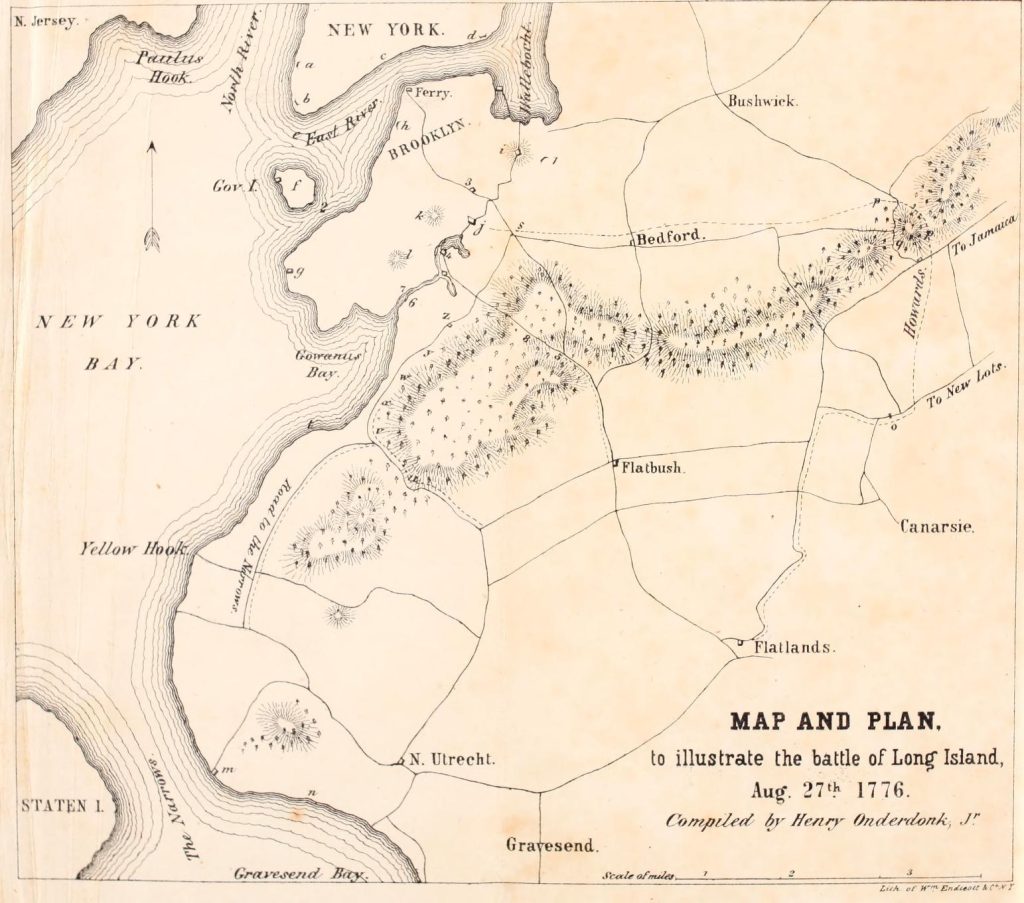
“In August 1776 [at 18 years old] the 10th Regiment of Connecticut Militia commanded by Cpl Benjamin Baldwin was ordered out, to go to New York – I was a member of Capt. Jesse Moss’s company, belonging to that regiment – & on the 17 August we turned out – we marched to New York [colony]– We were at New York City [Brooklyn was the northernmost area of LongIsland] when Gnl Washingtons army retreated from Long Island – I acted as one of the oarsmen in bringing the army over all night – The night was exceedingly dark & a very thick fog”
The Battle of Long Island was the first major battle to take place after the United States declared its independence on July 4, 1776 in Philadelphia. It was the largest battle of the Revolutionary War in terms of both troops deployments and combat.
The British army had nearly 20,000 soldiers and were helped by naval forces. British ships moved the East River toward Staten Island, seen on the bottom left of the map below. There were more than 400 transport ships, protected by 30 warships.
The Americans had about 10,000 soldiers led by General George Washington. He moved his troops to Brooklyn on Long Island, to defend New York. British troops landed and attacked the American troops on three sides.
Rather than surrender, General Washington decide to have the army cross the East River. He ordered every available boat to be taken. The oarsmen wrapped cloth around the oars so they would make as little noise as possible. The men rowed all night, back and forth. Stephen Atwater was one of these oarsmen. By morning there was still many men left on the Brooklyn side of the river. But the very thick fog in the night that Stephen mentioned continued late into the next day, so they were able to complete their mission by the time the fog lifted.
This was the closest Stephen Atwater came to being “Aid to George Washington”, but his story wasn’t over yet. He was under the command later of General Washington, among others.
↓Stephen Atwater rowed north to Manhattan (New York) across
the East River from Brooklyn on Long Island
Stephen Atwater’s pension application continues:
“After the American army was brought over to the city [New York City], our regiment remained there a few days, & were then ordered out to Harlem – there I was taken sick & was Discharged there or somewhere near there.”
“I remained sick till I was carried home. It was called a three months tour – but I think I was not out three months – but two months of more-Then April 1777 our company & regiment was ordered out again when Danbury [Connecticut] was burned “
“We moved to Fairfield[CT]– & then to Compo [CT] – I think the British embarked there. Our men & the British had a considerable battle in that neighborhood there – several of my acquaintances were killed there – Gnl Worster was killed in that battle – I saw him as a corpse – Our company had then got up & was not in that battle”
“After the British had embarked, & went off, we were discharged, & went home – I can’t say how long we were out at that time – probably 8 or 10 days – In October 1777 the same company & regiment were ordered out again – I marched to West Point. We had the same Colonel & same officers as before – The company I belonged to were out scouting the principal part of the time – At a place called Fishkill[NY] our company was divided – a part went to the north & a part went to the south –“
“Esopus [Kingston, NY] was burned at that time – This tour was called a three months tour – but I do not recollect how long we were actually out – our orders were for three months, but we did not stay out so long – Titus Moss was the ensign of our company – During this tour I lost the end of the forefinger of my right hand by a felon which I was not able have taken care of in consequence of our moving about – & my finger healed for several more weeks.”
“In 1780 I was called out again – This was a draught [draft] – Capt Amos Hotchkiss commanded the company – Willis was the Colonel – We were marched to New London & stationed on Winthrop Point. We were employed principally in building breastworks – fachines [fascines –brush and sticks used to reinforce trenches] & the like – That time I was out about two months – I was the orderly sergeant of the Company that tour –“
“I received no written discharge at any of these tours, except the first, when I did receive one – but it has been lost – at least I have looked carefully for it & can’t find it — I was out on a short tour where Genl [Benedict] Arnold attacked New Haven – which I think was in July 1779 – This was in my original company – Capt Jesse Moss – We were out 10 or 12 Days –
”I was out a number of short tours – we were obliged to keep ourselves in constant readiness – The militia was hanged [as in suspension] very much for several years –We would lay out a piece of business at night – & by next morning were called away from it – We kept ourselves ready always to go – to march at a minutes warning – for several years- I can’t tell how long I was out altogether in actual service – but making the best estimate I can, I would say it was about eighteen months but I can’t be positive about it and not less than sixteen months—
After the war I continued to reside at Cheshire til 1811 – I then removed to Granville in the state of New York – remained there till October 1824, when I moved to Oil Creek in Crawford county [PA] & in January 1829 I moved to the farm in which I now live in Troy Township, Crawford county – Pennsylvania.”
My GGG grandparents, Matilda Atwater and Horace Day, may have met in Granville, NY, since both their families lived there. However they didn’t marry until both families were in Pennsylvania. They married 2 Dec 1827 in Crawford County, PA.
I’m very proud of my Revolutionary War ancestor, Stephen Atwater! He wasn’t an “aid” (Aid-de-Camp) to George Washington as stated in the paper my father gave me, but he certainly aided General Washington, and many others in the Revolutionary War.
THE DAY FAMILY IN THE REVOLUTIONARY WARby Carol Gillies Handke.
The Day Line. Robert Day, Mary Day, Capt. Day etal Page 2
Contributed by Anna Kent Winsemiusm, Grand Rapids, Mich
-My 7X great grandfather, 6 of his 8 sons, and a son-in-law, all served in the Revolutionary War. This is something our family is very proud of. Here is a copy of their Bible records:——————-
Children of Robert Day:
Mary, M.Capt. Eleazor Warren, and D.Jul.8, 1744
II. Sarah, Bap. Sept.23, 1722
III. David
IV. James (mentioned below)
V. Elizabeth, Bap. 1717, M. Ar.Whitmore
VI. Patience, B.Sept. 1717, M.John, son of Andrew Phillips
VII. Jonathan, B. 1719, D. Jul. 6, 1745
VIII. Robert, B.1719 (Sept 23, 1722)
IX. Susanah
X. Thomas, B. Feb 19, 1727
James (2) son of Robert (2) Day, was born about 1717, died in
Killingly, Conn. Dec. 25, 1782.
His tombstone has this inscription:
“I sought the Lord in early youth,
nor did I seek in vain;
He leads me in the path of truth
and great has been my gain”
He was a blacksmith by trade; married in 1740 to
Mary Parkhurst, of Plainfield, Conn. B. about 1721,
D. in Killingly Jul, 28, 1818, aged 97 years, Bur. Dayvill
Children:
Nathan, Bap. Jul 28, 1744 in Putnam Heights Church
Was a Corporal in Capt. Jas.Cady’s Co. the 3rd, 11th.Regt
Moved to Granville, N.Y. M. in Brooklyn, Conn. Sept.20
1770, Hannah Hewitt
Jonathan, bap.Mar.12, 1745, Corp. in Revolution
Elias, B.Sept.25, 1746 “ “ “
Mary, B. Mar21, 1753
Thomas, B.Jun 19th, 1755 Private “ “
John, B. Mar. 12, 1757 “ “ “
James, B.Aug 23, 1758
Asa, B.Jul 23, 1760 “ “ “
David, B. Jul 20, 1762
James Day (1717-1782)was the father of this family, son of Robert Day and Elizabeth Dresser. He married Mary Ann Parkhurst in 1740. Their children were born between 1744 and 1762. When the Revolutionary War began, he was 59 years old. James was one of the Connecticut men who marched to Boston for the relief of the town in the Lexington Alarm. He was recruited from New Haven and served as Adjutant to Col. Samuel Parsons, Sixth Regiments. James was commissioned on May 30, 1775. He also served in the Battle of Long Island, New York in 1776. James remained stationed in the Hudson River area until his term of service expired on December 31, 1776.
Children of James and Mary Ann Parkhurst:
Nathan Day (1744-1821). He married Hannah Hewitt in 1770. They had 3 children before he served in the Revolutionary War. In 1776 he was a Corporal in Capt. Jas. Cady’s Co when they marched from Connecticut to West Chester, New York. There are no records of how long Nathan served, but he was home by 1777 when his 4th child was born and in 1779 when their 5th child was born. He re-enlisted in 1780 as Private in Capt. Stillwell’s company. He was on the muster roll for August 1780 as a “Waggoner.” Nathan was discharged in 1781 at 37 years old. Four more children were born after his discharge but two died young. In 1790 Nathan and his family moved to Granville, New York with the State Bounty Land Grants. He became Deacon of the First Presbyterian Church. Nathan’s wife Hannah died in 1796. Nathan died in 1821 at 77 years old.
Jonathan Day (1745-1825). He may have married Tamar May, but records are sketchy. There is no record of children. The family Bible and headstone shows that he was a Corporal in the Revolutionary War. Compiled war records state that he was a Private in Capt. David Cady’s company and also with Capt. Ephriam Warren’s company with the Connecticut militia. Jonathan was a pensioner in 1818. He died in 1825 at 80 years old.
Elias Day (1745-1838). Elias was a private in the 9th and 18th Connecticut Regiments, at one time under Capt. Abraham Mead. He signed up as early as August 13, 1776. After the war he married Percey “Esther” Blanchard in 1781. They had 7 children. They moved to Dayville, CT, the town named after his brother John Day, in about 1830. Elias’ wife Esther died in 1815. He died in 1838 at age 92.
Mary Day (1753-~1820. She married Nathaniel Maine and they had 5 children. Her husband was a Corporal in Capt. Dixon’s company.
Thomas Day (1755-1830). He was a private under Capt. Crosby. Records also show him with the Wadsworth Brigade and Johnson’s Regiment in 1778. After his military service he married Susannah Buck in 1783. They had 10 children. Thomas was one of the Deacons at Brandy Hill Baptist Church in Thompson, CT. He died in 1830 at 75 years old.
John Day (1756-1838). There are records that he was in Capt. Warren’s Company. After his time served, John married Annis Bowman on Jan. 25, 1781. John and Annis had eleven children. On Oct. 17, 1793, he was commissioned Captain of the local militia by Governor Samual Huntington. The village of Dayville, CT, near Killingly was named after John. He built the first house there, about 1830. He also built and operated a small mill. Capt. Day bought himself a large tract of land in East Brooklyn, where his brother Thomas was a Deacon. John took a prominent part in local affairs and was very successful in his business ventures. John died on March 10, 1838. Annis died 10 years later in 1848.
James Day Jr. (1758-1808). James Jr. was 18 years old when the Revolutionary War began. There are no records that show that he served. Perhaps his mother needed at least one son to stay home. It appears that his sister Mary was still living there. There are also no records that he married, although there are some incorrect records that he married Deborah Carter in Pennsylvania. He lived in Connecticut and it’s unlikely that he traveled that far to meet her. James died in 1808 at 50 years old.
Asa Day (1760 – dec). Asa signed up as a private in 1778 at 17 years old in Johnson’s Regiment of militia. Records are sketchy but he may have been a Capt-Lt in Capt. Elisha Elys’ company on Sept 1, 1780. On August 7, 1782 he was a Captain. Some family trees state that he died before 1783 in England, but there are no records to prove that.
David Day (1762-1831). David was 13 years old when the Revolutionary War started and did not serve in the military. He married 1) Lurana Warren in 1788. They had 2 children. Lurana died in 1793 at 24 years old when the youngest child was 6 months old. David married 2) Sarah Sharpe 5 years later in 1798. They had 5 children together. He died on Apr 27, 1831 in Dayville.
You are free to copy articles to any non-commercial web site or message board or printed publication you wish. Don’t bother to ask permission, just do it.


 Explore the Exceptional Genealogy Classes at HQRL! Join us online via Zoom or in person at HQRL and connect with fellow genealogy enthusiasts who share your curiosity and drive—together, we can explore the fascinating world of family history!