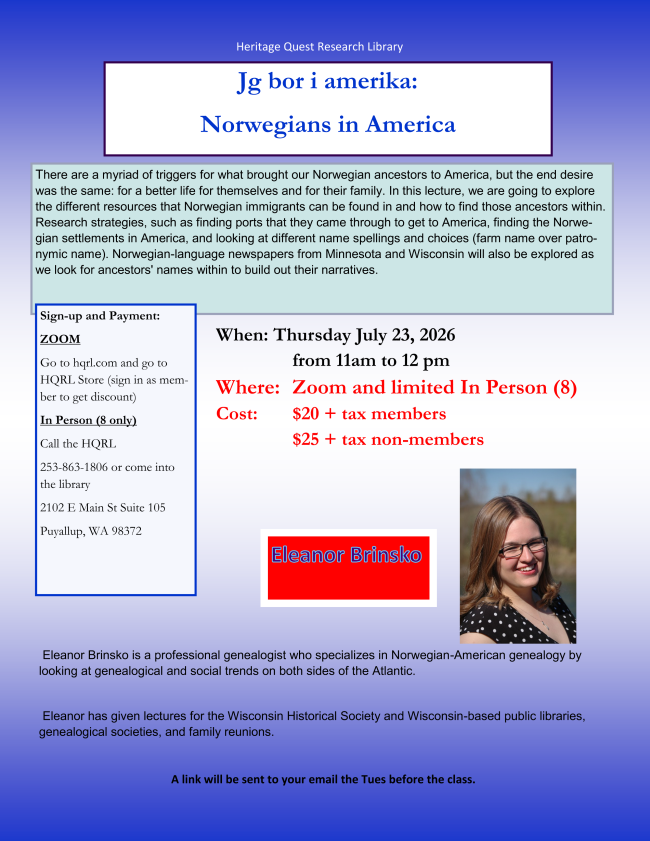
Topic: 3 Types of DNA, 4 Challenging Types of Families, and 5 Testing Companies – Help Me Understand!
Speaker: Kelli Jo Bergheimer
Join us Saturday, March 21, 2026 @ 10am
In Person at the Bainbridge Public Library and via Zoom
This presentation includes a review of the three kinds of DNA. The speaker will also discuss the four kinds of challenging families that make working with DNA matches difficult. The presentation closes with a review of the highlights of five testing companies.
Kelli Jo Bergheimer is a writer, teacher, editor, and international genealogical speaker. Kelli is Director of Curriculum and Assessments for Blue Kayak, a K-12 textbook company. She works as the Director of Education for Your DNA Guide. She also runs a small business called “Mess on the Desk,” a genealogical organization company with a YouTube channel, and is the facilitator for Genetics, Genealogy, and You, an online DNA Interest Group.
David Smith was said to have been born in Ireland in 1740. He came to America at some time and appeared in Farmington, Hartford county, Connecticut where he married Lydia Orvis Hawley, a young widow of Benjamin Hawley, in January, 1775.1, 2
Two years later, shortly after his first son, Chauncey was born, David enlisted in the Continental army on March 1, 1777.3 At that time there was a significant effort to recruit new volunteers for the army; a number of others were recruited from Farmington around the same time. It appears as if he entered as a corporal, which would not be too surprising for an older volunteer when a new company is being established. He was recruited into Col. Samuel Wyllys’ 3rd Connecticut Regiment in Capt. William Judd’s Company. The third regiment was organized between January and April, 1777 and was composed of 8 companies from Windham and Hartford Counties.
The 3rd regiment was initially assigned on April 3 to the 1st Connecticut Brigade, an element of the Highlands Department.4
The Brigade had two primary tasks: to protect the Hudson Highlands, and to deter British troops occupying New York City from joining up with other British forces, specifically British General Burgoyne’s army which had just captured the supposedly impregnable Fort Ticonderoga and was headed south towards Albany. The Brigade was reassigned to the main army for a few weeks in mid-summer, 1777, when British General Howe and General Washington were maneuvering for position in northern New Jersey, and Washington was concerned about defending Philadelphia.5 Then the Connecticut Brigade was returned to the Highlands Department until July 1778. Most of David’s time in the war was spent in the Highlands (see map), an area where the Appalachian Mountains cross the Hudson River. Because the military records do not indicate David’s whereabouts from in March, 1777 until summer 1778, the only way to determine where he is, is to track his regiment under General Putnam.
The aptly named Highlands Department’s role was primarily to protect the New York Highlands, especially the Hudson River. If the British could penetrate up the River and connect with Fort Ticonderoga which General Burgoyne had just captured, Lake Champlain and Canada , they could split the colonies in two, separating New England from the other colonies. Barely a month after the war started at Lexington and Concord on May 25, 1775, the Continental Congress authorized the placement of chains across the Hudson River to deter British ships and protect the Highlands.
During 1776 and 1777 several chains and wooden spike blockages were placed upstream from Peekskill. To protect the chains, the Continental Congress also authorized the construction of Fort Montgomery, which was built by the Army in 1776. Another fort, Fort Clinton, was built nearby on higher ground.
David’s regiment was part of General Israel Putnam’s command and was stationed nearby at Peekskill. British General Sir Henry Clinton, who commanded the occupation troops in New York City, moved a contingent of them in the direction of Saratoga where General Burgoyne was having difficulties. Clinton made a feint that completely fooled Gen. Putnam, who went back into the Highlands where he thought the British were. Then on October 6, 1777, Sir Henry moved in, captured the two forts, and dismantled the chain.6 David almost certainly was in the fooled force and apparently avoided any battle at this time. The British were able to keep the river open and raided as far upstream as Kingston, NY, a distance of about 50 miles north from the lost forts.
In spring, 1778, the very heavy “Great Chain” was stretched across the Hudson at West Point, being supported by huge, floating logs. Each link was 2 feet long and weighed 114 lb. The chain could be adjusted for tides and currents by means of ropes, pulleys, and other devices. It was removed in winter and reinstalled each spring, remaining in place until 1783. The British never tried to “run” the Great Chain.
In June, 1778, General Clinton, now in charge of all British Forces,7 withdrew from Philadelphia, fearing a blockade by French Ships. Because the French officially entered the fray in March8, and because Britain had to divert resources, Clinton could accomplish essentially nothing in the north. He needed his major forces in the mid-Atlantic and South. So the Highlands troops faced no major difficulties. British raiders attacked with some frequency along the coast and inland New England, but these were relatively small events handled usually by militia and local troops rather than bringing in the Continental Army.
In the summer of 1778, David’s unit spent most of its time in the White Plains area, although he had a 15 day furlough in August. By early December, his brigade was at Camp Redding, near Danbury, CT, where it could not only spend the winter, but also could guard a major supply depot at Danbury. Although David missed the opportunity to be at Valley Forge in the very difficult winter of 1777-78, the winter of 1778-79 at Camp Redding, CT was said to be more severe than Valley Forge, although on a smaller scale.9
David arrived at Camp Redding in mid-November. In December, he was reported as sick since Nov 22, 1778. In January, he was reported “Lame at Hartford Hosp since Dec 10, 1778″, but he was back with his company in February, 1779. While he was apparently gone, there was an uprising by the soldiers regarding the lack of adequate food and clothing, along with pay in low value continental dollars. When a group of soldiers started off to Hartford “to air their complaints”, they were intercepted by Maj. Gen. Putnam, who with a stirring speech persuaded the men to return. One unrepentant ringleader was jailed, and then shot dead when he tried to escape. The site was known as “Connecticut’s Valley Forge”.
In May, David’s unit moved to Camp Highlands of New York, then to Camp Nelson’s Point across the river from West Point in June. He spent July, August and September at Camp Robinson’s Farm, a little further downstream near Garrison, NY.10 As typical, the unit largely powered down for the winter. David’s location is unspecified but he is on the rolls until January 22, 1780 when he is discharged by paying Benjamin Perry to replace him.11 He received $32.60 from the paymaster for back pay and for returned clothing.
Fighting in the north was nearly done for the war. David’s captain, William Judd, spent from January 1780 until at least June “on command at home”, or “at Hartford”. In August, he was across the Hudson from White Plains at Orangetown, NY, but then was furloughed from October through the end of the year. Clearly, David would not have faced much fighting if he had stayed in. So, why did he pay someone to cut short fairly easy duty; after all, he was a corporal and would not have the worst of military chores like a private. Maybe it was something at home. That will warrant further investigation.
From January 1780 until April 1782, David was a civilian and presumably in Farmington. In May 1782, he joined the army again for a period of 3 years. A little perspective is necessary here. The “turning point of the war”, in retrospect a few months later, was considered to be the defeat of General Burgoyne and capture of his army at Saratoga in October, 1777.12 Also important to the Highlands, that defeat severely diminished pressure from the north, which combined with limits on British resources resulted in little activity north of New York city, other than British raiding. After a few battles in the mid-Atlantic area in 1779, the British focused on the “Southern Campaign”, while still maintaining control of New York City. Then the surrender of Cornwallis at Yorktown occurred in October, 1781, effectively ending the war. The British House of Commons voted to end the war in April, 1782, and a preliminary peace agreement was reached in November, 1982.
So, rejoining the army in May of 1782 did not seem very risky for David, but we do not know why he did it. He entered as a private in the 5th Continental Regiment of foot commanded by Lt. Col. Sherman in the 3rd company captained by Nehemiah Rice. In November 1782, he transferred into the 2nd Connecticut Regiment commanded by Col. Heman Swift, serving in Capt Elijah Chapman’s “Light Infantry Company”. His previous unit, the 5th Connecticut was disbanded at the end of the year.
It doesn’t look like David, or anyone else, was seeing any action, but he stayed in nearly to the end. He was on furlough in December 1782 and January 1783.13 In March he was transferred into Capt. Thaddeus Weed’s company. He was present on muster rolls until it was reported that he deserted July 20, 1783; but he “joined from desertion” before Aug 13. This is the last muster card I could find for him. The use of the term desertion seems strange; perhaps it is more like what is currently called AWOL, absent without official leave. Perhaps he had something to do in Farmington. But it also seems strange because the army is disbanding at this time; five regiments were collapsed into three, then one regiment The Connecticut Line was completely disbanded on November 15, 1783. David was already home.
Larry Turner, Feb 21,2021, file Genealogy\Smith\David et al\David Smith War Narrative
1 Descendants of David Smith by Eben C. Farley, Los Gatos, CA 1902 (from DAR Library, printed brochure; no publication information; used to support DAR membership).
2 This narrative includes very little beyond David’s military service. There is much else that will be the subject of a future narrative.
3 All military information comes from muster cards and similar military records obtained from Fold3. There were no muster cards or other Fold3 records for David from his enlistment in March, 1777 until June, 1778. There are also no records for his captain, William Judd or his sergeant, Asa Chapman during that same period; however, there are cards for Captain Judd in 1776, suggesting that the company records for the 1777-early 78 period were lost.
4 A “Department” is composed of 2 or more Brigades, each of which have 3 or more Regiments. A Regiment at full strength will have 8-10 companies each having up to 90 men.
5 Information on the army composition, movement, and battles was derived from a variety of on-line sources. These recommended websites and Wikipedia are considered generally reliable, but they were not always in complete agreement, mostly about details not relevant to David’s service. I have included some of my own thoughts also. While the surrounding history may have some embellishments, all individual information is based factually as determined from the military records.
6 Both forts were destroyed; the modest number of American defenders took significant casualties. General Washington had a new fort built to the north at West Point; the fort that Benedict Arnold tried to give to the British in September, 1780. Sir Henry, having provided General Burgoyne the diversion he thought Burgoyne wanted (actually, Burgoyne wanted the troops to come fight with him), returned his troops to New York City. As a side note, Forts Clinton and Montgomery were defended by brother generals George and James Clinton, after one of whom the fort was named; George also had just been appointed governor of New York. With Gen. Henry Clinton (no known relationship) leading the British, the event was often called the “Battle of the Clintons”.
7 His predecessor, British General Howe had resigned and returned to Britain.
8 The French had long helped the American cause in many ways. But when the French provoked Britain into declaring War against France, it was on a worldwide basis. Britain then had to contend and defend well beyond the 13 colonies. Men and resources in America became a serious difficulty for the British.
9 Private Yankee Doodle; A Narrative of Some of the Adventure, Dangers and Sufferings of a Revolutionary Soldier – Joseph Plumb Martin, edited by George F. Scheer; The New York Times & Arno Press, 1962
00 Camp Robinson’s Farm was one of the largest camps of the Revolution with troops mostly from CT and MA. Benedict Arnold was headquartered at the Robinson House prior to his committing treason.
11 Private Perry began his duty by going on leave for two weeks in February, and then deserted April 1. Not a good bargain for the army. (Perry previously served a six month enlistment from August, 1779 until January 15, 1780, 7 days before David’s discharge.)
22 France officially entered the war in March, 1788, when they provoked Britain into declaring war by recognizing the United States. The decision for France to recognize the United States was greatly influenced by the American victory at Saratoga; thus the “turning point”.
33 Location was not noted on any of his muster cards, nor those of his captains, for his entire second enlistment. We also do not know where he enlisted or where he was discharged.
Did you know that one of Washington’s first cross-state highways, the Sunset Highway, provided the first automobile route over the Cascade Mountains? When it opened in 1915, the highway largely followed the route of an Indian trail that had been developed into a wagon road. The Sunset Highway changed designations a number of times over the years…. being known as Highway #2, U.S. 10 and Interstate 90. The route serves as the primary east-west route in Washington.” So states the HistoryLink article by Jennifer Ott.
As early as 1853, a passable route over Snoqualmie Pass was becoming a necessity. There were several trails connecting points in Washington, but the Cascades were a major headache to cross. By 1867, a wagon road was open from North Bend to Easton. A 1906 report emphasized the importance of such a route, calling it “the most important trans-mountain road projected.”
The 1909 Alaska-Yukon-Pacific Exposition’s transcontinental auto race form New York to Seattle underscored the urgent need for better roads. During the race, cars were frequently bogged down in mud, particularly along some sections over Snoqualmie.
By 1913, the Sunset Highway was designated as a primary state route and on July 1, 1915, it was officially opened. But what did it look like then compared to today??
I’ve been state-crossing in I-90 since 1954 and I can tell you that without a doubt there has not been a single year without road construction! The route is getting busier and busier and better and better all the time.
And by-the-by, it’s Sno-qual-mie NOT NOT Sno-qual-a-mie.
Ancestry has been adding new features that are available to all subscribers. While many of the new features on Ancestry are only accessible to users who purchase the protools package, these tools are being rolled out to everyone. Some users may not have access yet, but will soon.
Ideas This feature uses AI to generate research tasks for an ancestor. It can accessed using the “Ideas” button on an ancestor’s profile page.
Stickies Just like a Post-It note, this feature is a handy way to save your to-do list on a profile. They are found in the notes section under each ancestor profile (Tools > View Notes). One stickie can be saved to multiple ancestors.
SGS SPRING SEMINAR TO LOOK AT TURNING POINTS IN U.S. HISTORYSaturday-Sunday, April 11-12Join Seattle Genealogical Society this spring for a two-day virtual seminar exploring turning points in American history, the records created, and how they can transform your genealogical research.
Presented online via Zoom Saturday, April 11, 2026, 9:00 AM – 12:00 Noon (PT) Sunday, April 12, 2026, 1:00 PM – 4:00 PM (PT)
Program includes:Great Expectations: Union Pacific Land Grants & East-West Expansion Presented by Annette Burke Lyttle, CG
Hidden Narratives: Reconstructing Families Through Civil War Pension Records Presented by Mica L. Anders
U.S. Citizenship: The Law and Records of Naturalization Presented by Rich Venezia
The New Deal: Putting your Ancestors to Work Presented by Michael Strauss, MA, AG®, AGL™There will be Door Prizes!Registration fee: $60.00 (SGS Members – $45.00). Join the Seminar!images courtesy of Library of Congress and National Archives
SGS to Tour Puyallup Research Library, Tuesday, March 24Join us for a visit to the Heritage Quest Research Library, the nonprofit genealogy library in Puyallup, managed and staffed entirely by volunteers. HQRL’s collection includes books (over 16,000 titles), and microfiche. The facility also houses a bookstore where you can purchase genealogy books, family tree forms/charts, software and supplies.
Upon arrival, the group will gather in one of the library’s large rooms and receive an orientation and tour of the library. There is a computer room with five computers. Researchers who bring laptops can connect to the library’s database while on the premises.
Lunch Let us know your preference for bringing a sack lunch to eat in the library or a dining out option. We’ll be in touch with further details as the day draws near.
Coffee There is a Wanna Cupcake? next to the library for coffee and sweet treats that visitors can bring into the library classroom.
Getting there Drive: The library has plenty of free parking..Sign Up for the Tour images courtesy of The New York Public Library, Max Harlynking and Trnava University / Unsplash
TURN YOUR RESEARCH INTO A BOOKJoin a Hands-On Self-Publishing WorkshopJill Morelli Join Jill Morelli, CG, CGL, Wednesday, March 25 at 6 p.m. as she shares what she learned self-publishing Journeys of the Forgotten: The Orphans of Hamilton County, Iowa. Morelli will walk through the major steps of the process and discuss practical considerations to help genealogists move from research to a finished book.
Bring a laptop. Morelli more direct attendees in publishing a document. A document will be provided to those who don’t have something to publish. Everyone will publish something!
In person only at the SGS Library. Limited to 25 participants Class Fee: $30 (SGS members $25)
Any questions contact registrar@seagensoc.org. Sign Up for the WorkshopSecond Saturday: March 14, 1:00 p.m.In April 2026, the long-anticipated release of the 1926 Irish census will occur. Taken on April 18, 1926, this record set captures the first detailed portrait of life in Ireland following the establishment of the Irish Free State.
Join Irish genealogist Susan McKee as she introduces the 21 datasets included in this census and explains how they can transform your family history research.
Born in Dublin, Susan McKee is a member of the Seattle Genealogical Society, where she facilitates the monthly Irish Special Interest Group. She presents regularly on researching Irish ancestors, including seminars for the Seattle Irish Festival and genealogical societies across the U.S.Sign Up Today!NO SECOND SATURDAY NEXT MONTH: SGS will be offering our Spring Seminar: Pivotal Moments: Records that Changed Lives, Families, and History. Learn more and sign up. photos courtesy of Ulrike R. Donohue and K Mitch Hodge / Unsplash book image courtesy of Library of Congress‘ANCESTORING’ AUTHOR PUTS RECORDS IN HISTORICAL CONTEXTVirtual Sunday: March 22, 1:00 p.m.In her book Ancestoring: Understanding Records, Family, and Ourselves, Darcie Hind Posz invites genealogists and family historians to look more deeply at the records they use—and at themselves as researchers.Understanding Records affirms the importance of placing records in their historical context.
Understanding Family encourages researchers to ask “why,” and to remain objective and nonjudgmental as they uncover ancestors’ decisions and actions.
Understanding Ourselves challenges genealogists to recognize their own assumptions and biases when analyzing records and interpreting ancestors’ lives.This Virtual Sunday program offers a unique opportunity to hear directly from the author and explore how a more reflective and contextual approach can strengthen both research and writing.
Darcie Hind Posz is an author, genealogist, and researcher. She has been a board-certified genealogist since 2013 and was elected a Fellow of the American Society of Genealogists in 2023. A widely published genealogical writer, her work has appeared in several scholarly quarterlies, and her full bibliography is available at darciehindposz.com.Register nowWHY I VOLUNTEER WITH SGSBy Jim Secan, Vice President, SGS As the newest person on the SGS Board I’ve been asked to write a short note as to why I chose to volunteer for this position. The main reason is the concept of “pay it forward” as applied to genealogy. I have been able to research my family, none of whom were ever anywhere near the Pacific Northwest, by accessing information collected by volunteer organizations like SGS all over the country, with the information they collected made available either by contacting the organization or through an on-line database. No travel necessary. A lot of key information for my family has come not from Ancestry.com, but from local genealogical society holdings such as these. I see volunteering for SGS, particularly for a Board position, as a way of both paying back these out-of-state volunteers and paying forward to other out-of-state researchers who are tracking ancestors who moved out West and to future genealogists both out-of-state and local.
If you have benefited from the help of an individual at the SGS or at any other GS, consider volunteering at SGS. We have Board positions that need a dedicated volunteer, and various ad hoc positions are open as well. Pay back and pay forward!SGS LIBRARY NEWSExercise Your Research Skills. Help Patrons in Drop-In Sessions at SPL Branches Based on the success of the drop-in sessions during the pilot project, the SGS Board and SPL agreed to continue the program through December 2026. Ideally, we would like at least 3 volunteers at each branch – Ballard, Magnolia and Northeast. Many of the people we’ve assisted simply want to know how to get started on their own genealogy.
Others may need help with where and how to find available resources. The 1 ½ hour sessions are held once a month and there is no long-term commitment – just whatever fits your schedule. Please consider signing up for one of the drop-in sessions so that we can continue this successful program. Email splvolunteers@seagensoc.org if you have questions or need additional information on this joint SPL/SGS program.
SGS CALENDAR OF EVENTSGood Shepherd Center, Suite 302 4649 Sunnyside Ave N Seattle, WA 98103 206 522-8658Hours : Tuesday, Wednesday, Thursday, Friday, and Saturday ** 10:00 a.m .- 3:00 p.m. * * Always check the SGS Website Calendar of Events for the meeting links, registration, or for last minute updates or changes to the schedule. Be advised you may need to register in advance to join a meeting. Meeting content is for personal genealogy learning and may not be recorded or transcribed. All times listed are Pacific Time unless otherwise noted Wednesday, March 4, 2026, 6:30 p.m.-7:30 p.m., Pacific Northwest Interest Group (Virtual), Share information and discuss Pacific Northwest genealogical research. Register on the SGS website. Thursday, March 5, 2026, 6:30 p.m.-8:00 p.m., Artificial Intelligence (AI) for Genealogy SIG (Virtual), explore the intersection of artificial intelligence and genealogical research Email SGSAISIG@seagensoc.org. Saturday, March 7, 2026, 10:00 a.m.- 12:30 p.m., FamilySearch SIG, Discover the many ways to use the FamilySearch website in your research. Meeting includes instruction and time for Q&A. Email SGSFamilySearchSIG@seagensoc.org to join the mailing list.
Monday, March 9, 2026, 10:00 a.m.-11:30 a.m., Brags & Bricks Social Interest Group (Virtual), Join us for an informal social gathering. Share your recent genealogical successes and challenges, or just come to hang out with other genealogists. See SGS Calendar for more information.
Monday, March 9, 2026, 1:00 p.m.-2:30 p.m., SGS Board of Directors Meeting (Virtual), All SGS members are welcome to attend. SGS is an all volunteer organization. Please be involved. Members must sign in to website to see Zoom link.
Tuesday, March 10, 2026, 10:00 a.m.-11:00 a.m., Tech Tuesday (Virtual), informal consultation time on DNA, genealogy software, or genealogy-related technical issues. All are welcome. No appointment necessary. Bring us your problem; we’ll try to help. NOTE: Zoom link alternates between 2nd and 4th Tuesday. Tuesday, March 10, 2026, 6:30 p.m.-8:00 p.m., Ancestry Users SIG (Virtual), The Ancestry Users Special Interest Group is for people who use Ancestry.com (and AncestryDNA) to research their family histories. Email SGSAncestrySIG@seagensoc.org. NOTE: New Zoom link for 2026. Wednesday, March 11, 2026, 7:00 p.m.-9:00 p.m., MAC Computer SIG, Jointly sponsored by SGS and Fiske. Meetings address topics and resources for Macintosh (Apple) computers and the Reunion genealogy software program. A link to login will be sent to the MAC SIG email list. If you would like to join, send an email to macusersig@seagensoc.org to be added to the email list.
Thursday, March 12, 2026, 7:00 p.m.-8:30 p.m., Publishing SIG, Participate in writing and publishing the SGS Journal twice a year. Email SGSPubSIG@seagensoc.org. NOTE: New Zoom link for 2026. Saturday, March 14, 2026, 12:30 p.m-1:00 p.m., General Membership Meeting, Update on SGS activities and slate of board candidates for upcoming election. The meeting will be followed by a Second Saturday presentation. (See below.). Register here. Only one registration is needed for both the membership meeting and the Second Saturday presentation. Saturday, March 14, 2026, 1:00 p.m-2:30 p.m., Second Saturday, “Unlocking the 1926 Irish Census.” Presented by Susan McKee. Register here.
Monday, March 16, 2026, 10:00 a.m.-11:30 a.m., Brags & Bricks Social Interest Group (Virtual), Join us for an informal social gathering. Share your recent genealogical successes and challenges, or just come to hang out with other genealogists. See SGS Calendar for more information. NOTE: New Zoom link for January – June. Friday, March 18, 2026, 10:30 p.m.–12:30 p.m. Family Tree Maker SIG, Join Eastside Genealogical Society and SGS to learn and share tips and tricks for using Family Tree Maker by Software MacKiev. The meetings open about 15 minutes in advance. You can join and/or leave whenever you have to, and you may email your question(s) in advance or bring them up during the meeting.
Wednesday, March 18, 2026, 6:00 p.m.-7:30 p.m., Transcription SIG, Want to strengthen your ability to read, transcribe, and analyze original records? This SIG is ideal for anyone looking to practice, build confidence, and sharpen their research skills in a collaborative setting. The group meets at the SGS Library. Send questions to Betsey Cotter at sgstranscription@seagensoc.org.
Wednesday, March 18, 2026, 7:00 p.m.-8:30 p.m., Write It Up! SIG (Virtual), Join this group to share and discuss writing projects, resources, and ideas. To join or learn more, contact Sheyna Watkins at sgsWriteItUpSIG@seagensoc.org. NOTE: New Zoom link starting this month.
Saturday, March 21 2026, 10:00 a.m.-noon, Irish SIG (Virtual), with Susan McKee. Share information and discuss Irish ancestral research. View SGS calendar for details on joining this group.
Saturday, March 21 2026, 1:00 p.m.-3:00 p.m, German SIG (Virtual), Share what you know OR get help with problems in your own research. Register on the SGS website.
Sunday, March 22, 2026, 1:00 p.m-2:00 p.m., Virtual Sunday, “Ancestoring: Understanding Records, Family, and Ourselves” Presented by Darcie Hind Posz. Register here.
Monday, March 23, 2026, 10:00 a.m.-11:30 a.m., Brags & Bricks Social Interest Group (Virtual), Join us for an informal social gathering. Share your recent genealogical successes and challenges, or just come to hang out with other genealogists. See SGS Calendar for more information. Tuesday, March 24, 2026, 10:00 a.m.-11:00 a.m., Tech Tuesday (Virtual), informal consultation time on DNA, genealogy software, or genealogy-related technical issues. All are welcome. No appointment necessary. Bring us your problem; we’ll try to help. NOTE: Zoom link alternates between 2nd and 4th Tuesday. Wednesday, March 25, 2026, 6:00 p.m-8:00 p.m., Your Story, Your Book: Hands-On Self-Publishing, Jill Morelli shares what she learned self-publishing. She will walk through the major steps of the process and discuss practical considerations to help genealogists move from research to a finished book. Register here.
Saturday, March 28, 2026, 10:00 a.m.-12:30 p.m., DNA SIG, Join our quarterly meetings to discover what’s new in genetic genealogy and learn more about select, in-depth topics. To participate you need to be on the SGS DNA Interest Group email list. Contact Cary Bright at sgsdnasig@seagensoc.org to join. Monday, March 30, 2026, 10:00 a.m.-11:30 a.m., Brags & Bricks Social Interest Group (Virtual), Join us for an informal social gathering. Share your recent genealogical successes and challenges, or just come to hang out with other genealogists. See SGS Calendar for more information.
Wednesday, April 1, 2026, 6:30 p.m.-7:30 p.m., Pacific Northwest Interest Group (Virtual), Share information and discuss Pacific Northwest genealogical research. Register on the SGS website.Thursday, April 2, 2026, 6:30 p.m.-8:00 p.m., Artificial Intelligence (AI) for Genealogy SIG (Virtual), explore the intersection of artificial intelligence and genealogical research Email SGSAISIG@seagensoc.org. Saturday, April 4, 2026, 10:00 a.m.- 12:30 p.m., FamilySearch SIG, Discover the many ways to use the FamilySearch website in your research. Meeting includes instruction and time for Q&A. Email SGSFamilySearchSIG@seagensoc.org to join the mailing list Saturday, April 4, 2026, 1:00 p.m.-3:00 p.m., DNA Workshop, with Cary Bright and Craig Gowens. To participate you need to be on the SGS DNA Interest Group email list. Contact Cary Bright at sgsdnasig@seagensoc.org to join. NOTE the change of day due to the Easter holiday. Monday, April 6, 2026, 10:00 a.m.-11:30 a.m., Brags & Bricks Social Interest Group (Virtual), Join us for an informal social gathering. Share your recent genealogical successes and challenges, or just come to hang out with other genealogists. See SGS Calendar for more information.
Monday, April 6, 2026, 7:00 p.m.-8:30 p.m., Organizing for Genealogy SIG, Share information and discuss organization tips, techniques, and habits to enhance your genealogical journey. Contact Susan McKee at sgsOrganizingsig@seagensoc.org to join. Thursday, April 9, 2026, 7:00 p.m.-8:30 p.m., Publishing SIG, Participate in writing and publishing the SGS Journal twice a year. Email SGSPubSIG@seagensoc.org. Saturday-Sunday, April 11-12, 2026, Saturday 9:00 a.m-noon, and Sunday 1:00 p.m.-4:00 p.m. SGS Spring Seminar, “Pivotal Moments: Records that Changed Lives, Families, and History” Presented by Annette Burke Lyttle, Mica Anders, Rich Venezia, and Michael Strauss. Register here.
Monday, April 13, 2026, 10:00 a.m.-11:30 a.m., Brags & Bricks Social Interest Group (Virtual), Join us for an informal social gathering. Share your recent genealogical successes and challenges, or just come to hang out with other genealogists. See SGS Calendar for more information.
Monday, April 13, 2026, 1:00 p.m.-2:30 p.m., SGS Board of Directors Meeting (Virtual), All SGS members are welcome to attend. SGS is an all volunteer organization. Please be involved. Members must sign in to website to see Zoom link. Tuesday, April 14, 2026, 10:00 a.m.-11:00 a.m., Tech Tuesday (Virtual), informal consultation time on DNA, genealogy software, or genealogy-related technical issues. All are welcome. No appointment necessary. Bring us your problem; we’ll try to help. NOTE: Zoom link alternates between 2nd and 4th Tuesday. Tuesday, April 14, 2026, 6:30 p.m.-8:00 p.m., Ancestry Users SIG (Virtual), The Ancestry Users Special Interest Group is for people who use Ancestry.com (and AncestryDNA) to research their family histories. Email SGSAncestrySIG@seagensoc.org. OUR NEIGHBORS AND BEYOND Fiske Genealogical LibraryVarious Wednesdays, 10 a.m. (virtual)
March 4 The Black Experience in the Revolutionary War Speaker: Janice Lovelace
March 11 A Genealogist’s Guide to Lesser Known Research Tools Speaker: Claire Smith
RootsTech 2026 Thursday, Mar. 5 – Saturday, Mar. 7 (virtual)
A family history conference. An on-demand learning library. A way to grow closer to the people, places, and stories that matter most. RootsTech is all that and so much more. Join us as we celebrate together the joy of connection. Get more information.Lower Columbia Genealogical Society Various Thursdays, 10 a.m. (virtual)
March 12: Did Your Ancestor Work on the Railroad? Speaker: James Tanner
April 9: Researching Newspapers Outside of Newspapers.com Speaker: Amber Oldenburg
May 14: Subject TBA Speaker: Maggie Cogswell
June 11: Missing: Reward! Locating Widows, Spinsters, and Bachelors Speaker: Sara Cochran
“How to Write a Family History Book,” with Rebecca Shamblin Eastside Genealogical Society Thursday, March 12, 6:30 p.m. (virtual)
Maybe it has always been a secret dream of yours to create a book out of your research. We will talk about the research process, what to include, how to turn facts into stories, how to organize your book, how to get it printed, and finally how to share it. For more information and to register.
TIP OF THE WEEK – NEW FEATURES ON ANCESTRYAncestry has been adding new features that are available to all subscribers. While many of the new features on Ancestry are only accessible to users who purchase the protools package, these tools are being rolled out to everyone. Some users may not have access yet, but will soon.
Ideas This feature uses AI to generate research tasks for an ancestor. It can accessed using the “Ideas” button on an ancestor’s profile page.
Stickies Just like a Post-It note, this feature is a handy way to save your to-do list on a profile. They are found in the notes section under each ancestor profile (Tools > View Notes). One stickie can be saved to multiple ancestors.
DONATE TO SGSYour donations represent a significant part of the SGS budget. Your continued generosity helps us increase our financial security and expand our services for everyone. We make it easy for you to contribute appreciated stock from your portfolio. We have a brokerage account established and ready to receive your donation from any firm. For details, write treasurer@seagensoc.org. For questions about our needs and our vision, write president@seagensoc.org.
March 4, 2026
SGS eNews! comes out the first of every month. contact eNews!
This book presents selected entries from Phoebe Goodell Judson’s diary, chronicling her remarkable journey as a young bride traveling by covered wagon from Ohio in 1853 to her final home at the head of the Nooksak River in 1904. Rather than offering daily accounts, these excerpts provide readers with vivid glimpses into the realities of pioneer life. Like many women of her era, Phoebe gave birth to a child while journeying west, and she candidly describes the hardships faced along the way—scarcity of water and food for livestock, and encounters with local tribes that were sometimes fraught with tension.
The Judson family initially settled in Ground Mound, Thurston County, near Phoebe’s parents. However, the discovery of gold near Fort Colville in 1855 brought dramatic changes. Discontent among Eastern Washington tribes over treaty terms led to attacks on prospectors and government troops, and the resulting unrest soon spread to the western side of the mountains, creating an atmosphere of uncertainty and fear.
In 1858, following her husband’s election to the state legislature, the family moved to Olympia. Through Phoebe’s eyes, readers gain insight into the early history of this developing town. Yet the search for an ideal home continued, and the family eventually relocated to the headwaters of the Nooksak River—a remote and uncharted region, far from other white settlers. For a time, Phoebe was the only white woman north of Bellingham Bay. It was here that she overcame her fear of Indigenous peoples and earned their respect and friendship.
This is the story of a woman who exercised her right to vote in territorial elections from 1883 to 1887, witnessed Washington’s transformation from a new territory to statehood in 1889, and whose son George, a graduate of the Territorial University in Seattle, helped lay out the town of Lyden. More than just the personal account of Phoebe Judson, this narrative offers a unique perspective on the history and development of western Washington.
Available at Amazon in hardback, paperback and on Kindle
Gerry Shepard will give a presentation on French-Canadian Research focusing on the Quebec Region. Richard Kyle will be speaking on the American Loyalists living in the colonies during the American Revolution. The Canadians welcomed the Loyalists who were forced to leave the colonies, giving assistance and free land. Producing legal papers and records. A number of these families returned to the United States.
The Spring Seminar is Free, at the door we do accept Donation to pay for handouts and refreshments. Please sign up ahead to save your seat. Sign-up sheet on the librarian desk or call the library at (509) 248-1328. Or email Richard Kyle at rkyle98902@charter.net .Snacks, coffee and water will be provided.
Following the General Meeting, Kathy Sizer will be giving a presentation on ways to research the state of Connecticut. In January 1788, Connecticut became the fifth State of the union, played a crucial role in the early history of the United States, being one of the original thirteen Colonies has plenty of rich history to explore. Join us in learning how to expand your ancestry through researching Connecticut.
Tacoma Pierce County Genealogical Society Monthly Educational Meeting Tuesday, March 10, 2026, starting at 6:00 pm
This month’s presentation: A free RootsTech video titled “Using the FamilySearch Wiki” presented by Angela Thorup of the Family Search Library.
The FamilySearch Research Wiki is a free, online, genealogical guide that helps you find ancestors from around the world. Learn how to effectively navigate and use the Wiki to find websites, databases, records, and research strategies.
We hope you will attend and share your experiences using the Wiki as well as any questions you may have.
This month’s meeting will be Zoom Only until we can find a new physical location to meet in person.
You are free to copy articles to any non-commercial web site or message board or printed publication you wish. Don’t bother to ask permission, just do it.