America 250 Joseph Guess

America 250 – Joseph Guess by Angela Michener

Joseph Guess was born about 1762 in Fairfax, County in the Colony of Virginia. His family moved to Orange County, in the Province of North Carolina when he was young and he was drafted in the local militia when he was of “age”, usually 16. He served as a private for 9 months in the New Levies (emergency conscripted soldiers in 1778 and 1779 authorized by the North Carolina General Assembly) under Capt. William Jamieson and Lt. Col. Archibald Lytle. They marched to Charlotte, then on to South Carolina; Charleston, Purrysburg, Two Sisters and Turkey Hill on the Savannah River. He was discharged at a place called Stono, according to his pension information.

A short time after his discharge, he was again drafted as a private and served for 3 months under Capt. Davis Gresham, Lt. Col. Thomas Taylor and Col. Francois DeMalmedy in the North Carolina Light Dragoons. The Dragoons were trained to fight on both horseback and foot, playing a crucial role in the American Revolution. They went against the Tories on the Pee Dee River and had many skirmishes with them. The prisoners they took were sent to Gen. Henry William Harrington, who was in the field not far from them.

Joseph Guess was my 5th great grandfather. He applied for a Revolutionary War pension and was placed on the pension roll on 14 March 1833. He died on 13 Jan 1835 in Caldwell, Kentucky. There is no marriage record and in order to continue to receive his pension, his widow Constance (Taylor), appeared in the Princeton, Kentucky courthouse on 17 May 1841 and testified under oath that she and Joseph were married on 11 Jan 1785 in North Carolina.

Angela Michener, Yakima Valley Genealogical Society
Ann Eklund Named One of WSGS’s Outstanding Volunteers in 2025

Since 2003, the Washington State Genealogical Society has recognized over 600 outstanding volunteers and teams, nominated by their local society or genealogical organization for their service and dedication. These volunteers are the backbone of their local society, giving their time and expertise, to the organization and the field of genealogy. In the coming months, you will be introduced to each of the 2025 award recipients and learn why they received they received a WSGS Outstanding Volunteer and Team Award.

Today we’re introducing Ann Eklund of Bainbridge Island, Washington who was selected by the Bainbridge Island Genealogical Society as its recipient of a WSGS Outstanding Volunteer Award.

Since joining BIGS in 2021, Ann has consistently been a vital and willing contributor. For several years, Ann has infused our special events—from Antiques Roadshow and BIGS at the Beach to the Winter Holiday Celebration and our milestone 20th Anniversary Party—with her unique “magic.” Drawing on her background as an educator and school administrator, Ann has masterfully organized volunteers, cultivated genuine connections among members, and thoughtfully critiqued each event, creating a blueprint for the next time around. Her efforts are always delivered with a warm smile and an open and positive attitude.

Ann was elected to the BIGS Board in 2024, where she has continued her work with our special events, creating a committee charter and yearly workplan. Her skills in organizational and team management are valuable assets, greatly appreciated by her fellow board members.

For more information on the WSGS Outstanding Volunteer Award program, visit the Recognition page of the WSGS website or contact Info@wasgs.org. Please type “Volunteer Award” in the subject line.

Let’s Talk About: WWII Potato Piglets

World War II was especially hard on England, specifically English citizens. And most specifically English housewives striving to feed their families on limited and rationed food. Quoting from a 2024 article on the BBC History website by Eleanor Barnett:

“Sharing information on the benefits of potato eating and recipes for potato-based breakfasts, dinners, teas, snack and desserts, Potato Pete’s Recipe Book aimed to educate those on the home front on the benefits of potato-eating. Potatoes could be easily grown at home or bought cheaply, providing a rich source of nutrients.” 

“When rationing was introduced in January 1940, the amount of butter, bacon and sugar you could buy was limited and by August 1942 almost all foods other than home-grown vegetables, fruits and game were in some way restricted.”

Here’s the recipe for Potato Pete’s Potato Piglets:  “Take 6 potatoes, 6 sausages and 1/2 head of cabbage. Remove the centre (sic) of the potatoes using an apple corer or knife. Remove the skins from the sausages and fill the potato holes with sausage meat. Bake for 45″ at 200oC (400oF). Meanwhile, chop the cabbage and boil on the hob (stove) for five minutes. Once baked, serve your potato piglets on top of the cooked cabbage.”

If you try this recipe, please let us know how it turned out and how your family liked it.

Let’s Talk About: Spokane’s Trent Alley

Then (above) and Now (below)

Richard Sola probably knows more about Spokane’s history than anybody else I know. He shares his expertise with folks via presentations to EWGS and with local tours via the Southside Community Center. Along with an eager group, I recently took his tour where I learned a bit about Spokane’s historic Trent Alley. Read about Trent Alley below, quoted from the Spokane Historical website: 

“In 1913, the east side of Spokane’s downtown teemed with small businesses run by Japanese, Chinese, Italian, Greek and German immigrants. Their restaurants, laundries and baths, barber shops, hotels, groceries and pool halls mainly served the city’s working-class residents. Japanese photographer Ryosuke Akashi captured the lives of Spokane’s Japanese entrepreneurs in an album entitled Spokane Japanese Business Men and their Enterprises. Akashi carefully photographed each Japanese business and proprietor, as well as Japanese farmers, Japanese baseball players, and a Japanese cemetery. “We are always discriminated based on our race in this foreign place,” he wrote. “I would like to share our story.”

In the 1880s, downtown Spokane had a bustling international district. Known as Trent Alley, the four block stretch between Spokane Falls Boulevard and Main Avenue, contained a network of alleys filled with Chinese and Japanese businesses such as Kotaro Konishi Barber Shop, located where you are standing. The neighborhood attracted workers passing through to work for the various railroads and mines in the region.

Scattered with bars, gambling houses, opium dens and bordellos, Trent Alley started out with a bad reputation. Edith Huey describes Trent Alley as “a small but busy community living to a considerable extent apart from the rest of the city.” As more families moved in and businesses grew, the area became a thriving international neighborhood. A 1912 newspaper article observed residents of Trent Alley celebrating Christmas “in true American fashion . . . all along the alley the rattle of ivory chips and dominoes could be heard . . . and the click of the cue ball was also in evidence.”

During the 1930s, Trent Alley was hit hard by the Great Depression. After the bombing of Pearl Harbor in 1941, the neighborhood experienced a brief renewal, as many Japanese-Americans attempting to escape internment settled in Spokane. Through the 1950s and 1960s, most of Trent Alley’s Asian residents relocated into other parts of the city or passed away from old age. In 1972, the Spokesman-Review described the area as derelict: “Spokane’s ‘Chinatown,’ centered along Trent Alley just south of Trent and east of Washington, is now a series of empty, boarded-up buildings. Gradually the old hotels and stores once occupied by Chinese [people] are being torn down.” The one surviving building was the Hip Sing Association’s headquarters, which hosted tea and conversation for a handful of elderly men who remembered Trent Alley in its heyday. In late 1974, the Hip Sing left Trent Alley for a new headquarters on the north side of town. Its headquarters and the other buildings of Trent Alley succumbed to urban renewal efforts over the subsequent decades. The last building associated with the Trent Alley area was torn down in 2009.”

So now you know about Spokane’s Historic Trent Alley. Ever wandered there? 

Jim DeLucia Named One of WSGS’s Outstanding Volunteers in 2025

Since 2003, the Washington State Genealogical Society has recognized over 600 outstanding volunteers and teams, nominated by their local society or genealogical organization for their service and dedication. These volunteers are the backbone of their local society, giving their time and expertise, to the organization and the field of genealogy. In the coming months, you will be introduced to each of the 2025 award recipients and learn why they received they received a WSGS Outstanding Volunteer and Team Award.

Today we’re introducing Jim DeLucia of Ferndale, Washington who was selected by the Whatcom Genealogical Society as its recipient of a WSGS Outstanding Volunteer Award.

Jim is recognized for his outstanding contributions to WGS since 2018. As head of Research-Reviews, he assists global researchers from Canada, Switzerland, England, and the U.S., connecting people with their heritage. Jim also serves as the editor of the monthly newsletter, keeps society publications updated, and manages commun­ications as the primary email contact, fostering collaboration. Jim’s work with the Web Team has improved the website, increasing membership.

Jim maintains 4,373 files on his home computer and has converted research publications into accessible CD formats, preserving historical data. He curates the society’s library of old items and helps craft outreach letters. An active member of the “Missing in America” project for six years, Jim exemplifies dedication and service. Jim’s contributions significantly benefit the society and community, making him a deserving nominee for this volunteer award.

For more information on the WSGS Outstanding Volunteer Award program, visit the Recognition page of the WSGS website or contact Info@wasgs.org. Please type “Volunteer Award” in the subject line.

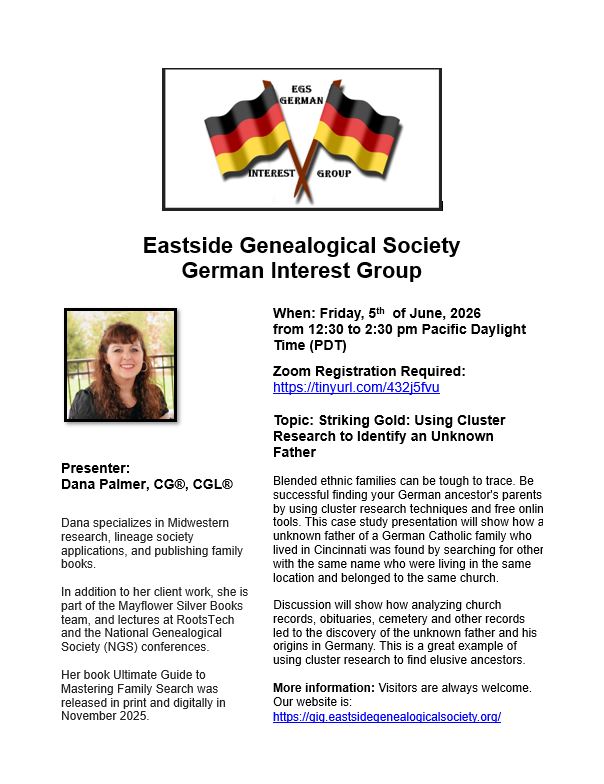
Tacoma Pierce County Genealogical Society Genealogy Chat

Tacoma-Pierce County Genealogical Society Genealogy Chat
Tuesday, May 19, 2026, starting at 7:00 PM via Zoom

Please join us and let’s chat!

Discussion starter topic – open discussion.

This is a monthly opportunity to connect with others and talk about anything and everything genealogical.
The value of this meeting increases with the participation of each person that attends and contributes to the conversations. This is your chance to celebrate the breaking down of a brick wall in your research or ask questions of others that can help you find records or relatives. Everyone, members, and guests are welcome and encouraged to attend and participate.

Date & Time: Every month on the Third Tue, from 7:00 PM until 8:30 PM Pacific Time

Please download and import the following iCalendar (.ics) files to your calendar system.

Monthly: https://us02web.zoom.us/meeting/tZMldOCprTsqGtSoVglOBTElUaBRgTq5IEgI/ics?icsToken=98tyKuGvpjgjG9eVsBmHRpwEGojCXevztmJfjbdukyniDw9xVib6A-NgALVLAY35

Join Zoom Meeting:
https://us02web.zoom.us/j/87839130000?pwd=dGdHY2wrZ0d1bDNRTEQ4Uk15OVk0Zz09
Meeting ID: 878 3913 0000
Passcode: 836216

One tap mobile:
+12532050468,,87839130000#,,,,*836216# US
+12532158782,,87839130000#,,,,*836216# US (Tacoma)

Dial by your location:
        +1 253 205 0468 US
        +1 253 215 8782 US (Tacoma)
Meeting ID: 878 3913 0000
Passcode: 836216

Find your local number: https://us02web.zoom.us/u/kdesX0el3t

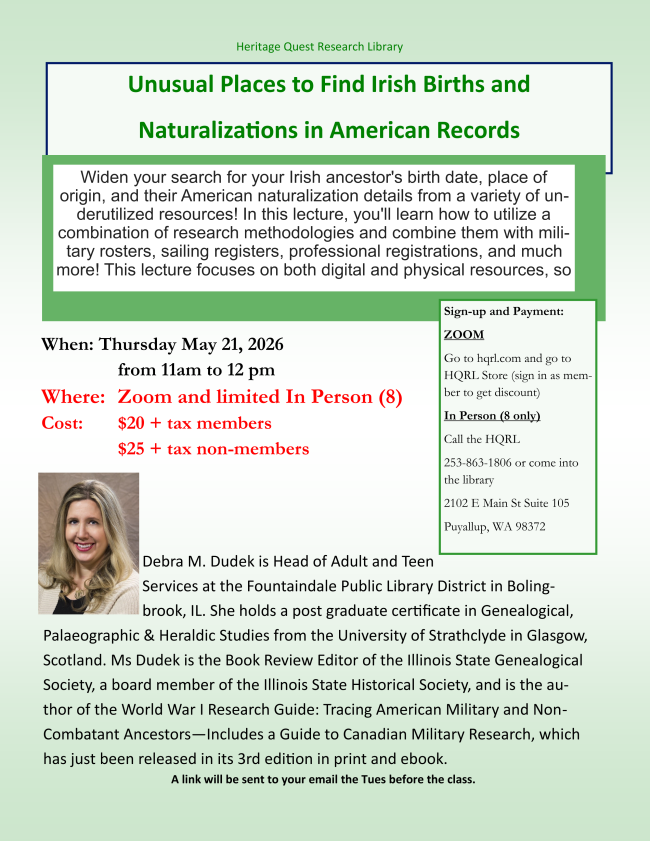
Heritage Quest Research Library Find Irish Births and Naturalizations in American Records

Explore the Exceptional Genealogy Classes at HQRL! Join us online via Zoom or in person at HQRL and connect with fellow genealogy enthusiasts who share your curiosity and drive—together, we can explore the fascinating world of family history! JOIN US for our next class on May 21, 2026! Don’t miss out, sign up today! Click Here to See All of Our 2026 Classes! Visit our blog for great tips & hints exploring your family story! HQRL.com / Classes & Events / Contact
Heritage Quest Research Library | 2102 East Main Ave Suite 105 | Puyallup, WA 98372 US

Let’s Talk About: Accessing Digitally Newspapers

The full title of this post should have read “Digitally Accessing Newspapers State by State,” and it’s from an article by Kyle Hurst appearing in the American Ancestors magazine for Winter 2026. I quote:

“Appreciating the importance of preserving US newspapers, all fifty states have participated in at least one project to digitize their newspaper collections.”   WOW, indeed.

Your first click-to-website for finding digitized newspapers should be the Library of Congress’s Chronicling America (ChroniclingAmerica.loc.gov). This site “contains millions of newspaper pages from nearly every state and territory in the U.S. published through 1963.” Hurst states in her article that “about one third of the states have elected to keep their (digitized newspapers) solely accessible via Chronicling America.” 

Other states offer their digitized newspapers via different institutions such as state archives, state universities or libraries. Our own Washington Digital Newspaper website brings together over 600,000 pages from Washington’s earliest Territorial newspapers to the present day. Freely accessible to the public, this growing collection complements the Washington State Library’s physical collection of more than 6500 newspaper titles. 

I suggest you ask Google for “free digitized newspapers in XXXX” state and prepare to be amazed and rewarded. 

Ichabod Brown Revolutionary War Soldier America 250

Jan Wells Minzel’s DAR Revolutionary War Soldier ancestor is Ichabod Brown from Rhode Island, my 4th Great Grandfather. He was commissioned by Gov. Greene of Rhode Island in 1779. He was appointed ensign in 1779 of the 1st Cumberland company 2nd regiment, of the Rhode Island militia. He served as a Sargent for Rhode Island under Capt. Weatherhead and Col. John Mathewson.

He was born on April 1745 in Smithfield, Rhode Island and died on September 16, 1828, in Farmington, New York. He married Hannah Ballou on November 9, 1777, in Cumberland, Mass. Their daughter, Rhoby Brown, married my 3rd great grandfather, Joseph L. Wells, on October 27, 1803, in Manchester, New York.

By Jan Wells Minzel, a member of the Mason County and Olympia Genealogical Societies.