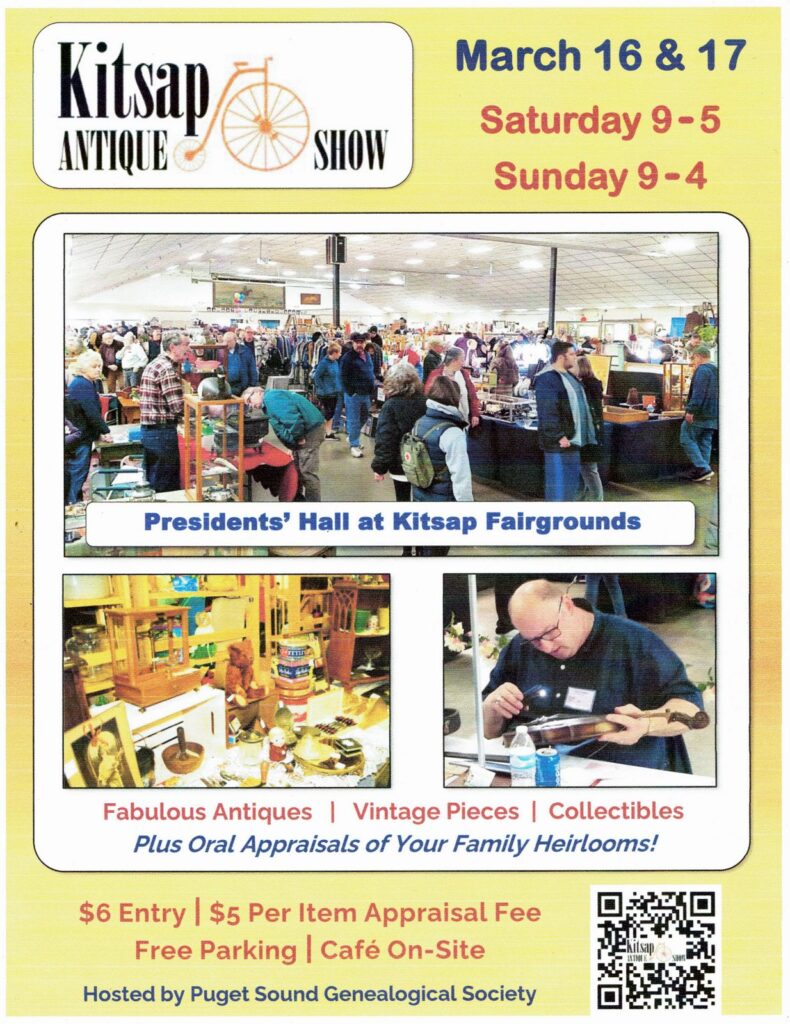
Kitsap Antique Show Hosted by Puget Sound Genealogical Society
Since 2003, the Washington State Genealogical Society has recognized over 600 outstanding volunteers and teams, nominated by their local society or genealogical organization for their service and dedication. These volunteers are the backbone of their local society, giving their time and expertise, to the organization and the field of genealogy. In the coming months, you will be introduced to each of the 2023 award recipients and learn why they received the 2023 WSGS Outstanding Volunteer and Team Award.
Today we’re introducing Winona Hahn Laird of Kent, Washington, who was nominated by the South King County Genealogical Society (SKCGS).
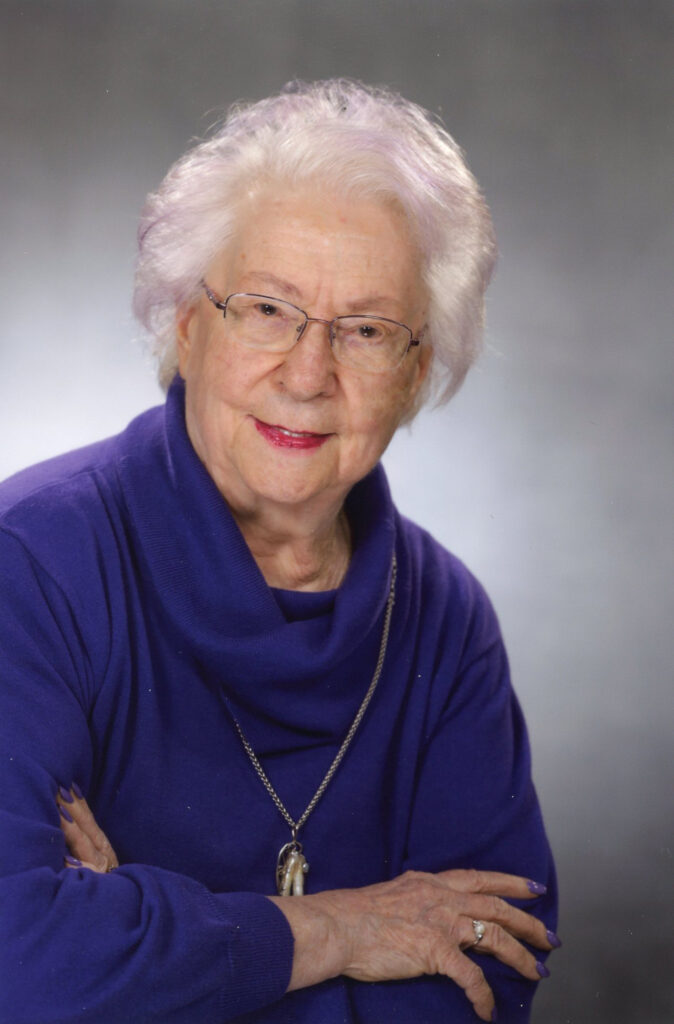
Winona is being honored for the effort she put into creating and teaching beginning genealogy classes for SKCGS in 2023. The society experienced a 25 percent increase in membership directly attributable to her classes.
Winona also has served as president and vice president of SKCGS and on numerous committees, including chair of the last two seminar committees, and head of the education committee and the five-year planning committee. Currently she runs the virtual Family Tree Maker Special Interest Group and the in-person Research Workshop at the Kent Family Search Center (FSC). She has also been group liaison for the Family Search Center.
For more information on the WSGS Outstanding Volunteer Award program, visit the Recognition page of the WSGS website or contact Info@wasgs.org. Please type “Volunteer Award” in the subject line.
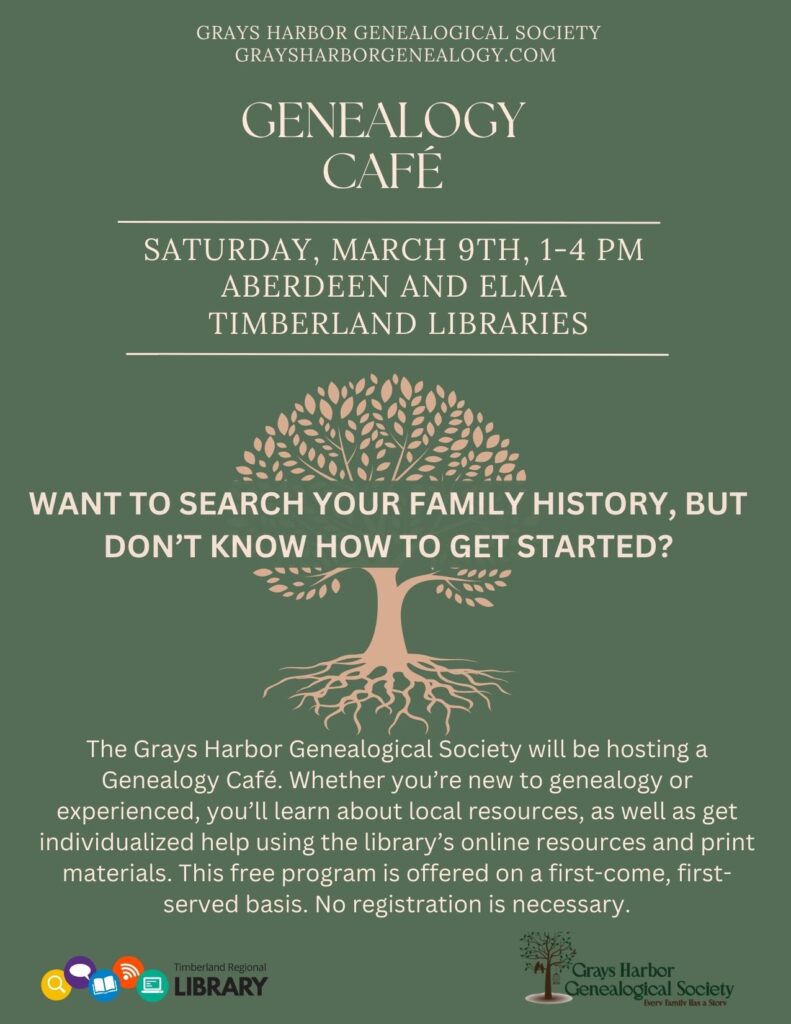
Aberdeen and Elma Timberland Libraries
The Grays Harbor Genealogical Society will host Genealogy Cafés. Whether you’re new to genealogy or experienced, you’ll learn about local resources, as well as get individualized help using the library’s online resources and print materials. This free program is offered on a first-come, first-served basis. No registration is necessary.
Regards,
Debbie Stiles-Lusk
Aberdeen, Grays Harbor County, Washington, USA
360-624-6258, debbie.stileslusk@gmail.com

Tacoma-Pierce County Genealogical Society Genealogy Chat
Tuesday, February 20, 2024 starting at 7:00 PM via Zoom
Our conversation starter topic this month will be presented by Alisha Chang, she will be talking with us about the Tacoma African American Family History Event taking place on Saturday Feb 24th from 9am – 2pm at the Family Search Center, 1102 S Pearl St., Tacoma, WA 98465.
This is a monthly opportunity to connect with others and talk about anything and everything genealogical. The value of this meeting increases with the participation of each person that attends and contributes to the conversations. This is your chance to celebrate the breaking down of a brick wall in your research or ask questions of others that can help you find records or relatives. Everyone, members, and guests are welcome and encouraged to attend and participate.
Date & Time: Every month on the Third Tue, from 7:00 PM until 8:30 PM Pacific Time
Please download and import the following iCalendar (.ics) files to your calendar system.
Join Zoom Meeting:
https://us02web.zoom.us/j/87839130000?pwd=dGdHY2wrZ0d1bDNRTEQ4Uk15OVk0Zz09
Meeting ID: 878 3913 0000
Passcode: 836216
One tap mobile:
+12532050468,,87839130000#,,,,*836216# US
+12532158782,,87839130000#,,,,*836216# US (Tacoma)
Dial by your location:
+1 253 205 0468 US
+1 253 215 8782 US (Tacoma)
Meeting ID: 878 3913 0000
Passcode: 836216
Find your local number: https://us02web.zoom.us/u/kdesX0el3t

Endogamy: Know what that means? According to the website of the International Society for Genetic Genealogy, endogamy “is the practice of marrying within the same ethnic, cultural, social, religious or tribal group.” Examples of endogamous groups include Jews, Polynesians, Mennonites, Amish, Acadians, French Canadians and folks from many Arab countries.
FamilySearchCenter: Do you have all the funds to allow subscriptions to the many paid genealogy websites that you’d like to use? Ha, not me either. Did you know that there are about 30 subscription websites that you can use FOR FREE at any FamilySearch Center! Go and you can pick up a 2-page, small-print, handout listing all these sites. Don’t know where a FamilySearchCenter is? They’re all listed on our EWGSI.org website.
Commonwealth: What is a “commonwealth?” At the time of the founding of the United States, the designation “Commonwealth” carried with it the implication of a greater degree of self-government that did the word “state.” Four states officially label themselves as “Commonwealths,” rather than “States.” They are Massachusetts, Pennsylvania, Virginia and Kentucky. It is also the designation of Puerto Rico.
Worth of old county histories: Knowing my ancestor, Caleb Carr, was a Baptist minister, 1810ish, who lived in Erie County, New York, I happily hefted the 500-page Centennial History of Erie County from the shelf and flipped it to the back……… alas, no index. Of course, published in 1876, these older books don’t have indexes. (Unless more recently done and then usually in a stand-alone volume.) BUT the hour I spent browsing through the pages was not a waste of time. I didn’t find any mention of Rev. Carr but I did learn about the early history of the county. Tidbits such as this: “The structures under which the early families sheltered themselves and their families hardly rose even to the dignity of log houses. They were frequently mere cabins of small logs, (there not being help enough to handle large ones) covered with bark. Sometimes there was a floor of split logs, or “puncheons,” sometimes none. A log house 16-feet square, with a shingle roof, a board floor and a window containing six lights of glass, was a decidedly stylish residence and its owner was in some danger of being disliked as a bloated aristocrat.”
Quote from Thomas Jefferson: “How sublime to look down into the workhouse of nature, to see her clouds, hail, snow, rain, thunder….. all fabricated at our feet! And the fgorious sun gilding the tops of the mountains and giving life to all nature.”
Quotes from Garrison Keillor: “Some people get what they want. Some people get what they got.” …… “After all is said and one, more is said than is done.”
Quote from Ethel Mertz, “I Love Lucy,” “Just because we’re married to men doesn’t mean we’ve got anything in common with them.”
Quote from AAA about travel: “Thou shalt, when in Rome, do somewhat as the Romans do, and if in difficulty, thou shalt use thy common sense and much friendliness.’
Since 2003, the Washington State Genealogical Society has recognized over 600 outstanding volunteers and teams, nominated by their local society or genealogical organization for their service and dedication. These volunteers are the backbone of their local society, giving their time and expertise, to the organization and the field of genealogy. In the coming months, you will be introduced to each of the 2023 award recipients and learn why they received the 2023 WSGS Outstanding Volunteer and Team Award.

Today we’re introducing Russell Kruse of Yakima, Washington, who was nominated by the Yakima Valley Genealogical Society (YVGS).
Russell became interested in genealogy and became a member of YVGS in 2011. He actively volunteers when a maintenance issue arises.
Russell has been very active in multiple activities working on the semi-annual yard sale with other members transporting discarded items from church yard sales to the YVGS storage garage and setting up, selling and cleaning up at the end of the sale. Russell oversees the recycling project for the YVGS library loading up the recyclable items each week and hauling them to the recycler — an invaluable task.
For more information on the WSGS Outstanding Volunteer Award program, visit the Recognition page of the WSGS website or contact Info@wasgs.org. Please type “Volunteer Award” in the subject line.

February being Black History Month, thought I’d share this bit with you:

If your knowledge of Black History in America was as spotty as mine then when those terms come up, you first think of southern slavery and possibly some in colonial New England. But Canada? Nova Scotia? Yes, indeed!
One of Canada’s best kept secrets, the largest free Black settlement in the 1780s where people voted with their free for freedom, is the Black Loyalist Heritage Centre. This is a unique historical site, nestled in beautiful Birchtown on the western shores of Shelburne Harbour in Nova Scotia.
This Centre (yes, centre…. Canadian spelling) tells the story of the arrival of the Black Loyalists seeking freedom on these shores at the end of the 18th century. At that time, they represented the largest free Black settlement outside of Africa.
A quote from their website: Welcome to the Black Loyalists Digital Collections site.
This site explores an untold story of our nation’s history: how Canada became the home of the first settlements of free blacks outside Africa.
As Revolution began in the thirteen American colonies in the late 1770s, the British were badly outnumbered. When in desperation they promised freedom to any slave of a rebel who fought the Americans on their behalf, the response was greater than they could have imagined; as many as 30 000 slaves escaped to British lines. Working as soldiers, labourers, pilots, cooks, and musicians, they were a major part of the unsucessful British war effort. As defeat became inevitable, these free blacks were evacuated to Nova Scotia with the other Loyalists.
But their hoped-for promised land never arrived. Their land was never granted, and most were reduced to a position not so different from slavery, where they were dependent on the meagre wages they could earn from manual labour. In the end most chose to seek a new life in Sierra Leone, away from the cold lands where they had experienced so much prejudice.
This is the story of those Black Loyalists.