Fiske Genealogical Library Virtual Classes

Wednesday, February 18  

10:00 am to 11:15 am Pacific Time – Fiske Genealogical Library, Seattle (Virtual Class)

Finding Immigration and Naturalization Records: Advanced Strategies and Techniques

Presented by Lisa Alzo

For links to join the meeting and get class notes, select https://fiskelibrary.org

Every immigrant has a story. This webinar will discuss how to leverage the data in passenger lists, naturalization records, and other documents of ethnic-based communities and neighborhoods (such as historic newspapers and oral histories,) to uncover key clues about your immigrant ancestors. Learn strategies and techniques to find your elusive ancestor among others with the same name and how to deal with name changes, as well as how to locate missing manifests due to transcription or other database errors. A brief overview of how social history and migration patterns can help you track your ancestors on both sides of the ocean will also be provided.

Wednesday, February 25  

10:00 am to 11:15 am Pacific Time – Fiske Genealogical Library, Seattle (Virtual Class)

From RootsTech 2025 to 2026; What to look for and how to enjoy next week’s conference

Presented by Jenny Hansen

For links to join the meeting and get class notes, select https://fiskelibrary.org

A look at last year’s new features brought out in RootsTech 2025, and some tips about what new things to look for in RootsTech 2026 on March 2-6.

Wednesday, March 4

10:00 am to 11:15 am Pacific Time – Fiske Genealogical Library, Seattle (Virtual Class)

The Black Experience in the Revolutionary War

Presented by Janice Lovelace

For links to join the meeting and get class notes, select https://fiskelibrary.org

African Americans have fought in all the wars in which the United States has been involved, beginning with the Revolutionary War. It is estimated about 10,000 people (mostly men) of African ancestry fought on both sides of the conflict – hoping that freedom from slavery would come at the end of war. This presentation looks at factors leading up to the war, notable individuals who fought and where to find records on the service of Blacks in the Revolutionary War.

Wednesday, March 11

10:00 am to 11:15 am Pacific Time – Fiske Genealogical Library, Seattle (Virtual Class)

A Genealogist’s Guide to Lesser-Known Research Tools

Presented by Claire Smith

For links to join the meeting and get class notes, select https://fiskelibrary.org

Serious researchers know that success depends on mastering the right tools. This session explores powerful resources to enhance your research: ArchiveGrid’s manuscript collections, the Digital Public Library of America’s archives, the American Genealogical-Biographical Index, and the Periodical Source Index (PERSI). Learn to integrate these tools and uncover new paths in your family’s story.

Let’s Ask: Where Is Danville, WA?

Have you ever been to Danville? There are 24 places in America with the name of Danville, but our Danville is in Ferry County, Washington, just a few miles south of the border with Canada. 

Originally named Nelson from merchants Peter and his uncle Ole Nelson. An early reference to this settlement is dated 1896. The town was renamed in 1899 to prevent confusion with Nelson, British Columbia just across the border.  By 1897 the town boasted a jewelry and watch repair section of a general store, a post office, a newspaper (lasted only a year) and a sawmill. By 1913, the mill which produced 50,000 feet of lumber daily, was one of the three larger producers in the area.The 1920s brought increasing prosperity to Danville when it became a rendezvous for whiskey smugglers, who employed local guides familiar with the old trails to avoid detection by border authorities as they smuggled booze from Canada down into the “dry” U.S. 

The top image is of the U.S.-Canada border crossing station. The lower photo is the Nelson’s general store in the 1890s. 

 From the website MyNorthwest:  Danville is in the part of Washington that was once the Colville Indian Reservation. However, when valuable minerals were discovered there, the land was taken away from Indigenous people by the federal government and opened to settlement and mineral claims by white homesteaders and miners. This little-remembered episode surely ranks as one of the great injustices in the state’s history.

Heritage Quest Research Library Genealogy Classes

Explore the Exceptional Genealogy Classes at HQRL! Join us online via Zoom or in person at HQRL and connect with fellow genealogy enthusiasts who share your curiosity and drive—together, we can explore the fascinating world of family history! Just a reminder of upcoming class February 5, 2026! Don’t miss out, sign up today! The Genealogy Roll-up: Essential Shortcuts Every Genealogist Needs  Thursday, February 5, 2026 Jennifer Patterson Dondero
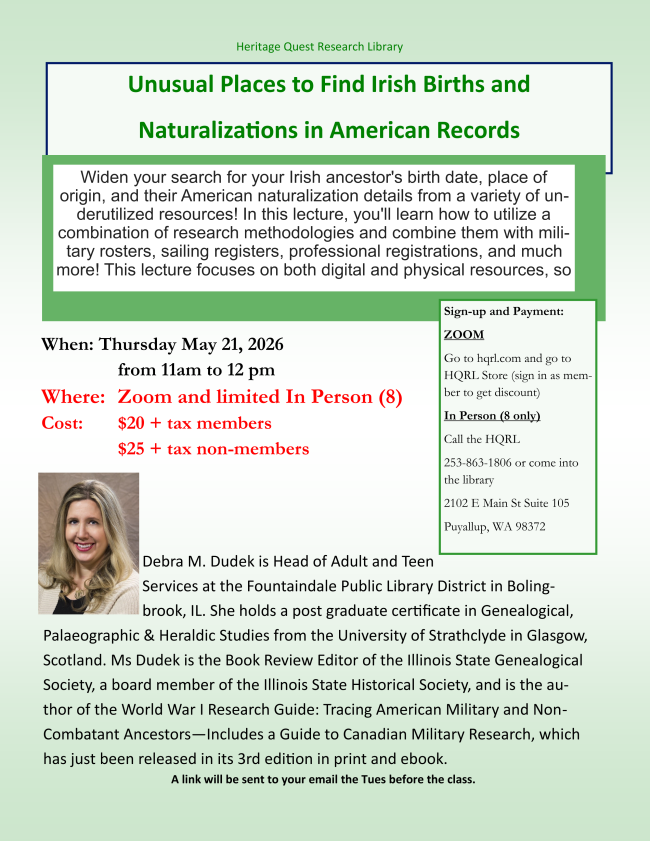
Every genealogist can aspire to do great genealogy. But how do you find the time for all those “things” you’ve been told you should be doing: planning, logging, note-taking, analyzing, and reporting? There’s one shortcut you need and it’s so easy to get started!
Click Here to Sign-up
Jennifer Patterson Dondero has been an avid genealogist for over 30 years, and a professional genealogist since 2005. Her specialties include southern research, DNA, and technology for genealogy. She lives with her husband and two children in Georgia, where she enjoys researching, writing fiction and nonfiction, reading mystery novels, and clogging.
Click Here to See All of Our 2026 Classes! Visit our blog for great tips & hints exploring your family story! HQRL.com / Classes & Events / Contact
Heritage Quest Research Library | 2102 East Main Ave Suite 105 | Puyallup, WA 98372 US

Tacoma Pierce County Genealogical Society Legacy Family Tree Software SIG

Tacoma-Pierce County Genealogical Society Legacy Family Tree Software SIG Meeting
Tuesday, February 3, 2026, from 7:00 pm to 8:00 pm virtual via Zoom

This month we will discuss using the Search functions in Legacy with live screen sharing so start thinking about the things you would like to find in your Family Data Base file.

This is our monthly meeting to share tips & tricks, problems & solutions. Sometimes we will watch videos or share our screens to aide in learning more about using Legacy Family Tree software.

Everyone is welcome to attend and participate in the learning. If you are just thinking about trying Legacy for the first time, you’ve been using it for a year or two or you are an old pro with many years of experience using Legacy this is the group for you.

We look forward to meeting with you, every month on the First Tuesday at 7:00 PM Pacific Time

We look forward to meeting with you, every month on the First Tuesday at 7:00 PM Pacific Time

Please download and import the following iCalendar (.ics) files to your calendar system.

Monthly Calendar Reminder: https://us02web.zoom.us/meeting/tZYpfuyuqDovHNwtBgxtQjWKOjDQ8k5Q9bPD/ics?icsToken=98tyKuGqqjIvHNKUtR-PRpwQBor4Z-7wpn5Ygo1KiD3iGzRiaDTdGehmA-p0RemJ

Join Zoom Meeting:
https://us02web.zoom.us/j/82495661568?pwd=dy85YmluVzF5aEU4SzFTcTUrVDlTUT09

Meeting ID: 824 9566 1568
Passcode: 715731

One tap mobile:
+12532050468,,82495661568#,,,,*715731# US
+12532158782,,82495661568#,,,,*715731# US (Tacoma)

Dial by your location:
+1 253 205 0468 US
+1 253 215 8782 US (Tacoma)

Meeting ID: 824 9566 1568
Passcode: 715731

Find your local number:
https://us02web.zoom.us/u/kcphK19I1E

Skagit Valley Genealogical Society Washington State Library Family History Resources


You can’t keep a good library down! Join SVGS on Saturday February 14, 2026, at 1pm at the Burlington Public Libraryfor “Washington State Library Family History Resources” with librarian Crystal Hicks. From historic newspapers and local city directories to maps and tribal histories, the Washington State Library has materials to aid you in your family history research. Come learn how we can still access these materials despite the library’s closure to the general public due to budget cuts. Can’t make it to the Burlington Library, request a zoom link by emailing info@skagitvalleygenealogy.org.

Let’s Ask: What Is A Keeper?

Sue Kreikemeier is president of the Whitman County Genealogical Society. Her editorial in their November 2025 newsletter was a real zinger and I asked permission from her to share it with you.

“Dear Readers, I am sure many of you can related to the quandary I find myself facing on a continual basis… how to manage my plethora of notes, hard copy records, unlabeled family photos and other ephemera from my genealogical pursuits. How do I know what to keep and what to toss out? Might something seeming irrelevant become an important clue in the future? 

“Asking myself what is a “keeper,” I went to Google and found many definitions. My favorites were (1)a person whose job it is to guard to take care of something or (2) a curator. This gave me a new way of looking at those challenging piles and files. Instead of thinking about which items I should keep, I started thinking about how I might better define and deliver on my role of “keeper” especially as it relates to family history.”

Sue went on in this editorial to tell about how she and her siblings were collaborating on putting down their memories of a very frightening event that occurred in the family when Sue was about nine years old. Sue says she has realized that “sometimes being a “keeper” means sharing something that can’t be found in any document or archive.”

Isn’t that just another way to say WRITE YOUR STORIES NOW! I think Sue would second that motion. 

Tacoma Pierce County Genealogical Society DNA SIG Meeting

Tacoma-Pierce County Genealogical Society DNA Special Interest Group Meeting
Tuesday, January 27, Starting at 7:00 pm via Zoom

Your assignment: explore the Gedmatch site, upload your DNA data (if you haven’t already), and see what you can discover using the various tools available.

Calendar reminder: TPCGS DNA Special Interest Group Meeting

Every month on the Fourth Tuesday beginning at 7:00 PM Pacific Time

Please download and import the following iCalendar (.ics) files to your calendar system.

Monthly: https://us02web.zoom.us/meeting/tZYqdeyrrz0iEtx-c_J3gNfcI8mebT1zajLo/ics?icsToken=98tyKuGqqTkvGdWTuBGPRpwQB4joZ-nzmCFHj7dF0RzaKXNUTAX1H7pPN7BLQcLR

Join Zoom Meeting:
https://us02web.zoom.us/j/82725316888?pwd=MDc3UEZrUVJNbmxmK2ZORmw5YzdDdz09

Meeting ID: 827 2531 6888
Passcode: 811780

One tap mobile:
+12532050468,,82725316888#,,,,*811780# US
+12532158782,,82725316888#,,,,*811780# US (Tacoma)

Dial by your location:
        +1 253 205 0468 US
        +1 253 215 8782 US (Tacoma)
Meeting ID: 827 2531 6888
Passcode: 811780

Find your local number: https://us02web.zoom.us/u/kIKCyZLQy

Let’s Talk About: Ossuaries?

Do you know what an ossuary is? What it was used for….and when? Well, let’s learn!

An ossuary was usually a smallish chest or box used to hold the bones or cremains of the dead. As far back as 40 B.C. ossuaries were popular among the Jewish population.  Historically they have been used in areas where burial space was scarce or in situations were large numbers of people died in a short time such as a plague or battle. Also, over time, they were used when the bones were exhumed from a grave to make space for a new burial. (Very common in Europe even today. You have your cemetery space or plot for x-number of years and then the plot is reused.)

Are ossuaries used today? Certainly yes. How many have their deceased loved ones still with them sitting on the mantel?? There are funeral urns even for our beloved pets!