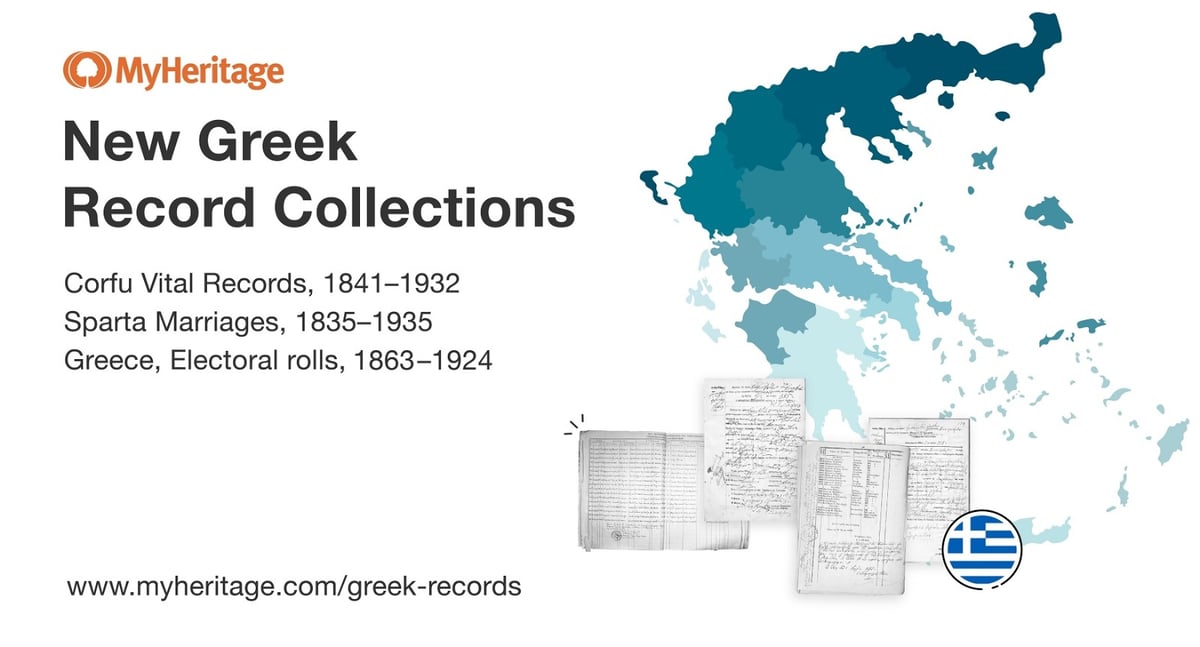
The Greece Electoral Rolls (1863–1924) consist of 1,006,594 records and provide nationwide coverage of males ages 21 and up who were eligible to vote. The Corfu Vital Records (1841–1932) consist of 646,807 birth, marriage, and death records that were collected by the civil authorities in Corfu and document the life events of all residents of the island, regardless of their ethnicity or religion. The Sparta Marriages collection (1835–1935) consists of 179,411 records which include images of the couple’s marriage license and their listing in the marriage register.
In one of our pro bono initiatives, MyHeritage Founder and CEO Gilad Japhet personally traced the descendants of a Jewish family that was hidden during World War II on the small island of Erikoussa, north of Corfu. Gilad further utilized his hands-on experience in Greek research to develop the enhanced method by which MyHeritage now handles Greek surnames in the new collections.
In Greece, a woman’s last name is the genitive form of her father’s surname, or when she marries, of her husband’s surname. The new Greek collections on MyHeritage have been made gender-agnostic to facilitate enhanced searching and matching. For example, a search for the Jewish surname “Velleli” in the new collections on MyHeritage will also locate people named “Vellelis”. It is also possible to find these surnames by searching for “Belleli”, because the Greek letter beta is pronounced like the English letter V, but in some countries this distinction has been lost and Greek surnames are sometimes pronounced with the letter B, the way they are written in modern English.
MyHeritage’s Global Name Translation Technology further ensures that when searching on MyHeritage in other languages, such as Hebrew and Russian, the results will also include names in the new Greek collections. No other major genealogy company has these Greek record collections, nor such sophisticated algorithms customized for Greek genealogy research.
Learn more about the new Greek record collections in the press release below.
Wishing you good health and sending warm regards, Daniel Horowitz
Genealogy Expert


MyHeritage Releases Three Major Collections of Greek Historical Records
TEL AVIV, Israel & LEHI, Utah, May 18, 2020 — MyHeritage, the leading global service for discovering your past and empowering your future, announced today the publication of three important Greek record collections: Greece, Electoral Rolls (1863–1924), Corfu Vital Records (1841–1932), and Sparta Marriages (1835–1935), comprising 1.8 million historical records.
This release constitutes the first substantial set of Greek record collections available on MyHeritage. All three collections have been indexed by MyHeritage and for the first time are now searchable in English, as well as in Greek. The total size of MyHeritage’s historical record database is now 12.2 billion records. This release positions MyHeritage as an invaluable genealogy resource for family history enthusiasts who have Greek roots.
“As the cradle of western civilization and a crossroads of continents and cultures, Greece is becoming a gem among MyHeritage’s historical record collections. The records in these collections are rich in detail and have pan-European, Balkan, and Mediterranean significance. The communities documented were shaped by Greek, Italian, French, and Russian influences, have been home to significant Catholic and Jewish communities, and represent some of the world’s most progressive systems of governance. These collections will prove valuable both to novice researchers and experienced genealogists,” said Russ Wilding, Chief Content Officer of MyHeritage.
The publication of these collections furthers MyHeritage’s commitment to providing new avenues for Greek family history research. In one of the company’s pro bono initiatives, MyHeritage Founder and CEO Gilad Japhet personally traced the descendants of a Jewish family that was hidden during World War II on the small island of Erikoussa, north of Corfu. The entire population of the island collectively gave refuge to the family, and saved it from death. His genealogical detective work, combined with MyHeritage’s extensive global database of historical records, culminated in recognition for the courageous people of Erikoussa, who were presented with the House of Life award by the Raoul Wallenberg Foundation. This was depicted in the books ‘When the Cypress Whispers’ and ‘Something Beautiful Happened’ by Yvette Manessis Corporon, whose grandmother was among those who saved the Jewish family on Erikoussa.
Japhet utilized his hands-on experience in Greek research to develop the enhanced method by which MyHeritage now handles Greek surnames in the new collections. In Greece, a woman’s last name is the genitive form of her father’s surname, or when she marries, of her husband’s surname. The new Greek collections on MyHeritage have been made gender-agnostic so that searches and matches will work to the fullest extent. For example, a search for the Jewish surname “Velleli” in the new collections on MyHeritage will also locate people named “Vellelis”. It is also possible to find these surnames by searching for “Belleli”, because the Greek letter beta is pronounced like the English letter V, but in some countries this distinction has been lost and Greek surnames are sometimes pronounced with the letter B, the way they are written in modern English. MyHeritage’s Global Name Translation Technology further ensures that when searching on MyHeritage in other languages, such as Hebrew and Russian, the results will also include names in the new Greek collections. No other major genealogy company has these Greek record collections, nor such sophisticated algorithms customized for Greek genealogy research.
The Greece Electoral Rolls (1863–1924) consist of 1,006,594 records and provide nationwide coverage of males ages 21 and up who were eligible to vote. They list the voter’s given name, surname, father’s name, age, and occupation. Each record includes the individual’s name in Greek, and a Latinized transliteration of the name that follows the standard adopted by the Greek government. MyHeritage translated many of the occupations from Greek to English and expanded many given names, which are often abbreviated in the original records. This new collection includes scans of the original documents and is the most extensive index of Greek electoral rolls currently available anywhere.
The Corfu Vital Records (1841–1932) consist of 646,807 birth, marriage, and death records. The records were collected by the civil authorities in Corfu and document the life events of all residents of the island regardless of their ethnicity or religion. Birth records from this collection may contain the child’s given name and surname, birthdate and place of birth, name and age of both parents, and the given names of the child’s grandfathers. A marriage record from this collection may include the date of marriage, groom’s given name and surname, age, place of birth, residence, and his father’s name. Similar information is recorded about the bride and her father. Death records in this collection may include the name of the deceased, date of death, age at death, place of birth, residence, and parents’ names. The indexed collection of Corfu Vital Records includes scans of the original documents and is available exclusively on MyHeritage.
The Sparta Marriages collection (1835–1935) consists of 179,411 records which include images of the couple’s marriage license and their listing in the marriage register. The records in this collection list the full names of the bride and groom, the date of marriage, their fathers’ names, the birthplace of the bride and groom, and occasionally the names of witnesses to the marriage. The images in this collection were photographed, digitized, and indexed by MyHeritage from the original paper documents, in cooperation with the Metropolis of Monemvasia and Sparta.
The new collections are available on SuperSearch™, MyHeritage’s search engine. Searching the Greek record collections is free. A subscription is required to view the full records and to access Record Matches.
Search the new Greek record collections.
About MyHeritage
MyHeritage is the leading global discovery platform for exploring family history and gaining valuable health insights. With billions of historical records and family tree profiles, and with sophisticated matching technologies that work across all its assets, MyHeritage allows users to discover their past and empower their future. Launched in 2016, MyHeritage DNA has become one of the world’s largest consumer DNA databases, with more than 4 million customers. As the world’s leading global service that combines family history and DNA testing for genealogy and health, MyHeritage is uniquely positioned to offer users a meaningful discovery experience that unites their past, present, and future. Available in 42 languages, MyHeritage is the most popular DNA test and family history service in Europe. www.myheritage.com
MyHeritage
Rafi Mendelsohn
Director of PR & Social Media
Phone: 917-725-5018
Email: pr@myheritage.com
MyHeritage (USA) Inc.,
2975 Executive Parkway,
Lehi, Utah


 Ancestry® Announces Virtual Memorial Day “Parade of Heroes” in Honor of 75th Anniversary of the End of World War II Many of us will honor our family and others who served in the military this Memorial day, but may be restricted under our current circumstances.
 NGS 2020 Live! As a long-term partner of the

 Ancestry added over 50 million new records to the world’s largest digital archive of searchable online obituaries and death announcements. Newspapers.com Obituary Index, 1800s-current – About 50 million new records

 1.7 million new records coming in May Today is VE Day, we have additional records available this month to discover your WWII family story. We’re adding 1.7 million records covering records gathered from the French Allied Zone and areas outside of modern Germany. This collection consists of foreigners and German persecutees in Germany between 1939-1947 who were persecuted by public institutions, social securities and companies. The records may also include information on those who died, including burial information. The documents were assembled according to the Zones of Occupation – American, British, French and Soviet – by the Allied forces within Germany. Areas outside Germany were also recorded.
 – New Message Center – Full rollout continues, but most users have the new experience. Download folders in the New Message Center until Aug 31 Existing international users will see the new experience soon
 The proportion of deaths to the population was greater than any other conflict in American history. Nearly 3% of the population died – roughly comparable to 6-10 million Americans today. Civil Stories is an ambitious project that ultimately hopes to create a comprehensive list of every soldier that fought in the Civil War, the company and regiment he belonged to, the battles he fought in, and finally what happened to each soldier following the war.

 War of 1812 Pension and Bounty Land Warrant Application Files

 “Roots Less Traveled”, an exciting new television series co-produced by Ancestry®!



 Saturday, April 25 from 10:00 – 11:30 a.m., the
 The
 How often have you considered sharing a copy of your weekly GFO E-News? We would like to make it easier for you to do just that. Take a look on the bottom of the banner of this newsletter. There is now a link which will enable you to access an easy to read copy of each week’s GFO E-News in PDF format. You can use it to archive a copy for your personal files, or you can share our content and send the link to your friends, to your colleagues, share it to your organization’s newsletter, or to your personal blog.
 GFO member Sheila has asked us to identify the parents of her 2nd great grandfather, Austin Baldwin, born 1810, in either Canada or New York. Ordinarily, border crossing records would help us sort out the family, but prior to April 1908, people were able to move freely across the U.S. border to Canada and back, and typically no record of immigration exists. Join the
 Join the
 A very kind GFO member wrote to us last week wondering if
 Feeling overwhelmed? Perhaps you’ve considered hiring a professional genealogist to help.
 We have an official ballot now for this year’s GFO Board election. Vince Patton is running for re-election as president. Alexa Waddle is running for secretary. Joyce Grant-Worley seeks re-election as a Director at Large. And Geoff Smith has offered to serve again on our Endowment Committee. While voting on a GFO election may not seem like a top priority right now, our bylaws require that the election be held. We are attempting to follow our bylaws despite the difficult circumstances. Only active GFO members are eligible to vote.
 You have two weeks left to send us your GFO Hall of Fame Nominations! Any GFO member may nominate another member by May 1. Nominees must have a well-documented history of service, leadership, and accomplishment in more than one facet of the GFO, over a long period of time.
 Since we are unable at this time to process new books and new digital content for the GFO Library, we will be temporarily suspending our “What’s New” weekly feature. In this time of physical distancing and responsible sheltering in place, we will instead share online resources so that you can reach out and connect as well as continue to learn and build on your genealogy skills from home.
 Here is a good site to save in your bookmarks. Tami and
 Legacy Tree Genealogists has some great suggestions on their page,
 • I always wanted recipes from my relatives. Yesterday, I found 3 from my maternal grandmother (d.1953) that were published in a fundraising cookbook. They were submitted by her sister in 1914 and 1920. Can’t wait to try them.
 • I am working on school records in Columbia and Washington Counties, Oregon. The U.S. federal census records often record if a person (child) was attending school during that year and/or if they were teaching. The school records are from 1871 to 1889. It is interesting to look back in time at a community and how it evolved. Such records may be buried at local repositories.
 We’re all in this together. And we can help each other get through it. GFO is providing the resources for you to connect with the Special Interest Groups, we send you the weekly eNews, and we’re brainstorming other ways to help our members stay connected. We’re looking for feedback and for other ideas that we may not have considered. Please, take our survey now.


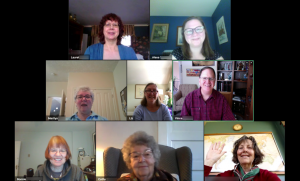
 GFO’s Library Committee had a virtual meeting that cheered everyone up. Library Chair Laurel Smith said it felt very healing to finally see and talk with each other again. I couldn’t agree more. The GFO will have some more virtual special interest group meetings and you’ll get advance notice of them here. I hope you’ll take part and find them as valuable as I have.. We got a bit of good financial news in the last week. Ancestry and Fold3 have agreed to suspend our pricey contracts for as long as the library is closed. They’ll extend our subscription by an equivalent number of months. If you’re a member,





 We might as well make the best of being stuck at home. What a great time to learn new genealogy skills! (Some of you already have. Please see the survey results below.) The genealogy conference website




 Wondering how you can support preserving our history while stuck at home? Here’s any easy way that doesn’t cost you any extra. Please register your Fred Meyer Rewards Card to link it with the Genealogical Forum of Oregon.

 I watched

 I learned some tricks for searching for the women in my lines from a webinar from the

 Most of us are stuck at home, and most of those we’ve heard from tell us they are doing more genealogy than normal. We can all use a little inspiration, so, this week, we’d like you to tell us about a discovery you’ve made recently. Please share via our survey.