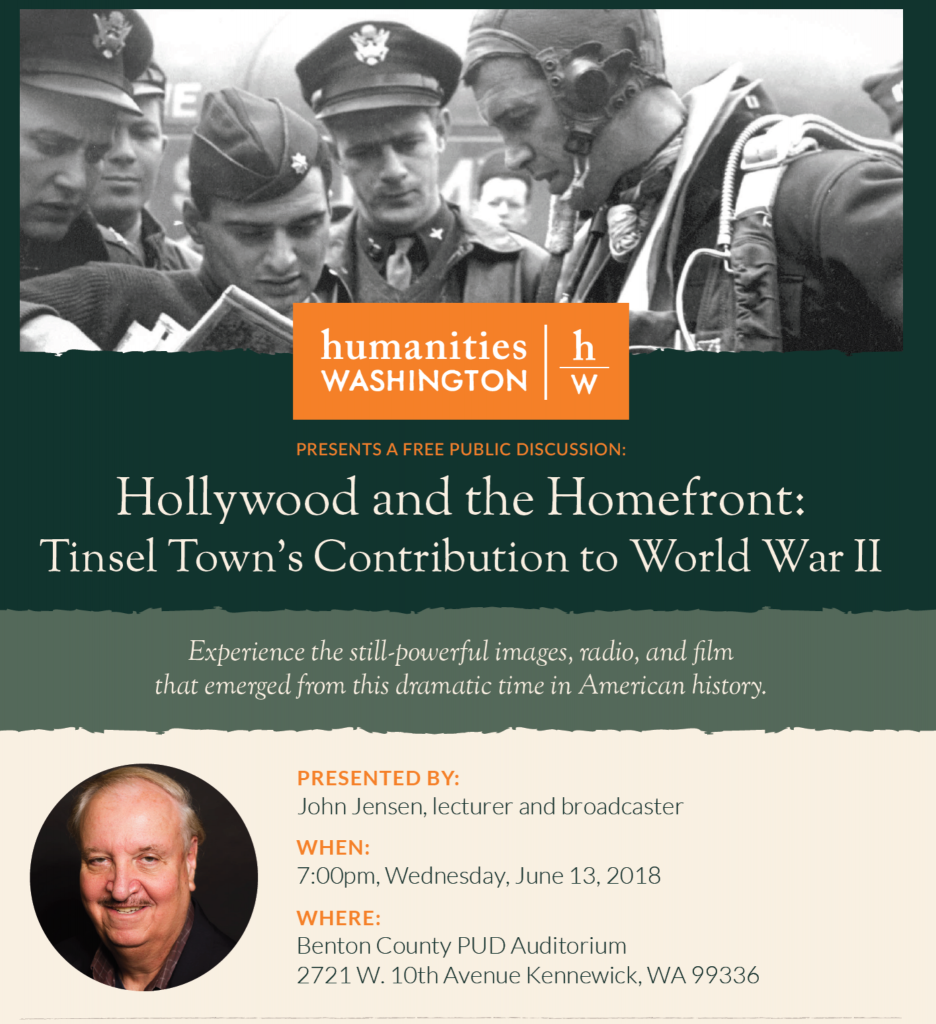
Flyer: Jensen, Benton County PUD Auditorium


Flyer: Jensen, Benton County PUD Auditorium

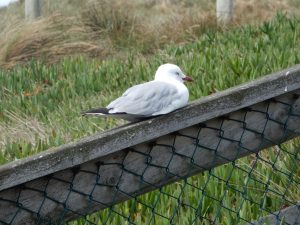
We know what a seagull is, right? Would you guess how many different types of gulls there are?? This is Mr. Resting Seagull that I spotted in New Zealand…. just posing for tourist photos, no doubt.

“There are at least 28 types of gull species seen in North America. These birds are fairly well distributed throughout the continent along the coastlines and at sea. Although gulls are referred to as seagulls on a daily basis by most people, they are simply referred to as “gulls” in the birding society.” (Quoting from this website: https://www.birds-of-north-america.net/gulls.html )
From another website, I learned that there are 50 species world wide! Gracious. Never would have guessed. Would you?


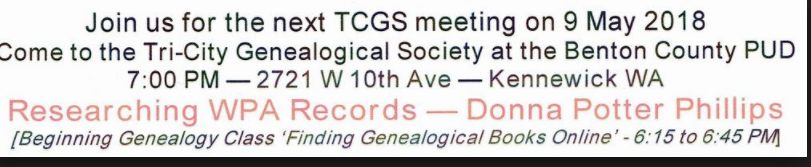
I hope you have made plans to attend tonight’s Tri-City Genealogical Society’s meeting. Please see the enclosed attachment about our program – WPA Records.


The German Interest Group of The Eastside Genealogical Society (EGS) will meet on Friday, June 1, 2018, from 1 to 3 pm in the Relief Society Room of the LDS Church at 10675 NE 20thSt, Bellevue, WA 98004 with doors opening at 12:45 pm for networking. Visitors are always welcome at our meetings.
Topic: “How to Find German Records on Family Search Efficiently and Effectively” – Many genealogists use FamilySearch and yet may not realize that they are accessing only a small portion of the records available. Learn several strategies for using FamilySearch to access the 70% of the records not currently indexed. This means more than 1.33 billion records and 247,000 books not indexed on FamilySearch. The presentation will include step-by-step actions and examples to specifically access German records in the U.S. and Europe. (Feel free to bring your laptops.)
Speaker: Janet O’Conor Camarata, a member of Eastside Genealogical Society and South King County Genealogical Society, has over 25 years of experience in genealogy. She is an instructor in genealogy at Pierce College, a seminar presenter and trainer in genealogy societies across Washington, who takes advantage of the latest technology and staying mobile with the latest computing tools.

For more information, kindly visit our website

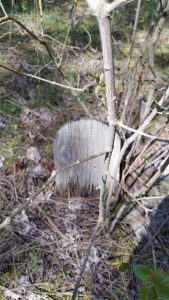
Cannot speak for you, but my heart kinda breaks when I see a nearly forgotten gravemarker …………….like this:

It was a small wooden curved marker, well rotted off at the bottom, and looking to me like somebody stuck it into this bush. No writing was visible.
Who did this marker memorialize? Did they want a marker that would eventually turn to dust? Was it a quick-simple marker by a family of limited means?
I took this photo in the un-endowed portion of Greenwood Memorial Terrace cemetery here in Spokane.
Would this be a fun challenge: Who would like to write the story of this little wooden marker, how it came to be and who it was for? If you would, send it to me, Donna243@gmail.com

Whatcom Genealogical Society will meet Monday, May 14th at 2 p.m. at the Bellingham Elks Lodge, 710 Samish Way. May’s program is Blaine Bettinger’s Legacy Family Tree webinar on GedMatch.com. “The DNA website GEDmatch can be intimidating, so this lecture will start at the beginning and look at some of its basic but very important tools that genealogists can utilize in their research. We will look at the ethnicity tools, the One-to-Many tool, the One-to-One tool, and the X One-to-One tool.” Visitors welcome. Contact: 360-733-8300

Today’s Trivia is Part 2 of my notes compiled from Carol Buswell’s talk to EWGS on April 7th:
“We genealogists must remember that governmental archives must, by mandate, keep and preserve the records of the governmental doings of that agency and that’s mostly pretty boring stuff,” Carol smiled and said.
How do you figure out which libraries, historical societies and museums might have the information you seek? “Take the papers of the famous architect, Frank Lloyd Wright, for instance,” Carol said. “Some of his papers are in the National Archives, some in the Library of Congress, some in the Frank Lloyd Wright Museum, some in the Getty Research Institute….well, you get the idea,” she quipped. “No one repository or source will furnish all there is to know or that you want to know on a given topic; you MUST keep looking for new sources.”
On the other hand, government archives keep EVERYTHING created in government offices that is deemed “permanent.” The rest is destroyed. So it is easier to figure out exactly where government-created materials will be than it is in a library, historical society, or museum. It will be in the archives of that government!
Critical to finding anything in an archives is using the card catalog. In the case of our U.S. National Archives, that address is www.catalog.archives.gov . “Just go there and poke around,” Carol advised, “and use a different mindset than you’ve used before.” With 27 billion documents of primary sources, using the catalog is a must, so we must learn to use the catalog and use it creatively. “Looking at something without understanding what you’re looking at is like looking at a black hole,” Carol laughed.
Carol shared some statistics with us. “Less than 1% of material held by the National Archives has been digitized; most stuff is still in boxes and some of those boxes are opened, on average, once every 87 years! NARA has the records of every federal agency that ever existed….. If those records survived and were turned in.”
One good use of archival records is for furnishing background to enrich the timeline of life for an ancestor. “So they were born in 1851 and died in 1910, what was going on around them in their lifetime?” Carol asked. “A wonderful feature of the National Archives is the website www.docsteach.org. At this website you’ll have access to thousands of primary sources…. Letters, photographs, speeches, posters, maps, videos and other document types…spanning the course of American history and we’re always adding more,” as was shown in Carol’s slide from the home page of this website.
(to be continued/completed next week)
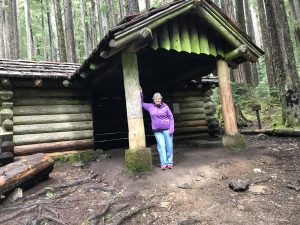
Below is a photo of me standing next to a structure on the trail to Sol Duc Falls built by who? when? why? That’s your mystery question today!