Wednesday Nostalgia

In this month of thinking turkey, here’s a question for you: How many kinds or species of turkey are there? The answer surprised me.

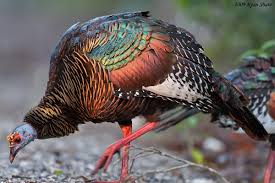
This image (from Wikipedia) is of a Mexican turkey. Other sorts are Eastern Wild Turkey (what we’re familiar with), Osceola Wild Turkey or Florida Wild Turkey, Rio Grande Wild Turkey, Merriam’s Wild Turkey and Gould’s Wild Turkey.

Wild turkeys are found in 49 of the 50 states (all except Alaska). They can be seen from southern Canada to southern Mexico. Many species have also been introduced into Europe and New Zealand. Turkeys are able to live in many different areas, including in the forests on the edge of suburban areas.

Here’s some bits that will win you the $10,000 prize: A bunch of turkeys is called a rafter. A baby turkey is called a poult. And when writing to refer to a rafter of turkeys it is turkeys not turkies.

Think your ancestors ate turkey???? 

Eastern Washington Genealogical Society Christmas Party


Annual Christmas Party - Your Pioneer Ancestor

Saturday, December 1
Annual Christmas Party – Your Pioneer Ancestor  (EWGS Meetings)
12:30 pm to 3:00 pm
Spokane Public Library Auditorium, Downtown Spokane
This year’s theme is “Your Pioneer or Early American Ancestor.”
Tell us about a family, or family member, that came from somewhere other than the United States of America. America is the “Great Melting Pot” so we should see some wonderful diversity in the presentations. Each presentation will be limited to a maximum of 5 Minutes.
The following questions come to mind: Why did your ancestors come here? When? How?
Maybe your story will enable the group to learn a new research trick or prompt some ideas for you to solve a brick wall. Visual aids are always welcome. Show and tell!!
Our annual cookie parade will continue. Please bring a couple dozen of your favorite homemade holiday cookies to share. Don’t forget your recipe! We still have hopes of a cookbook some day.
There will be door prizes so be prepared for a fun and festive holiday get together.
Organizer – Mary Holcomb.
If you have questions or suggestions please contact Mary at:  mkholcomb@live.com

2019 International German Genealogy Conference

Seven months to go:
73 reasons for dressing cool casual

Wondering about the weather when you arrive in Sacramento for the International German Genealogy Conference next June?

It is true that, on average, there are 73 days in the year when temperatures exceed 90°F (32°C). But if you were on the French Riviera, would you mind? No! Just think of Sacramento as the “California Riviera” because it enjoys the same Mediterranean climate: mild winters and very warm, dry summers that stay comfortable because of the low humidity. Think cool and casual when packing for your trip.

The Mediterranean climate’s characteristics were first described by Wladimir Peter Köppen. Born in St. Petersburg in 1846, he was the grandson of a German doctor invited to Russia by Empress Catherine the Great. Köppen spent most of his life and professional career in Germany and Austria. His interest in climate and its effect on vegetation led to the development of the “Köppen climate classification system,” which is still in use.

Now that you have some guidance on the weather, register for the conference and book your hotel. A sell-out in the early-bird registration period is a possibility. And you don’t want to miss the Mediterranean in California!

  NEW!   Follow conference updates on our blog.

Register now
Take advantage now of the early bird registration rates, which end Jan. 15. With limited seating available, it’s best not to hesitate. If the conference is full, your registration will go on a wait list.
Book a room
The conference hotel, The Hyatt Regency, now has limited availability. But you can get a conference rate for rooms at the Marriott Residence Inn, just two blocks from the conference hotel.
Your hosts, the Sacramento German Genealogy Society and the International German Genealogy Partnership, encourage you to learn more about the products and services offered by conference sponsors. We thank them for their support.

Tuesday Trivia

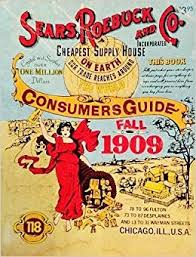
I think it was said in days of yore, “if it ain’t in the Sears Roebuck catalog, you don’t need it.”  I’m old enough to remember pouring over a S&R catalog, especially the toy catalog at Christmas time! Bet you did too.

I bought this little paperback for 25-cents at a roadside junque sale. It’s been such fun browsing the pages……..but only in strong light and with a magnifying glass for it’s teeny print/pictures.

This 1909 catalog offered everything:  Pianos, corsets, guns, sofas, typewriters, rocking chairs, “quick cures for dyspepsia,” violins, diamond rings, watchmakers’ tools, shoes (ohmygoshthewomensshoesAWFUL), and “the highest grade steel range” for $22.43 (plus postage? and you know how HEAVY they were).

Did I mention fishing hooks, men’s shirts, lamps, dishes, crucifixes, “Parisian depilatory” (for 58 cents), blacksmith tools…………… well,you get the idea.

A genuine stroll-through-time as I browse those 900-pages of goods offered in 1909 by Messrs. Sears and Roebuck.

Jewish Genealogical Society of Washington State DNA Successes

Dear Genealogy Friends,


You are invited to attend our upcoming free genealogy event, on
Monday evening, December 10, 2018.


The Jewish Genealogical Society of Washington State is pleased to present our December meeting program


“DNA Successes–Despite Endogamy!”

presented by Lara Diamond, Genealogist/Blogger/Speaker


DATE: Monday, December 10, 2018

LDS Factoria Church Building
4200 124th Ave SE

Bellevue, WA 98006

(just off I-90 and I-405)

  • Doors open at 6:30 p.m., for all to enjoy the extensive JGSWS Library’s genealogical resources and, available again, the LDS Family History Center computers and database programs!
  • Free Wi-Fi available and come early to network with other attendees
  • Presentation starts promptly at 7:15 p.m.
  • Free admission and refreshments


ABOUT OUR PROGRAM: “”DNA Successes–Despite Endogamy!””

Genetic genealogy is much more complicated when dealing with endogamous populations than the general population, and many people get frustrated when trying to identify actual relatives from the mass of genetic cousins, who are actually related in many ways quite far back. Learn how you can have success when dealing with endogamy by examining stories from the speaker’s own family’s DNA, which include reuniting with branches thought killed in the Holocaust.


ABOUT OUR SPEAKER

Lara Diamond is President of Jewish Genealogical Society of Maryland and has been researching her family for 25 years. She has traced all branches of her family back to Europe and most multiple generations back in Europe using Russian Empire-era and Austria-Hungarian Empire records. Most of her research is in modern-day Ukraine, with a smattering of Belarus and Poland. She leads JewishGen’s Subcarpathia SIG, is on the Ukraine Sig board and also runs several town-focused projects to collect documentation to assist all those researching ancestors from common towns. She blogs about her mostly Eastern European research at http://larasgenealogy.blogspot.com.


Please    by clicking on
https://www.facebook.com/Jewish-Genealogical-Society-of-Washington-State-548090815567964/


Please visit our website at http://www.jgsws.org to join or to donate to JGSWS to help support the incredible speakers and workshops we bring to you, to view library listings, download handouts, or for more information.  JGSWS is a 501(c)(3) tax-exempt non-profit organization. Membership dues and donations are tax deductible.


Thank you very much and we look forward to seeing you, your friends and family members!

Karen vanHaagen Campbell
Secretary & Publicity, Jewish Genealogical Society of Washington State
www.jgsws.org



Monday Mystery

Did you know that if Benjamin Franklin had had his way, the turkey would be our national bird and symbol and not the eagle? Quoting from HISTORY News post by Christopher Klein, 16 Nov 2016:

“The story that Franklin proposed the turkey as the national symbol began to circulate in American newspapers around the time of the country’s centennial and are based on a January 26, 1784, letter in which he panned the eagle and extolled the virtues of the gobbler to his daughter, Sarah. In doing so, though, he was not delivering a critique of the Great Seal but a new medal issued by the Society of the Cincinnati, an association of Continental Army veterans. “For my own part I wish the bald eagle had not been chosen as the representative of our country,” he wrote. The Founding Father argued that the eagle was “a bird of bad moral character” that “does not get his living honestly” because it steals food from the fishing hawk and is “too lazy to fish for himself.”

“In contrast, Franklin called the turkey “a much more respectable bird” and “a true original native of America.” While he considered the eagle “a rank coward,” Franklin believed the turkey to be “a bird of courage” that “would not hesitate to attack a grenadier of the British Guards who should presume to invade his farm yard with a red coat on.” While the private letter was a spirited promotion of the turkey over the eagle, Franklin never made his views public, and when the chance had been given to him to officially propose a symbol for the United States eight years earlier, his idea was biblical, not avian.”

Olympia Genealogical Society’s December Meeting

In keeping with our annual tradition, Olympia Genealogical Society’s December  program will consist of 10 minute presentations by several OGS members. This year’s topic is Genealogy’s Oddballs and Quirky Ancestors. It is always fun to hear these personal stories, and we’re sure to have some laughs!

=======================================================================
Joyce T. Ogden
jtogden@comcast.net

Friday Serendipity

Shall we have some plain ole fun today? I gather pondering-points and so today share some with you:

“There is a relation between the hours of our life and the centuries of time.” (Emerson)

“Only in understanding the past an we interpret and use the present for history is not made but unfolded.” (Benjamin Ide Wheeler, 1854-1927)

“I didn’t exaggerate….. I just remember big!”

“I’ve been working on my brick walls and think I’ve chipped off a few bricks.”  (Donna Heine)

“When there is no one in the living world who remembers you, you disappear.” (movie Coco)

“All electronic devices hate people! But humans have the ultimate power….we can pull the plug!!” (Ron Tanner)

“We have intermarried all over the world…..so we are really a one-world family, so why not a one world family tree? We must realize this.”  (Ron Tanner, works for FamilySearch)

“Do you realize you share much the same DNA as a banana?  (Anna Swayne, formerly of Ancestry)

Seattle Genealogical Society Tip of the Week

TIP OF THE WEEK –
CAUTIONS ON SHARING DATA

It is easy to become lackadaisical and accept research data you have found in a public family tree at face value. Remember to treat information you get from someone else’s family tree as a helpful hint to aid you in your own research. No matter how credible their source citation looks, until you have examined a source yourself, it is just hearsay.

Likewise, don’t put speculative information in your public tree, where it can be perpetuated by others.  A good practice is to have two family trees. A tree you make public should only have substantiated data in it. Research you are still working on, not yet verified, should be in a private tree, your WIP (work in progress) tree, so to speak.