I am kindly asking you to extend an invitation to any of your group’s members who are attending RootsTech to please stop by our booth, #1216, and say “Hi” during the conference. At RootsTech we’ll be:
Giving away our signature notebooks and other swag
Offering daily chances to win a 6-month subscription to Related Faces.
If they have a couple of photos they would like us to use as demonstration, bring along digital copies. We will help as many people as time allows.
Saturday March 4, we will be playing a little game to let attendees test their skills at identifying people in old photos. Their tally sheet is also an entry form to win a free 6-month subscription.
Plus, conference attendees will be receiving a special discount coupon.
For those who are not able to attend RootsTech, we don’t want them to miss out, so we are offering 10% Off their first Related Faces subscription, either 6 months or 1 year. Use code RFVFYBVM89 through 3/31/23when signing up at https://RelatedFaces.com. We will also be exhibiting at the NGS conference in Virginia at the end of May. We will have similar give-a-ways and activities there as well. So, that will be a second opportunity to stop by and meet us! If you are looking for speakers for your group meetings, I offer a free virtual class on identifying unknown people in photos. It’s called “Connecting Faces Through Time.” Please, email me @ tina@relatedfaces.com if you would like to know more. Thank you to all of you who have already hosted a class! Thank you for passing along my invitation, and I hope to see you during 2023!
Want to discover your Irish and Scots-Irish ancestors?
Many people believe that researching Irish ancestors is impossible because of the destruction of the Public Record Office in 1922. While many records were destroyed, others survived and large collections have come online in recent years.
Join Fintan Mullan and Gillian Hunt from the Ulster Historical Foundation during their annual United States lecture tour to learn how to get the most out of Irish resources and records, gain strategies for breaking down brick walls, and grasp important historical context that may help fill in gaps in your research.
Whether you are just beginning your Irish research or have been at it for years, you won’t want to miss these workshops!
Navigating the ‘Net The internet is a goldmine of genealogical information. Sometimes, it can be daunting to decide where to begin. In this presentation, we will have brief overviews of the largest and most frequently used sites. We’ll talk about some of the differences among them and their overall usefulness. We will also visit some sites that may not be at the top of a researcher’s list. There is value in all of them, and you just may find a new vein to mine! Joleen Aitchison has been involved in genealogical endeavors since she was a child and continues the search. She is a member of the Association of Professional Genealogists, the Bainbridge Island Genealogical Society, and the consulting genealogist for Traditions of the Ancestors (TOTA). Joleen has presented at various events throughout the United States. She teaches family history locally in Kitsap, Jefferson, and Clallam counties, as well as making presentations for area genealogical societies. She has served as a Family History Center Director and organized and presented at the Kitsap County Genealogy Expo held in Silverdale, Washington, for five years. You can find her blog at yourpedigree.blogspot.com.
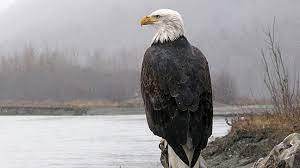
According to Aaron, our education presenter on the cruise, the Mississippi River valley is a major fly path for many eagles (and other birds). While they can be seen in almost all states, they are predominately in Alaska, Minnesota and Wisconsin. Here is some Upper Mississippi River eagle trivia (compiled by me and I hope I jotted down the facts correctly):
An eagle’s head stays dark until age 5.
In the early 70s, DDT nearly decimated the eagle population.
When only one nest could be found (by boat/survey between St. Paul and St. Louis) a loud alarm was raised and finally in 1973 DDT was banned.
Unless you are Native American, it is illegal to own any part of an American Bald Eagle.
Eagles mate for life; they lay 1-3 eggs per year with only a 50% survival rate.
Eaglets fledge in 8-12 weeks.
Nests can be as big and heavy as a VW bug! And are used year after year.
Eagles only weigh 7-8 pounds and have a 6-8 foot wingspan. They can turn their heads 180o.
Females are 1/3 larger than males.
The name “bald” comes from an Old English word meaning white.
Why is this our national bird? And not the turkey (as Benjamin Franklin lobbied for)? It was decided that an eagle symbol was more militant and a turkey was, well…. a turkey.
They can live 18-20 years in the wild but twice that long in captivity.
Their “eagle eyes” can spot a hopping rabbit 3 miles away.
The Upper Mississippi River is prime habitat for Bald Eagles…. lots of trees to the shore line, lots of islands.
Eagles eat mostly fish; their talons are as big as a man’s hand.
One does not need to be a card-carrying bird watcher to appreciate our American Bald Eagle. Out on the top deck of our ship, it was fun to look for and spot eagles with other passengers. We were all appreciative and in awe.
Since 2003, the Washington State Genealogical Society has recognized over 600 outstanding volunteers and teams, nominated by their local society or genealogical organization for their service and dedication. These volunteers are the backbone of their local society, giving their time and expertise, to the organization and the field of genealogy. In the coming months, you will be introduced to each of the 2022 award recipients and learn why they received the 2022 WSGS Outstanding Volunteer and Team Award.
Ann exhibited extraordinary dedication, knowledge, skill and patience while shepherding the board through a year-long process, during the COVID-19 pandemic, over Zoom, to create the society’s strategic plan.
For more information on the WSGS Outstanding Volunteer Award program, visit the Recognition page of the WSGS website or contact Info@wasgs.org. Please type “Volunteer Award” in the subject line.
Please join us for Tri-City Genealogical Society’s March General meeting at 7 p.m. on Wednesday, March 8. Richland FamilySearch Center (formerly known as the Richland Family History Center) director Wayne Ross will be presenting in person at the FamilySearch Center on the FamilySearch Wiki. At this point no Zoom streaming is planned.
The Richland FamilySearch Center is located at 1314 Jadwin Ave. in Richland. Entrance is down the ramp from the parking lot that is to the north of Dairy Queen.
Planning continues for further speakers in 2023 with the intention to have the presentations continue to occur on the second Wednesday of the month at 7 p.m. In the planning stages are presentations on April 12 by Michelle Hedgepeth on Researching Before the Census Records. On May 10 Ryan Bennett will be presenting at the East Benton County Museum and Historical Society in Kennewick on using facial recognition on My Heritage and Google. In June Margie Belden will be presenting on a topic to be determined. Please mark your calendar.
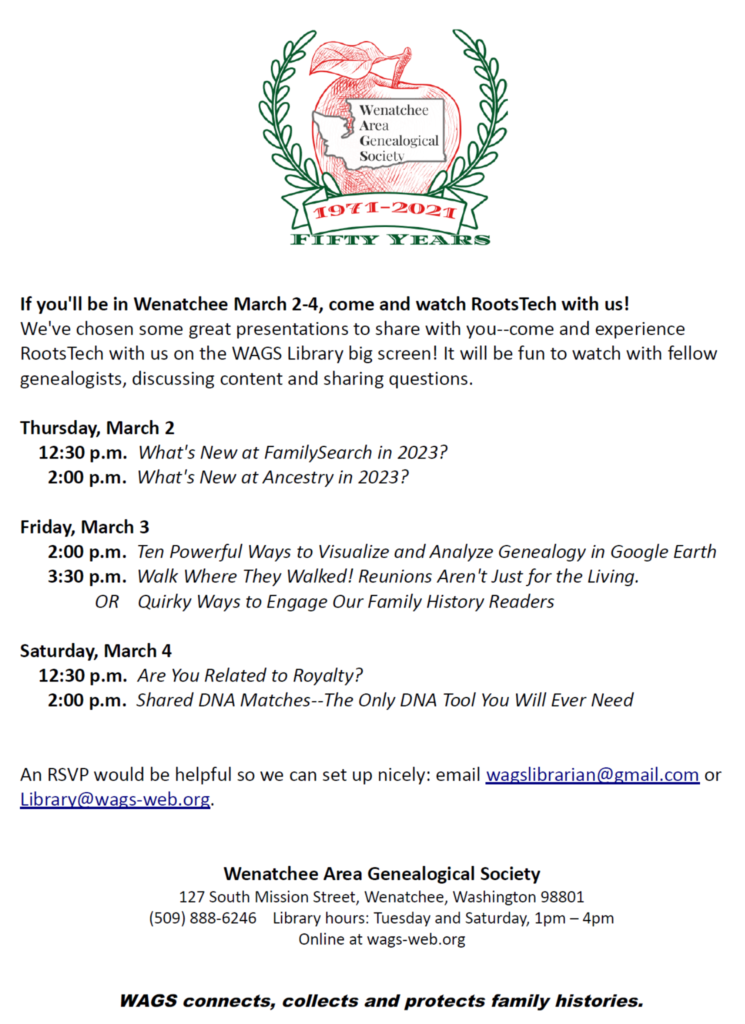
RootsTech 2023 is scheduled to begin on Thursday, March 2 and run through Saturday, March 4. If you cannot attend in person you may register for the virtual presentations at no cost. Search for RootsTech 2023 to register.
Ever heard the term mudlarking? If you’ve talked very much with me, you know that mudlarking, or beach-walking-looking-for-treasures is one of my favorite activities. I’ve been a beachcomber all my life and just recently learned about mudlarking. Nicola White has a YouTube channel showing her walking along the Thames foreshore in London at low tide and finding wonderful and interesting things, some even dating back to Roman times. I’m hooked on her posts.
So of course on my cruise I looked for opportunities to walk along the Mississippi and see what I might find. The river is at a 40-year low which means lots of beach was exposed that hasn’t been in 40 years. When our ship was moored just below the St. Louis Arch I couldn’t wait to get off and go mudlarking! I did pick up some interesting glass and other stuff and did create a window-art piece with it…. here are my finds in the raw (laid out on a daily bulletin on the ship):
It was here that I found my biggest find! The bottom of a ceramic or clay beer bottle dating to the 1850s from a brewery in Wisconsin! I didn’t keep it but gave it to Aaron, our history presenter on the ship, and he documented it for me. But it was such fun to find something that old and hold it in my hand.
What else do beachcombers and mudlarkers find? Anything that’s been tossed into the river or ocean or lost into the same. One can find coins, toys, jewelry, nails, tools, broken glass, pieces of dishes, etc. The best thing about Nicola’s presentations (on YouTube, remember) is that if there is an inscription on her find, she does the history of that piece and perhaps how it came to be in the Thames mud.
Have you time in your life for a new hobby? Come mudlark with me!
For years there has been periodic emphasis on “growth of our genealogical societies.” While we always welcome new members, we must not overlook another important task–sustaining the function of our existing societies.
Successful societies have established a mission such as that of SKCGS:
Stimulate interest in genealogy and aid individual members in compiling their family records
Seek genealogical and historical knowledge
Preserve and perpetuate the records of our ancestors
Promote the preservation of public and private genealogical materials
While the mission may be tailored to fit the needs of its members by time and location, one thing remains constant–who is sustaining the operation of the society? Does the society meet the needs of its members? Who is working behind the scenes to to accomplish that goal? How do leaders, members and newcomers contribute?
SKCGS works toward our purpose through monthly meetings featuring knowledgeable speakers on a range of topics in the field of family history and genealogical research. We have an Education Committee who plan an annual program, seek speakers and negotiate contractual details.
Who is on the Education Committee?
We have user groups and special interest groups for assistance with genealogical software, technology and DNA/genetic genealogy. We have this weekly blog with timely articles of interest.
Who is responsible for producing these outlets of information?
During the Covid pandemic we developed a very successful virtual program and have gained wonderful friends and members throughout the world. The Membership Committee maintains the current database, welcoming new members and sending gentle reminders for renewals.
Who is serving on the Membership Committee?
I can go on by listing the other committees and individuals who operate SKCGS–Publicity, Outreach, Resources, Librarian, Webmaster, etc. The point is, it takes many individuals to bring you a sustaining and healthy society.
And that is a crucial point, that the society must be able to sustain itself. It is a fact that our membership are an aging population. While our interests may not wane, our physical abilities do become diminished. We need capable helpers to start filling in.
It is the responsibility of a leader to recruit and train their replacement. But, in a virtual world such as we have now, how do we find willing volunteers? How do we get to know people? We still have telephone service. Leaders–look at the membership database and call people. Find someone you haven’t “seen” recently and renew an acquaintance. Or contact a new person to find out if they have a special need–or a special skill.
Your new contact may not be ready to take on a major volunteer role but perhaps would be willing to do a one time job or a small recurring job. Many people are just waiting to be asked to help. They may already be thinking about some way to help the society; they just need a suggestion.
And, new person, please don’t be shy. If you see a way to help the society please speak up to any of the group leaders with a question or suggestion. You will not be stepping on any toes by offering to help.
* images courtesy of Pixabay
MaryLynn Strickland
Published with permission from South King County Genealogical Society
Since 2003, the Washington State Genealogical Society has recognized over 600 outstanding volunteers and teams, nominated by their local society or genealogical organization for their service and dedication. These volunteers are the backbone of their local society, giving their time and expertise, to the organization and the field of genealogy. In the coming months, you will be introduced to each of the 2022 award recipients and learn why they received the 2022 WSGS Outstanding Volunteer and Team Award.
Today we’re introducing Teresa “Terry” Mattison of Longview, Washington, who was nominated by the Lower Columbia Genealogical Society (LCGS).
Terry Mattison
Terry has been a very active member of the society for a number of years. She has served as president as well as a trustee serving on the program committee. She is currently the web page webmaster, and she is seeking ways to improve the society’s webpage. She is also a strong voice as a board member, and she advocates for new and innovative ideas to assist the members with their genealogical research.
Terry has presented various programs to help members interpret their DNA results, and she has written articles for the society’s newsletter, The Key, on the subject of DNA. As one LCGS member stated, “She offers herself rather than waiting to be asked.”
For more information on the WSGS Outstanding Volunteer Award program, visit the Recognition page of the WSGS website or contact Info@wasgs.org. Please type “Volunteer Award” in the subject line.
You are free to copy articles to any non-commercial web site or message board or printed publication you wish. Don’t bother to ask permission, just do it.