QUEST CONNECTIONS
June 2026
Volume 31 – Issue 2
Table of Contents
HQRL Dinner and Auction Fundraiser
Upcoming Events
Membership Fees
Welcome New Members
Super Supporters
Above and Beyond
Volunteer Opportunities
New in the Library
Paul Revere Quiz
New Library Books
Quiz Answers
Revolutionary War Slogan
“United We Stand
Divided We Fall”
HEAR YE! HEAR YE!
THERE IS NO TIME TO WASTE!
JUST NINE DAYS TO GET READY
FOR
HQRL’s MAJOR FUNDRAISING EVENT OF THE YEAR!
America 250 Patriot Celebration
Place: Farm12, Puyallup, WA
Time: 5-8:30 pm

Final Prep for the Big Event
by Jennifer Pasquier
The Auction Committee has been hard at work. Under the leadership of Carmen McIntyre, we have secured the auction location, confirmed the menu, scheduled the evening, and secured sponsors and auction items. There’s still time to pitch in and lend a hand. We continue to collect auction items and baskets. Our next get-together is on Wednesday, June 3, at 1:00 pm to assemble auction baskets. If you can help, contact Carmen McIntyre (253) 241-6777, camway@outlook.com or Susan Nolan (253) 351044, gaelicsue@yahoo.com for the location directions. We will be assembling and organizing baskets and donations for the Auction. Please join us and help make this auction a fundraising success.
We also need extra hands to help at Farm12, June 9, starting at 1 pm to help decorate, keep things running smoothly during the dinner, and pack up afterward.
Upcoming Events
HQRL Class
Thursday, June 4
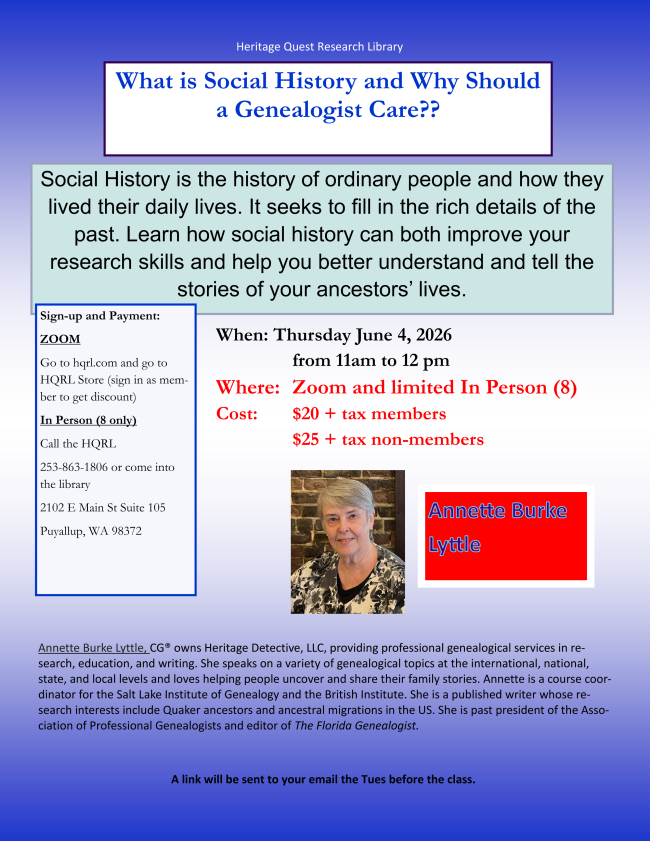
What Is Social History & Why Should a Genealogist Care?
Heritage Quest Research Library (Classroom & Zoom)
11:00 am to 12:00 pm
Join Annette Burke Lyttle to learn how social history can both improve your research skills and help you better understand and tell the stories of your ancestor’s lives. Register at the library or online using the HQRL Store icon. Fee: $20+tax for members, $25+tax for non-members. (the zoom link will be sent to your email 1-2 days before the class along with any handouts)
HQRL 250 Celebration Dinner and Auction
(ticket sales are now closed)
Tuesday, June 9, 5-8:30 pm
Farm12
3303 8th Ave SE, Puyallup, WA 98372
Management Team Meeting
Wednesday June 17, 12:00 noon – 2:00 pm
Heritage Quest Research Library Classroom
HQRL Class
Thursday, June 18
Genealogical Research in Missouri: The Basics
Heritage Quest Research Library (Classroom & Zoom)
11:00 am to 12:00 pm
Bill Eddleman’s presentation teaches about the thousands of documents available in archives across Missouri. Record survival has been excellent, with French records dating back to the mid-1700’s. Register at the library or online using the HQRL Store icon. Fee: $20+tax for members, $25+tax for non-members. (the zoom link will be sent to your email 1-2 days before the class along with any handouts)
Sumner Rhubarb Days
Saturday, June 20 and Sunday, June 21
HQRL will have a booth at the celebration on both days. We still need several volunteers to man the booth for three hour shifts on Saturday and Sunday. There is a white board in the classroom where you can sign up or call HQRL, 253-838-1806 to find out what shifts are available. Librarians will be happy to sign the board for you.
Membership Fees Increase
HQRL membership fees increased April 1.
Individual Membership – $50.00
Individual Membership with mailed quarterly newsletter $65.00
Family membership $60.00
Family membership with mailed quarterly newsletter $75.00
Welcome to our New Members
March
Howard Frisk
Juanita Hembrow
Michele Horaney
Laura Lee
Kathy Penne
Shirley Stalgis
Wendi Thurnau
April
Diane Bertram
Sheryl Hayes
Christine and Jason Neil
May
Amy Plumb
Ryan Raburn
Gail Sanders
Peg Hinshaw
Sally Ives
Jamie Mittan
Janet K. Johnson
Super Supporters
Gloria Brain
LeeAnn Fogt
Lori Jewell and Lois Hoult
Judy Line
Carolyn Pasquier
Ileen Peterson
Phyliss Kleist
Holly McGuire
Maureen Vanek
Terry Vaughan
Steve and Roberta Weech
Keith Weissinger
Thank You So Much
Above and Beyond
Our wonderful library thrives thanks to the dedication of our faithful volunteers. These exceptional individuals maintain our facility in immaculate condition year-round. Though they expect little and often fly under the radar, they consistently show up despite personal commitments and challenges.
Debbie Barr – Librarian
Mike Bartlett – Board of Trustees, Librarian
Gloria Brain – Research Coordinator
Angi Burslem – Board of Trustees, Book Repair, Scan Project
Gordon Chisholm – Librarian
Monty Euston – Board of Trustees Chair
Rachel Farley – Webmaster
April Fredricks – Assistant Treasurer
Heidi Geise – Education Coordinator
Elena Gosner – Board of Trustees
David Grimm – Community Events Coordinator
Jo-Anne Huber – Librarian
Sally Hurst – Librarian
Judy Line – Librarian
Dale Loseth – Grant Coordinator, Scan Project Manager
John Gillem – Board of Trustees
Sara McGlothlen – Membership Coordinator, Librarian
Carmen McIntyre – Promotions Coordinator
Jay McNabb – Board of Trustees
Judy Myers – Librarian
Susan Nolan – Volunteer Coordinator, Librarian
Jerry Olson – Librarian
Lauren Orheim – Board of Trustees
Carolyn Pasquier – Director, Collections Manager, Librarian
Linda Perry – Librarian
Joyce Phillips – Board of Trustees, Librarian
Marilyn Schunke – Librarian
Nancy Thaut – Librarian
Jean Van Hoof – Librarian
Terry Vaughan – Treasurer, Librarian
Volunteer Opportunities
Management Team positions
Secretary for the Monthly Management Team Meetings
Technology Manager to Maintain and update computers and electronics
Editor of Quarterly Newsletter
Assistant to the Education Coordinator
New in the Library
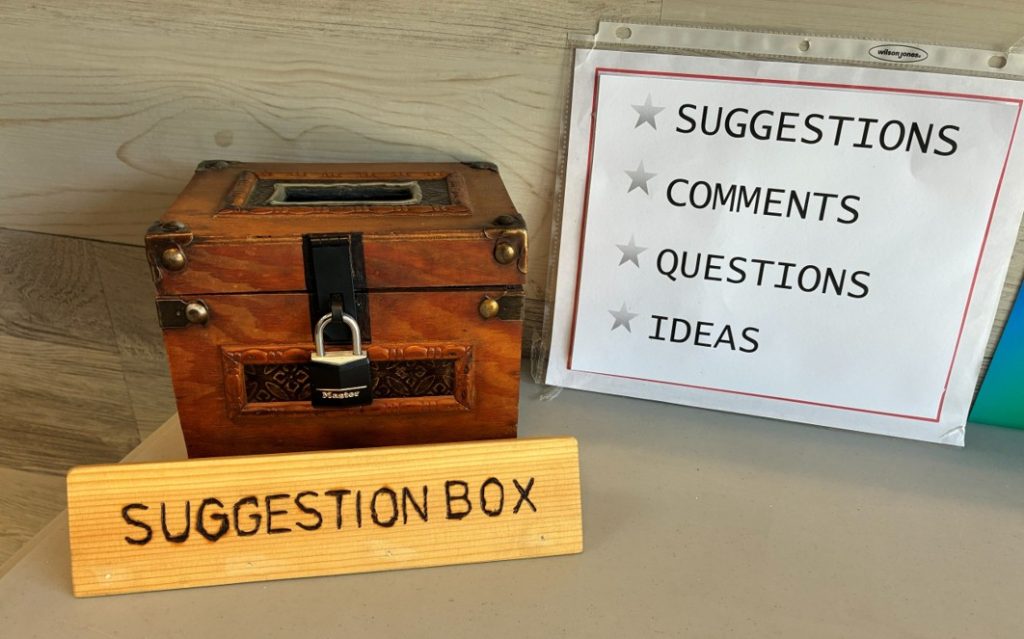
If you haven’t been to the library in awhile, you haven’t seen our Suggestion Box. It is placed on the table just in front of the Reception Desk. We welcome any suggestions, concerns, and other comments from our members and visitors.
Special Volunteer Opportunity

Leader for a once-a-month discussion group

One of our members recently suggested that we resume the discussion group we had before covid. In her own words, "The group was very beneficial" and other members agree.


The group would meet to discuss a a topic decided by the leader, their research questions and challenges or other topics of interest. The group would be informal and informative. Plus it is great way to meet other members and make new friends.

What do you know about Paul Revere?

    What was the name of Paul Revere’s parents?
    Where were they born?
    What was Paul Revere’s father’s occupation?
    When Paul Revere was 15 years old, he and six of his friends were paid to ring the bells at which church in Boston?
    How old was Paul Revere when he made his midnight ride?
    What was the name of the horse he borrowed to make his midnight ride?
    Paul Revere was married twice and had 16 children! How many grandchildren did he have?
    Who wrote the poem “Paul Revere’s Ride” in 1860 that made the patriot famous?
    On the road to Concord on April 19, 1775, Paul Revere and William Dawes ran into a third rider. What was his name?
    In 1802, Paul Revere’s copper rolling mill in Canton, Massachusetts made the copper sheeting for the dome of the new Massachusetts State House. When the building was completed in 1798, what was the dome originally covered with?
    A bell cast by Paul Revere in 1801 and connected to the 1766 tower clock rings out the time hourly at Old South Meeting House. What year was the bell installed?
    How old was Paul Revere when he died and where is he buried?

New Library Books


Discover our New Book Shelf - the first shelf to the left of the classroom door. Our new books are from these generous donors: Sumner Family Search Center, Tacoma Family Search Center, Carolyn Harkness, Alan Manning, Steve Barndt, and Elisabeth Bender.


Thank You for keeping our collection new and fresh.


And a special Thank You to those who are cataloging all these book donations.

Debbie Barr

Angie Burlem

Sara McGlothlen

Nancy Peterson
IL Knox 003 Index to Marriages 1879-1904 Knox County Illinois, Volume II Knox County Genealogical Society
IL Knox 004 1855 Personal Property Tax Lists, Knox County Knox County Genealogical Society
IL Lake 011 Index to Portrait and Biographical Album of Lake County, Illinois, Lake County Illinois Genealogical Society
IL Lake 012 Index to the Past and Present of Lake County, Illinois, Lake County Illinois Genealogical Society
IL Lee 002 Recollections of the Pioneers of Lee County (1893), Seraphina Gardner Smith
IL Tazewell 003 v.1 Tazewell County Illinois Marriage Records Index 1827-1859 volume one, David C. Perkins
IN Cass 004 Will book I, Cass County, Indiana, Barbara Wolfe
IN Owen 005 Owen County Indiana Military Veterans 1775-1903, Owen County Historical and Genealogical Society
IN Putnam 003 Personal Name Index 1971 to History of Putnam County Indiana 1887, Mike Marler
IA Taylor 002 History of Lenox, Iowa 1872-1972, Lenox Centennial
IA Warren 003 Warren County Iowa Cemeteries, Warren County Bicentennial Commission
KS Cherokee 002 Cherokee County Kansas Marriages 1867-1886, first twenty years, Cherokee County Genealogical Society of Southeast Kansas
KY 015 v.1 Kentucky Court of Appeals Deed Books A-G Vol 1, Michael L. Cook, Bettie A. Cook
KY 048 Talley’s Kentucky Papers, William K Talley
KY Bath 001 Bath County Kentucky Records # 1 Marriages 1811-1850 Joan Colbert Gioe
KY Bath 002 Bath County Kentucky Records # 2 Deaths 1852-1859, Wills 1811-1850
KY Edmonson 003 Jacob’s People [Descendants of Jacob Locke; history of Good Spring church; vital records Edmundson County, KY], Kenneth H. Lee
KY Green 003 The Long Hunters of Skin House Branch, Ruth Paull Burdette, Nancy Montgomery
LA 016 Cemeteries in the State of Louisiana by Parishes, Louisiana Cemetery Board
MD 061 Gleanings from Maryland Newspapers 1727-1775, Robert Barnes
MD Baltimore 043 Baltimore Directory of 1807. F. Edward Wright
MD Washington 010 Washington County, Maryland. Our Past, Our People. a Historical Portrait Vol II, Herald-Mail Company
MD Worcester 005 Cemetery records of Worcester County Maryland, Ruth T. Dyland
MA Plymouth 017 History of the Town of Middleboro Massachusetts, Thomas Weston
MO Clay 003 v.1 Clay County Missouri Cemetery Records volume 1, Elizabeth Prather Ellsberry
MO St Francois 002 St. Francois County Missouri Small Cemeteries, Rosalea Hopper
NY 000 Military 12 New York in the American Revolution, a source guide for genealogists and historians, Eric G. Grundset
ND Barnes 002 Zion Free Lutheran Church Valley City, North Dakota 1888-1988, Zion Free Lutheran Church Centennial Book Committee
OH Hamilton 007 Collection of Pioneer Marriage Records, Hamilton County, Ohio 1789-1817 volume 1, John D. Caldwell
OH Hamilton 008 1791-1826 Abstract of Book 1 and Book A Probate Record 1791-1826, Hamilton County, Ohio Hamilton County Ohio Genealogical Society
OH Hamilton 009 Willis Filed Probate Court Hamilton County Ohio 1791-1852, Ohio Genealogical Society
TN Dickson 006 v.1 Dickson County, Tennessee Deeds, Mar. 1804 – Dec. 1808 Vol. 1, Laura Willis
TN Dickson 006 v.2 Dickson County, Tennessee Deeds, Dec. 1808 – Sept. 1812 Vol. 2, Laura Willis
TN Dickson 006 v.3 Dickson County, Tennessee Deeds, Sept. 1812 – Aug. 1815 Vol. 3, Laura Willis
TN Dickson 006 v.4 Dickson County, Tennessee Deeds, Aug. 1815 – Feb. 1818 Vol. 4, Laura Willis
TN Dickson 006 v.5 Dickson County, Tennessee Deeds, Feb. 1818 – Oct. 1820 Vol. 5, Laura Willis
TN Dickson 006 v.6 Dickson County, Tennessee Deeds, Oct. 1820 – Apr. 1823 Vol. 6 Laura Willis
TN Gibson 002 History of Gibson County, Indiana, with illustrations descriptive of its scenery and biographical sketches of some of its prominent men and pioneers, [Published 1884] Jas T. Tarrt & Co.
WV Greenbrier 006 Walking Tour of Historic Lewisburg, West Virginia, Greenbrier County Convention and Visitors Bureau
WI Milwaukee 003 Old Cemetery Burials of Milwaukee County Wisconsin Vol 2, Elizabeth Doherty Herzfeld
Foreign IRELAND 000 Research 31 Irish Ancestors, a pocket guide to your family history, John Grenham
Mayflower 039 Mourt’s Relation, a Journal of the Pilgrims at Portsmouth, Dwight B. Heath
Military REV WAR 076 Forgotten Patriots – the untold story of American prisoners during the revolutionary war, Edwin G. Burrows
Military REV WAR 077 Battle of Piqua Revolutionary Encounter in Ohio, [Brief history of the Shawnee Indian Village that formerly occupied the plot of ground now designated as George Rogers Clark Park, Springfield Ohio], Richard Roland Juday
Source GENEALOGY 081 Genealogist’s Question & Answer Book, Marcia Yannizze Melnyk
Source MAPS 023 Ward Maps of United States Cities, selective checklist of pre-1900 maps in the Library of Congress Michael H Shelley
Source PRESERVATION 006 More Than Memories, the complete guide to preserving your family history, Julie Stephani
US History WOMEN 033 Pioneer Women, the lives of women on the frontier, Linda Peavy, Ursula Smith
Family History CLINGENPEEL 01 Clingenpeel Family Lineage, Ronald Harvey Clingenpeel
Family History WATERMAN 01 Genealogical Line of Paternal Descent of the Waterman family of Davenport, Iowa, Fred L. Waterman
Family History WILDMAN 01 Wildman – Huckaby (all spellings), July 5, 1983, Bettina Pearson Higdon
Quiz Answers
Apollos Rivoire and Deborah Hichborn
Paul’s father was born in Riocaud, France; his mother in Boston
Silversmith
Christ’s Church (Old North Church)
He was 40 years old
Brown Beauty
He had 51 grandchildren
Henry Wadsworth Longfellow
Dr. Samuel Prescott
Wooden Shingles
2011
He was 83 and is buried in the Granary Burying Ground in Boston, Massachusetts
Source: Walking Boston, https://www.walkingboston.com/paul-revere-quiz-1/
Heritage Quest Research Library | 2102 East Main Ave Suite 105 | Puyallup, WA 98372 US