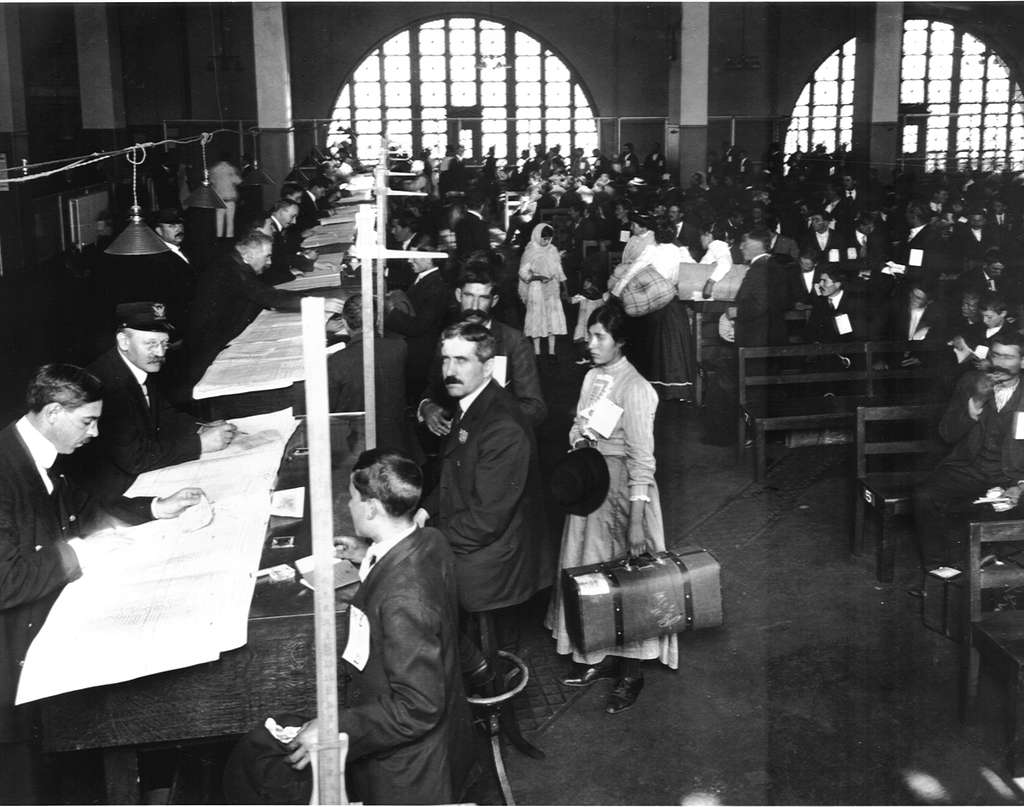
Whatcom Genealogical Society Land of My Own Understanding the Rectangular Survey System
Polish Genealogical Society of America
Quarterly Webinar
“Ask a Polish Researcher”
Aleksander Zawilski
Researcher and Guide, Polish Origins
Sunday, November 16, 2025 2:00 PM Central Time
Mr. Zawilski will answer your questions
about researching Polish genealogy.
What questions do you have about:
– What are…? Where do I find…? How do I…?
– Who can I ask about…? Why is it difficult to…?
– What helpful questions will others ask?Once registered you will be able to send your questions via a link on the PGSA website.
Free for members (Please log in to get your discount)
Non-members pay $15
Register: https://pgsa.org/product-category/webinars/
The Polish Genealogical Society of America is hosting its next quarterly webinar on November 16th at 2pm Central Time. The topic is “Ask a Polish Genealogy Researcher.” A flyer is attached – feel free to distribute to your networks.
Our presenter, Aleksander Zawilski, is a researcher and tour guide with Polish Origins. He will answer your questions about researching Polish genealogy.
What questions do you have about:
– What are…? Where do I find…? How do I…?
– Who can I ask about…? Why is it difficult to…?
– What helpful questions will others ask?
If you would like to submit your questions in advance, please do so before October 30th and send to: president@pgsa.org
This webinar is free for PGSA members (please log in to get your discount) and non-members pay $15.
Register here: https://pgsa.org/product-category/webinars/
PGSA memberships start at $25: https://pgsa.org/membership2021/
If you have any questions don’t hesitate to ask,
Ellen Zielinski
PGSA Marketing Volunteer
This is page 2 of the Washington State Sales and Use Tax Form, page 2 is the same for monthly, quarterly and annual reporting. Since our genealogical societies will be paying Use Tax on Live Presentations, this is how it is calculated. (Note while the Department of Revenue still provides the paper form on their website, they require everyone to file online now. ) The cost of the live presentation goes on line 31 for the state use tax of 6.5%. Line 35 is where you calculate the local use tax if everyone was at that location. I used the rate of 2.6% for the City of Spokane. Notice there are lines for more locations and so if you have people on Zoom at different locations you need to calculate how much of the $900.00 went to each location and then calculate the local tax for each location. Now since the Spokane local rate is second highest in Spokane county doing all of the required calculations will probably save some local use tax. So I did a test calculation to see how much money you might save if all the people on Zoom are in different local tax rates. To make the calculations easier I assumed we had 90 people at the October seminar and that 80 of them were in the room with the speakers (actually the speakers were on Zoom also). So a quick calculation:
80 people at Spokane is $800.00x 2.6% is 20.80
3 people at $10.00 each x 1.6% =0.48
3 people at $10.00 each x 2.4% = 0.72
1 person at $10.00 x 2.7% = 0.27
1 person at $10.00 x 2.5% = 0.25
1 person at $10.00 x .015 = 0.15
1 person at $10.00 x .026 = 0.26
All this work totals up to $22.93 local tax which means doing this much bookkeeping saves 47 Cents! For 20 people on Zoom double the savings to 94 Cents!
And you need the addresses of all the people on Zoom so you can calculate their local rate and keep all these records for at least 6 years. Now do we need to keep addresses of our Zoomers for the government? One option they give in their guidelines is to assume everyone is in the same room with the speakers and pay the use tax on that location, or for us the 2.6% local rate. And for saving of 94 cents this amount of bookkeeping is not worth the extra work.
I went to the Department of Revenues website: https://secure.dor.wa.gov/gteunauth/_/ and it has Business lookup to see if you signed up when you became a non profit, and also a Quick Sign up Wizard for non profits that either did not sign up when they became a non profit or signed up over 5 years ago.


 Inspiring the Next Generation of Genealogists November 6, 2025 11am to 12pm PDT LEARN MORE HERE! |
| COMING SOON! Our genealogy classes for 2026 are exciting! Be on the lookout for the schedule to land in your inbox so you can start signing up! |
| Heritage Quest Research Library 2102 East Main Avenue, Suite 105 Puyallup, WA 98372 (253) 863-1806 |

Tacoma-Pierce County Genealogical Society DNA Special Interest Group Meeting
Tuesday, Oct 21, Starting at 7:00 pm via Zoom
We will discuss GedMatch and their offerings.
Download: 1745378587_DNASIGMeetingInvite.pdf
Calendar reminder: TPCGS DNA Special Interest Group Meeting
Every month on the Fourth Tuesday beginning at 7:00 PM Pacific Time
Please download and import the following iCalendar (.ics) files to your calendar system.
Monthly: https://us02web.zoom.us/meeting/tZYqdeyrrz0iEtx-c_J3gNfcI8mebT1zajLo/ics?icsToken=98tyKuGqqTkvGdWTuBGPRpwQB4joZ-nzmCFHj7dF0RzaKXNUTAX1H7pPN7BLQcLR
Join Zoom Meeting:
https://us02web.zoom.us/j/82725316888?pwd=MDc3UEZrUVJNbmxmK2ZORmw5YzdDdz09
Meeting ID: 827 2531 6888
Passcode: 811780
One tap mobile:
+12532050468,,82725316888#,,,,*811780# US
+12532158782,,82725316888#,,,,*811780# US (Tacoma)
Dial by your location:
+1 253 205 0468 US
+1 253 215 8782 US (Tacoma)
Meeting ID: 827 2531 6888
Passcode: 811780
Find your local number: https://us02web.zoom.us/u/kIKCyZLQy
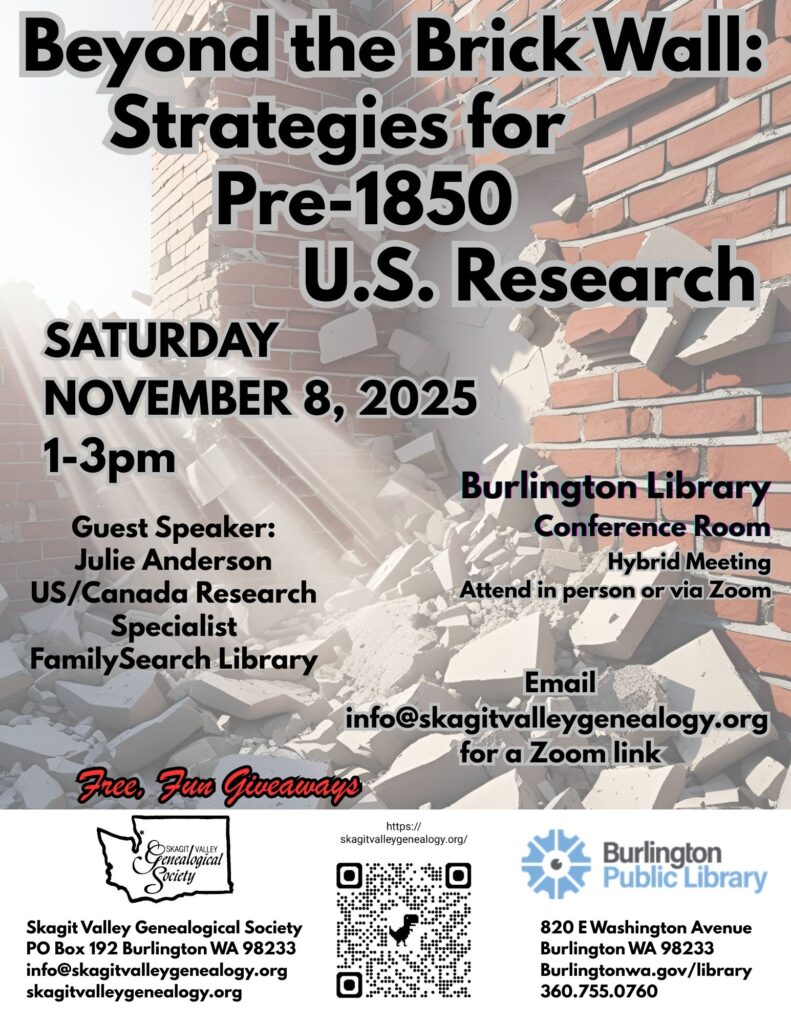
Join SVGS Saturday, November 8, 2025, 1pm at the Burlington Public Library for “Beyond the Brick Wall: Strategies for Pre-1850 U.S. Research” with Julie Anderson. Julie is a U.S./Canada Research Specialist at the FamilySearch Library in Salt Lake City. Come learn what resources and research techniques are available to help you locate your ancestors in records before the 1850 Census. Can’t make it to the Burlington Library, request a zoom link by emailing info@skagitvalleygenealogy.org.

| DATE: TIME: TOPIC: PRESENTER: November 15, 2025 1:30 PM (PST) How Italian Migration Laws Affected Our Ancestors Victoria Calabrese, PhD |
| Description: How easy was it to emigrate from Italy? What was the process like after one made the decision to leave? This presentation will discuss Italian emigration laws regarding migration in the late 19th and early 20th centuries and how these laws influenced our ancestors’ lives. The talk will cover topics such as who could and could not emigrate (and why), what was needed to get a passport, how to buy tickets, and travelling to the port of departure. |
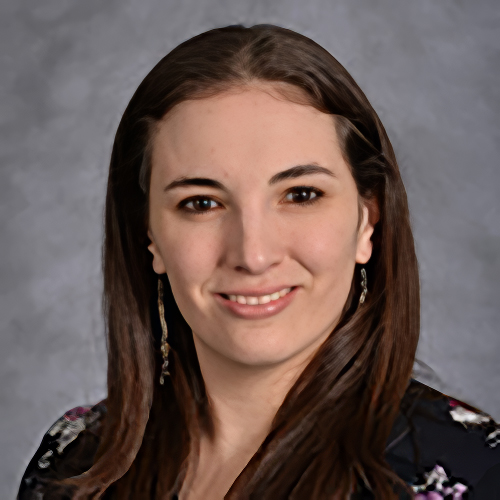 Speaker Bio: Victoria Calabrese received her Ph.D. in modern European history from the Graduate Center at the City University of New York. Her research focuses on modern Italian history, gender, migration, and nation building. Her book, Italian Women in Basilicata: Staying Behind but Moving Forward during the Age of Mass Emigration, 1876–1914, was published by Lexington Books in 2022. The book examines women in the southern Italian region of Basilicata and the many ways their lives changed when their husbands emigrated. In addition to the women who remained behind, she has written articles on honor and infanticide, and on traveling child musicians. Victoria is an avid genealogist, focusing on southern Italian genealogy research. She is currently an adjunct professor at Lehman College, teaching courses in early modern and modern European history Speaker Bio: Victoria Calabrese received her Ph.D. in modern European history from the Graduate Center at the City University of New York. Her research focuses on modern Italian history, gender, migration, and nation building. Her book, Italian Women in Basilicata: Staying Behind but Moving Forward during the Age of Mass Emigration, 1876–1914, was published by Lexington Books in 2022. The book examines women in the southern Italian region of Basilicata and the many ways their lives changed when their husbands emigrated. In addition to the women who remained behind, she has written articles on honor and infanticide, and on traveling child musicians. Victoria is an avid genealogist, focusing on southern Italian genealogy research. She is currently an adjunct professor at Lehman College, teaching courses in early modern and modern European history |
| COUNTDOWN TO THE MEETING: |
 Days Hours Minutes Seconds Days Hours Minutes Seconds |
| Eastside Genealogical Society – Italian Interest Group P.O. Box 374 Bellevue, WA 98009-0374 |
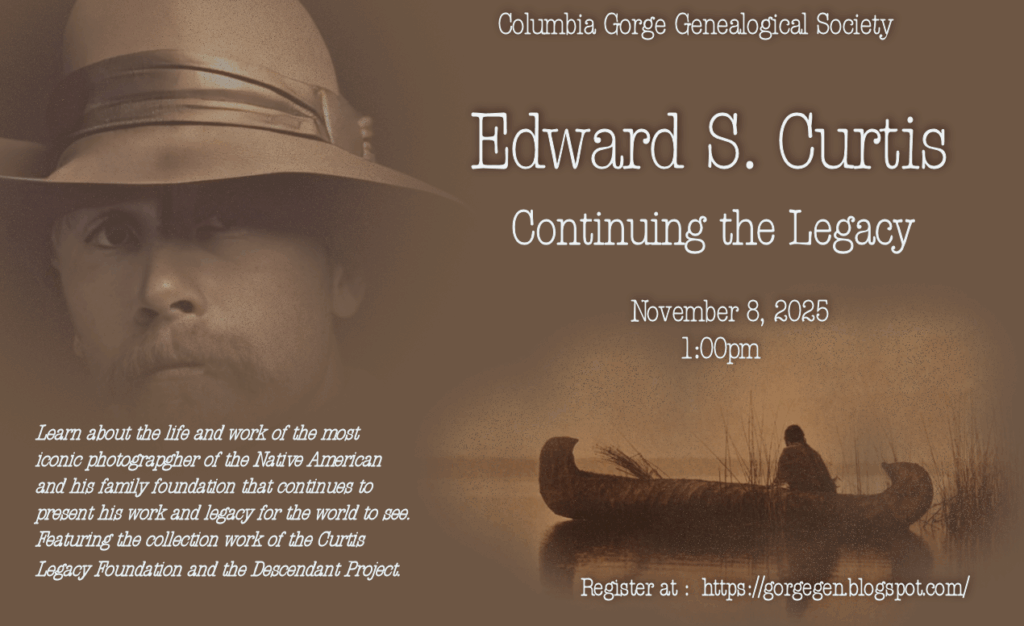
Edward S. Curtis, a renowned American photographer and ethnologist, dedicated over three decades of his life to documenting the cultures, traditions, and daily lives of Native American tribes through his monumental work, The North American Indian. Beginning in the late 19th century, Curtis captured over 40,000 photographs and extensive ethnographic records of more than 80 tribes, creating an unparalleled visual and cultural archive that preserves the heritage of Indigenous peoples facing rapid cultural change. His work, characterized by its artistic sensitivity and anthropological depth, remains a vital resource for understanding Native American history and identity. The Curtis Legacy Foundation, established to honor and extend Curtis’s mission, promotes the preservation, study, and appreciation of his photographic and ethnographic contributions, ensuring that his legacy continues to educate and inspire future generations about the rich diversity of Native American cultures.
This presentation covers life stories and photos from his private studio in Seattle and the on going preservation of this renowned photographer and historian through the Curtis Legacy Foundation. The foundation is presently involved with two projects, the Unpublished Series of books which have been released for sale and the Descendants Project that is being conducted with cooperation of native tribes in the Northwest and Southwest. Program facilitator is Georga Foster.
Register at https://gorgegen.blogspot.com/

Join us for this all-day, online event!
Federal records are invaluable tools for genealogists because they often preserve detailed, first-person data that may not appear in local or family-held sources. These records — ranging from pension applications and service records to land bounty files and employment records can reveal not only dates and locations but also personal experiences, physical descriptions, family relationships, and even financial or medical hardships. They provide context to an ancestor’s life by situating them within national events such as wars, migrations, or public service, often uncovering stories of resilience, sacrifice, or opportunity that enrich the broader family narrative. Our speaker will focus on several historical periods that affect a wide range of the U.S. population.
The seminar will take place via Zoom.
Saturday, November 8
9:00 am – 10:15 am – Fighting on the Frontier: Researching the Indian Wars
10:30 am – 11:30 am – That Splendid Little War: Researching the Spanish-American War
1:00 pm – 2:00 pm – Enemy Aliens: Registering Our Immigrant Forebears
2:00 pm – 3:00 pm – Federal Taxes and the Genealogical Records They Created
3:00 pm – 3:15 pm – Closing, including door prizes and final words
Pricing: $70 (members $55)
Registration: gfo.org/seminar
Meet Our Speaker:
Our speaker, Michael L. Strauss, AG®, is an Accredited Genealogist and forensic investigator. He holds a BA in History and is a United States Coast Guard veteran. He is a licensed Private Investigator and qualified expert witness in Surrogate Court and Circuit Court in Pennsylvania, New York, New Jersey, and Virginia.
He is best known in the genealogical community as an expert on military and federal records, and is a national genealogical lecturer and instructor for military courses at the Institute of Genealogy and Historical Research (IGHR).
Mr. Strauss has worked on identifying MIA remains from WWII and the Korean and Vietnam wars, and was the film historian for the 2015 Academy Award nominated movie “Finding Vivian Maier”.

Coffin nails
Little white slavers
Dope sticks
Devil’s toothpicks
Satan sticks
Coffin pills
Little white devils.
These are names for cigarettes in the late 1800s and early 1900s.
Residents of Washington State were so opposed to cigarettes that they passed a law, in March of 1893, prohibiting any person to “buy, sell, give away, or manufacture cigarettes or cigarette paper.”
This law, a first of its kind in the country, was struck down in the Federal Court four months later. The Federal Court declared it unconstitutional on the grounds that it improperly restrained interstate trade.
The anti-cigarette lobby did not give up – they got another prohibition bill introduced in the State Legislature in 1907 and that law passed as well. Two years later the Legislature enacted an even more draconian law banning the mere possession of cigarettes and cigarette paper.

Washington State was not, however, alone in its concern for this unhealthy substance. Fifteen states passed laws prohibiting sale and manufacture of cigarettes in the late 1800s and early 1900s. Even if they did not get a law passed, many other States, debated the topic.
The Seattle P-I ran a satirical piece – an interview with Mr. Cigarette (“the attenuated friend of the undertaker”). The cigarette was quoted as saying: “I have learned to love the Puget Sound country. I have many close friends in Seattle. It is sad to part with them. I have become attached to scores of them, and it is a consolation to me to know that they will miss me.”
After it became clear that the law could not be enforced – too many violators – it was repealed in 1911. That was the end of cigarette prohibition.
To put this in context of the ‘Prohibition” that we are more familiar with – prohibition on alcohol –
Washington State passed a law prohibiting the sale and consumption of alcohol in 1916. The rest of the country caught up with Washington State by passing the 18th Amendment to the Constitution which prohibited the manufacture, sale and transportation of alcohol in 1920.

(Photo: Prohibition Agents destroying barrels of whiskey – Wikimedia Commons)
The 18th Amendment was repealed by the 21st Amendment in 1933.
SOURCE:
Cigarette Prohibition in Washington, 1893-1911 – HistoryLink.org
Karen Treiger is the author of the new book – Standing on the Crack: The Legacy of Five Jewish Families from Seattle’s Gilded Age.
Website: Homepage – Karen Treiger – Author
Her weekly blog about the history of Seattle and stories about her ancestors can be found here: Ancestry, Genealogy, Legacy, History: Stories of Five Jewish Families in Seattle