Dr. Elisha Story: A Revolutionary Cousin with a Boston Tea Party History
by Janice Moerschel
In researching my family history, I often come across names that at first appear only as basic genealogical facts: dates, places, marriages, and family connections. Dr. Elisha Story, my third cousin seven times removed, caught my attention. He is one of those relatives whose record leads well beyond the family tree and into the history of Revolutionary Boston.
Elisha was born in Boston, Massachusetts, on 3 Dec 1743, into the Story family line that traces back to my immigrant ancestor, William Story, who arrived in New England in the seventeenth century. Like my direct Revolutionary ancestor Ebenezer Story (The Story Behind a Story: Ebenezer Story of Revolutionary Connecticut) Elisha belonged to a family whose roots were already deep in colonial Massachusetts by the time resistance to British rule began to intensify.
Massachusetts was one of the centers of colonial frustration, and Elisha came of age in a world charged with the issues surrounding taxation, representation, and rights. He joined the Sons of Liberty, the patriot network that included historical figures like Samuel Adams, John Hancock, and Paul Revere. He was also known as a close friend of Dr. Joseph Warren, one of the most important patriot leaders in Boston before the Revolution.
On 16 Dec 1773, Elisha stepped into one of the defining acts of American resistance to the tax on tea. That night, men disguised themselves as Mohawk Indians and set off from Griffin’s Wharf into the Boston Harbor, where three ships carrying East India Company tea lay in waiting. Elisha was among the participants who boarded the vessels and threw the tea overboard. Some accounts describe him as a leader of the group, but historians do not all agree on the extent of his role. What is clear is that he was not merely sympathetic to the cause – he participated in it.
Elisha’s commitment continued during the Revolutionary War. As a physician and surgeon, he served during the Lexington and Concord alarm and fought briefly at Bunker Hill before tending to wounded soldiers. One especially tangible reminder of his service survives: his medical chest, reportedly used during the war and now preserved as part of Marblehead’s historical memory.
Dr. Story died 27 Aug 1805 at Marblehead, Massachusetts.
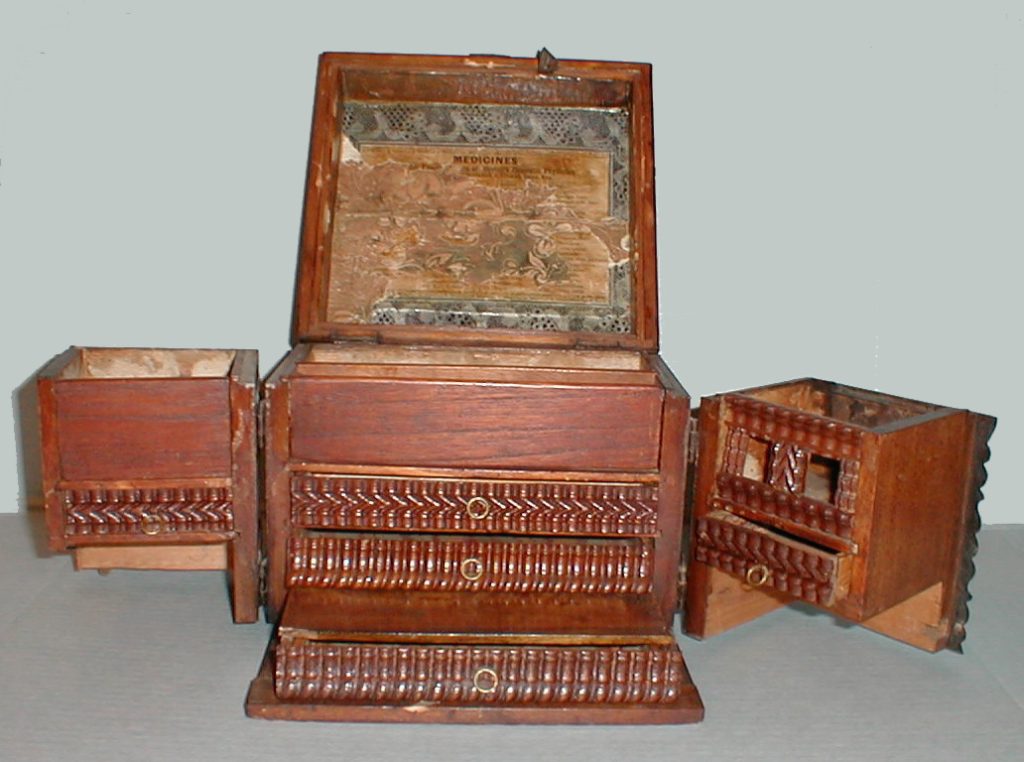
Medical chest of Elisha Story. Photo courtesy of the Museum of Marblehead (Mass.)
After the war, Elisha returned to Massachusetts, helped manage a serious smallpox outbreak around Marblehead, and settled there permanently. He had married Ruth Ruddick on 12 May 1767 in Boston, Massachusetts, with whom he had 11 children. After Ruth’s death, his second wife Mehitable Petrick raised those children. One of them was Joseph Story, who would become an influential Supreme Court Justice.