The Story Behind a Story: Ebenezer Story of Revolutionary Connecticut
by Janice Moerschel
Some ancestors are known only as names in a tree. My 4-times great grandfather Ebenezer Story left traces of a fuller life in shipyards, taverns, waterways, woodlots, saltworks, old Connecticut soil, and finally the Sugar House Prison. He was born in Norwich on 26 June 1749. His roots trace back to William Story, who arrived in Massachusetts in 1637. Ebenezer worked as a carpenter, farmer, fisherman, woodsman, and salt maker. These skills placed him in Revolutionary-era Connecticut’s shipbuilding economy along the Thames River. His life comes into focus through the Continental frigate Confederacy, the Norwich shipyard, and his wartime service aboard that vessel. Pieced together from records and rediscovery, his story reveals a young husband, father, craftsman, and patriot. He was drawn into the costly struggle for American independence.
On 15 Nov 1771, Ebenezer married Mehitable Webb in Brooklyn, Connecticut. They settled near Brewster’s Bar on the Great River in Norwich. Their home became more than a residence. In 1777, Ebenezer petitioned to operate a tavern, mere steps from the shipyard where the Confederacy was being built. The Story family served that bustling economy by providing meals, milk, carting, timber, and other goods. These supported workers constructed what was later praised as one of the continent’s finest ships.
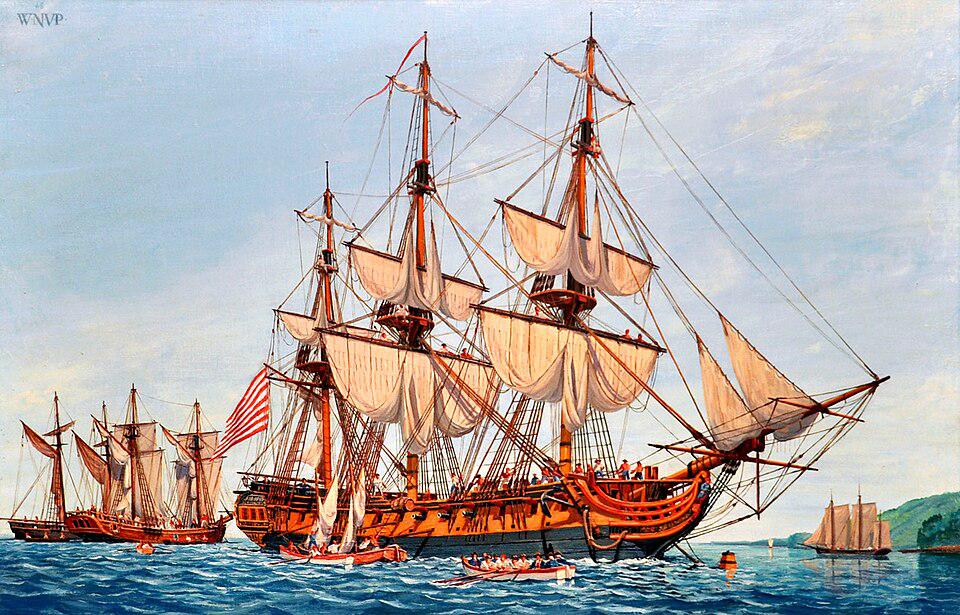
The Confederacy, Wikimedia
Ebenezer’s connection to the Confederacy (first named the Continental) became both a point of pride and a tragic turning point. He helped build the ship. Then he joined its crew in 1779 as carpenter. Though it played no major role in the war, the frigate sailed the West Indies, Chesapeake Bay, and waters off Delaware – where the British captured it. The ship and crew were taken to New York Harbor. Ebenezer was confined in Brooklyn’s notorious Sugar House Prison, where overcrowding, hunger, sickness, and suffering killed many prisoners. A Sons of the American Revolution Membership Application records that he starved to death there between September 1781 and November 1782.
His probate record, dated 5 Nov 1782, offers a vivid glimpse of the world he left behind. Mehitable was widowed with three young sons. She was appointed executrix, and the document was witnessed by her uncle Samuel Huntington, a signer of the Declaration of Independence. The inventory shows Ebenezer’s wide activity and resources. It lists clothing, silver, tools, livestock, canoes, a scow, fishing gear, saltworks and cider-mill shares, land, and gold and silver money.
Centuries later, archaeology brought remnants of Ebenezer’s life back into view. The rediscovery of the Story site in Preston, Connecticut, helped illuminate how families lived and worked along the state’s tidal waterways during the Revolutionary period. Through records and artifacts, Ebenezer emerges not simply as a name. He appears as an ancestor, craftsman, tavern keeper, sailor, prisoner, husband, and father. His life was woven into America’s fight for independence.