STEPHEN ATWATER, 1758-1836
REVOLUTIONARY WAR SOLDIER
Years ago my father gave a paper bag on which was written many names and dates of ancestors. At the very top of the bag was written “6/5/05 [her birthday – 6/5/1805] Matilda Atwater – father was aid to Geo Washington.” My search began!
Research revealed that there were many Stephen Atwaters. The Atwater family was prominent in colonial Connecticut. After much research, I discovered the following, copied from his pension application 14 Nov 1832:
“Stephen Atwater, Conn, S12014. I was born in Cheshire, Connecticut, New Haven colony, on 13 May 1758. I presume the records of my birth is in Wallingford Connecticut (for Wallingford & Cheshire were then one town) but I have no record of it anywhere – I was 74 years old on the 13 May last [1832].”
Stephen was the last of 7 children born to Stephen Atwater (1720-1806) and Hannah Hotchkiss (1722-1779). There were probably 2 sisters left at home when he enlisted.
Stephen Atwater’s pension application continues:
“In August 1776 [at 18 years old] the 10th Regiment of Connecticut Militia commanded by Cpl Benjamin Baldwin was ordered out, to go to New York – I was a member of Capt. Jesse Moss’s company, belonging to that regiment – & on the 17 August we turned out – we marched to New York [colony]– We were at New York City [Brooklyn was the northernmost area of LongIsland] when Gnl Washingtons army retreated from Long Island – I acted as one of the oarsmen in bringing the army over all night – The night was exceedingly dark & a very thick fog”
The Battle of Long Island was the first major battle to take place after the United States declared its independence on July 4, 1776 in Philadelphia. It was the largest battle of the Revolutionary War in terms of both troops deployments and combat.
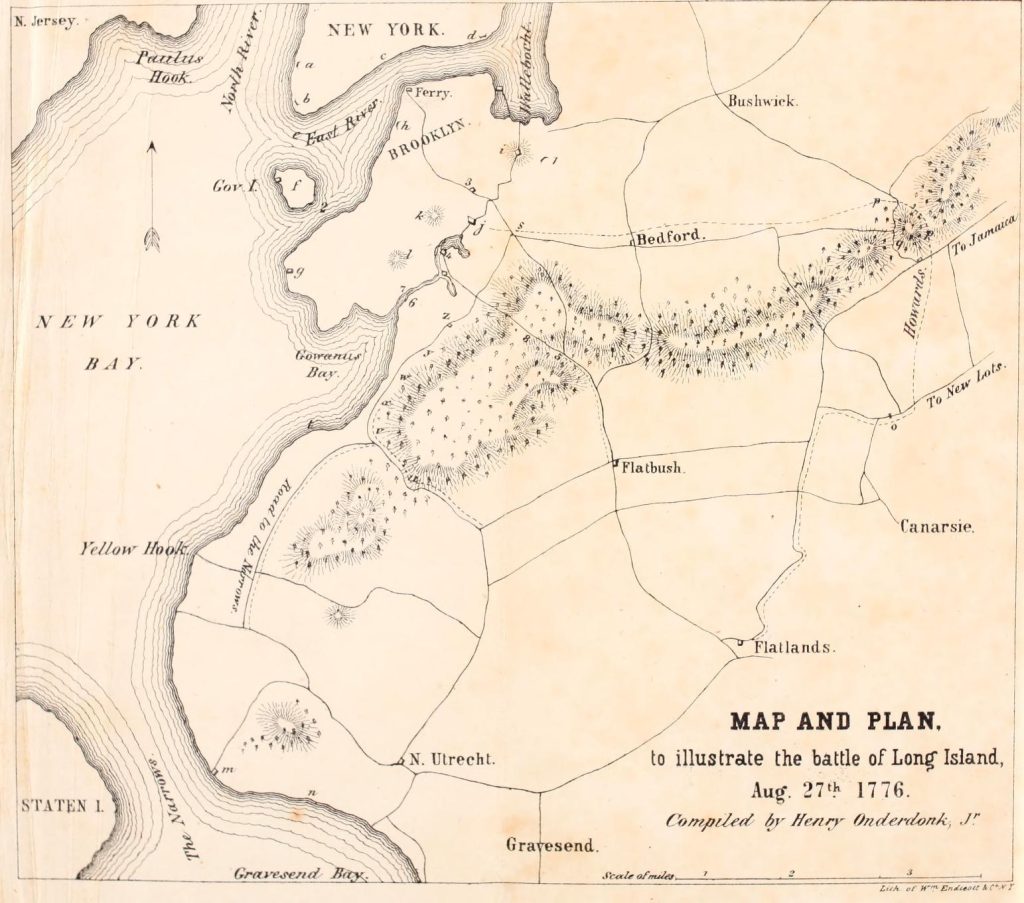
The British army had nearly 20,000 soldiers and were helped by naval forces. British ships moved the East River toward Staten Island, seen on the bottom left of the map below. There were more than 400 transport ships, protected by 30 warships.
The Americans had about 10,000 soldiers led by General George Washington. He moved his troops to Brooklyn on Long Island, to defend New York. British troops landed and attacked the American troops on three sides.
Rather than surrender, General Washington decide to have the army cross the East River. He ordered every available boat to be taken. The oarsmen wrapped cloth around the oars so they would make as little noise as possible. The men rowed all night, back and forth. Stephen Atwater was one of these oarsmen. By morning there was still many men left on the Brooklyn side of the river. But the very thick fog in the night that Stephen mentioned continued late into the next day, so they were able to complete their mission by the time the fog lifted.
This was the closest Stephen Atwater came to being “Aid to George Washington”, but his story wasn’t over yet. He was under the command later of General Washington, among others.
↓Stephen Atwater rowed north to Manhattan (New York) across
the East River from Brooklyn on Long Island
Stephen Atwater’s pension application continues:
“After the American army was brought over to the city [New York City], our regiment remained there a few days, & were then ordered out to Harlem – there I was taken sick & was Discharged there or somewhere near there.”
“I remained sick till I was carried home. It was called a three months tour – but I think I was not out three months – but two months of more-Then April 1777 our company & regiment was ordered out again when Danbury [Connecticut] was burned “
“We moved to Fairfield[CT]– & then to Compo [CT] – I think the British embarked there. Our men & the British had a considerable battle in that neighborhood there – several of my acquaintances were killed there – Gnl Worster was killed in that battle – I saw him as a corpse – Our company had then got up & was not in that battle”
“After the British had embarked, & went off, we were discharged, & went home – I can’t say how long we were out at that time – probably 8 or 10 days – In October 1777 the same company & regiment were ordered out again – I marched to West Point. We had the same Colonel & same officers as before – The company I belonged to were out scouting the principal part of the time – At a place called Fishkill[NY] our company was divided – a part went to the north & a part went to the south –“
“Esopus [Kingston, NY] was burned at that time – This tour was called a three months tour – but I do not recollect how long we were actually out – our orders were for three months, but we did not stay out so long – Titus Moss was the ensign of our company – During this tour I lost the end of the forefinger of my right hand by a felon which I was not able have taken care of in consequence of our moving about – & my finger healed for several more weeks.”
“In 1780 I was called out again – This was a draught [draft] – Capt Amos Hotchkiss commanded the company – Willis was the Colonel – We were marched to New London & stationed on Winthrop Point. We were employed principally in building breastworks – fachines [fascines –brush and sticks used to reinforce trenches] & the like – That time I was out about two months – I was the orderly sergeant of the Company that tour –“
“I received no written discharge at any of these tours, except the first, when I did receive one – but it has been lost – at least I have looked carefully for it & can’t find it — I was out on a short tour where Genl [Benedict] Arnold attacked New Haven – which I think was in July 1779 – This was in my original company – Capt Jesse Moss – We were out 10 or 12 Days –
”I was out a number of short tours – we were obliged to keep ourselves in constant readiness – The militia was hanged [as in suspension] very much for several years –We would lay out a piece of business at night – & by next morning were called away from it – We kept ourselves ready always to go – to march at a minutes warning – for several years- I can’t tell how long I was out altogether in actual service – but making the best estimate I can, I would say it was about eighteen months but I can’t be positive about it and not less than sixteen months—
After the war I continued to reside at Cheshire til 1811 – I then removed to Granville in the state of New York – remained there till October 1824, when I moved to Oil Creek in Crawford county [PA] & in January 1829 I moved to the farm in which I now live in Troy Township, Crawford county – Pennsylvania.”
My GGG grandparents, Matilda Atwater and Horace Day, may have met in Granville, NY, since both their families lived there. However they didn’t marry until both families were in Pennsylvania. They married 2 Dec 1827 in Crawford County, PA.
I’m very proud of my Revolutionary War ancestor, Stephen Atwater! He wasn’t an “aid” (Aid-de-Camp) to George Washington as stated in the paper my father gave me, but he certainly aided General Washington, and many others in the Revolutionary War.