Let’s Talk About: EWGS & Heritage From the Heartland

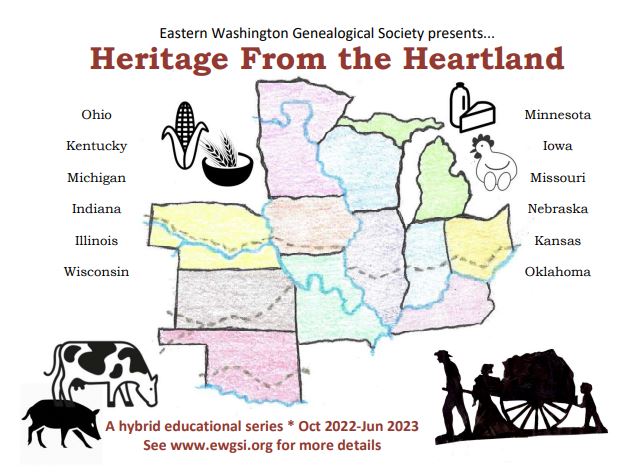
Betting you have ancestral ties back into the above show “heartland” states. Am I right? Would you like to know more……. and learn up-to-date research “more” about these states?

 The Eastern Washington Genealogical Society is giving you the chance to learn more about researching in the heartland of America in a series of programs beginning in October and ending in June, 2023.

Kickoff for the EWGS series, Heritage from the Heartland, will be the focus of the October 1st meeting. It will be a hybrid meeting (both in person and ZOOM) but PLEASE, EWGS is limited to only so many via ZOOM so you in-towners COME and let the out-of-towners ZOOM, okay?) Besides, come and have lunch with your genealogy friends.

Click to www.EWGSI.org to learn more details and to register (yes, right from the website!).

Let’s Talk About: Names, Yesterday & Today

Picking a name for baby has always been a delightful challenge. Surely it has always been so. I have a family of four siblings born in the early 1700s in Connecticut named John, Mary, Elizabeth…………… and Bazeleel.  Bazeleel? Yep, a Bible name for sure.

We might think that names for baby popping up today are kinda crazy but it was the same decades or centuries ago (as proved by the above example, no?).

Doing some “pay-it-forward” work for the St. Clair County Genealogical Society in Illinois (where some of my ancestors hail from), and helping index and proofread early birth records, I’ve come upon these names…. and they are first names:

Orben, Noal, Truthadoris, Honey, Ermil, Calliem, Argana, Bornodna, Yarlotts, Falenda, Mortha and Ceeylia.

How long ago were these names, you ask? 1916! 

I’m quite sure that a list compiled in 2122 of some of today’s names might sound just as “interesting.” Agree? 

Let’s Talk About: Coats of Arms

I‘ve posted before about Coats of Arms and do we believe them….. or deserve them….today?  Here’s a story that I just HAD to share:

At the town of Stirling began the great wood of Caledon where roamed a number of white bulls, with crisp and curly manes, like fierce lions….and more wild than any other beasts. As soon as any man appeared before them, the bulls would rush forward without fear of hounds, sharp lances or other weapons.

“It is said that King Robert Bruce went hunting in this wood and, having only a small party with him, narrowly escaped with his life. One of the bulls, after being sorely wounded by the hunters, rushed fiercely on the King who had then no weapon in his hand to defend himself from the impact. 

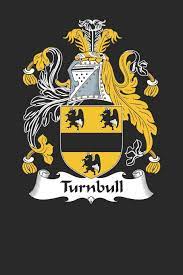
“Then a man of great spirit, who was nearby, leapt before the King and, grappling with the bull, cast it to the earth with great force and held it there while the remaining hunters slew it with their weapons. The man who rescued the King was called thereafter TURN-E-BULL and awarded with rich lands by the King.”

This story is retold in a 20-page booklet titled, I Save the King: The Story of the Turnbulls, by R.E. Scott, 1977. Author Scott cites The History of Scotland, published in Latin in Paris about 1626.

Working on a history of Cyrus Turnbull, for whom Turnbull National Wildlife Refuge (south of Cheney near Spokane) was named (although he never owned land there and only “squatted” for six years), I found a reference to this story. Tracking it down, I found that a copy was held by a library in Michigan. Inquiring of them, a most kind librarian found a copy online for me!

Note the lesson there, dear readers. About helpful librarians, I mean. But back to the question: Do you “believe” in a family today having/boasting of a coat of arms from yore???

Let’s Talk About: Elvis Presley the Man

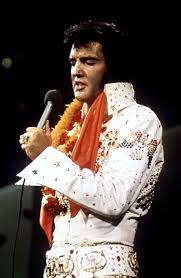
Did you light a candle or shed a tear today, August 16th, ……. the 45th anniversary of Elvis Presley’s death?

We “all” loved or hated Elvis. In 1958 I recall hurrying home from Sunday evening youth group to see Elvis on the Ed Sullivan show! Only from the waist up, of course. 

What did you really know about Elvis the man??

1. He had a twin brother, Jesse, who died at birth.

2. His full name was Elvis Aaron (his father was Vernon Elvis).

3. His favorite sandwich was peanut butter, bacon and banana.

4. His home/mansion, Graceland, was originally a church when he bought it.

5. His first hit? Heartbreak Hotel in 1956.

6. He earned a Black Belt in karate in 1960.

7. He married Priscilla in 1967 in Las Vegas; Lisa Marie was their only child.

8. His first movie was “Love Me Tender.”

9. He made 24 albums.

10. He was reading The Scientific Search for the Face of Jesus at the time of his death.

One last Elvis story:  My father was in Sacred Heart hospital in about the year 2000 and when I went to pay for parking, the attendant said it would be free if I could tell him the date of Elvis’s death. “Easy! I said. Everybody knows he’s NOT dead!”  The fellow laughed and let me pass. 

Let’s Talk About: Websites for Social History

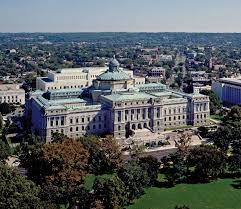
Library of Congress, Washington, D.C.

Big thanks to the July/August 2022 issue of Family Tree Magazine for this information.


Why do we want to learn about social history? What has it to do with genealogy? It has everything to do with our family history! Genealogy is the facts. Social history gives the why-when-how of those facts.

When I learned that my great-grandmother took her 8-year-old daughter (my grandmother, Clara) upstream on the Mississippi River to visit family in St. Louis, I wanted to know more about the circumstances of that story. THAT’S social history. 


We’ve probably all used Google to find images of what life was like for our ancestors in any past time period or place. That’s well and good, but there are other website you might consider:


** Encyclopedia Britannica – yes! No more a groaning load of huge volumes on our living room shelves, but all online AND up to date!  (www.britannica.com)
** Food Timeline  (www.foodtimeline.org). What your ancestors ate, and how they fixed their food, tells you much about their daily lives.
**History Net (www.historynet.com). Search for U.S. history topics at this website from the California Gold Rush to D-Day.
**Immigration to the United States, 1789-1930… really long website address:library.harvard.edu/collections/immigration-united-states-1789-1930This Harvard Library resource allows you to search among thousands of digitized books, pamphlets, periodicals, manuscripts and photos to learn more about voluntary immigration to America.
**Library of Congress Digital Collections (www.loc/gov/collections). This site includes Chronicling America (the only US newspaper resource) and more. 

At the bottom of the article was this banner bit:  “Read Shelley K. Bishop’s list of free social history website, categorized by subject at www.familytreemagazine.com/history/top-social-history-websitesThere is ALWAYS more to learn about the lives and times of our ancestors. 

Let’s Talk About: Mr. Spock

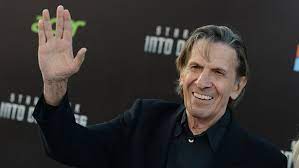
One of my favorite TV stars was Mr. Spock of Star Trek. On a whim, I decided to learn more about Leonard Nimoy the man. Perhaps you’ve wondered too?

Leonard Simon Nimoy was born in Boston, Massachusetts, on 26 March 1931, to Dora (Spinner) and Max Nimoy, who owned a barbershop. His parents were Ukrainian Jewish immigrants. (“My folks came to the US as immigrants, aliens, and became citizens. I was born in Boston, a citizen, went to Hollywood and became an alien.”) He had one brother, Melvin. Raised in a tenement and acting in community theaters since age eight, Nimoy did not make his Hollywood debut until he was 20. After two years in the U.S. Army, he was still getting small, often uncredited, parts.

In February 1965, he made his first appearance as Spock in the Star Trek TV pilots “The Cage” and “Where No Man Has Gone Before,” and went on to play the character until the end of the production run in early 1969…… soon followed by eight feature films and guest appearances in later spin-offs in the franchise.

Got his famous role of Spock on Star Trek (1966) in part because discussions among writers and producers of the series about the character of Spock led them to put out the word that they were looking for a tall, thin guy to play the role of an alien crew member. Gene Roddenberry and casting director Joseph D’Agosta remembered Nimoy from his work in Roddenberry’s first TV series, the WWII drama The Lieutenant (1963). After being invited to come look at the sets and props, Nimoy was offered the role…and so was born his most famous role and start as a popular culture icon.

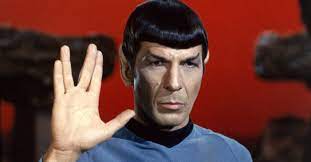
Leonard Nimoy first saw what would become the famous Vulcan salute, “Live Long and Prosper,” as a child. The placement of the hands comes from a childhood memory, or an Orthodox Jewish synagogue service in Boston. “This is the shape of the letter shin,” Nimoy said in the 2013 interview, making the famous “V” gesture. The Hebrew letter shin, he noted, is the first letter in several Hebrew words, including Shaddai (a name for God), Shalom (the word for hello, goodbye and peace).

The “Vulcan nerve pinch” concept on Star Trek (1966) was invented by Nimoy when he and the series’ writers were trying to figure out how an unarmed Spock could overpower an adversary without resorting to violence.

Leonard Nimoy was twice married and left a son and daughter. He was 6’1” tall, was an avid writer of poetry and wrote many books and he was best friends with William Shatner (only a few days older). He spoke Hebrew and Yiddish and was an advocate for keeping that language alive.

Mr. Spock passed away on 27 February 2015, one month away from what would have been his 84th birthday. Cause of death was COPD (Chronic Obstructive Pulmonary Disease). His final Tweet, posted four days before his death, was “A life is like a garden. Perfect moments can be had, but not preserved, except in memory. LLAP”  (Live Long and Prosper)  He rests in Hillside Memorial Park Cemetery in Culver City, California.

A search with Google will give way more information than I included here.

Donna
Let’s Talk About: WORDS!

      This has got to be one of the most clever E-mails I’ve received in a while. Someone out there  must be “deadly” at  Scrabble or Wordle.  

PRESBYTERIAN
When you rearrange the letters:  BEST IN PRAYER
 
ASTRONOMER
When you rearrange the letters:  MOON STARER  

DESPERATION: When you rearrange the letters:  A ROPE ENDS IT  
   
THE EYES
When you rearrange the letters:  THEY SEE  


THE MORSE CODE:
When you rearrange the letters:  HERE COME DOTS
   
DORMITORY
When you rearrange the letters:  DIRTY ROOM

SLOT MACHINES:
When you rearrange the letters: CASH LOST IN ME      

ANIMOSITY:
When you rearrange the letters:  IS NO AMITY  

SNOOZE ALARMS: When you rearrange the letters:  ALAS! NO MORE Z ‘S  

A DECIMAL POINT
When you rearrange the letters:  I’M A DOT IN PLACE  

THE EARTHQUAKES
When you rearrange the letters:  THAT QUEER SHAKE      

ELEVEN PLUS TWO
When you rearrange the letters:  TWELVE PLUS ONE  

AND FOR THE GRAND FINALE:

MOTHER-IN-LAW:
When you rearrange the letters:  WOMAN HITLER
Bet your friends haven’t seen this one!!! 

DON’T FORGET TO SHARE THIS        

Let’s Talk About: Carnegie Libraries

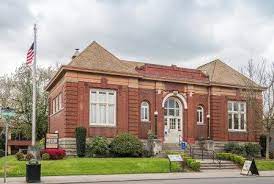
We recognize them anywhere: Carnegie Libraries. Seemingly, every city has one….or more. Some 43 were built in Washington State; 32 are still standing and 14 are still used as libraries.

We think of Andrew Carnegie as a self-made millionaire and philanthropist, and he certainly was. But did you know he obtained most of his education from libraries? Andrew Carnegie was born in 1835 in Dunfermline, Scotland, and came with his family to America in 1848. He became the protegee of one Col. James Anderson who opened his personal library to “working boys” so that they might better themselves. Carnegie was grateful for this opportunity that he promised if he ever had the means he would provide for other boys what he had received.

Carnegie Library in Vancouver, Clark County, now a museum.

Carnegie funded the building of 2,509 “Carnegie Libraries” worldwide between 1883 and 1929. Of those, 1,795 were in the United States: 1,687 public libraries and 108 academic. Others were built throughout Europe, South Africa, Barbados, Australia, and New Zealand. Andrew Carnegie spent over $56 million of his fortune building these libraries and the buildings standing proud today are a living, lasting legacy.

Do you know where the Carnegie library is in YOUR town? (Google has a list.)

Let’s Talk About: Dr. George K. Schweitzer & Burned Courthouses

Born in 1924 and approaching his 100th birthday, I’d bet that many of us have had the privilege of sitting at his feet and learning from the best historian/genealogist there is (my opinion!). Author of dozens of books, many on specific state-genealogy, I’d also bet that we’ve had and learned from those text books.

My favorite lecture was one he presented in 1992 at a National Genealogical Society conference. Coming to the lectern in the costume of a Civil War-era town clerk, he proceeded to teach us how to research in counties with burned courthouses in his unique fashion.

As “Carter,” the clerk, he welcomed us and thanked us for coming to the town meeting. “Many of you are tired, having been out late on the bucket brigade last night,” be began, “but we must keep on with county business as best we can.” He thanked all for helping carry boxes of records out of the burning courthouse but “so much stuff was lost.” He continued, “Our meeting today is to try to re-construct our records so to keep our county going!”

“Carter” urged us to bring in our documents and re-register them. Our deeds, marriage certificates (“if your marriage is worth it, he quipped) and any other similar county-important papers. “We’ll get our county going again; a burned courthouse won’t slow us down.”

“Carter” then switched to Dr. Schweitzer and began to explain to us what records existed OUTSIDE of the courthouse that we might turn to for our research.

  1. Title companies – this office has records of all deeds and land grants in the county
  2. Judical records – West’s Decennial Index lists cases that have ben appealed from the county
  3. Law offices – files of cases and client work exist, including wills, mortgages, appeals, etc.
  4. Cemetery – tombstones have names and dates and there are on file deeds to cemetery plots
  5. Church records – some churches kept good “people records” and others not so much
  6. Fraternal Societies – Masonic, DAR, Woodmen of the World, Elks, Eastern Star, GAR, UCW, etc.
  7. Funeral director – lots of files!
  8. Newspapers – always full of obits, accidents, marriages, anniversaries and “run-away wives”
  9. School records – schools received state money based on student attendance, so records were kept

Dr. Schweitzer, once again as “Carter,” town clerk, finished his talk with this: “We’re gonna save what wasn’t burned but where are these records today? We’re gonna re-construct the records and you’ll discover there ain’t hardly nothing in the burned courthouse that’s plum GONE.”

Let’s Talk About: Railroads, Part 2

Continued from last week’s post………………

The Union Pacific Railroad had a must easier time of it due to the flat midwestern terrain. A large 20-car work train crawled along the newly-laid tracks to bring supplies and support the army of workers. This train was a combination of factory, hotel, restaurant, hospital and administrative center. It required two locomotives to pull it along. Some cars were divided into offices, storerooms, blacksmith shop, carpenter shop, saddler shop. The rail hands boarded in huge sleeping cars packed with 144 bunks and fed in massive 75-foot long dining cars. Food was good and plentiful: bread, meat and coffee being the staples.

The Central Pacific had less mileage to cover but the Rocky Mountains were extremely difficult to conquer. Remember, all the work was done by blasting with TNT and then with the workers’ hands. At first, labor was scarce and expensive and unemployed immigrants were quickly snapped up by railroad recruiters. “The solution to this labor shortage lay not across the Atlantic but the Pacific,” wrote David Norris in his publication, History of Railroads. China provided thousands of men willing to travel over the ocean to work on the railroad; Chinese recruiting began in 1865 and soon grew to over 10,000 men…… who, being Chinese, were paid $31.00 per month instead of $45.00 for whites.

The worst part of the route for the Central Pacific was the Summit Tunnel over Donner Pass. This project took two full years and in the winter the workers had to dig through tunnels of deep snow just to reach the work site.

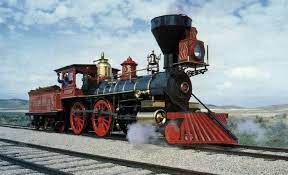
The sunny May day in 1869 when the two rail lines finally converged at Promontory Summit in Utah was indeed a milestone and reason to celebrate but the photos of the day omit the details of the full story. In those historic photos, you’ll see no Black or Chinese faces….. these ethnic workers were given no credit for their sacrifices on that auspicious day.

Jumping ahead, the Pullman sleeper car was the brain child of George Pullman who, after being “tormented during a jolting and uncomfortable ride in an overnight passenger car,” turned his mind to a solution and came up with a way to improve overnight rail travel. By 1869, his Pullman sleeper cars were running coast to coast on the new combined Union & Central Pacific Railroads.