Let’s Talk About…Pecan Pralines! Best Candy Ever!

Of course I snagged a Pecan Praline at most every opportunity! They are quintessentially The South and they are beyond description delicious. Several of my fellow passengers and I went looking for The Best Praline recipe and we agreed: this looks like it! But all did agree on this: you must have a candy thermometer for best results. 

******BEST Louisiana Pralines Recipe

These Louisiana pralines are the best sweet tooth treat because they’re sweet, filling and so addicting. A mix of cream, vanilla, and pecans combine perfectly to make this easy bite-sized candy. Prep Time5 minutes Cook Time15 minutes Total Time20 minutes

Ingredients

  • 1 1/2 cup chopped pecans
  • 7 tbsp salted butter
  • 1 cup light brown sugar
  • 1 1/4 cup granulated sugar
  • 1 tbsp pure vanilla extract
  • 1/2 cup half & half

Instructions

  • Combine the butter, sugars, and half in half into a large saucepan, then turn the heat up to medium.
  • Bring the candy mixture to 240 F, and let the candy mixture cook for about 5 minutes without stirring.
  • After the five minutes, add in the vanilla extract, and stir.
  • Remove from the heat.
  • Toss in the pecans, and fold in.
  • Grab a wooden spoon, and stir the hot candy mixture until it thickens.
  • Spoon out the candy mixture onto parchment paper.
  • Let the candy cool completely.
  • Enjoy!

Let’s Talk About…Southern Cemeteries: Charming & Sobering

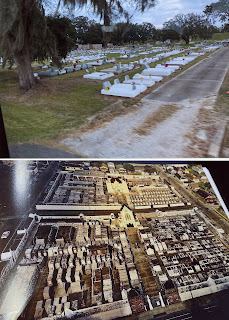
On this particular trip, I didn’t see very many cemeteries but always and of course, those I did see made an impact on me.

Top Top:  A typical rural cemetery near New Orleans. Away from New Orleans, in-ground burials work fine, apparently. Top Bottom:  Take from a book on New Orleans, a typical city cemetery….all above-ground crypts.

Top Bottom:  The final resting place of more than 17,000 Union dead at Vicksburg National Memorial Park. Look closely and you’ll see some upright stones and some flat stones. The flat ones were when the identification of the soldier was unknown. Scanning the whole scene, it was so sad to see how many flat ones there were. 

The park signboard on the right also shares this:  “At hundreds of Civil War battle sites the remains of fallen soldiers lay nearly forgotten, scattered in woods, fields and roadside ditches.”  Now did they gather those up to bury here???

Burials in cemeteries in New Orleans are tightly packed together and above ground. Why? The water table is too high for in-ground burial. The deceased are not put into coffins (in many cases) but are just laid on a shelf in an above-ground mausoleum…… and such crypts have been, in some cases, used by the family for 150 years. 


Trivia: There are 8000 cemeteries in Louisiana.   

Let’s Talk About…Gateway Arch In St. Louis

I’ve been to St. Louis and took the tiny tram to the top of the Gateway Arch several times but it’s always a thrill.  From the viewing window at the top, look how teeny the cruise ship looks! (Ship nearest the bridge.)


Arch Trivia:

  • The cost to build the Arch in 1967 was the same as the Louisiana Purchase, $15,000,000. 
  • The Arch sits on the smallest national park in the U.S., only 98 acres.
  • President Franklin D. Roosevelt established the park in 1935.
  • Construction on the Arch was begun in 1965 and was finished in only two years. 
  • The Arch is 630-feet high and there is 630-feet between the ends of the Arch legs.
  • The purpose of the Arch was to commemorate Thomas Jefferson, the Louisiana Purchase and all the pioneers settling the United States. 
  • To go to the top, only 5 people can squeeze into the little tram cars for the 5-minute ride to the top. 
  • You get 10-minutes up there and then it’s back down. 
  • Then they sell you a $20 photo!!

Next trip to the Midwest, you MUST visit the Gateway Arch …. with or without the official photo.

Let’s Talk About…Rock Island Arsenal


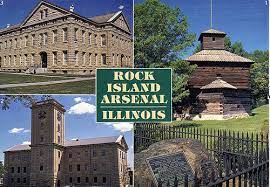
When our cruise ship was near Davenport, Iowa, I learned about the Rock Island Arsenal. I had heard about the Black Hawk War but had no idea that disputes over ownership of this place sparked that conflict. 

Located on an island in the Mississippi, it was established as a government site in 1816 first as a defensive fort and then, in the 1880s, a government-owned weapons manufacturing arsenal in the U.S. Still in use, and even as being designated as a National Historic Landmark, the arsenal still produces ordinance (bullets), artillery, gun mounts, small arms, aircraft weapons sub-systems, grenade launchers and a host of associated components. Some 250 military personnel work there along with 6000 civilian workers. 

Back to the Black Hawk war.  In his autobiography, Black Hawk wrote: “When we arrived (to our tribal summer camp) we found that the troops had come to build a fort on Rock Island…We did not object, however, to their building their fort on the island, but were very sorry, as this was the best one on the Mississippi, and had long been the resort of our young people during the summer. It was our garden, like the white people have near their big villages, which supplied us with strawberries, blackberries, gooseberries, plums, apples and nuts of different kinds.” 

Did you know that Abraham Lincoln served in the Illinois Militia in 1832 in this conflict…..”he never saw action.”

Last but not least, Rock Island holds a Confederate cemetery; nearly 2000 prisoners, including Union Colored Troops who served as guards, are buried there. 

AND, last of all, the Rock Island Arsenal Museum was established on July 4, 1905. It is the second oldest US Army Museum after the West Point Museum. 

Think of all the Jeopardy trivia you just learned!  🙂 

Let’s Talk About…. Pirates On The Mississippi?

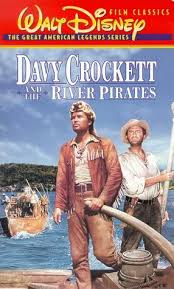
When you imagine a pirate, Johnny Depp might come to mind. The Mississippi River pirates were real but they weren’t as colorful as Johnny depicted.  Between about 1806 and 1844, there certainly were pirates prowling on the Mississippi River. Any of you remember this Walt Disney movie:

I had no idea there were pirates on the Mississippi and when the ship’s education guy told about these fellows, I was really surprised. I never learned about this before! River pirates have operated along rivers all over the world. Quoting from Wikipedia:


 “American river piracy in the late 18th and mid-19th century was primarily concentrated along the Ohio River and Mississippi River valleys. River pirates usually operated in isolated frontier settlements which were sparsely populated areas lacking the protection of civil authority and institutions. These pirates resorted to a variety of tactics depending on the number of pirates and the size of the boat crews involved, including deception, concealment, ambush and assaults in open combat near natural obstacles and curiosities, such as shelter caves, islands, river narrows, rapids, swamps and marshes. River travelers were robbed, captured and murdered, and their livestock, slaves, cargo and flatboats, keelboats and rafts were sunk or sold downriver.


Did your ancestor float down the Ohio or Mississippi Rivers and were they attacked by pirates?

What a story!

Let’s Talk About…John Deere & Spam

 No matter where in the world you live, and certainly in America, you’d recognize the “Nothing Runs Like A Deere” logo. 

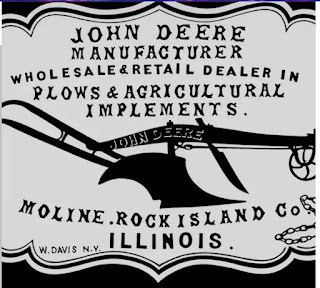
John Deere was born in 1804 in Vermont and moved to Illinois in 1836 and began manufacturing tools. He made pitchforks, shovels and plows. In those days, a product was not made until ordered, which was a very slow business model. By 1857, the company was manufacturing a variety of farm equipment; that year their sales reached 1120 implements per month. John Deere as an American business icon was off and running.  

There are three main John Deere museums and a big selling item these days are the John Deere tractor toys.

SPAM is another iconic midwestern product. I always thought the letters stood for “Special Processed American Meat,” meat that was portable and sent to the troops in Europe during WWII.
SPAM is a brand of cooked pork introduced by Hormel in 1937. The origin of the name is not fully documented (so maybe I’m right?).  SPAM was a lifesaver to U.S. soldiers in Europe because of the difficulty in having fresh meat for the soldiers on the front lines. Some 150,000,000 pounds of SPAM was purchased by the military before war’s end. Nowadays SPAM can be found on grocery shelves in 41 countries.


When was the last time you had fried SPAM? SPAM and eggs? A SPAM sandwich??

Let’s Talk About….Teddy’s Bear

There is so much history swirling around the town of Vicksburg, Mississippi! Doubt one could have time to read all the books that have been published about this river town through the decades. One story concerns Teddy Roosevelt. 

TR (1858-1919), was a politician, statesman, soldier, conservationist and naturalist and was America’s 26th president. He was a cousin to Franklin D. Roosevelt. TR’s biggest love was anything outdoors and he especially loved the sport of hunting. Hoping to get some good publicity, Mississippi’s governor, Andrew H. Longino, invited Teddy on a bear hunting trip in 1902 near Onward, Mississippi.

The hunting party went off in great spirits, but after several days they had not yet even seen a bear. One of Roosevelt’s assistants, led by Holt Collier, a born slave and former Confederate cavalryman, corned and tied a black bear to a tree. They summoned Roosevelt and suggested he shoot it. Viewing this as extremely unsportsmanlike, Roosevelt refused to shoot the bear.

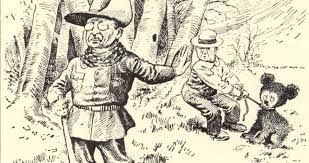
The story of “Teddy’s Bear” flashed quickly across the country and everyone loved the tale. A political cartoon of the day shows Roosevelt in his Rough Riders garb refusing to shoot a loveable-looking little bear. 

This image inspired a couple in Brooklyn, who were making stuffed toys, write to Roosevelt asking his permission to make “Teddy’s Bear.” Hearing a yes reply, the couple set to making stuffed little bears and nowadays teddy bears are everywhere. Fun to think the worldwide popularity of teddy bears can be traced back to Theodore’s fateful hunting trip in Mississippi in 1902.

And that’s the rest of the story…………….. this is an original Teddy’s Bear, now in the Smithsonian.

Let’s Talk About…. Weyerhaeuser, IA TO WA

We here in the heavily timbered land of the Pacific Northwest have certainly seen and heard the name of Weyerhaeuser Company and know it has something to do with the timber and lumbering industry. We’d never have guessed that Frederick Weyerhaeuser (1834-1914) began his company in the Mississippi River town of Davenport, Iowa, but he did.

The company was founded in 1900 by Frederick Weyerhaeuser who had emigrated to the U.S. from Germany when he was 18. He worked first as a laborer in Erie, Pennsylvania, where he met and married Elisabeth Bladel. In 1856, the young couple moved to Rock Island, Illinois (across the river from Davenport). Weyerhaeuser found work in a sawmill and lumber yard, eventually becoming foreman and arduously began saving his money. Weyerhaeuser was a workaholic and by the mid-1860s he had purchased the mill and was buying pine tracts in Wisconsin, expanding into Minnesota, Idaho, Oregon and Washington.

By 1903, Weyerhaeuser owned more than 1.5 million acres of land in Washington even though he kept his residence in St. Paul. He was survived by seven children; his son, John P. Weyerhaeuser, succeeded him as president of the company. Demands for lumber during World War I led to a substantial increase in the company’s business. The military demand for lumber was so high that the Army sent soldiers to work as lumberjacks in Weyerhaeuser’s forests to increase production. By 1941, industry executives joined John P. Weyerhaeuser and Washington Gov. Arthur Lang in dedicating the nation’s first tree farm near Montesano.

And it all started with a hard-working German immigrant in a small Midwestern town.

(Thanks to www.historylink.org for the information on Weyerhaeuser.)  If you want all the details of his life, click to Google.

Let’s Talk About….Nuns & Can Buoys

Here I stand between a nun buoy and a can buoy. I knew buoys (whether ocean, lake or river) came in red and green and that was about it. The plaque below reads:

“Buoys are floating navigational aids that mark channels, hazards and prohibited areas and also help navigators locate their position. Buoys are coded by color, shape and numbers. They are moored to the bed of a waterway by chain or rope to concrete sinkers. Nun buoys are red with cone-shaped tops. They mark the right side of a waterway when entering a channel from the sea. Nun buoys carry even numbers.  Can buoys are green and are square or shaped like a large can. They mark the left side when entering a channel from seaward. Can buoys carry odd numbers.”

Capt. Kelly explained all this to us (a rapt audience) and then with a smile told of how buoys get “whacked” by ships or barges and float loose……… to end up on the sand or even up in the trees during high water. He said at one point there was a program for folks to rescue and return for a bonus these stranded buoys. “But soon that program had to be abandoned,” he said, “because the buoys were disappearing from the river.” (Think about it. 🙂

Let’s Talk About….Samuel Clemons/Mark Twain: One Great American

(Sign on lamp post in downtown Hannibal; it reads:  “Suppose you were an idiot. And suppose you were a member of Congress. But I repeat myself.” )

It was a really, really windy day when our cruise ship ported at Hannibal, Illinois. I put on every jacket and shirt  I had and out I went………could not miss the opportunity to visit Mark Twain. 

I enjoyed the Mark Twain museums (there were two), touring the Thatcher home and just trying to “feel” being there. 

I shall not go into his biography for I’m guessing that’s pretty well known. One of his favorite homilies was that he was born in 1835 when Halley’s Comet could be seen and held onto life until 1910 so he could go out with it.

His personal life was a rather sad affair.  He married Olivia Langdon, who died six years before him. Their first child, Landon Clemons, died at age one. Their first daughter, Olivia Susan, died at age 23. Next child was Jane who passed the year before her father. Only Clara was left, living to 1962. Her daughter, Nina, never married, so Samuel Clemons has no direct descendants.

I never had read any of his books (yes, where have I been all my life?) so bought a book containing five of his best known stories. The Adventures of Huckleberry Finn was a revolutionary book that still holds much relevance today. The powerful friendship of young Huck and runaway slave Jim highlighted many of the great racial injustices of the past and has astounded generations of readers the world over. It was a darn good read.

Gotta love some of his quotes:

“Never tell the truth to people who are not worthy of it.”

“When in doubt‚ tell the truth.”

“If you tell truth you don’t have to remember anything.”