Let’s Talk About…. New England Books Give-away

Some short time back I was given three big boxes of the basic reference/resource books for New England research. Here in Spokane I’ve tried to find way for anybody interested to have access to these books and I have failed. Could lengthen the story but bottom line I have all these wonderful books that need a home. I’m posting here hoping that some one of you, dear readers, belongs to a genealogical society who has interest (and space!) to have these books available to your members. (EWGS no longer has a genealogy library; too long and too sad a story to share here.) For postage, or UPS charges, I’d be happy to ship these boxes to you………. just say the word. Here is the short history and the list of those books:

I have two “Xerox-size” boxes of books pertaining to early New England research. These books were discards from the Yakima Valley Genealogical Society library.  These are basic books for New England research. That’s not to say everything in each volume is correct; but the volumes do provide clues.

  1.  Compendium of American Genealogy, First Families of America by Virkus, published 1926-1942; there are Volumes 2 – 3 – 4 – 6 – 7.
  2. New England Marriages Prior to 1700, by Torrey, and Supplement
  3. The Great Migration Begins, Immigrants to New England, 1620-1633, by Anderson; 3 volumes,  A-F,  C-F,  G-H. (yes looks like a typed mistake but tiz not), published 1995. Likely there are more volumes to this series but my two boxes don’t contain them. J
  4. The Great Migration, by Anderson, published between 1999 and 2011, 7 volumes, A-Z.
  5. Genealogical Dictionary of First Settlers of New England, Three Generations prior to May 1692, by Savage; 4 volumes covering A-Z, originally published 1860-1862.
  6. Digest of Early Connecticut Probate Records, by Manwaring, Vols 1-3 cover Hartford, 1635-1750.
  7. Families of Ancient New Haven, by Jacobus, there are 3 compiled volumes only,  1-3, 4-6, and 7-8, first published 1922-1932
  8. New England Historic Genealogical Society Register:
    1. 15 volumes from Fall 2019 to Winter 2022
    1. Bunch of old ones, Volumes 1-6,  15-26,  31-34, published between 1847 and 1881.

Email me directly, please: Donna243@gmail.com…. and ONLY if you’re interested in having the books. Please don’t just say “sorry we cannot.”

Let’s Talk About: Appaloosa Horse Museum

 Last March, several EWGS members had a Learning Day Out Road Trip! Jeanne Coe, Jennilyn Weight and me, were joined by Karen Lehfeldt and Janet Damm (of the Whitman Co Gen Soc), for a most fun day.

Janet is the Librarian for WCGS and since they are paring down their collection to keep mostly only Whitman County books, a long list of give-away-books enticed us to stop and load our tote bags. (Possibly they still are culling and giving away; contact them if you’re interested.) 

For years I’ve driven past this museum and today was the day to finally stop and learn. I had thought this breed of horse somehow originated with the Native Americans in the Palouse area, but no. There are ancient cave paintings depicting “spotted horses.”

And did you realize that Appaloosa horses, like many horse breeds, have recorded pedigrees? In the museum was a big thick book of Appaloosa Horse Pedigrees…..

Then we five had a fun lunch at Roosters in Clarkston and attended a local history talk in the Lewiston Public Library………. after a stop at the Lewiston County Historical Society Museum, of course!

There are soooooo many day trips to take in our wonderful Evergreen State! Gather up a car full and GO!

Let’s Talk About: Nordic Museum/Seattle

 Are you of Norwegian descent? Especially Norwegians who came to the Pacific Northwest? Are you aware of the fabulous National Nordic Museum in Seattle?? WOW, you say?

Located in NW Seattle, close to the water, this museum offers so much of interest to those of Nordic descent and those (like me) who are not. Here’s a snip from their website:

Five countries, twelve thousand years  —  At the Museum, you’ll visit five distinct galleries with selections from our permanent collection and more than 100 objects on loan from the national museums of all five Nordic countries (Denmark, Finland, Iceland, Norway, and Sweden.) Whether you want to be transported to the Viking-era or explore twentieth-century modern design, there’s something for everyone to enjoy.

You just must visit their website to see what all the Nordic Museum offers:  www.nordicmuseum.org.  Right now, until June 30, there is a really special artwork display: “….an immersive artwork…. specifically crafter for the museum and illumimating the natural ocean connections between Seattle and its Nordic sister city, Reykjavik.” “To immerse guests into a marine atmosphere, the scent of seaweed harvested from the Pacific and North Atlantic oceans will be tinctured, distilled and dispersed through the room.”  I want to go!!


The Ellis Island tidbits come via a query posted to the Washington State Genealogical Society and from a lady in one of my classes: Steve asked “if 1st and 2nd class ships’ passengers to New York disembarked “at the pier” and the ship then went to Ellis Island to unload 3rd class passengers for screening…..what about the upper classes’ servants (nannies, maids, valets, wet nurses, etc)? Did they disembark with their employers? And would they be on the passenger lists?”  The answer to Steve was advising him to click to this site:http://immigrationinmy.weebly.com/the-experience-at-ellis-island.htmlI answered the other question, posed in my beginner’s class, that Ellis Island opened in 1892 and prior to that the records would be at Castle Garden. WELL!  This lady found her ancestor coming from France into Ellis Island in 1889! Doing some fact-checking for her, I found that yes, indeed, there were some immigrants who somehow came through Ellis Island prior to its official opening. 


Don’t we learn something every single day if we but keep our eyes and mind open??

Let’s Talk About: RootsTech!

 I purposely planned for a few library days after RootsTech and I’m so glad I did! Combining RootsTech learning with some new realizations was both wonderful and sobering.  Maybe you already realized these things…………

One good talk was on “Avoiding Ancestor Theft,” and how we must be SURE when we’re adding new people to our family tree. We cannot rely on same-name alone; all the factors must concur: name, date and place. Consider this image; is there such a bird? Or cat?

Sure looks real, doesn’t it. But is it?? This was the speaker’s example of how we add 2 + 2 and get 5. His point: just as there are such images posted online, there are fictional trees posted online too. (Woohoo, there is a posted online tree that has John Smith married to Pocahontas!! Do you think??) 

Another thing one of the RootsTech presenters pointed out is this: You are looking for a Robert Smith who married Mary Wilson. But you find an almost perfect match for Robert Smith but he’s married to Rebecca Thompson! Is is the right Robert Smith or not? In other words, don’t get hung up on one marriage; our ancestors were survivors and death came easily so often second and third marriages did happen. 

One last Golden Point I learned. The presenter asked bluntly, “What sources do you swallow as good and add them to your tree?” She was referring to online trees, especially the older ones like Pedigree Resource File, Ancestral File, the very ancient IGI. She cautioned us to note them as exactly what they are: tidbits that might be true or not. Mostly usually not. 

Trivia:  The presentations from 2023 RootsTech are and will be available online for at least a year. Google and learn!!

Let’s Talk About: What’s New In The FamilySearch Library

 First news of all is the name change: our favorite genealogy library is now the FamilySEARCH Library and new signs on the building proclaim that. Makes sense; FamilySearch is the “umbrella” program we all use. 

Second big change is the arrangement of each floor. The first floor is a welcome-and-entry-level-help with an army of smiling volunteers. They’ll give you an iPad and key to your tree on FamilySearch and you go to stations to learn things like what’s the origin of your surname, info on the place you were born, etc. Fun-fun-fun!

The second floor is totally different. The microfilm cabinets are still there but gone is that “dark alley” of big hooded film readers. Now there are table-stations, each with a film reader (foreground) and two screens….. you can view and print right from your chair.

Third floor still has all the US and Canada books; most family histories are digitally available through the catalog. And there are fewer tables but bigger stations with two computer screens. 

Not quite sure about B-1 and B-2; they’re still international but also have been re-arranged.

Trivia:  The Salt Lake airport is totally re-done also! It’s bigger, and (of course) more spread out. The Plaza hotel is still there (thankfully!) but as of this spring, there is no in-house restaurant. They tell me they have strong nibbles for one to come soon.  Temple Square is still under construction and we’ll have to walk around until 2026, I understand. The restaurants in the Joseph Smith Memorial Bldg are closed too. As you’d guess, this makes getting meals a bit more difficult but within two blocks is the Food Court and others. 

Don’t be shy about going to spend time in the FamilySearch Library! They’re eager to help us with any genealogical problem. 

Let’s Talk About: Port Gamble & Straits of Juan de Fuca

Did you realize that the lovely old church in Port Gamble, Washington (which you see on your way to Port Townsend or Port Angeles), was built in 1870 by two homesick Bostonians? They patterned their church after the 1836 church in Machias, Maine (top). See the similarities?

  The Straits of Juan de Fuca. You’ve read about it, been on it and been by it many times, no doubt. But ever wondered where such a Spanish-sounding name got tagged onto this body of water?  In 1592 (100 years after the discovery of the New World by Columbus) the entrance to Puget Sound was first seen by Juan de Fuca, a Greek mariner in the service of the Viceroy of Mexico. De Fuca had been commissioned in that year to explore the west coast of the New World and claimed that he sailed along the California coast until he came to the latitude of 47 degrees and there, finding that the land tended north and northeast with a broad inlet of sea, he entered and sailed for more than twenty days. De Fuca was firmly convinced that he had discovered the “fabled Straits of Anian,” the connecting link between the Pacific and Atlantic oceans.

The explorers who came after, the English especially, sought to discredit the performance and claims of de Fuca. He was pronounced a myth…his discovery a fable. Even Capt. Cook, while attempting to discover the illusive passage to the Atlantic Ocean entered this notation in his log book: “It is in the very latitude where we now are, that geographers have placed the pretended Strait of Juan de Fuca. But we saw nothing of it nor is there the least possibility that any such existed.”

The Green mariner was vindicated after all; the strait now bears his name even if it is not the “Strait of Anian.”


What is a “megacity” would you guess? The answer is: any city with a population of over 10,000,000 people.  And how many are there? You’d be amazed.  Asking Goggle’s help for “world most populous cities,” I browsed through a list of 1000 cities from all around the world.

Most populous city in the world? Tokyo, Japan. Followed by Delhi, Shanghai, Dhaka (in Bangladesh), Sao Paulo, Mexico City, Cairo, Beijing, Mumbai and Oskaka.  It makes sense that the majority of bigger cities are in China and India which are the two most populous countries.

The U.S. doesn’t make the list until #41: New York City. Next after that is Los Angeles, Houston, Phoenix, Philadelphia………. And that last is #323!  Seattle is #750. Frankly, I’m glad that we don’t have “megacities” in America.

China has six megacities; India has five. The source found by Google stated that “of nearly 8 billion people on Earth, 7% live in megacities (where population exceeds ten million).”

Point of the story: Be thankful for where you live. Especially if it’s in Port Gamble.

Let’s Talk About…Cotton Was & Is King

One last wonderful stop was Frogmore Plantation in Louisiana, a huge cotton processing facility. There I learned that the U.S. is #3 in cotton producing countries (China is #1 and India #2). 

I learned that cotton is delivered wrapped in pink from various area growers. Each “roll” is tagged with the grower’s name, moisture content, date, etc. And each “roll” is processed separately. 

 The basket on the left shows one pound of picked cotton. Just this one basket would take an enslaved person ALL DAY to pick out the seeds. Believe me, I tried it and it is HARD to do. Frogmore Plantation is fully mechanized and nice clean ready to use and wrapped bales finalize the process. The pictures below show how cotton was baled and shipped in the old days. 

There are hundreds of resources to access if you wish to know more about cotton, A-Z. With this small blurb, I hoped to just give you a pinch of information. And no, I shall not never become a cotton picker…………… although to pick one fluffy ball was kinda fun.

Let’s Talk About: Benge, Washington


Benge, Washington, with a 2000 population of 57 souls, is in Adams County. The famous Mullan Road, built to connect the Missouri River with the Columbia River, passed through Benge…..that portion was finished in May 1861. Still in 2008, the wagon ruts from the Mullan Road could be seen.

The road was built as a military road, but civilians and travelers alike used the road until the Northern Pacific Railroad was completed in 1883. 

The town was named for Frank H. Benge, who, with his family, was an early settler. He represented Adams County in the State Legislature in 1904 and he donated the land to found the town. 

Here’s a very early picture of Benge, Washington. Anybody have relatives or ancestors who lived in this Adams County farming town???

Let’s Talk About…Mississippi River’s Worst Disasters

The New Madrid Earthquake of 1811  —  The area known as New Madrid was, in 1811, a ways upriver and was sparsely populated. After the Revolution, people were flocking west, crossing the Appalachian Mountains, but blessedly there were few settlers in the New Madrid area in 1811.  So what happened?

On 16 December 1811, at 2:15 am, not one but THREE magnitude 8.0 or higher shook the area in that one day. In January 1812, there was another big shake, followed in February by a last 8.8 shock. Church bells rang as far away as Charleston, South Carolina, and Boston. These four big quakes in a three month period happened because “a seam between two plates pulled apart,” explained our presenter. “And the quakes continue to today…. There have been 4000 quakes recorded since 1974! And if and when another big one comes, the entire Midwest will be in big trouble,” he mused.

The Sultana disaster of 1865  —  In the early morning hours of 27 April 1865, mere days after the end of the Civil War, the side-wheeled steamboat Sultana burst into flames, taking 1169 people….mostly Union soldiers (newly freed from Anderson Prison in Georgia) returning home. This was the worst maritime disaster in U.S. history.  So what happened?

The ragged band of paroled Union soldiers was taken by train from Andersonville to Vicksburg, Mississippi. There, the steamboat Sultana was to take them north and home. The Sultana was moored there in Vicksburg needing to replace a faulty/leaking boiler. The captain was offered a bounty (bribe!) for each man he would take upriver so he ordered the ailing boiler to be patched up and loaded up the men. Built to take 375 passengers and crew, the wooden Sultana had regularly ferried cotton between St.Louis and New Orleans; she was only two years old. The greedy captain (sorry, called it what it was) loaded nearly 2130 souls on board and pushed off into the river. (1953 freed prisoners, 22 guards, 70 fare-paying passengers and 85 crew.) The Sultana spent two days pushing upriver against the worst spring floods in the river’s history.  At around 2:00am on 27 April 1865, when the ship was about seven miles north of Memphis, three of its four boilers suddenly exploded. (If you want to read all the grizzly details click to Wikipedia.) All in all, some 1169 people perished that dark night. “Greed killed them all,” our presenter opined. “And no charges were ever filed against anyone.”

The Flood of 1927  —  The third worst disaster was the Flood of 1927.  Aaron taught us: “That year, we learned the hard way that men had to live with the Mississippi River on her terms. The river drains 40% of the American heartland and as many smaller rivers flow into the Mississippi, the river becomes like a great big funnel and that year, 1927, after heavy spring rains, the “funnel” opened flooding 27,000 square miles.” This was the most destructive river flood in U.S. history. All those miles of land were inundated up to 30 FEET deep over the course of several months in early 1927. About 500 people died and over 630,000 were directly affected. Some 200,000 African Americans were hit hardest; they were poor and unable to pick up and leave in contrast with the “richer white folks” many of whom could and did pick up and leave. 

Levees along the Mississippi were recognized as needed by the 1820s and work was begun to construct them. Long story short, in the early years they were not properly constructed and continually were breached or broken by the tremendously rushing flood waters. Floods still happen today despite much better engineering.  

Any of you, dear readers, have an ancestor who was involved or impacted by one of these disasters?

Let’s Talk About…Duff Green & His Mansion


Duff Green, 1791-1875, was an American teacher, military leader, Democratic party politician, journalist, author, diplomat and industrialist…….. and he lived in Vicksburg. He made a good part of his fortune as a cotton broker. He was sympathetic to the Confederate cause but was a realist…………

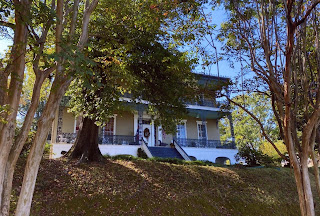
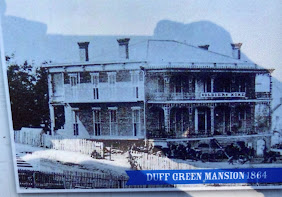
I quite love to learn the story-behind-the-story, especially in American history, and the story of Duff Green’s mansion is one such story.  The above photos show it as it is today and was during the Civil War.  

Duff Green built his mansion in 1856 high on a bluff using skilled enslaved labor and bricks that were fired onsite. The grand home survived the Siege of Vicksburg because Green designated it a “hospital” where both Confederate and Union soldiers were treated. 

Our tour guide in this mansion was the current owner and her love of this old house was evident. This red-walled photo was of the dining room where dinner was a 6-13 course affair with “libations” served with each course. After dinner there would be a ball with very strict man-woman protocol. “Ladies might wear out their slippers dancing,” she said.  And there is old Duff Green himself; he sired six children with two wives. 

What I’d ask you to imagine here, as I did while there, is this:  It’s summer and temps are nearing 100o. You’re dressed in this huge tight-busted-many-petticoats-and-skirts outfit going to dinner at the Green mansion. The windows are open (it’s HOT) and so there are bugs flying everywhere. The “necessary” (outhouse) was way out back of the house….and here you are in your voluminous garb. You must sit and smile for hours as your fellow guests chew their way through up to 13 courses with different “libations” served with each. And then you’ll dance for hours in that HOT room. No wonder they each wore gloves…… my hands would have been plenty sweaty. 

Now doesn’t that just sound fun??????