Do most of your ordered packages arrive on time? Either from the US Postal Service or the UPS, I’ll bet they did.
Bet you had no clue that the company that would become United Parcel service (UPS) began in Seattle, Washington, on August 28, 1907. Teenagers Jim Casey and Claude Ryan founded the American Messenger Company, a messenger and delivery service, with a $100 loan and two bicycles. They delivered packages and messages around Seattle, laying the groundwork for the global shipping giant UPS is today.
By 1919, the company had expanded to Oakland, California, and changed it’s name to United Parcel Service. That same year, the brown trucks and uniforms became the company colors. The headquarters of the company today is in New York City.
There are over 5700 UPS stations across America and Washington state boasts over 130 of them.
Did you or an ancestor work for UPS?? Why did they choose to work for UPS?
The Diamond Point Quarantine Station across Discovery Bay from Port Townsend. was a 156-acre federal facility opened in 1893 to control infectious diseases on ships entering Puget Sound. The station featured barracks, labs, staff housing and disinfection services for vessels wishing to enter Puget Sound and an isolation hospital for passengers or crew members found to be suffering from or suspected of carrying infectious disease. The site grew from three to 27 buildings over the course of its 43 operational years. Moved eventually nearer Port Townsend, it is now the site of Miller Peninsula State Park.
If you’d care to learn more about this episode in Washington history, click to www.historylink.org (a free website) and look for the article by Paula Becker, posted in 2007 on this subject.
All vessels arriving from foreign ports were required to pass through quarantine. When deemed necessary, vessel were fumigated with burning pots of sulphur in order to kill fleas, rats, live and other vermin. Passengers or crew members were inspected for any symptom of infectious diseases such an influenza, cholera malaria, smallpox, yellow fever, diphtheria and leprosy. This place was not a happy place. Quoting from a 1937 book: “Port Townsend’s pest-house was situated in the dense woods about two miles west of town. Here the unfortunate patients was kept under the care of a volunteer nurse, usually an old sailor, and a doctor visited the sufferer when he could spare the time.”
In 1878, Congress had passed the National Quarantine Act which prevented vessels from carrying infectious diseases into any U.S. port. In 1888, the Diamond Point station was authorized and a total of $55,000 allocated for the construction.
There is much more to learn about this episode, event and place in Washington history. Ask Google to help you find more information.
The phrase “mad as a hatter” referred to the 19th century hat-makers were were poisoned by the mercury they used to treat the felt.
Christmas was not declared a national holiday until 1890.
The phrase “second string,” which today means replacement or backup, originated in the Middle Ages, when an archer carried a second string in case the one on his bow broke.
During the peak of the western cattle drives, as many as one in four cowboys was African-American.
After she was crowned, the first act of Britain’s Queen Victoria was to move her bed out of her mother’s bedroom and into a room of her own.
The first bomb dropped by the Allies on the city of Berlin during WWII claimed an unusual casualty…the only elephant in the Berlin zoo.
During his invasion of England in 1014, King Olaf’s fleet of Viking ships managed to pull down London’s wooden Thames River bridge. Hence the children’s song about London Bridge falling down.
The last soldier of WWII, Japan’s Lt. Hiroo Onoda, didn’t surrender until 1974. He refused to be “fooled” by allied stories about the war ending in 1945 and only gave up the fight after his old unit commander was flown to the Philippines and ordered him to lay down his arms.
And where did these wonderful bits come from? The Armchair Reader: Amazing Book of History, published in 2008, and found in a thrift store. Are they true?
Years ago my father gave a paper bag on which was written many names and dates of ancestors. At the very top of the bag was written “6/5/05 [her birthday – 6/5/1805] Matilda Atwater – father was aid to Geo Washington.” My search began!
Research revealed that there were many Stephen Atwaters. The Atwater family was prominent in colonial Connecticut. After much research, I discovered the following, copied from his pension application 14 Nov 1832:
“Stephen Atwater, Conn, S12014. I was born in Cheshire, Connecticut, New Haven colony, on 13 May 1758. I presume the records of my birth is in Wallingford Connecticut (for Wallingford & Cheshire were then one town) but I have no record of it anywhere – I was 74 years old on the 13 May last [1832].”
Stephen was the last of 7 children born to Stephen Atwater (1720-1806) and Hannah Hotchkiss (1722-1779). There were probably 2 sisters left at home when he enlisted.
Stephen Atwater’s pension application continues:
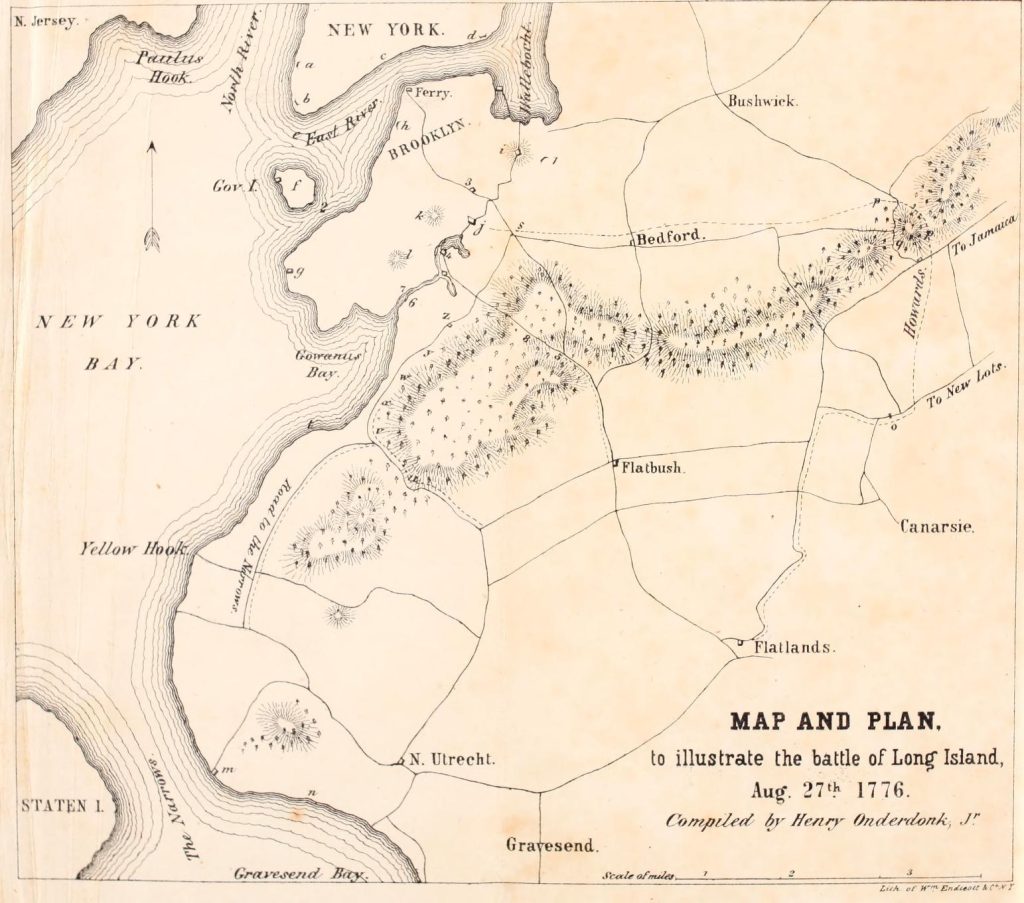
“In August 1776 [at 18 years old] the 10th Regiment of Connecticut Militia commanded by Cpl Benjamin Baldwin was ordered out, to go to New York – I was a member of Capt. Jesse Moss’s company, belonging to that regiment – & on the 17 August we turned out – we marched to New York [colony]– We were at New York City [Brooklyn was the northernmost area of LongIsland] when Gnl Washingtons army retreated from Long Island – I acted as one of the oarsmen in bringing the army over all night – The night was exceedingly dark & a very thick fog”
The Battle of Long Island was the first major battle to take place after the United States declared its independence on July 4, 1776 in Philadelphia. It was the largest battle of the Revolutionary War in terms of both troops deployments and combat.
The British army had nearly 20,000 soldiers and were helped by naval forces. British ships moved the East River toward Staten Island, seen on the bottom left of the map below. There were more than 400 transport ships, protected by 30 warships.
The Americans had about 10,000 soldiers led by General George Washington. He moved his troops to Brooklyn on Long Island, to defend New York. British troops landed and attacked the American troops on three sides.
Rather than surrender, General Washington decide to have the army cross the East River. He ordered every available boat to be taken. The oarsmen wrapped cloth around the oars so they would make as little noise as possible. The men rowed all night, back and forth. Stephen Atwater was one of these oarsmen. By morning there was still many men left on the Brooklyn side of the river. But the very thick fog in the night that Stephen mentioned continued late into the next day, so they were able to complete their mission by the time the fog lifted.
This was the closest Stephen Atwater came to being “Aid to George Washington”, but his story wasn’t over yet. He was under the command later of General Washington, among others.
↓Stephen Atwater rowed north to Manhattan (New York) across
the East River from Brooklyn on Long Island
Stephen Atwater’s pension application continues:
“After the American army was brought over to the city [New York City], our regiment remained there a few days, & were then ordered out to Harlem – there I was taken sick & was Discharged there or somewhere near there.”
“I remained sick till I was carried home. It was called a three months tour – but I think I was not out three months – but two months of more-Then April 1777 our company & regiment was ordered out again when Danbury [Connecticut] was burned “
“We moved to Fairfield[CT]– & then to Compo [CT] – I think the British embarked there. Our men & the British had a considerable battle in that neighborhood there – several of my acquaintances were killed there – Gnl Worster was killed in that battle – I saw him as a corpse – Our company had then got up & was not in that battle”
“After the British had embarked, & went off, we were discharged, & went home – I can’t say how long we were out at that time – probably 8 or 10 days – In October 1777 the same company & regiment were ordered out again – I marched to West Point. We had the same Colonel & same officers as before – The company I belonged to were out scouting the principal part of the time – At a place called Fishkill[NY] our company was divided – a part went to the north & a part went to the south –“
“Esopus [Kingston, NY] was burned at that time – This tour was called a three months tour – but I do not recollect how long we were actually out – our orders were for three months, but we did not stay out so long – Titus Moss was the ensign of our company – During this tour I lost the end of the forefinger of my right hand by a felon which I was not able have taken care of in consequence of our moving about – & my finger healed for several more weeks.”
“In 1780 I was called out again – This was a draught [draft] – Capt Amos Hotchkiss commanded the company – Willis was the Colonel – We were marched to New London & stationed on Winthrop Point. We were employed principally in building breastworks – fachines [fascines –brush and sticks used to reinforce trenches] & the like – That time I was out about two months – I was the orderly sergeant of the Company that tour –“
“I received no written discharge at any of these tours, except the first, when I did receive one – but it has been lost – at least I have looked carefully for it & can’t find it — I was out on a short tour where Genl [Benedict] Arnold attacked New Haven – which I think was in July 1779 – This was in my original company – Capt Jesse Moss – We were out 10 or 12 Days –
”I was out a number of short tours – we were obliged to keep ourselves in constant readiness – The militia was hanged [as in suspension] very much for several years –We would lay out a piece of business at night – & by next morning were called away from it – We kept ourselves ready always to go – to march at a minutes warning – for several years- I can’t tell how long I was out altogether in actual service – but making the best estimate I can, I would say it was about eighteen months but I can’t be positive about it and not less than sixteen months—
After the war I continued to reside at Cheshire til 1811 – I then removed to Granville in the state of New York – remained there till October 1824, when I moved to Oil Creek in Crawford county [PA] & in January 1829 I moved to the farm in which I now live in Troy Township, Crawford county – Pennsylvania.”
My GGG grandparents, Matilda Atwater and Horace Day, may have met in Granville, NY, since both their families lived there. However they didn’t marry until both families were in Pennsylvania. They married 2 Dec 1827 in Crawford County, PA.
I’m very proud of my Revolutionary War ancestor, Stephen Atwater! He wasn’t an “aid” (Aid-de-Camp) to George Washington as stated in the paper my father gave me, but he certainly aided General Washington, and many others in the Revolutionary War.
The FamilyTree blog recently used this very image to head their article titled 31 Free Social History Websites. Today’s post is a Part 2 from last week’s post.
Some of those 31 sites mentioned in that article include:
*Documenting the American South (www.docsouth.unc.edu)
Whatever you want to learn about your ancestors’ life and times, type that question into YouTube: Immigration, Civil War, Recipes, Dress Styles, Oklahoma Land Rush, tuberculosis, U.S. Navy….. hopefully you get the idea.
Ask these questions:
*What was a typical dinner in Maine in 1880?
*What was typical Sunday dress in 1910?
*Did my ancestor attend a World’s Fair?
*Did my ancestor serve in the military?
* Did my ancestor come by steamship or sail in 1870?
*Why did my people settle in ______________?
Social history is learning the answers to those questions.
Google AI says: Social history studies the everyday lives, experiences, and cultures of ordinary people, focusing on social structures, class, gender, and community rather than just elites or politics, often called “history from below“. It explores how societies function through the perspectives of different groups, examining work, family, belief, and culture, using diverse sources like diaries, newspapers, and material artifacts to bring the past to life and understand societal change from the ground up.
Social History is learning what our ancestors did and did not do. What they wore and why. What they ate and why. Why they feared bathing. Why they believed the homilies they recited. Why they moved to and/or lived where they lived. What sort of shoes did they have? Did colonial women smoke? How did they cope with pain? What was share-cropping?Amazon offers hundreds of books on this subject; just type in “social history California” or your state. Or just type those words into Google.
If you’re not satisfied with only knowing the names-dates-places for your ancestors, and what to know who they were, then dig into the social history of their lives and times.
Did you know that one of Washington’s first cross-state highways, the Sunset Highway, provided the first automobile route over the Cascade Mountains? When it opened in 1915, the highway largely followed the route of an Indian trail that had been developed into a wagon road. The Sunset Highway changed designations a number of times over the years…. being known as Highway #2, U.S. 10 and Interstate 90. The route serves as the primary east-west route in Washington.” So states the HistoryLink article by Jennifer Ott.
As early as 1853, a passable route over Snoqualmie Pass was becoming a necessity. There were several trails connecting points in Washington, but the Cascades were a major headache to cross. By 1867, a wagon road was open from North Bend to Easton. A 1906 report emphasized the importance of such a route, calling it “the most important trans-mountain road projected.”
The 1909 Alaska-Yukon-Pacific Exposition’s transcontinental auto race form New York to Seattle underscored the urgent need for better roads. During the race, cars were frequently bogged down in mud, particularly along some sections over Snoqualmie.
By 1913, the Sunset Highway was designated as a primary state route and on July 1, 1915, it was officially opened. But what did it look like then compared to today??
I’ve been state-crossing in I-90 since 1954 and I can tell you that without a doubt there has not been a single year without road construction! The route is getting busier and busier and better and better all the time.
And by-the-by, it’s Sno-qual-mie NOT NOT Sno-qual-a-mie.
“The DAR of our grandmothers has grown and flourished. Inspired by our Founders, we are celebrating history while shaping the future.” So stated an email message from DAR headquarters inviting me into membership.
The email went on to extole and explain:
*DAR member achieved 7.4 million service hours to their communities in 2024.
*DAR is heavily involved and promoting the America 250! celebrations nationwide.
*DAR gave a $2 million contribution to help preserve Washington DC’s iconic cherry trees.
*DAR’s Patriots of Color Database now featured on the 10 Million Names project, providing public access to research on those of African descent who lived in pre- and post-colonial America.
*DAR donated $250,000 to the Military Women’s Memorial.
And the list went on for a full page.
Did you know there are 36 DAR chapters in Washington State? Surely there is one in or near your town. Click to www.dar.org/national-society/become-member-chapters to find one.
If you’ve been doing family history for most any time at all, and if you have Colonial era ancestors, you do most likely qualify for DAR membership. You most likely do have a patriot ancestor. Be proud to recognize your connection!
David Benscoter is a pomologist on a mission. That means he studies fruits and in his case, his passion is apples.
He’s given several presentations in the area, and I enjoyed learning about his apple passion at a Westerners meeting in November, 2025.
David explained that by the early 1900s, there were over 17,000 cultivars of apples in North America. A “named cultivar” is any apple someone thought was good enough to give a name to after immigrants first came to North America. But unfortunately, over 12,000 of those apples are lost and probably extinct today, he told us.
In his 2024 book, Lost Apples: The Research for Rare & Heritage Apples in the Pacific Northwest, Benscoter states “When the earliest settlers reached Washington, Idaho and Oregon, one of the first things they did was plant apple trees. They knew each apple tree planted had a specific purpose. Some apples ripened early and could be enjoyed in the middle of summer. Fall apples were especially good for canning or drying while late fall apples kept well in the cellar until the next spring.”
For over a decade, Benscoter has searched out old homesteads…. old apple trees…. wanting to resurrect some of the lost apples. And he has succeeded in identifying (by DNA) some 1623 previously-lost varieties. He said that evening that he’s still on the hunt.
“Did you know,” he said, “that the Spokane Beauty apple was introduced about 1900 by a WSU nurseryman? This was a big commercial success. Cosmic Crisp is one of the newest varieties to come out of WSU.”
David ended his excellent presentation with a quote from Henry David Thoreau: “Surely, the apple is the noblest of fruits.”
What can you do here? “Trace your roots for free with our searchable dtabase containing thousands of identified and mystery photos for genealogy enthusiasts looking for long-lost family.” Wowsers, indeed!
Did you catch the word “free?” And could you read the fine print under the photo? 23,659 surnames, 163,161 records.
At this really fun website (and it’s FREE to use, remember) you can search photos and post photos. I searched for the surname “Gurney,” and there was one entry, for baby Forrest Gurney. I don’t know where he fits into my tree, but I’ll be looking.
Do check out www.DeadFred.com. You’ll be glad you did.
You are free to copy articles to any non-commercial web site or message board or printed publication you wish. Don’t bother to ask permission, just do it.